

Why Use Node JS for Your B2B SaaS in 2026?
Your SaaS is growing, but the backend is starting to feel like a tax on growth. Product wants faster releases. Sales wants more automation. Operations wants cleaner data flows between the CRM, outbound tools, dashboards, and support systems. Meanwhile, every new integration adds more moving parts, and simple features somehow take weeks.
That's usually when founders ask a better question than “what's popular?” They ask why use node js for this business, for this product, and for this stage of growth.
For automation-focused B2B companies, Node.js is rarely just a developer preference. It's a strategic choice about speed, hiring flexibility, API responsiveness, and whether your stack will help or slow the business when usage spikes.
Why Smart B2B Founders Choose Node.js
The strongest reason to choose Node.js is simple. It aligns technical execution with business pressure.
Most B2B SaaS teams hit the same wall at some point. Frontend and backend work drift apart. Product delivery slows because one team is waiting on another. Integrations multiply across HubSpot, Salesforce, Stripe, Slack, internal dashboards, outbound systems, and reporting layers. Then real-time requirements show up, such as webhook handling, live analytics, or AI-assisted workflows.
Node.js solves several of those problems at once.
According to the Node.js adoption and productivity data referenced here, companies using Node.js have reported development cost reductions of up to 58% and developer productivity gains of 68%. That matters more than any language debate. If your engineering team can ship faster with less coordination overhead, the business gets a direct advantage.
Why founders care about that
A founder doesn't buy “event-driven architecture.” They buy outcomes:
- Faster release cycles so product improvements and automations reach customers sooner.
- Lower coordination friction because JavaScript can run across frontend and backend.
- Better responsiveness under load for integration-heavy products.
- A practical path to scale without immediately rebuilding the team around multiple backend specialties.
Node.js also fits the operating reality of many modern SaaS products. Most early and growth-stage platforms are not dominated by heavy computation. They're dominated by APIs, queues, webhooks, auth flows, background jobs, and dashboards. That's where Node.js tends to earn its place.
Decision lens: If your core product spends most of its time moving data between systems, reacting to events, and serving users in real time, Node.js is often a business-efficient default.
There's also a structural benefit. A unified JavaScript stack makes team design easier. Instead of sharply separating frontend and backend ownership on every feature, you can often let the same product-focused engineers move across the workflow. That's one reason Node.js works so well in Node.js microservices architectures for B2B products that need to iterate quickly.
Founders who choose well don't ask whether Node.js is universally best. They ask whether it's best for the parts of the business that need to move fastest. Very often, it is.
Understanding the Node.js Event Loop
Traditional backend systems often behave like a restaurant that assigns one waiter to one table and makes that waiter stand still until the kitchen finishes every order. That model works, but it wastes motion and staff time when the bottleneck is waiting.
Node.js works more like one highly efficient waiter handling many tables at once. Orders are taken, sent off, and while the kitchen works, the waiter keeps moving. That's the essence of non-blocking I/O.
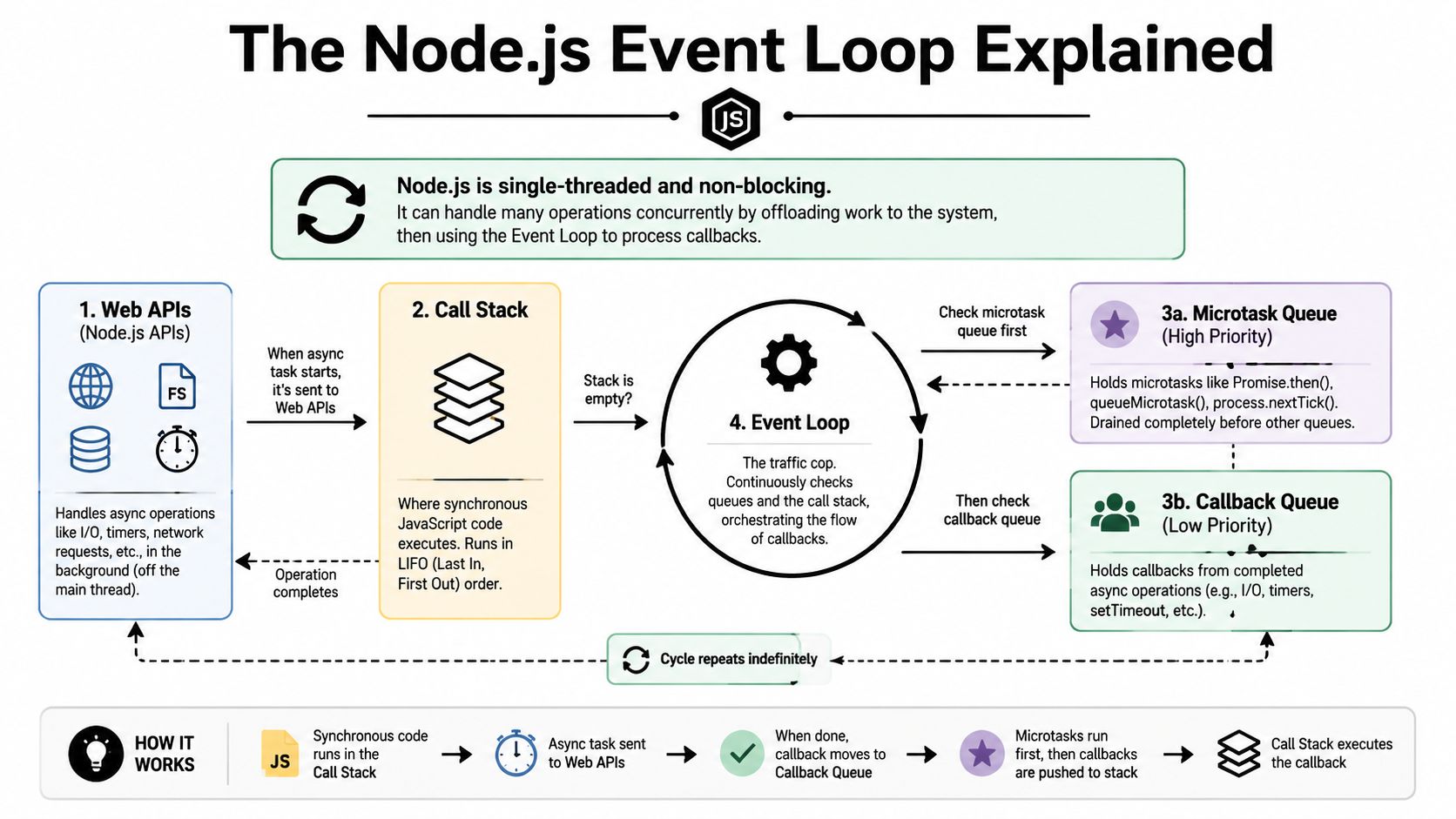
What the event loop actually does
In Node.js, synchronous JavaScript runs on the call stack. When work involves waiting on something external, such as a database query, API request, file read, or network call, Node hands that work off to underlying system capabilities and keeps moving.
When the result is ready, the callback or promise continuation gets queued. The event loop checks whether the call stack is free, then processes the next task. That design lets one process handle many waiting operations without creating a separate heavyweight thread for each request.
Here's the practical version for a B2B product:
- Webhook arrives from Stripe
- CRM update comes in from HubSpot
- A customer opens a live dashboard
- An outbound voice workflow requests data
- A background job writes activity logs
Node.js can keep all of those flows in motion without stalling the whole server every time one external service takes a moment to respond.
Why that matters in SaaS operations
According to this explanation of Node.js architecture, Node.js's event loop can manage thousands of concurrent connections on a single thread, which makes it a strong fit for high-volume automation platforms.
That's not just a technical curiosity. It changes cost and reliability.
When your platform spends much of its time coordinating external systems, thread-heavy models can waste infrastructure on waiting. Node.js is often leaner in those situations because waiting doesn't tie up a thread per request. For products with constant bursts of API traffic, that can translate into steadier latency and less pressure to overprovision.
A good Node.js service isn't “fast” because JavaScript is magical. It's fast because it avoids wasting resources on idle waiting.
There's a catch, though. The event loop helps when workloads are dominated by I/O. It does not make CPU-heavy work disappear. If you use Node.js for orchestration, queues, APIs, and real-time coordination, you're playing to its strengths. If you force it to do expensive computation in-process, you can block the same loop that keeps everything responsive.
That distinction becomes important when deciding whether to use worker threads, split services, or adopt a hybrid stack. If you want the implementation details behind parallel work in Node, this guide on multithreading in Node.js is a useful companion to the event-loop model.
Top Reasons to Use Node.js for B2B Growth
A founder usually feels this decision when the product starts doing real work. Signups hit the CRM, billing events trigger account changes, customer data moves between internal systems, and users expect the app to stay responsive while all of that happens in the background. At that point, the question is less "what language do we like?" and more "what stack keeps execution fast without creating a maintenance tax six months from now?"

One language across the stack
For many B2B SaaS teams, Node.js pays off first in coordination costs.
Using JavaScript on both the frontend and backend reduces translation work between product surfaces and service layers. Teams can share types, validation rules, API contracts, formatting logic, and testing patterns. That cuts friction during handoffs and makes it easier to move engineers between customer-facing features and backend services when priorities shift.
According to EPAM's overview of Node.js advantages, full-stack JavaScript can reduce code duplication compared to a mixed-language stack.
That matters in products with:
- Admin dashboards and backend APIs that rely on the same validation logic
- Customer portals and reporting features that need consistent business rules
- Internal workflow tools where frontend and backend teams iterate on the same domain model
The business effect is straightforward. Fewer translation layers usually mean faster releases, fewer inconsistencies, and lower onboarding cost for new hires.
npm shortens the path from idea to working system
Speed matters early, but so does repeatability.
Node.js benefits from npm, which EPAM also cites as one of the platform's practical advantages because of its package depth. For B2B teams, the value is not the raw package count. The value is that common problems are usually already solved well enough to avoid custom infrastructure work on day one.
That shows up in areas like:
- Authentication and authorization
- Queue processing and job scheduling
- Schema validation and API tooling
- Logging, tracing, and metrics
- Connectors for payments, messaging, and CRM platforms
Used with discipline, npm helps teams ship integrations and operational plumbing faster. Used carelessly, it creates dependency risk, version churn, and security review overhead. Senior teams treat package selection as architecture, not convenience.
If your roadmap includes conversational workflows, support automation, or sales assistants, a practical next step is studying how to build an AI chatbot with Node.js so your team can judge where Node should own the interface layer and where a separate model service should do the heavier inference work.
Node.js fits products built around coordination
Node.js is a strong choice when the product's job is to receive events, apply business rules, call other services, and return a response quickly. That pattern is common in SaaS companies building automation features, customer-facing dashboards, notification systems, and workflow engines.
A useful architecture question is simple: where does your application spend its time?
If the answer is waiting on APIs, databases, queues, webhooks, and user actions, Node.js is often a good fit. If the answer is long-running computation, large-scale model training, or heavy data science pipelines, a hybrid stack is usually smarter. In practice, many automation-focused SaaS companies use Node.js for the product and orchestration layer, then hand off CPU-intensive or AI-heavy tasks to Python services, managed inference endpoints, or workers written in Go or Java.
That split is often the right business decision. It keeps the customer-facing system responsive while giving data and ML workloads an environment better suited to numerical processing.
A quick primer helps if your team wants a visual walkthrough before committing to architecture choices:
Operator mindset: Node.js creates the most value when your bottleneck is service coordination, integration throughput, and product responsiveness.
Why this translates into growth
For a B2B SaaS company, Node.js usually creates business value in three practical ways:
| Area | What Node.js improves | Business effect |
|---|---|---|
| Team execution | Shared language, shared logic, easier staffing flexibility | Faster delivery with less handoff overhead |
| Integration work | Mature package ecosystem and API-friendly development model | Less custom plumbing and shorter implementation cycles |
| Product responsiveness | Fast handling of event-driven workflows and user-facing updates | Better user experience for automation-heavy features |
This is also why Node.js shows up so often in revenue and operations software. Products tied to lead routing, alerts, account updates, messaging, and workflow orchestration benefit from a stack that is comfortable in the middle of many connected systems. If that is your market, the ReachInbox guide to sales automation is a useful reference point for the kinds of workflows your buyers are already trying to automate.
The short version is this. Node.js is rarely the right answer because it is trendy. It is the right answer when your growth depends on shipping connected product features quickly, keeping response times predictable, and avoiding a stack that slows the team down as integrations multiply.
Concrete Use Cases for Automation and AI
Theory matters, but founders usually decide after mapping technology to workflows they need. Node.js earns its keep when the product is moving information between systems quickly and continuously.

High-volume lead routing and webhook processing
A common B2B scenario starts with inbound events. A form submission arrives, enrichment data comes back from another provider, the lead needs scoring, ownership rules fire, and multiple systems must update without delay.
This is exactly the sort of workflow Node.js handles well. It can sit at the center as the API and webhook layer that receives events, validates payloads, transforms JSON, and dispatches tasks to queues, CRMs, outbound tools, and internal dashboards.
If your team is refining the process itself, this ReachInbox guide to sales automation gives useful context on the workflows many revenue teams are trying to automate in the first place.
AI chat interfaces and voice workflows
Node.js is also a practical fit for customer-facing AI layers that need responsiveness. According to this breakdown of Node.js in AI and data systems, Node.js performs well in use cases such as AI chatbots, real-time fraud detection, and recommendation engines because its non-blocking architecture supports responsive, low-latency data processing.
In practice, that makes Node.js a solid choice for:
- Chatbot APIs that receive messages, call external services, and stream replies
- Voice AI orchestration that coordinates prompts, transcripts, CRM lookups, and call outcomes
- Recommendation layers that serve precomputed outputs quickly to end users
If your product roadmap includes conversational interfaces, this guide on how to build an AI chatbot is a practical starting point for thinking through the architecture.
When users are waiting on a reply, orchestration speed matters almost as much as model quality.
Real-time dashboards and operations views
Another strong use case is the operational dashboard. Agencies, RevOps teams, and SaaS operators often need live views of pipeline activity, support load, campaign progress, or client account health. Those dashboards rarely need heavy compute in the request path. They need quick fan-out across databases, APIs, and event streams.
Node.js works well here because it can aggregate data from multiple sources and keep interfaces responsive while other services do the heavier analytical work in the background.
Serverless automation glue
Many automation systems don't require one giant backend. They require a clean orchestration layer across Lambda functions, queue consumers, schedulers, API endpoints, and internal tools. Node.js is widely used for that kind of glue code because it's effective at handling request-response logic and event-driven workflows without excessive ceremony.
For B2B automation, that's often the key win. Not a flashy rewrite. Just a backend that reacts quickly, integrates cleanly, and stays manageable as more workflows get added.
Node.js Compared to Python Go and Java
The useful comparison isn't “which language is best.” It's “which runtime is best for this layer of the product.” Different parts of a SaaS platform have different jobs. A public API gateway, a recommendation engine, a batch ETL process, and a legacy enterprise integration should not all be judged by the same metric.
Node.js vs alternatives for B2B SaaS
| Criterion | Node.js | Python | Go | Java |
|---|---|---|---|---|
| Best fit | Real-time APIs, orchestration, webhooks, dashboards | Data science, ML services, scripting, backend apps | High-performance services, infrastructure tools, efficient APIs | Large enterprise systems, mature transactional platforms |
| I/O-heavy workloads | Very strong | Good | Strong | Strong |
| CPU-heavy workloads | Weaker fit unless isolated with workers or separate services | Better for ML ecosystems, not always fastest runtime | Strong fit | Strong fit |
| Frontend-backend alignment | Excellent because of shared JavaScript | Limited | Limited | Limited |
| Ecosystem advantage | Huge npm ecosystem for web and integration work | Excellent for AI/ML and data tooling | Clean standard library and strong cloud-native tooling | Deep enterprise frameworks and long-term stability |
| Hiring angle | Broad web developer pool | Broad, especially for data and backend roles | Smaller but strong systems pool | Large enterprise talent base |
| Typical role in a hybrid stack | API orchestration and product-facing backend | AI model services, analytics, data workflows | Performance-critical services | Core enterprise platforms and regulated systems |
Where Python wins
If your differentiator lives in data science or model-heavy workflows, Python often belongs somewhere in the stack. Its libraries and talent base make it a practical choice for model development, experimentation, and analytical backends.
For companies building around AI features, access to strong python developers can matter when the product needs training pipelines, model-serving logic, or research-oriented tooling.
Where Go and Java win
Go tends to make sense when operational simplicity and efficient compiled performance matter more than shared frontend/backend language. Teams often choose it for high-throughput internal services, infrastructure components, or latency-sensitive backends.
Java remains a strong option when the company operates in a traditional enterprise environment with long-lived systems, stricter governance, and existing JVM investments. If your buyers require deep enterprise integration, Java may fit the surrounding ecosystem better than Node.js.
The smartest architecture choice is often mixed. Node.js for product-facing orchestration, Python for AI, Go for performance-sensitive services, and Java where enterprise constraints demand it.
The practical takeaway
If your SaaS product needs fast UI iteration, many integrations, and responsive APIs, Node.js is usually easier to justify than a pure performance-first stack. If your core product advantage depends on sustained compute-heavy processing, another language may deserve the critical path.
That's why the best answer to why use node js is often narrow and specific. Use it where event-driven coordination provides an advantage. Don't force it into jobs better handled elsewhere.
Recognizing the Trade-Offs and Pitfalls
A lot of Node.js content becomes unhelpful right when a founder needs honesty. It praises speed of development, then overlooks the situations where Node.js becomes the wrong tool.
The biggest issue is CPU-bound work.
If your service spends most of its time waiting on databases, network calls, queues, and external APIs, Node.js is usually comfortable. If it starts doing expensive inference, large ETL transforms, or heavy in-process analytics on the same runtime that serves customer requests, the event loop can become the bottleneck.
According to this analysis of Node.js limitations in AI-heavy stacks, for similar AI inference or ETL workloads, Go and Rust-based services can achieve 30 to 40% better latency percentiles and 20 to 25% lower CPU per request than Node.js.
That gap matters when the feature is revenue-critical. Think predictive lead scoring shown inside a dashboard, or real-time analytics that influence sales actions during a live session.
Common failure patterns
- Putting heavy compute in request handlers and wondering why API responsiveness collapses
- Using Node.js for every service by default because the team already knows JavaScript
- Underinvesting in observability so event-loop blocking and queue backlogs take too long to diagnose
- Letting TypeScript and async flows grow chaotic until incident response slows down
What usually works better
A hybrid architecture is often the mature answer:
- Node.js for APIs and orchestration
- Python for model-centric or data-science-heavy services
- Go for high-efficiency internal services that need lower CPU per request
- Queues and async boundaries between user-facing actions and expensive backend work
Architecture rule: Put Node.js on the I/O edge of the system. Move sustained compute away from the event loop.
That approach protects the customer experience while preserving Node.js where it offers the greatest advantage. You still get fast product iteration and strong integration ergonomics. You just stop asking one runtime to be excellent at everything.
Your Next Steps with Node.js and Automation
A typical B2B SaaS founder reaches this point after the same pattern shows up a few times. The product needs fast API responses, reliable webhook handling, and more automation across sales, support, and operations. At the same time, the roadmap starts pulling in AI features, heavier data pipelines, and more pressure to scale without rebuilding core services a year later.
The decision is not whether Node.js is good in the abstract. The decision is whether it fits the parts of your system that drive product speed, reliability, and engineering efficiency.
For many automation-focused SaaS products, it does. Node.js is a strong choice for APIs, integration layers, workflow orchestration, dashboard backends, and event-driven services. If AI inference, ETL, or compute-heavy analytics are becoming central to the product, a hybrid architecture is usually the smarter move. Keep Node.js where low-latency I/O and fast iteration matter most. Put sustained compute in services better suited to that job.
A practical founder checklist looks like this:
- Choose Node.js for real-time APIs, webhook consumers, integration layers, workflow engines, and customer-facing orchestration.
- Avoid forcing Node.js into CPU-heavy roles where event-loop contention will show up as slower product performance.
- Split service boundaries early if AI or analytics features are likely to become revenue-critical.
- Keep the stack maintainable with clear ownership, observability, and service boundaries that support incident response.
Technical choices also shape fundraising conversations. Investors do not need every implementation detail, but they do look for signs that the platform can scale without turning into an operating problem. If you are preparing for that stage, this guide to find top UK SaaS investors is a useful next resource alongside your product and architecture planning.
The best stack is usually the one that helps your team ship quickly, run reliably, and evolve without expensive rewrites. Getting that foundation right is the first step.
If you are evaluating Node.js for APIs, automation workflows, AI orchestration, or a hybrid B2B SaaS stack, MakeAutomation can help you design and implement a setup that fits your growth stage. Their team focuses on AI automation, Voice AI agents, CRM automation, SOP workflows, and scalable operational systems for B2B companies that need execution grounded in real technical trade-offs.