What Is Inbound and Outbound Calls? a Guide for 2026
Monday starts with three missed support calls, two demo requests that went to voicemail, and a sales rep asking why lead follow-ups still live in a spreadsheet. By noon, your customer success lead is covering phones, your account executive is chasing old trial users, and nobody can tell which calls move revenue.
That's the fundamental problem behind the question of what is inbound and outbound calls. It isn't terminology. It's operating design.
Founders usually feel this first as noise. Support calls interrupt sales work. Sales outreach gets delayed because service issues take priority. Reporting mixes everything together, so you can't tell whether the phone channel is protecting retention, creating pipeline, or doing both badly. The fix isn't “answer faster” or “make more calls.” The fix is to separate call intent, build the right workflow for each direction, then automate what should never be manual in the first place.
A modern B2B call strategy has to do two jobs at once. It has to capture demand when buyers or customers call you. It also has to create demand when your team reaches out first. Those jobs need different routing, different KPIs, different staffing logic, and different compliance controls.
If your current setup treats every phone interaction the same, you're making growth harder than it needs to be. Strong call operations aren't just about the contact center anymore. They sit inside RevOps, support, customer success, and sales execution. If you're tightening your phone workflows, these call handling best practices are the difference between a noisy channel and a scalable one.
The Phone Is Ringing Are You Answering Strategically
A SaaS founder usually doesn't decide to “build a phone strategy.” The phone strategy appears because something breaks.
A customer calls with a billing issue during the same hour a high-intent prospect calls to ask about implementation. Meanwhile, an SDR is supposed to follow up with dormant leads, but those calls get pushed because live inbound traffic always feels more urgent. By the end of the week, support feels understaffed, sales feels reactive, and leadership still doesn't know whether the channel is being run for service, pipeline, or damage control.
That mess happens when inbound and outbound calls share tools but not rules.
What chaos looks like in practice
In smaller B2B teams, one phone number often carries too much weight. It becomes the line for support, pricing questions, renewal concerns, partnership inquiries, and random cold callbacks. The team then tries to “be flexible,” which usually means calls route to whoever is available rather than whoever is appropriate.
Common symptoms show up fast:
- Support-first overload: urgent customer issues consume the same people who should respond to buying signals.
- Sales drift: outbound outreach becomes inconsistent because reps only call when their calendars clear.
- Weak reporting: leadership sees total call volume, but not which calls protect retention versus build revenue.
- No handoff discipline: a caller repeats context because the system didn't capture intent before the transfer.
The phone channel becomes expensive when every call starts from zero.
What strategic answering actually means
Strategic answering starts with one decision. Why is this call happening, and who initiated it?
That single distinction changes almost everything. Customer-initiated calls need fast identification, correct routing, and resolution. Company-initiated calls need targeting, sequencing, and clear next steps. If you don't separate those motions, you'll optimize neither.
For founders, this matters because phones are still one of the highest-friction and highest-trust channels in the business. A poor email workflow annoys people. A poor phone workflow wastes skilled labor, loses warm demand, and creates avoidable customer frustration in real time.
Inbound vs Outbound Calls Explained Simply
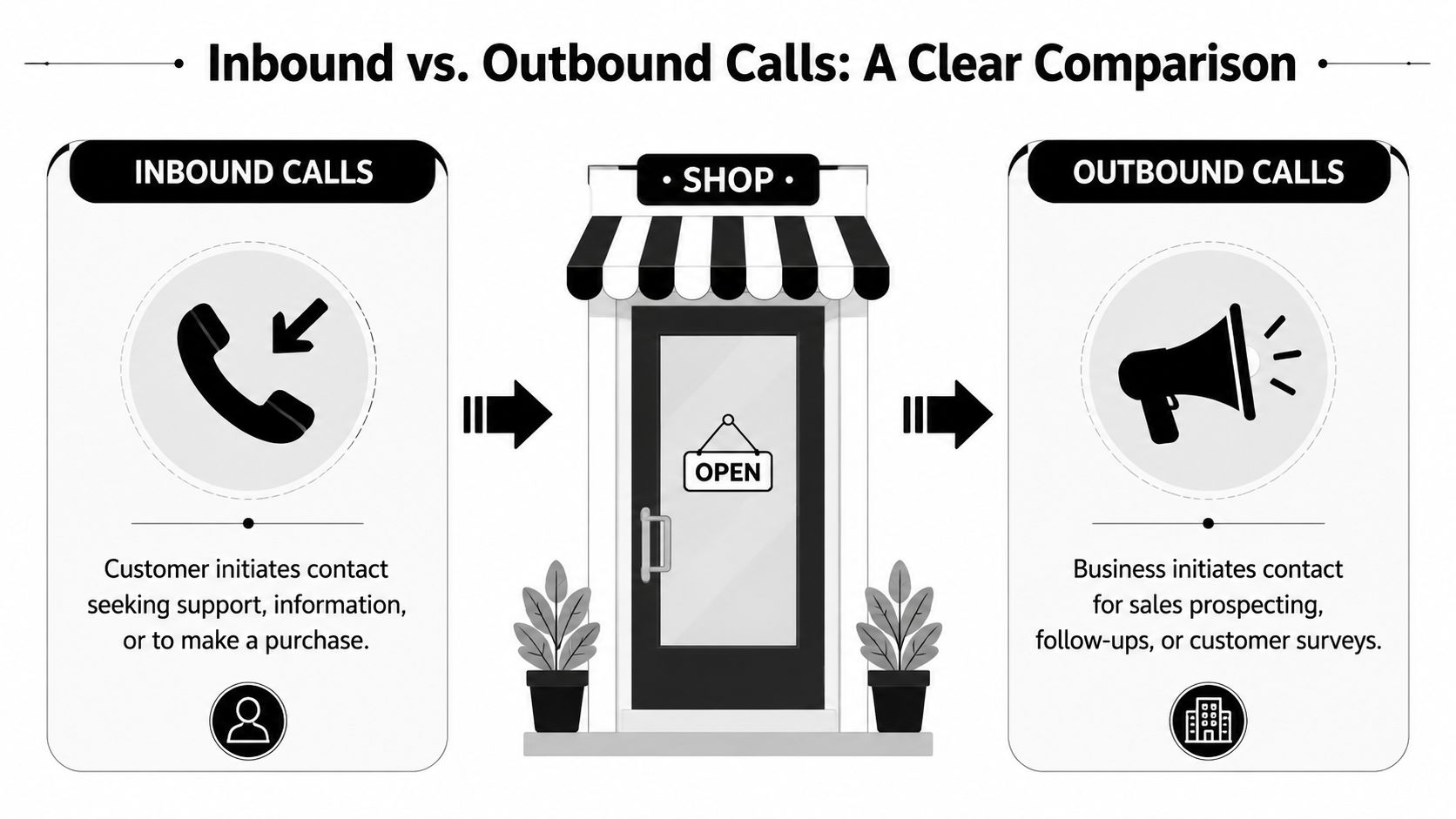
The easiest way to understand inbound and outbound calls is to stop thinking about telecom language and think about a storefront.
Inbound calls are like customers walking through your shop door. They came to you.
Outbound calls are like your team going outside and knocking on doors. You initiated the contact.
The simple definition that matters
The core difference is who starts the call.
Inbound calls are customer-initiated interactions, usually for support, order questions, scheduling, or issue resolution.
Outbound calls are company-initiated interactions, usually for sales, lead generation, follow-ups, surveys, or customer outreach.
That distinction aligns with how platforms report call activity. Many systems track “total inbound calls” and “total outbound calls” separately because the two directions need different routing, staffing, and KPI management, as outlined in DIDWW's overview of call statistics and inbound versus outbound reporting.
Why blended operations are normal now
Most B2B companies don't run a pure inbound or pure outbound environment. They run both.
Sales wants proactive outreach. Customer success needs a line for renewals and issue escalation. Support needs proper triage. Marketing wants attribution when a prospect calls after seeing a campaign. That's why modern teams operate as blended contact environments, even if they don't call themselves a contact center.
A useful way to think about it is this:
| Call type | Who starts it | Typical intent | What the business needs most |
|---|---|---|---|
| Inbound | Customer or prospect | Help, answers, action | Fast routing and resolution |
| Outbound | Business | Reach, qualify, re-engage | Smart targeting and controlled execution |
Where founders get this wrong
The mistake isn't failing to define the terms. It's assuming they can share the same playbook.
Inbound calls need responsiveness and context. Outbound calls need discipline and timing. When teams blend the queue but don't separate the operating logic, agents become generalists by accident. That usually hurts both customer experience and sales productivity.
If you want a broader GTM view, Reachly has a useful breakdown of the synergies between inbound and outbound in B2B. The same principle applies on the phone. These motions work better together when each one has a clear role.
When to Use Inbound vs Outbound Calls for Business Growth
The question isn't which call type is better. The question is which one fits the business goal in front of you.
If a buyer is already trying to reach you, that's a demand-capture problem. If your pipeline is thin in a target segment, that's a demand-creation problem. Inbound and outbound sit on different parts of the revenue path, so using them interchangeably creates bad decisions.
Use inbound when intent already exists
Inbound calls matter most when someone already has urgency. They may need pricing clarity, implementation details, account help, or reassurance before moving forward. Those moments have context built in because the caller chose to contact you.
One marketing industry compilation reports that inbound calls close at 4–5 times the rate of outbound calls, 15 times the rate of web leads, and 33 times faster than web leads, which is why many teams treat them as high-intent demand signals in phone-led conversion paths, according to Flex's call statistics roundup.
That doesn't mean every inbound call is a sales opportunity. Plenty are support-related. It does mean you shouldn't treat inbound as background noise.
Use outbound when you need controlled pipeline creation
Outbound calls exist for the moments when the market won't come to you fast enough.
That includes:
- New segment entry: your team wants conversations in an industry where brand awareness is still low.
- Lead follow-up: prospects downloaded something, attended a webinar, or went quiet after a trial.
- Renewal and expansion motion: account teams need structured outreach instead of waiting for customer issues to surface.
- Reactivation: old opportunities and dormant customers need a reason to re-engage.
For scaling teams, outbound is where process either saves you or buries you. Good outbound isn't random dialing. It's a controlled system of list selection, contact windows, call outcomes, CRM updates, and next-step automation. If you're rebuilding that motion, this guide to automated outbound calling software is a practical starting point.
Inbound captures demand that already exists. Outbound creates opportunities that won't appear on their own.
A founder-level decision filter
Use this quick filter when deciding where to put effort:
- If response time changes the outcome, prioritize inbound.
- If account coverage changes the outcome, prioritize outbound.
- If both matter, separate the workflows before adding more headcount.
That last point is where many teams gain an advantage. They don't need more call activity first. They need cleaner intent-based design so each call type does the job it's supposed to do.
Essential KPIs for Inbound and Outbound Performance
If you measure inbound and outbound calls with the same dashboard, your reporting will look tidy and tell you almost nothing useful.
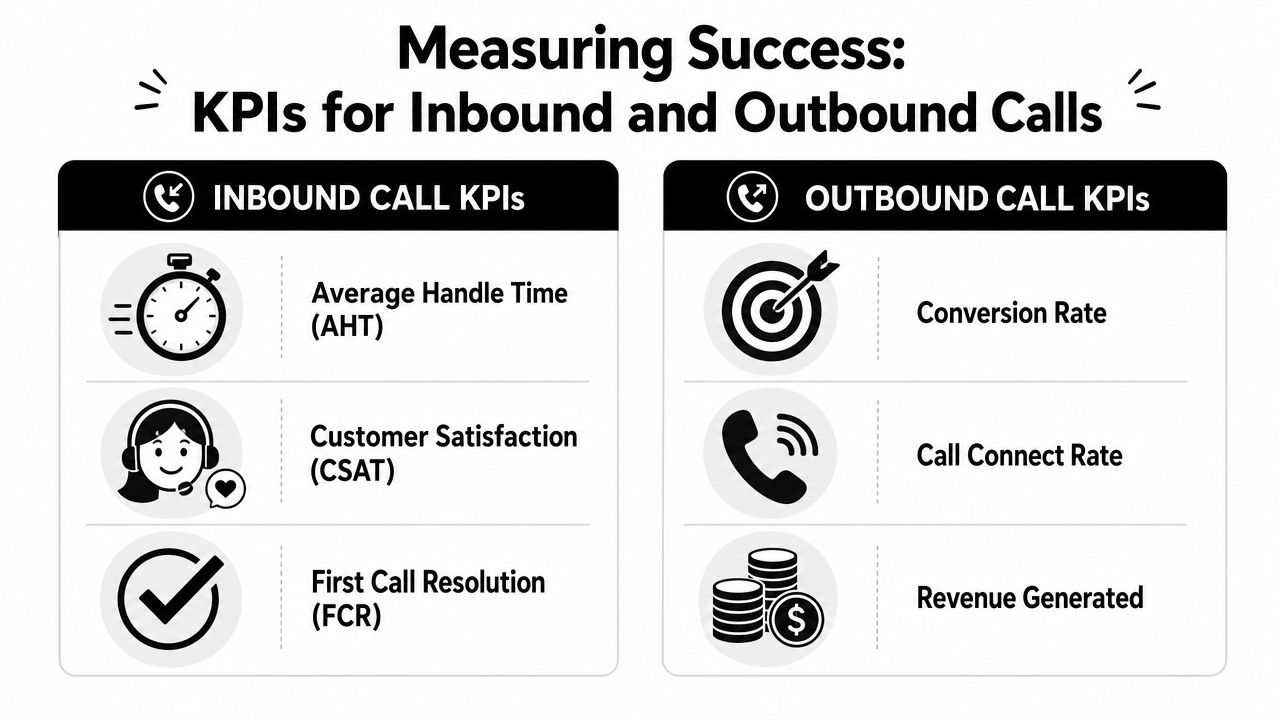
These call types exist for different outcomes. Inbound operations are built for reactive service delivery. Outbound operations are built for proactive revenue work. TeleDirect's overview of inbound and outbound call center design frames that difference clearly, including the shift from queue and resolution metrics on inbound to dialer efficiency and contact-to-sale ratios on outbound.
What to track on inbound calls
Inbound KPIs should answer a simple question. Did the caller get to the right outcome with as little friction as possible?
The most useful inbound measures usually include:
- Queue time: how long callers wait before someone or something useful responds.
- Resolution rate: whether the issue gets solved in the same interaction or needs escalation.
- Abandonment pattern: where callers drop off in the flow, especially before reaching help.
- Routing accuracy: whether the first destination was appropriate for the caller's intent.
- Agent availability by skill: whether the right people are staffed at the right times.
Notice what these metrics do. They focus on service reliability, caller effort, and workflow design. If queue time is low but callers still bounce between teams, you don't have an efficient inbound system. You have a fast transfer machine.
What to track on outbound calls
Outbound KPIs should answer a different question. Is the team turning targeted outreach into conversations and business outcomes?
That changes the measurement model:
| Outbound KPI | Why it matters |
|---|---|
| Connect rate | Shows whether your data, timing, and caller reputation are working |
| Contact-to-conversation quality | Separates answered calls from useful discussions |
| Conversion rate | Tells you whether outreach produces the intended action |
| Contact-to-sale ratio | Links activity to revenue outcomes |
| Workflow completion rate | Reveals whether reps actually follow the intended sequence |
What doesn't work
A lot of teams fall into two reporting traps.
First, they obsess over activity. More dials, more calls handled, more logged outcomes. Activity helps with coaching, but it isn't a strategy. If reporting rewards volume without context, reps optimize for motion rather than results.
Second, they import support metrics into sales outreach. Queue-style thinking doesn't belong in outbound. No prospect cares how quickly your rep started dialing. They care whether the call was relevant, timely, and credible.
Practical rule: tie inbound metrics to caller effort and resolution. Tie outbound metrics to conversation quality and business progression.
How to build a usable dashboard
Keep the views separate even if the platform is shared. Founders and operators should be able to answer three things quickly:
- What did inbound resolve, delay, or lose?
- What did outbound reach, convert, or stall?
- Where are handoffs breaking context?
That's the level where phone analytics become operational, not decorative.
Real-World B2B and SaaS Call Scenarios
Most explanations of what is inbound and outbound calls stop at definitions. The better question is how these calls behave inside a B2B or SaaS workflow.

Scenario one inbound support for a SaaS account
A customer from a mid-market account calls because their team can't access a core workflow after a permissions change. This is inbound because the customer initiated the contact. The issue is immediate, and the customer expects the company to recognize both urgency and account context.
A strong flow looks like this:
- Initial capture: the system identifies the account and asks for the reason for the call in plain language.
- Intent sorting: “login issue,” “permissions,” or “admin access” gets mapped to the right support lane.
- Context handoff: the assigned agent sees account details, recent tickets, and the likely product area before speaking.
- Escalation path: if it's a known outage or enterprise-level admin issue, the call skips generic support and goes to the appropriate team.
What fails here is overcomplication. Long IVR trees, generic front-line handling for specialized issues, and weak CRM context all force the caller to repeat themselves. In SaaS, that repetition doesn't just hurt experience. It signals operational immaturity.
Scenario two outbound demo follow-up from a B2B sales team
Now take an enterprise software company where a prospect downloaded a technical guide, attended part of a product webinar, and didn't book a demo. That's a good outbound calling scenario because the business has enough signal to justify proactive follow-up.
A disciplined flow usually looks different:
- The CRM creates a call task based on a defined trigger.
- The rep opens the record with firmographic data, engagement history, and the relevant message angle.
- The call aims for one next step, usually a discovery call, demo, or confirmation of timing.
- The outcome updates the sequence so the contact isn't called again in a conflicting campaign.
The rep isn't calling “to see if they're interested.” They're calling because the business has a reason to believe the outreach is timely.
Scenario three blended post-sale operations
The most interesting setups are blended. A customer success manager handles inbound renewal questions but also runs outbound calls to accounts with low usage before renewal risk becomes visible. Same account base. Different call direction. Different intent.
That's where many B2B teams realize the phone channel isn't just support or sales. It's lifecycle management.
A scalable call system treats each conversation as part of an account workflow, not as an isolated event.
When teams design around that idea, call handling gets cleaner. Support, success, and sales stop competing for the same phone channel and start using it deliberately.
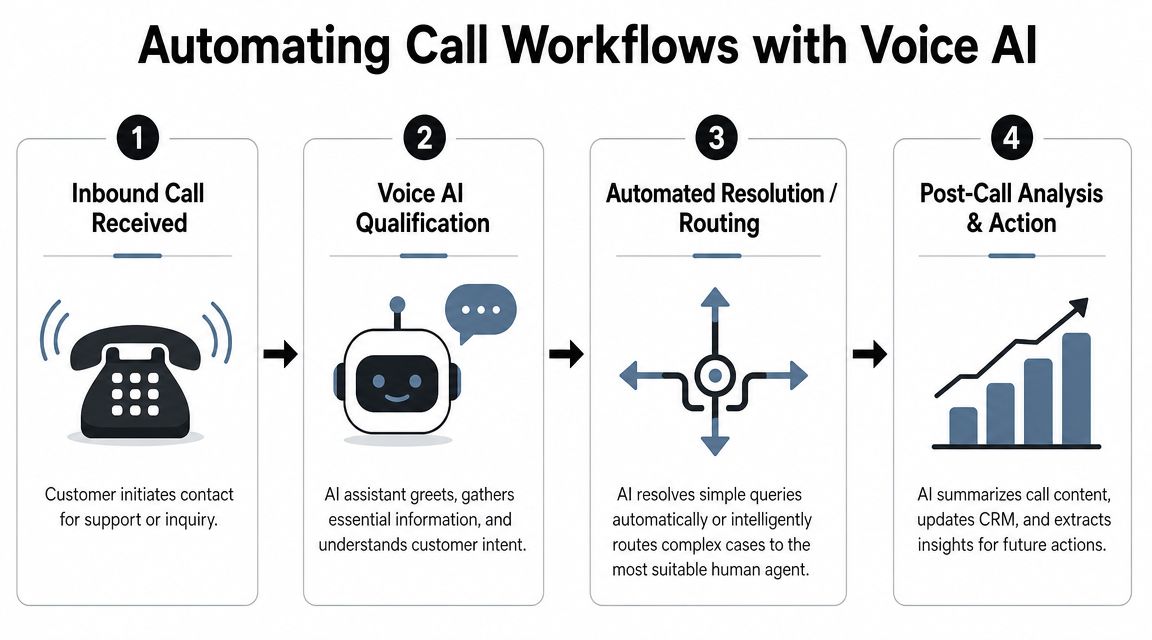
Automating Your Call Workflows with Voice AI
Manual call handling breaks at the same point every time. Volume rises, expectations rise with it, and your team starts compensating with heroics instead of systems.
Automation fixes that only when it's applied to the right layer. Don't start by asking whether AI can “handle calls.” Start by asking which parts of inbound and outbound work are repetitive, rules-based, time-sensitive, or context-heavy enough to standardize.
What automation should do on inbound
Inbound automation works best when it reduces friction before a human gets involved, or resolves low-complexity issues without creating a dead end.
Useful inbound automations include:
- Intent capture: a voice system gathers the reason for the call in natural language instead of forcing menu-driven guesses.
- Smart routing: the call moves to billing, support, success, or sales based on the actual request.
- Identity and account lookup: the system brings customer context forward before handoff.
- Post-call summaries: transcripts, summaries, and CRM notes get written automatically.
Voice AI helps most. Not as a novelty receptionist, but as a structured front layer that reduces repetition and passes context cleanly.
For teams evaluating practical deployment, Hosted Telecommunications has a useful example of Hosted Telecommunications AI agent solutions around forwarding inbound caller ID to an offsite AI workflow. That kind of design matters because caller identity and context continuity often determine whether the automation feels helpful or clumsy.
A short demo helps make the model concrete:
What automation should do on outbound
Outbound automation should never become spam with better software.
The right use cases are list prioritization, workflow enforcement, scheduled follow-up, pre-qualification, disposition logging, and CRM synchronization. Dialers and AI-assisted workflows can help teams move faster, but only when the targeting and call logic are already sound.
The overlooked issue is compliance. AnswerConnect notes that outbound calling is heavily constrained by consent rules, caller-ID authentication, and anti-spam controls, and it highlights tightening spam labeling as a growing operational issue in a 2026 projection in its discussion of inbound versus outbound call compliance realities. That means a scalable outbound system has to manage far more than scripts and call lists.
If your outbound workflow can't prove consent, manage caller identity, and suppress the wrong contacts automatically, it isn't scaled. It's exposed.
A practical modern stack
A useful call stack for B2B teams usually combines several layers:
| Layer | Inbound role | Outbound role |
|---|---|---|
| Phone platform | Receive, route, queue | Dial, log, distribute |
| CRM | Surface account context | Target, track, sequence |
| Voice AI | Qualify, route, summarize | Pre-qualify, triage, document |
| Automation layer | Trigger tickets and handoffs | Trigger tasks and follow-ups |
| Compliance controls | Record policy steps | Enforce consent and identity rules |
One option in this category is MakeAutomation's work around AI voice agents for customer service, which sits in the broader workflow layer for handling inbound and outbound call processes with connected automations.
What works is narrow deployment first. Pick one inbound intent with repeat volume. Pick one outbound motion with clear call criteria. Add AI where it reduces friction or admin, not where it creates ambiguity. Founders get the best ROI when automation removes expensive repetition and gives humans cleaner conversations to handle.
Unifying Your Call Strategy for Scalable Growth
The strongest phone operations don't ask whether inbound or outbound matters more. They build a system where each one does a different job, and both feed the same revenue engine.
Inbound calls help you capture and protect value that already exists. Outbound calls help you create value that won't appear without proactive effort. Once that distinction is clear, the rest gets easier. Routing gets sharper. KPIs make sense. Staffing gets less reactive. Automation becomes useful instead of decorative.
The operating model that scales
A scalable call strategy usually has four traits:
- Clear intent separation: inbound and outbound are defined by purpose, not just by direction.
- Different scorecards: service workflows and revenue workflows don't share the same success metrics.
- Tight system handoffs: CRM, phone system, and automation tools pass context instead of dropping it.
- Compliance by design: outbound controls are built into the workflow, not added after problems appear.
That's the shift founders need to make. Stop treating the phone as a generic communication channel. Start treating it as an operational system with two distinct motions inside it.
The call channel performs well when every ring, route, and follow-up has a reason.
If you're asking what is inbound and outbound calls, the useful answer is no longer just a definition. It's a blueprint. Know who initiated the conversation. Know what outcome that call is supposed to produce. Then design the workflow, measurement, and automation around that reality.
If your team is handling customer calls, sales outreach, or both, MakeAutomation can help you design the workflow behind the phone channel. That includes call routing logic, CRM-connected automations, voice AI implementation, and the operational guardrails needed to scale inbound and outbound calls without adding more manual chaos.