

Top 10 Network Automation Tools for 2026
You're staring at a change request that touches hundreds of ports, dozens of VLAN updates, and a maintenance window nobody wants to extend. It's late in the week, the ticket queue is already ugly, and you know exactly what manual CLI work leads to. One typo becomes drift. One missed device becomes an outage. One undocumented change becomes your Monday problem.
That's where network automation stops being a nice idea and starts being an operating requirement. Cisco describes network automation as automating the configuring, managing, testing, deploying, and operating of physical and virtual network devices, which is a useful framing because it keeps the conversation grounded in actual operations instead of buzzwords (Cisco network automation strategy). The category has also grown far beyond one-off scripts. One market estimate put network automation above USD 5 billion in 2021 and projected nearly 30% CAGR from 2022 to 2028, reaching roughly USD 30 billion by 2028 (network automation market analysis).
So the question in 2026 isn't whether automation matters. It's which tools fit your team, your network, and your tolerance for operational complexity.
This guide compares 10 network automation tools that teams deploy for configuration management, orchestration, compliance, provisioning, and lifecycle control. I'm treating them the way a network architect would during tool selection. Where each one fits. Where it breaks down. What kind of environment justifies the overhead. And how to think about ROI, AI agent integration, and ITSM workflow design without turning your automation stack into a second full-time job.
If you're also sorting out the physical side of infrastructure modernization, a strong professional computer network setup still matters. Good automation doesn't rescue bad network design.
1. Red Hat Ansible Automation Platform
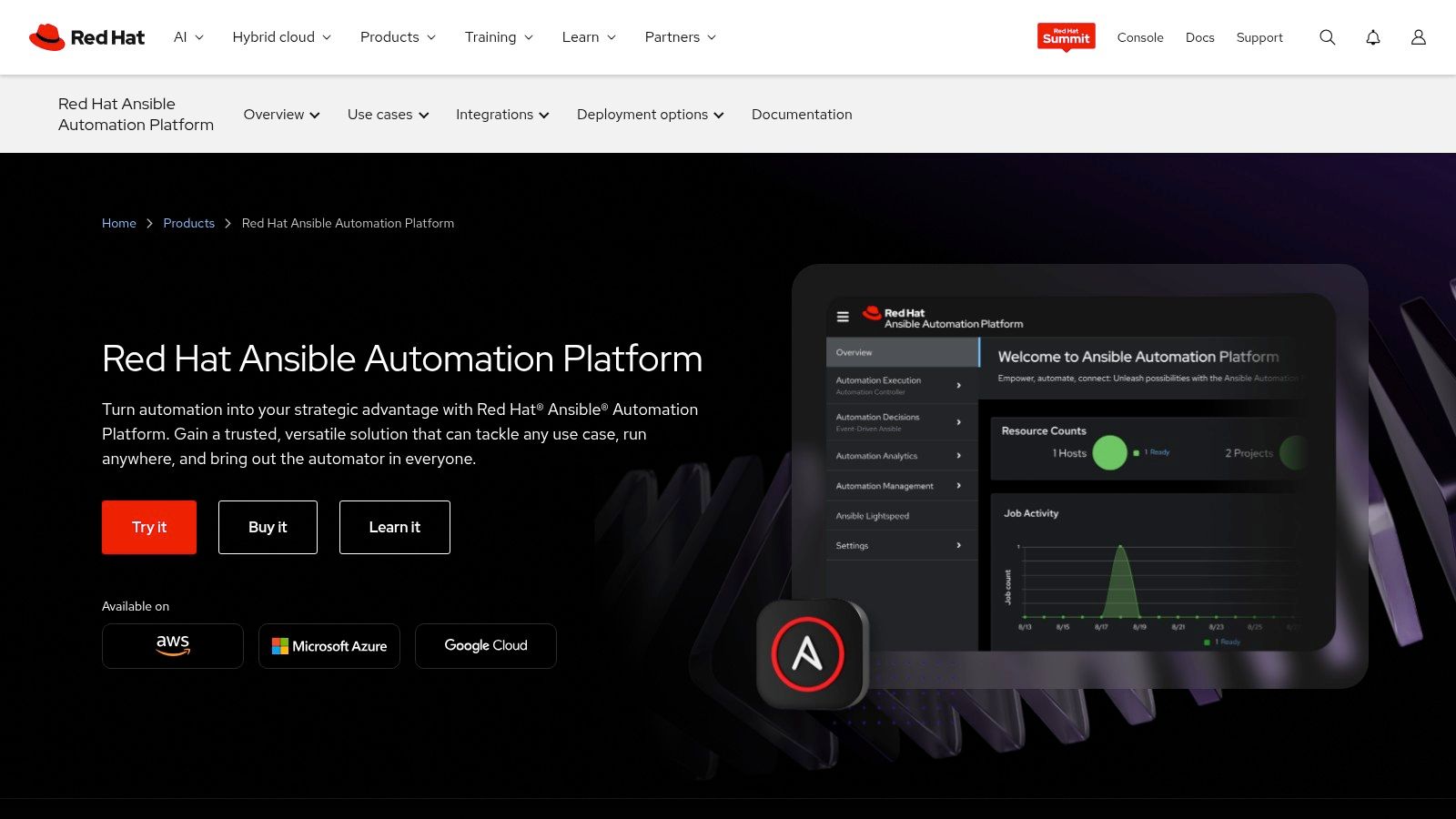
Ansible is often the first serious step teams take after ad hoc Python and CLI macros stop scaling. That's still true. The reason Ansible Automation Platform stays near the top of most shortlists is simple. It's flexible enough for small network teams, but structured enough to support enterprise governance when your automations start touching production at scale.
The platform gives you the Ansible engine plus the controls that operations teams usually end up needing later. Role-based access, workflow approvals, analytics, execution management, and ecosystem support all matter once more than one engineer is pushing changes. Red Hat also supports managed and self-managed deployment patterns, which helps if your organization has strong opinions about where automation control planes can run.
Where AAP works best
AAP is strongest in mixed environments where network changes are only part of the workflow. If the same process also updates IPAM, opens or closes tickets, pushes cloud policy, or kicks off validation tasks, Ansible handles that orchestration well because it's agentless and broad by design.
I also like it for teams that need to turn expert tribal knowledge into repeatable playbooks.
- Best fit: Multi-vendor enterprise networks, regulated environments, and teams that need approval workflows.
- Big advantage: Large community skill base and lots of reusable content through modules and collections.
- Watch closely: Licensing tied to managed nodes can get harder to forecast as scope expands.
What people underestimate
The hard part isn't getting a playbook to run. The hard part is creating a clean inventory, normalizing variables, and deciding who owns the source of truth. Teams often blame the tool when the underlying problem is inconsistent device naming, stale credentials, or unclear change logic.
Practical rule: Don't start by automating config pushes. Start by automating state collection, backups, and compliance checks. You'll learn where your data is dirty before you automate failure.
If you adopt AAP, treat standards and repository structure as first-class design work. Red Hat's platform can absolutely support enterprise network automation, but it won't compensate for sloppy playbook discipline. This is also where a clear set of Ansible best practices pays off early.
Use it when you want a broad automation foundation, not just a network-only tool. Visit Red Hat Ansible Automation Platform.
2. Cisco Crosswork Network Services Orchestrator
Cisco NSO isn't a scripting tool with a nicer dashboard. It's a service orchestration system built for teams that need transactional control, model-driven automation, and rollback discipline across complex networks. If Ansible feels like operational glue, NSO feels like a network control plane for service lifecycle management.
That distinction matters. NSO is the kind of platform you choose when you strongly care about service models, YANG abstractions, and northbound API consistency. Carrier teams have used that approach for years because it reduces the chaos of direct per-device automation.
Why NSO earns its place
NSO's strength is its service-centric architecture. Instead of writing procedural logic for every vendor and edge case, you define service intent and let the platform map that to underlying devices through NEDs and data models. The “diff and converge” approach is especially valuable in environments where rollback and consistency matter more than raw speed.
This is also one of the better platforms for tying network change into ITSM and CI/CD pipelines without custom one-off connectors everywhere.
- Best fit: Service providers, large enterprises, and environments with strict change governance.
- Big advantage: Transaction-safe, idempotent operations with strong rollback behavior.
- Watch closely: The learning curve is real. Model design takes commitment.
Where teams get burned
NSO can be overkill for shops that mainly need backups, bulk config updates, and basic compliance workflows. If your operating model isn't mature enough to maintain service definitions and validate vendor coverage carefully, you can end up with an advanced platform that only a handful of engineers fully understand.
The second gotcha is expecting instant value. NSO usually rewards teams that think in lifecycle terms. Provision, modify, validate, decommission. If that's how your network organization already works, it's powerful. If your team still works ticket by ticket with minimal standardization, start smaller.
Use NSO when your network is delivering services, not just device configs.
Cisco's own framing of automation maturity as a strategic necessity aligns well with NSO's place in the stack, even though NSO itself is most useful when the business has already accepted process standardization. You can explore the platform at Cisco Crosswork Network Services Orchestrator.
3. Arista CloudVision
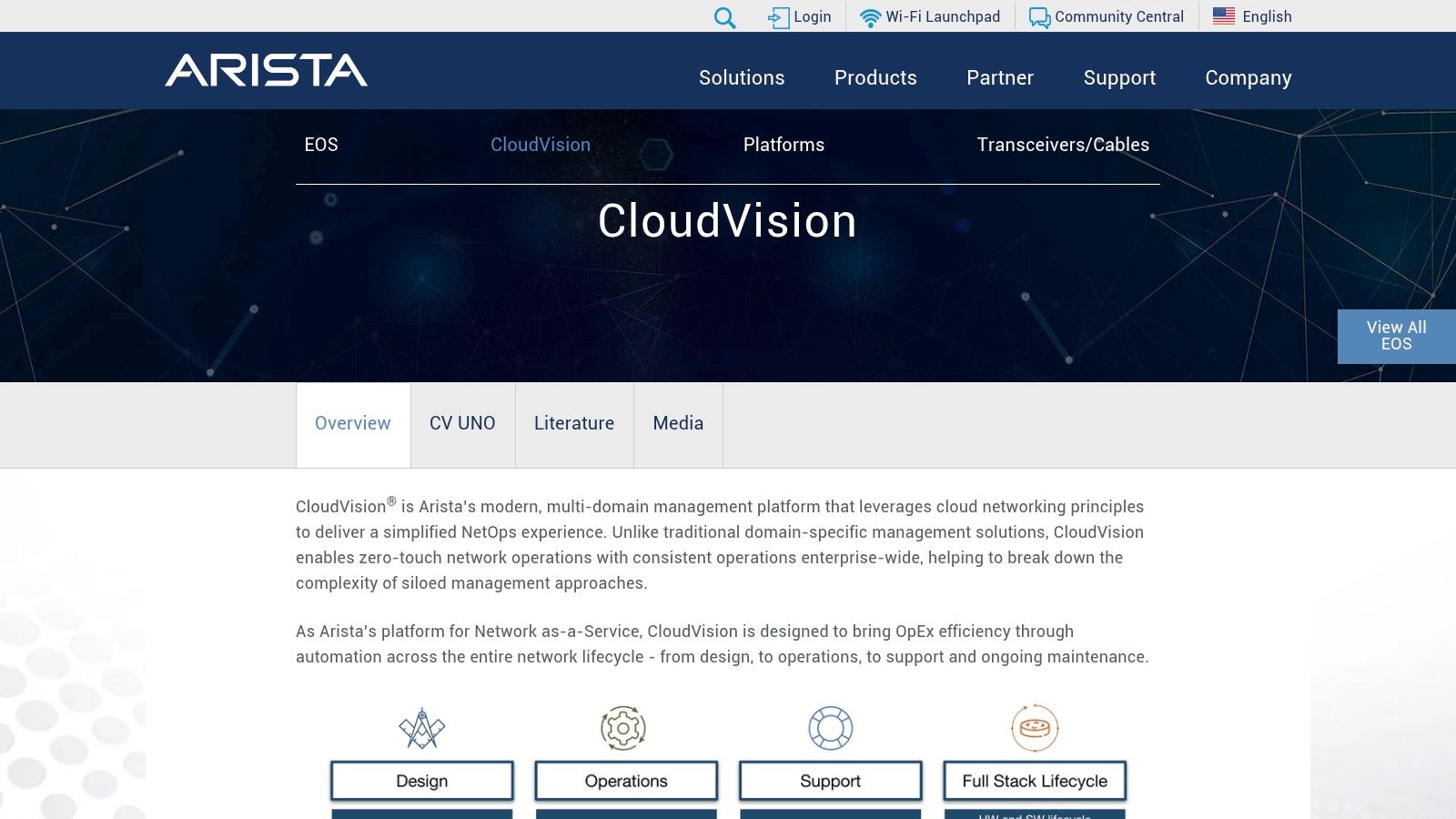
CloudVision is what I recommend when someone has a heavily Arista-centric environment and wants operations, telemetry, and lifecycle management to behave like one coherent system. In that context, it's excellent. The tighter your EOS footprint, the more value you get.
That's the core trade-off. CloudVision is not trying to be the universal answer for every brownfield network. It's strongest when you want to operate Arista fabrics as a whole rather than manage devices one at a time.
Why CloudVision feels different
Arista built CloudVision around state streaming, change control, provisioning, and lifecycle visibility. In practice, that means the platform is often more operationally elegant than generic automation frameworks in Arista-heavy data center, campus, and WAN deployments.
Zero-touch and Day-2 workflows are particularly strong when paired with Arista's documented design patterns and automation integrations. Teams that already use AVD and structured EOS automation generally find CloudVision complements rather than replaces those workflows.
Practical fit and limitations
CloudVision's biggest win is reducing the gap between “we changed something” and “we understand what the network is now doing.” Telemetry and change history live closer together, which makes troubleshooting cleaner during maintenance and incident response.
Its biggest limitation is just as clear. Third-party control exists, but it is not the main reason users choose it.
- Best fit: Arista-led data center and campus environments.
- Big advantage: Strong native EOS integration with telemetry-informed operations.
- Watch closely: Feature differences between CloudVision on-prem and CVaaS need validation before you standardize.
If your environment is mixed but strategically moving toward Arista fabrics, CloudVision can still make sense. If you need equally deep control across many vendors, it probably won't be your primary orchestration layer.
More details are available at Arista CloudVision.
4. Juniper Apstra Data Center Director
Apstra solves a narrower problem than some of the tools on this list, but it solves that problem very well. If you're building or operating EVPN-VXLAN data center fabrics and want intent-based design plus continuous validation, Apstra deserves serious attention.
This isn't a general network automation toolbox. It's a fabric-focused system with guardrails. That makes it especially valuable for teams that need repeatability more than infinite flexibility.
Where Apstra is strongest
The blueprint model is the main attraction. You define intended topology and policy, deploy against that design, and let Apstra keep checking whether the live network still matches intent. That closed-loop validation is useful because drift is one of the most persistent operational problems in data center networking.
For smaller teams running complex fabrics, Apstra can reduce cognitive load. Engineers don't have to remember every low-level dependency if the platform is continuously checking the environment against design expectations.
What to know before choosing it
Apstra is most compelling for greenfield or disciplined brownfield fabric programs. It's less compelling if your primary need is branch provisioning, WAN service orchestration, or broad multi-domain automation.
Its multi-vendor story also needs practical validation against your exact hardware and software combinations. “Supports multivendor” always sounds better in slideware than in production.
- Best fit: Data center teams standardizing EVPN-VXLAN design and operations.
- Big advantage: Intent-based validation helps catch drift before drift becomes outage.
- Watch closely: Scope is fabric-centric, not broad enterprise orchestration.
A lot of buyers confuse intent-based networking with magic. It isn't magic. It's structure, validation, and constraint. In the right environment, that's exactly what you want. See Juniper Apstra Data Center Director.
5. Itential Automation Platform
A common failure pattern looks like this. The team has solid automation scripts, but every meaningful change still depends on one or two engineers who know the APIs, the approval path, and the operational exceptions. Delivery slows down. Audit gets messy. Other teams stop trusting the automation because they cannot see how decisions were made.
Itential is built for that problem. It focuses on turning network automation into governed workflows that operations, security, cloud, and service management teams can use together.
That matters if your goal is bigger than pushing config. In larger environments, the hard part is often coordinating approvals, validations, tickets, inventory checks, and post-change actions across systems. Itential's value is in that orchestration layer. It can sit between network tooling and the broader operating model, which is why it often shows up in enterprises trying to connect automation with ITSM and hyperautomation initiatives across IT operations.
Why teams choose Itential
The strongest case for Itential is productized automation. Instead of treating every workflow like a custom engineering project, teams can package repeatable processes with guardrails, inputs, approvals, and integrations already defined. That approach is useful when multiple groups need to consume the same automation safely.
Itential's own guide to network automation tools highlights case studies with claims around time savings, faster payback, reduced process variation, and a large integration catalog (Itential's guide to network automation tools). I would treat those as vendor-reported outcomes, not baseline expectations. The practical takeaway is still valid. If your environment depends on ServiceNow, CMDB data, cloud platforms, source control, and API-driven checks, integration depth often matters more than another templating feature.
It also fits organizations that want to expose automation to AI agents or self-service portals without giving those systems direct, uncontrolled access to the network. A governed workflow layer gives you a safer control point.
What to know before choosing it
Itential works best when the process is worth standardizing. New service activation, firewall exception handling, circuit turn-up, compliance remediation, and ticket-driven changes are good examples. You get the most value when the same workflow crosses teams and gets executed often enough to justify design effort.
The trade-off is real. This is not the tool I would pick for a small team that mainly needs straightforward configuration automation at the lowest possible cost. You still need process design, integration testing, and clear ownership for each workflow. If those pieces are weak, the platform can turn into an expensive abstraction layer over messy operations.
- Best fit: Enterprises that need governed, multi-team workflows tied to ITSM, approvals, and APIs.
- Big advantage: Strong workflow orchestration and service design for reusable automation products.
- Watch closely: Adoption depends on process maturity, integration quality, and disciplined service design.
Plan the rollout like a service catalog project, not just a tooling install. Define the first few workflows, map every dependency, decide where approvals belong, and set ROI measures before implementation. Explore Itential Automation Platform.
6. Gluware Intelligent Network Automation

Gluware tends to appeal to teams living with a classic enterprise reality. Lots of devices. Mixed vendors. OS lifecycle headaches. Compliance demands. And very little appetite for building everything from scratch.
That's where Gluware is practical. It's designed for brownfield operations, not just clean-sheet automation programs.
Where Gluware earns trust
Its prebuilt apps for configuration changes, audits, policy enforcement, and mass OS upgrades make it attractive for teams that need operational automation now, not after a long platform engineering phase. That matters more than people admit. Plenty of network organizations don't fail because they chose the wrong vision. They fail because they chose a design that required too much custom build effort.
Gluware is also worth a close look if security and compliance tasks are driving the business case.
The trade-offs
You should still vet device support and feature packaging early. This isn't a platform you want to discover limitations in halfway through rollout. The ecosystem is also smaller than what you get around Ansible or Terraform, so your staffing and community support assumptions should be realistic.
- Best fit: Brownfield enterprise environments with compliance and lifecycle pressure.
- Big advantage: Practical support for policy enforcement and bulk OS operations.
- Watch closely: Validate coverage before committing to a broad deployment model.
A good way to think about Gluware is as an acceleration layer for teams that want automation outcomes without becoming an internal automation software company. If broader process orchestration is also on your roadmap, it can fit into a larger hyperautomation strategy.
You can review the product at Gluware Intelligent Network Automation.
7. SolarWinds Network Configuration Manager
SolarWinds NCM stays relevant because foundational network automation still matters. Backups, config diffs, compliance checks, approvals, and bulk template changes are not glamorous. They are, however, the work that prevents a lot of avoidable pain.
For teams already invested in the broader SolarWinds stack, NCM can be the obvious operational extension. It won't replace a full orchestration platform, but that's not always the job.
Where NCM makes sense
If your priority is getting control over configuration lifecycle and reducing manual drift, SolarWinds NCM is still a practical choice. It's mature, recognizable, and oriented around core network configuration management tasks that many organizations still haven't fully standardized.
A lot of teams jump too quickly to “intent” and “AI” before they've solved backup hygiene, config approval, and restore confidence.
Get your rollback story right before you automate anything high risk.
Where it stops
NCM-centric tooling has natural limits. You won't get the same service modeling depth as NSO or the same broad automation ecosystem as Ansible. It's stronger as a control and compliance layer around device configurations than as a universal automation fabric across cloud, ITSM, and application workflows.
That's not a criticism. It's positioning.
- Best fit: Teams focused on backup, restore, policy compliance, and controlled bulk changes.
- Big advantage: Strong baseline operational discipline for multi-vendor config management.
- Watch closely: Evaluate budget assumptions carefully if you expect long-term expansion.
For many organizations, SolarWinds NCM is the right “first real tool” because it fixes common operational weaknesses quickly. Learn more at SolarWinds Network Configuration Manager.
8. ManageEngine Network Configuration Manager
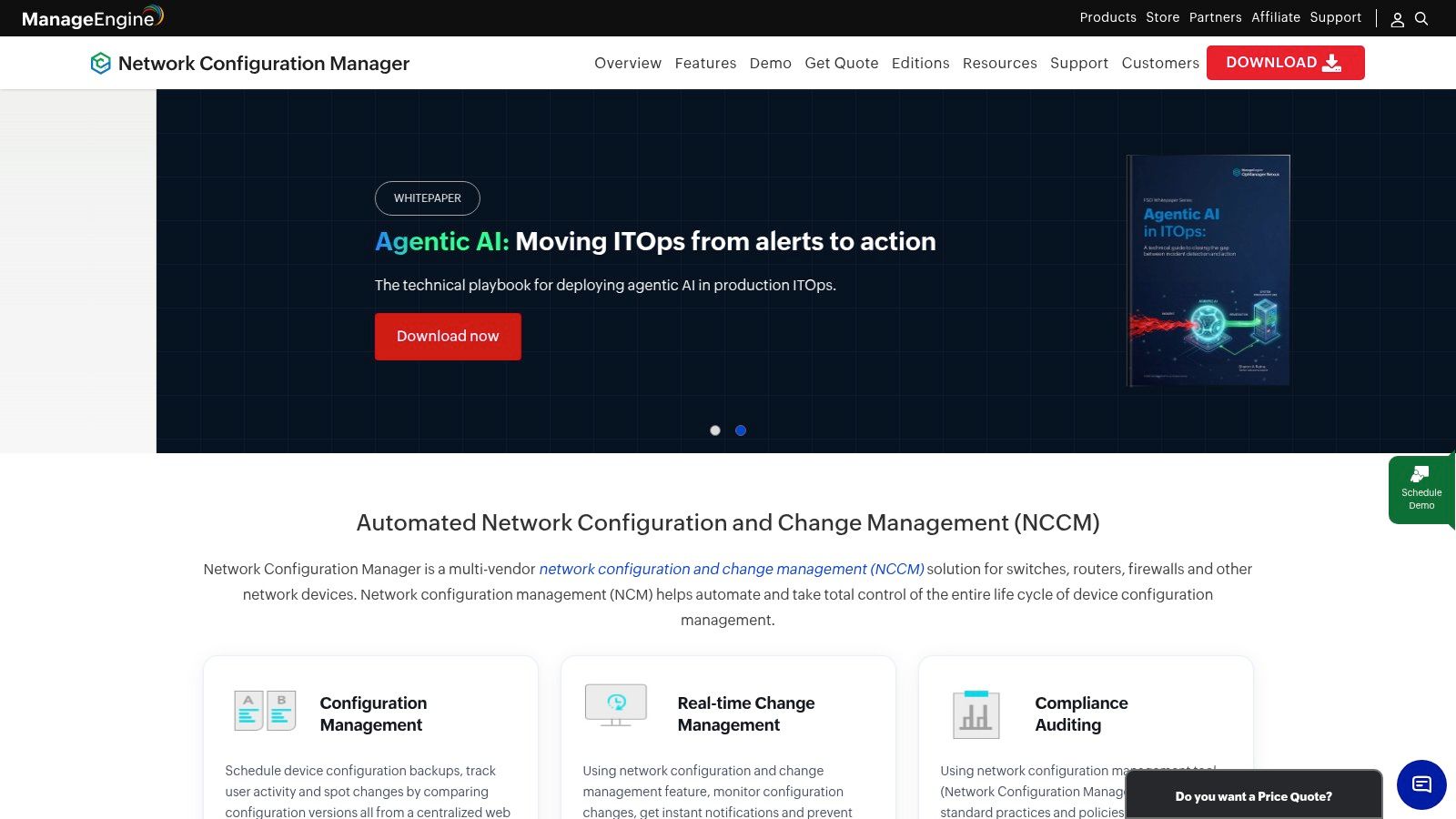
ManageEngine NCM is the tool I'd put in front of a lean IT team that needs real control but doesn't want to buy into a heavyweight orchestration story yet. It handles the basics well enough to produce operational improvement quickly, and for a lot of small and mid-sized organizations, that's exactly the right answer.
It's especially useful when the business case is operational consistency rather than transformation language. Backup configs. Detect unauthorized changes. Run bulk commands. Manage firmware and compliance with less friction.
Why smaller teams like it
ManageEngine positions the product around broad vendor support and approachable deployment. In practice, that means you can get value without a dedicated automation engineer or a long design phase. For distributed enterprises and mid-market IT groups, that accessibility matters more than abstract platform elegance.
The product also fits teams that are still maturing change controls. Approval workflows and role-based access can be enough to move a network shop from reactive to reasonably controlled.
The ceiling
The trade-off is orchestration depth. If your target state includes service abstraction, cross-domain automation, rich APIs everywhere, and tightly integrated ITSM-driven execution, you may outgrow it.
Still, that's not failure. It's progression.
- Best fit: SMB, mid-market, and distributed teams that need practical NCM fast.
- Big advantage: Accessible path into network automation tools without a major build effort.
- Watch closely: Test the user experience and scaling fit against your actual environment.
A lot of automation success comes from picking the next tool, not the final tool. ManageEngine often fits that “next tool” role well. Visit ManageEngine Network Configuration Manager.
9. HashiCorp Terraform for Network Automation
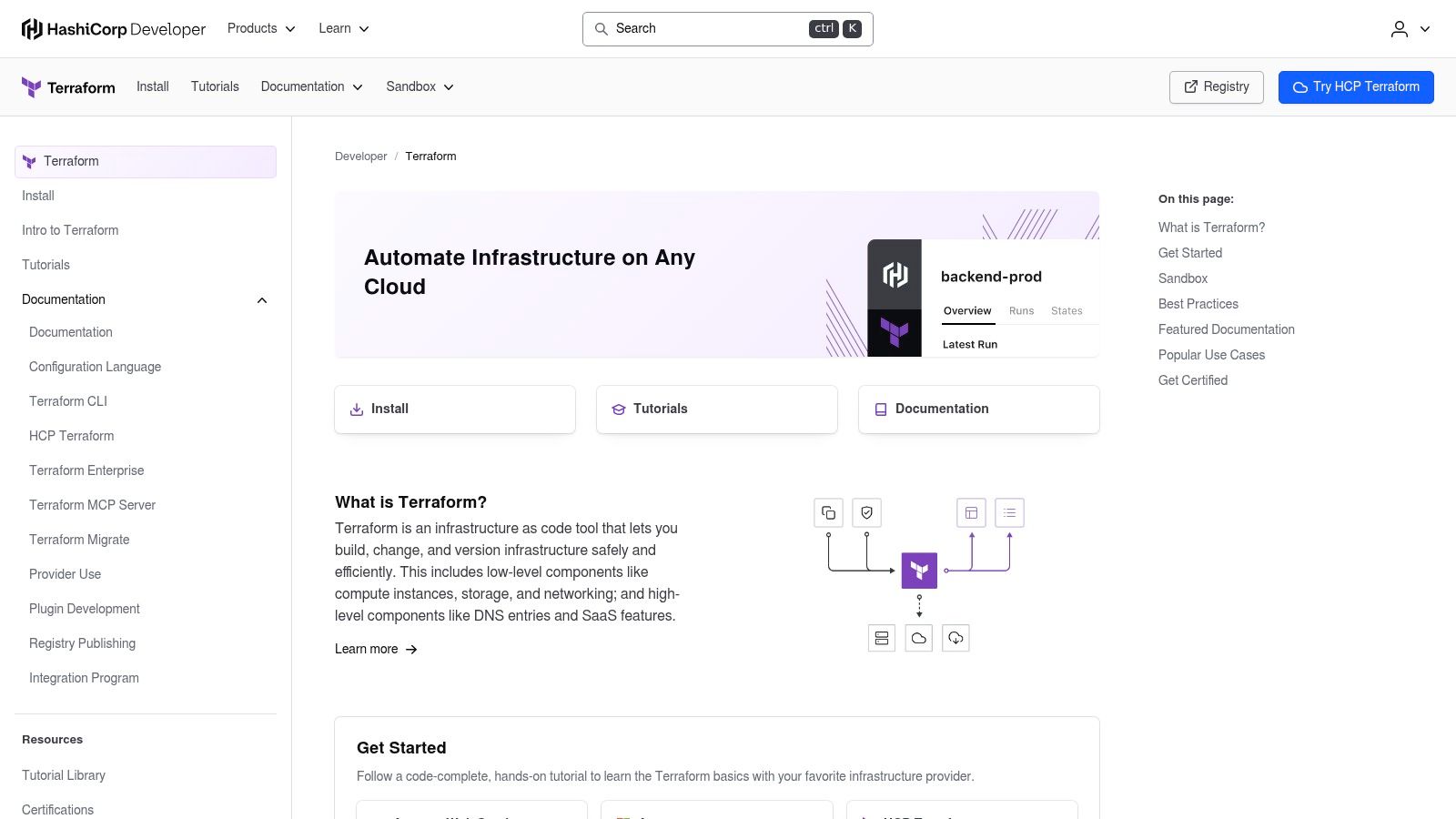
A common turning point looks like this. The network team automates switch changes one way, the cloud team builds VPCs another way, and the security team tracks policy in a separate process. Terraform earns its place when the problem is not pushing config faster, but managing shared infrastructure changes through one reviewable workflow.
That matters because many network changes now sit inside a larger service change. Routing, security groups, load balancers, DNS, and cloud connectivity often need to move together. Terraform handles that dependency model well, especially for teams already working from Git, pull requests, and pipeline-based approvals.
Where Terraform fits best
Terraform works best for declarative infrastructure. Cloud networking, network security objects, provider-managed services, and repeatable environment builds are the sweet spot. If the goal is to standardize how network, cloud, and platform teams define and approve changes, Terraform gives you a common operating model.
I usually recommend it when a team needs consistency across domains, not just network automation in isolation. That distinction matters for ROI. A shared IaC approach can reduce rework between teams, improve change traceability, and make ITSM integration cleaner because every approved change has a plan, an owner, and version history.
It also maps well to AI-assisted operations, with guardrails. AI agents can draft module changes, summarize plan output, or create incident-linked pull requests. They should not apply production changes without policy checks, peer review, and a clear rollback path.
Where teams get burned
Terraform is a poor fit for every network task that changes often at the device CLI layer or depends on operational state during execution. Provider quality varies. Some network and security platforms expose mature resources and clean lifecycle behavior. Others leave gaps that force ugly workarounds, partial deployments, or custom providers.
State is the other gotcha. If your team does not treat state storage, locking, drift detection, and import strategy as first-class design decisions, Terraform can create just as much operational risk as it removes. That is why mature implementations usually pair it with policy controls, CI checks, and a documented automated DevOps pipeline for infrastructure changes.
A practical migration path helps. Start with cloud networking and shared services. Keep device-level remediation, ad hoc operational tasks, and day-2 troubleshooting in tools better suited to procedural execution.
- Best fit: Teams managing cloud networking, network security services, and platform infrastructure through Git-based change control.
- Big advantage: One IaC workflow for network, cloud, and platform resources, with cleaner approval and audit trails.
- Watch closely: Provider maturity, state handling, and the temptation to force Terraform into jobs better handled by Ansible or vendor-native APIs.
Terraform is strongest as part of a broader automation strategy. Use it where declarative state, reusable modules, ITSM-linked approvals, and measurable change control improve operations. Explore the platform at HashiCorp Terraform.
10. Nokia Network Services Platform
Nokia NSP is built for scale and operational complexity that many enterprise buyers will never need. But if you operate across IP, optical, microwave, and multi-layer service domains, that scope is exactly why it deserves consideration.
This is a serious platform for serious networks. OSS and BSS integration, service lifecycle management, assurance, and domain coordination are central to its value.
Why NSP matters
A lot of automation content focuses on configuration speed. That misses the harder problem. In large operator environments, the challenge is coordinating intent, fulfillment, assurance, topology context, and service state across domains. NSP is designed for that class of problem.
That makes it a better fit for providers and very large enterprises than for mid-market IT groups.
Governance matters more than speed
One undercovered reality of network automation is that bad automation scales failure fast. A 2025 industry article warns that poorly designed automation can introduce new security and compliance risks and recommends version control, continuous observability, and automated incident response as safeguards (network automation challenges and solutions).
That warning is especially relevant in platforms like NSP where the blast radius can be large if governance is weak.
Automation maturity isn't measured by how fast you can push change. It's measured by how safely you can recover from the wrong change.
- Best fit: Service providers and large enterprises with multi-domain operations.
- Big advantage: Strong lifecycle and assurance context across complex networks.
- Watch closely: Deployment effort and commercial scope can be too heavy for smaller environments.
If your network spans multiple transport and service layers, simpler tools may not give you enough operational context. See Nokia Network Services Platform.
Top 10 Network Automation Tools Comparison
| Product | Core features | Target audience | UX & Scale | Value proposition | Licensing & Pricing |
|---|---|---|---|---|---|
| Red Hat Ansible Automation Platform (AAP) | Agentless Ansible modules; Automation Controller (RBAC, workflows, analytics); Automation Mesh | Enterprises, regulated ops, multi‑vendor environments, DevOps teams | Widely adopted skillset; strong ecosystem; scalable but evolving feature cadence | Enterprise governance, analytics, and vendor-backed productionization of automations | Commercial node-based licensing; can be complex/expensive at scale |
| Cisco Crosswork Network Services Orchestrator (NSO) | YANG model-driven device abstraction; transactional diff & converge; single northbound API | Carriers and large enterprises delivering service lifecycle automation | Carrier-grade scale and reliability; steeper learning curve; modelling investment required | Reliable, transactional service orchestration with CI/CD/ITSM integration | Vendor licensing; validate NED coverage and version support |
| Arista CloudVision (CV / CVaaS) | EOS-native provisioning, telemetry, compliance, software lifecycle; CVaaS SaaS option | Arista-centric data center, campus and WAN fabric teams | Deep EOS integration; rich telemetry; limited third‑party control | Network-as-a-system operations with integrated lifecycle and analytics | On‑prem vs CVaaS feature differences; subscription pricing |
| Juniper Apstra Data Center Director | Intent-based blueprints; EVPN‑VXLAN design/deploy/assure; continuous validation | Data center teams building EVPN‑VXLAN fabrics; multivendor DCs | Speeds greenfield deployments; reduces drift; focused on DC fabrics | Enforces intent with closed‑loop assurance and root‑cause validation | Tiered licensing by features and fabric size; edition mapping required |
| Itential Automation Platform | Low‑code workflow builder; API federation & governance; multi‑domain integrations | Cross-functional network+IT teams seeking automation as a service | Faster time-to-value vs DIY; strong integrations; needs scoping | Productize automations with API-first governance and ticketing/CI ties | Commercial offering with opaque public pricing; sizing workshops recommended |
| Gluware Intelligent Network Automation | Prebuilt apps for config, audits, OS upgrades; compliance remediation; GluAPI | Brownfield networks needing OS upgrades, policy enforcement | Strong for mass upgrades and drift remediation; smaller ecosystem than Ansible | Automates policy enforcement and lifecycle tasks across diverse fleets | Variable packaging; licensing requires solution scoping |
| SolarWinds Network Configuration Manager (NCM) | Config backup/restore; diff & approval workflows; compliance & vulnerability checks | Teams needing core NCM functions; SolarWinds customers | Mature NCM UX; focused on configuration management rather than full orchestration | Reliable foundational NCM with tight monitoring stack integration | Subscription/pricing shifts reported; budget and renewal planning advised |
| ManageEngine Network Configuration Manager (NCM) | Real-time change detection; bulk commands & firmware upgrades; RBAC | SMBs, mid-market, distributed enterprises | Transparent pricing and approachable deployment; mixed feedback on scale/UX | Cost-conscious multi‑vendor NCM with broad out‑of‑box support | Transparent/competitive pricing; validate scale in proofs of concept |
| HashiCorp Terraform (for Network Automation) | Declarative IaC, state management, providers/modules; GitOps/CI integration | DevOps teams unifying network, cloud and infra as code | Code-driven workflows; strong ecosystem; requires strict state guardrails | Standardizes network and cloud automation under IaC and CI pipelines | OSS core; paid enterprise options; provider maturity varies by vendor |
| Nokia Network Services Platform (NSP) | End‑to‑end service fulfillment across IP/optical; programmable APIs; lifecycle automation | Service providers and large enterprises with multi‑domain networks | Built for complex multi‑domain scale; heavier footprint for smaller orgs | Strong assurance, lifecycle context and OSS/BSS integrations for operators | Commercial solution design and licensing; appliances and partner services available |
Your Next Step in Network Automation
The best network automation tools don't start by replacing engineers. They start by removing the work engineers should never have been doing manually in the first place. Backup routines, repetitive config changes, policy checks, upgrade prep, change validation, ticket updates, and rollback preparation are all good candidates because they are repetitive, high-friction, and easy to get wrong under time pressure.
That's also why this market has expanded so aggressively. Forecasts vary widely depending on category definitions, but they all point in the same direction. Technavio projects growth of USD 46.61 billion from 2023 to 2028 at a 21.48% CAGR, while Grand View Research estimated USD 2.58 billion in 2021 growing to USD 15.60 billion by 2030 at a 22.9% CAGR, and MarketsandMarkets projects USD 7.88 billion in 2025 to USD 12.38 billion by 2030 at a 9.4% CAGR (Technavio network automation market analysis). The exact number matters less than the conclusion. This isn't a niche anymore.
The strategic mistake is choosing a tool before you choose an operating model. Start by deciding which category of problem you need to solve.
- If your pain is basic configuration control: Start with ManageEngine NCM or SolarWinds NCM.
- If your pain is multi-vendor execution and workflow automation: Start with Ansible Automation Platform.
- If your pain is service orchestration and rollback discipline: Look hard at Cisco NSO.
- If your pain is fabric intent and assurance: Juniper Apstra or Arista CloudVision may fit better than a generic framework.
- If your pain is brownfield lifecycle and compliance pressure: Gluware is worth attention.
- If your pain is cross-team orchestration and integration governance: Itential becomes more relevant.
- If your pain is cloud and network convergence: Terraform belongs in the core stack.
A practical migration path usually looks like this.
A realistic migration checklist
- Choose one painful workflow: Examples include switch backup validation, VLAN rollout, firmware compliance, or access policy updates.
- Define the source of truth: Inventory, IPAM, CMDB, Git, and device state must stop disagreeing.
- Build prechecks and postchecks: Don't automate only the change. Automate validation around the change.
- Create rollback paths: Every production workflow should have a documented and testable reversal plan.
- Add approvals selectively: Human approval belongs at risk boundaries, not every trivial step.
- Log every action: Auditability matters for trust, compliance, and troubleshooting.
- Measure labor and incident reduction qualitatively or with your own internal baselines: Don't import vanity metrics that don't match your environment.
AI agents are entering this space, but they should sit on top of disciplined automation, not replace it. An AI agent can summarize incidents, classify tickets, suggest remediation paths, correlate observability data, and trigger approved workflows through Ansible, Itential, NSO, or ITSM systems. It should not freeform its way into production without policy boundaries. The safer pattern is agent-assisted orchestration. Let the agent interpret, recommend, and prepare. Let governed workflows execute.
ITSM integration is where many automation programs either become trusted or stay sidelined. If your automation doesn't update the ticket, attach validation results, record who approved what, and preserve rollback context, operations teams won't treat it as production-grade. Tie your workflows into change records early. That matters as much as device support.
The longer historical view is useful too. CFEngine was first introduced in 1993, long before current cloud-era tooling, which is a reminder that the core value proposition hasn't changed. Automation exists to replace repetitive manual administration with policy-based control (TechTarget overview of leading network automation tools). The modern stack is better at tying that control to observability, compliance, and event-driven operations.
If you're building your own career alongside your tooling strategy, it also helps to prepare for CCNA certification. Strong fundamentals still matter, even in highly automated environments.
Start small. Pick one workflow. Make it reliable. Then expand. That's how network automation becomes part of how your team operates, not just another tool nobody wants to maintain.
If you want help turning scattered scripts, ticket bottlenecks, and manual handoffs into governed automation, MakeAutomation can help design the workflow architecture, documentation, AI agent layer, and implementation plan. That's especially useful for B2B and SaaS teams that need automation tied to ROI, cross-functional operations, and scalable execution rather than just another disconnected tool rollout.