

Master JSON Validator Schema Java for Robust Data
A lead form submits cleanly. Your webhook accepts the payload. The CRM record gets created. Then someone from sales opens it and finds email: null, a phone number in the name field, and a nested object where your downstream enrichment job expected a string. Nothing crashed loudly, so the bad data kept moving.
That's the problem behind most searches for json validator schema java. The underlying issue isn't parsing JSON. Java can already do that well. The issue is enforcing a contract before flawed payloads poison automations, break integrations, or create cleanup work for teams that should be selling, onboarding, or shipping.
In Java, schema validation sits right at that boundary. It answers a simple question early, before damage spreads: does this payload conform to the structure and rules we agreed on?
Why Robust JSON Validation Is Critical for Automated Systems

The failure mode is usually boring. A signup form sends an empty value for a required field. A partner API changes a nested shape without warning. A webhook includes a value with the wrong type, and your Java service happily deserializes part of it before a later step fails. By then, you're debugging symptoms instead of blocking the cause.
JSON Schema fixes that by turning a payload definition into an enforceable contract. It doesn't just say a field should exist. It can define structure, data types, formats, enumerations, and length constraints. That's why schema validation matters anywhere data crosses system boundaries.
For teams running CRM syncs, onboarding flows, or lead routing, validation belongs near the edge of the system. Catch the bad request before it enters the rest of the pipeline. If you care about improving data quality in automation workflows, this is one of the most direct controls you can add.
Where the business impact shows up
A weak validation layer causes practical problems:
- Sales ops gets dirty records that need manual cleanup before reps can act.
- Integration jobs fail later because a required field was missing upstream.
- Support teams lose time reproducing payload issues that should have been rejected at the API boundary.
- Auditability gets worse because no one can tell whether a malformed payload was accepted intentionally or by accident.
Practical rule: If bad data can enter through a request, webhook, or import job, validate it before any business logic runs.
This is also part of building software resilience. Reliable systems don't assume upstream senders behave perfectly. They validate, reject clearly, and keep the rest of the workflow stable.
What robust validation actually changes
When teams first add schema validation, they often think of it as defensive plumbing. In practice, it becomes a reliability feature. Once the schema is treated as the source of truth, the rest of the code gets simpler because downstream services can trust the shape of incoming data.
That matters even more in automated systems. A human can sometimes notice that a value looks wrong and correct it. An automation pipeline won't. It will keep executing exactly as designed on flawed input.
Setting Up Your Java Project for Schema Validation

If you want a straightforward starting point, Everit is still a practical library to learn the workflow. It makes the validation sequence obvious, and that matters when you're trying to build something reliable instead of clever.
The implementation pattern to copy is simple: load the schema once, compile it, then validate payloads against the compiled schema. An Innominds walkthrough of Everit validation shows the canonical sequence with JSONObject, SchemaLoader.load(jsonSchema), and schema.validate(jsonData). That pattern is dependable because schema compilation belongs in setup code, not per-request logic.
If dependency trees start getting noisy, it also helps to understand what a transitive dependency is in Java builds, because JSON tooling often pulls in more than you expect.
Maven and Gradle setup
A typical Maven dependency looks like this:
<dependency>
    <groupId>org.everit.json</groupId>
    <artifactId>org.everit.json.schema</artifactId>
    <version>...</version>
</dependency>
Gradle is the same idea:
implementation "org.everit.json:org.everit.json.schema:..."
I've left the version placeholder out on purpose. If you hardcode a version from memory without checking your build, you'll eventually copy an outdated snippet into a project and lose time to avoidable dependency issues. Pull the current version from your repository manager or existing build standards.
A minimal working example
Assume you want to validate a userProfile payload before writing it to your CRM sync queue.
Schema
{
  "type": "object",
  "required": ["id", "email", "name"],
  "properties": {
    "id": { "type": "string" },
    "email": { "type": "string", "format": "email" },
    "name": { "type": "string", "minLength": 1 },
    "company": { "type": "string" }
  },
  "additionalProperties": false
}
Java
import org.everit.json.schema.Schema;
import org.everit.json.schema.loader.SchemaLoader;
import org.json.JSONObject;
import org.json.JSONTokener;

public class UserProfileValidator {

    private final Schema schema;

    public UserProfileValidator() {
        String rawSchema = """
            {
              "type": "object",
              "required": ["id", "email", "name"],
              "properties": {
                "id": { "type": "string" },
                "email": { "type": "string", "format": "email" },
                "name": { "type": "string", "minLength": 1 },
                "company": { "type": "string" }
              },
              "additionalProperties": false
            }
            """;

        JSONObject schemaJson = new JSONObject(new JSONTokener(rawSchema));
        this.schema = SchemaLoader.load(schemaJson);
    }

    public void validate(String jsonPayload) {
        JSONObject data = new JSONObject(new JSONTokener(jsonPayload));
        schema.validate(data);
    }
}
That's enough to get a useful validator running. The important thing is where the schema is created. It happens once in the constructor, not every time validate runs.
What works and what doesn't
What works in production:
- Compile once: Keep the
Schemaobject cached and reused. - Fail early: Validate before mapping into business workflows.
- Use strict rules:
additionalProperties: falseis often worth it on external contracts.
What doesn't:
- Rebuilding the schema on every request: That adds avoidable overhead.
- Treating schema as documentation only: If the app doesn't enforce it, the contract isn't real.
- Mixing validation and business logic: Keep them separate so failures stay clear.
The fastest validation bug to fix is the one you reject before your service mutates state.
Choosing Your Validator Everit vs NetworkNT vs Jackson
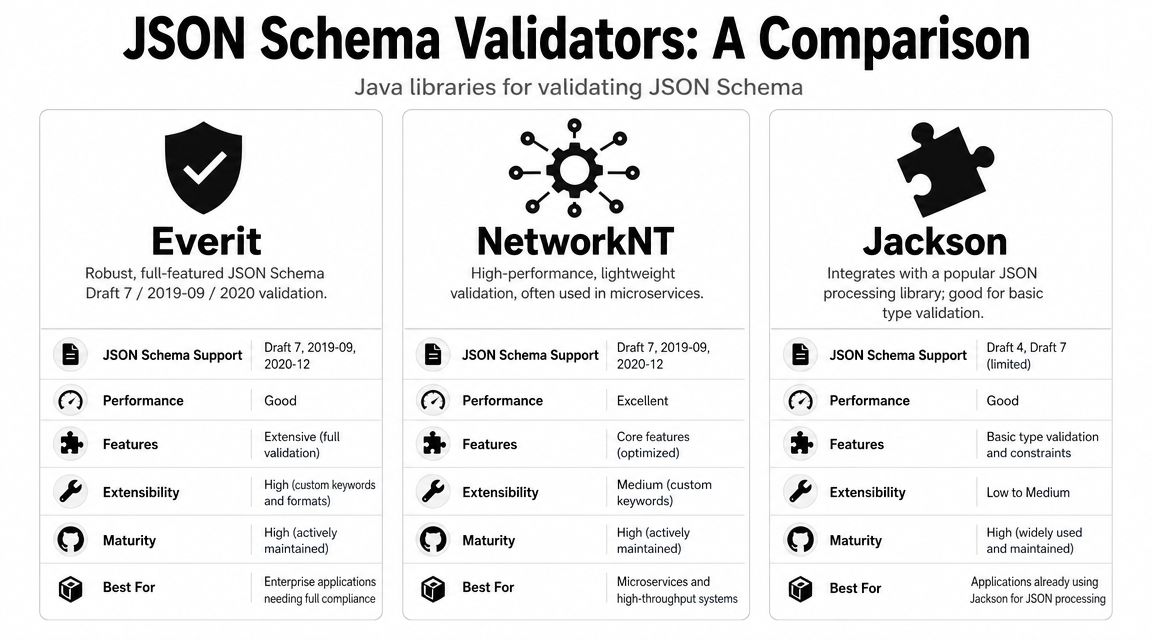
Most developers start by asking, “Which Java library validates JSON Schema?” That's too narrow. The better question is, which validator fits the way your system runs.
If your service handles a few internal payloads, the easiest API might be enough. If you're supporting older partner contracts and newer schemas in the same estate, draft coverage matters more. If validation sits on a hot API path, architecture matters as much as compliance.
Everit for a clear starting point
Everit is a good fit when you want a conventional workflow and easy-to-read code. It's useful in teams that need to make validation explicit for other developers.
A minimal usage style looks like this:
JSONObject schemaJson = new JSONObject(schemaString);
Schema schema = SchemaLoader.load(schemaJson);

JSONObject payload = new JSONObject(payloadString);
schema.validate(payload);
That style is approachable. The trade-off is that it follows the common Java pattern of loading JSON into an intermediate object model before validation. For many systems, that's fine. For high-throughput workloads, it can become part of the cost profile.
NetworkNT for draft coverage and enterprise compatibility
If schema version support is a deciding factor, NetworkNT deserves a close look. Its project documentation states support for Draft V4, V6, V7, 2019-09, and a partial implementation of 2020-12 in the NetworkNT validator project. That makes it a strong option when you have to validate contracts created across different eras.
That's not just a library feature. Apache Camel's JSON validator component also documents the same draft coverage through its use of NetworkNT in integration middleware, which tells you this validator shows up in real system boundaries, not just standalone examples.
A typical usage pattern is more framework-oriented than Everit:
// Illustrative structure only. Exact setup depends on the version in your project.
JsonSchema schema = schemaFactory.getSchema(schemaInput);
Set<ValidationMessage> errors = schema.validate(jsonNode);
NetworkNT is often the right answer when your constraints are operational:
- You have legacy partner schemas mixed with newer contracts.
- Validation happens in middleware or microservices.
- You need broad compatibility more than the simplest API.
Jackson for ecosystem fit, not full schema strategy
Jackson is everywhere in Java services. That makes it tempting to use Jackson alone as the validation story. For basic structural checks and mapping discipline, that can be enough. But Jackson itself isn't the same thing as a dedicated JSON Schema validator strategy.
Use Jackson when your main goal is smooth integration with existing serialization and deserialization pipelines. Don't expect it to replace a schema-aware validator if you need draft handling, contract enforcement, or richer validation feedback.
If your team says “we already use Jackson,” that's a serialization argument, not automatically a validation argument.
Performance is no longer a side note
A comparison of JVM-based validators found different leaders depending on draft generation. For older drafts, the benchmark leaders were Medeia and Everit. For newer drafts, the top performers were Skema, DevHarrel, and SchemaFriend. That split matters because many teams are validating a mix of old and new schemas, not a clean standard.
That same comparison also notes that SJF4J claims a 2x faster approach in Java by validating structured data directly and avoiding an intermediate JsonNode layer. Even if you don't adopt that library, the design point matters. Validation overhead doesn't come only from rule evaluation. It also comes from how many transformations you force before validation starts.
Java JSON Schema Validator Comparison
| Library | Best For | Schema Draft Support | Key Feature |
|---|---|---|---|
| Everit | Teams that want a simple, readable validation flow | Varies by implementation choice and project history | Straightforward compile-and-validate workflow |
| NetworkNT | Mixed legacy and modern production contracts | v4, v6, v7, 2019-09, 2020-12 | Broad draft compatibility across enterprise use cases |
| Jackson | Existing Jackson-heavy applications needing basic integration | Not a dedicated schema strategy on its own | Tight fit with common JSON mapping workflows |
The short version is practical. Pick Everit when clarity matters most. Pick NetworkNT when schema draft compatibility is a hard requirement. Use Jackson as part of the JSON processing stack, but don't confuse it with a full validator decision.
How to Interpret and Handle Validation Failures

A validator that only throws a stack trace isn't helping much. The core function is turning raw schema failures into responses that developers, clients, and support teams can act on quickly.
With Everit, that usually means catching ValidationException and walking through all collected failures instead of returning the first ugly message as-is.
Catch the exception and normalize it
A common pattern looks like this:
import org.everit.json.schema.ValidationException;

try {
    schema.validate(payloadJson);
} catch (ValidationException ex) {
    List<String> messages = ex.getAllMessages().stream().toList();
    // transform messages into your API error format
}
The important part is getAllMessages(). One invalid payload often violates several rules at once. If you only return the top-level exception message, the client fixes one field, resubmits, and hits the next error. That creates slow, frustrating iteration.
Turn schema output into API-friendly errors
Raw messages often look technical. Your API response shouldn't.
A useful internal mapping strategy is:
- Path extraction: Pull the failing JSON pointer or field path.
- Rule translation: Convert validator-specific wording into your API's language.
- Stable response format: Keep the same structure across all endpoints.
Example output:
{
  "errors": [
    { "field": "email", "error": "This field is required" },
    { "field": "name", "error": "Must not be empty" }
  ]
}
That gives API consumers something they can use immediately. It also makes logs easier to scan because your application speaks in the same error vocabulary everywhere.
Bad validation responses push debugging work onto the client. Good validation responses keep ownership inside your API.
A few gotchas that show up in real services
Not every validation failure should be exposed verbatim. If your schemas contain internal naming or implementation details, don't leak them directly in public responses.
A safer pattern is to separate concerns:
| Concern | What to return to client | What to log internally |
|---|---|---|
| Missing required field | Human-readable field error | Full validation message set |
| Wrong type | Friendly field-level message | Raw validator output and request context |
| Unknown property | Clean explanation of unsupported field | Exact property path and payload snippet |
Also decide early whether your API should return all validation issues or stop after a subset. For public APIs, returning the complete set is usually kinder to consumers. For internal event processing, a single clear failure may be enough if the message will be retried or dead-lettered.
Advanced Validation Patterns and Best Practices
A production-grade validator does more than answer true or false. It protects throughput, keeps schemas maintainable, and sits in the request path without becoming a bottleneck.
Cache schemas and keep validation close to the boundary
The first rule is architectural. Compile schemas once and reuse them. If you rebuild schema objects per request, you're paying setup cost repeatedly for no gain.
For high-volume services, the operational cost of validation matters. A newer Java approach described in a direct object validation article avoids converting everything into an intermediate JsonNode tree first, and the article claims roughly 2x performance improvement. The exact gain will depend on your workload, but the lesson is solid: object model choices affect latency.
If you care about maintainability as much as correctness, it helps to align validation with what makes good code in production systems. Validation code should be boring, reusable, and easy to test.
Break large schemas into reusable parts
Monolithic schemas become painful quickly. If your payloads share address blocks, contact objects, or common metadata, pull those into referenced definitions and reuse them with $ref.
That gives you two wins:
- Consistency: One shared definition means fewer drift bugs across APIs.
- Maintainability: Updating a common shape happens in one place.
I've seen teams skip this because the first schema is small. Six months later they're duplicating the same nested structures across services and wondering why one endpoint accepts fields that another rejects.
Put validation in framework-level infrastructure
Don't scatter validation calls randomly across controllers and service classes. Put them where every request has to pass.
In Spring Boot, that usually means one of these:
- HandlerInterceptor: Good when validation depends on route-specific behavior.
- Filter: Useful for broad request boundary checks.
- Dedicated service layer component: Best when payload validation is part of a larger contract enforcement step.
The pattern that holds up is simple. Resolve the right schema for the endpoint. Validate before business logic. Return a stable error format. Then let the service layer assume the payload is structurally sound.
Making JSON Validation a Core Part of Your Automation Strategy
Teams often treat schema validation like cleanup work. That's a mistake. In automated systems, validation is one of the controls that determines whether growth creates an advantage or just creates more broken handoffs.
The library choice should follow the job. Everit is a solid starting point when you want a clear implementation and low friction for the team. NetworkNT is the better fit when broad draft compatibility matters across older and newer contracts. Jackson belongs in the conversation when ecosystem fit matters, but it shouldn't be the entire validation strategy if contract enforcement is the goal.
The bigger point is operational. Clean payload contracts protect CRM records, webhooks, partner integrations, onboarding workflows, and every automation that depends on predictable data. If you're searching for json validator schema java, you're not just solving a parsing problem. You're deciding how much trust your systems can place in incoming data.
Build that boundary carefully once. It pays for itself every time a malformed payload gets rejected before it becomes a business problem.
If you're refining validation rules, API contracts, or end-to-end automation workflows, MakeAutomation helps B2B and SaaS teams turn messy operational flows into dependable systems that scale cleanly.