
AI Data Security: Enterprise Frameworks and Best Practices
AI data security stopped being a niche control problem when documented incidents jumped to 233 AI-related security incidents in 2024 and 362 in 2025, a 55% year-over-year increase according to 2026 reporting. That acceleration matters because AI is no longer sitting in a lab or a sandbox, it's in customer support, sales ops, engineering workflows, and internal knowledge systems where sensitive data moves constantly. For B2B and SaaS teams, the risk isn't just a compromised model, it's the steady leakage of customer, employee, and product data through the hidden seams of the AI stack.
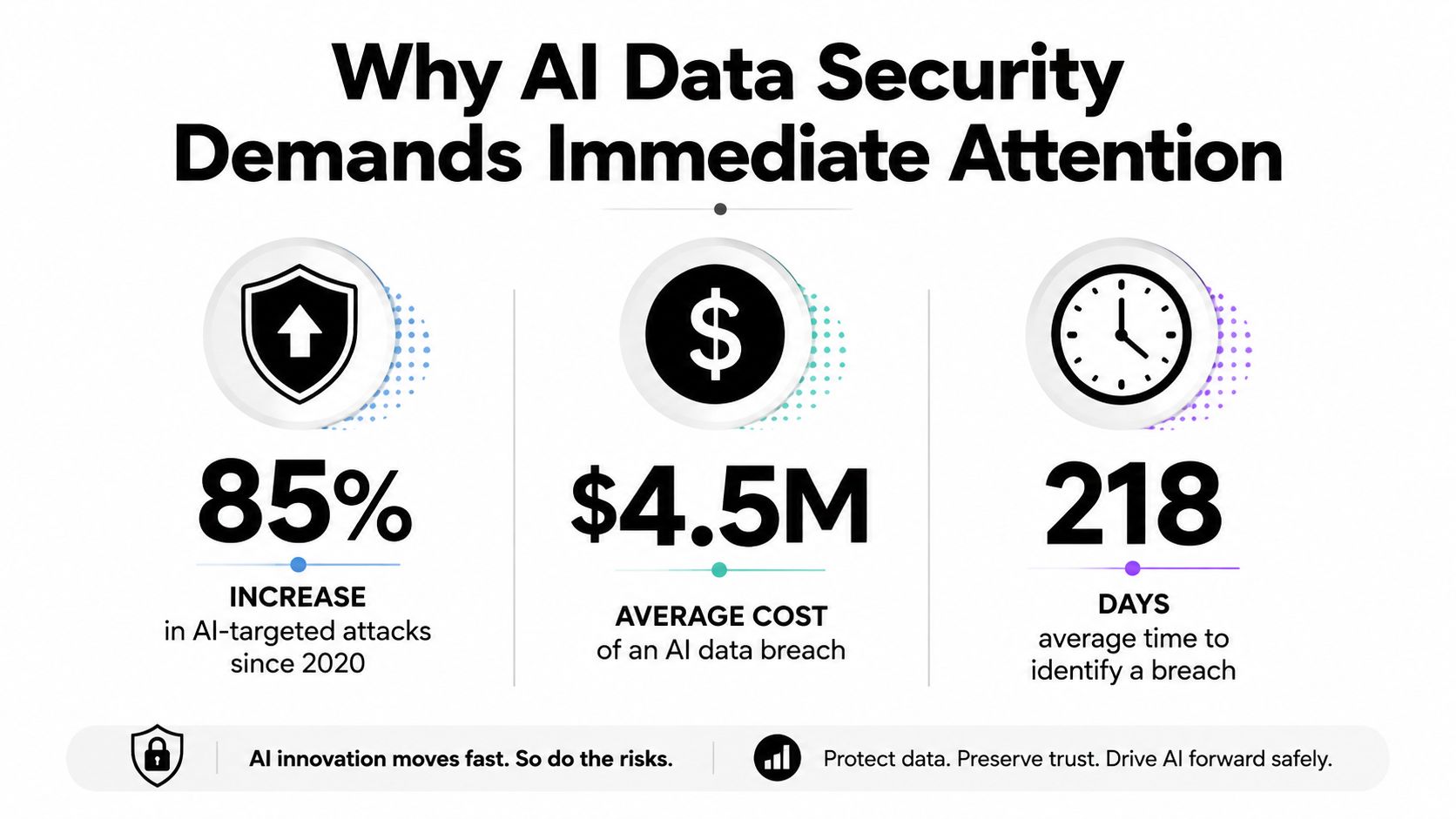
That's why the commercial case is hard to ignore. IBM-linked reporting places the global average data breach cost at $4.88 million, while security programs that use AI and automation extensively can reduce breach costs by an average of $2.2 million. At the same time, 68% of organizations have experienced data leaks linked to AI tool usage, but only 23% have formal security policies in place, which is a clear sign that adoption has outrun governance maturity. In practice, this turns AI data security into a cost-control discipline, a trust-preservation discipline, and a board-level governance issue at the same time. The teams that treat it as a paperwork exercise usually learn the hard way that prompt input, file uploads, and generated outputs can all become exposure points.
Why AI Data Security Demands Immediate Attention
The biggest mistake I see is teams assuming AI security is just a model-protection problem. It isn't. For most organizations, the immediate danger is data moving into places they don't monitor, then coming back out in forms they didn't expect, through chat logs, cached artifacts, shared workspaces, or agent workflows.
The business case is now operational, not theoretical
The incident curve is the warning signal, but the financial exposure is what gets leadership attention. When the average breach cost sits at $4.88 million and managed AI and automation can reduce breach costs by $2.2 million, the gap between disciplined and undisciplined deployment is large enough to matter in budget reviews and customer deals. The presence of 68% reported AI-linked data leaks alongside just 23% formal policies tells you exactly where the weak point is, not the model itself, but the controls around it Practical DevSecOps AI security statistics report.
Practical rule: if your security review focuses on model accuracy before data handling, you've already inverted the risk order.
For SaaS teams, this shows up in everyday ways. A support rep pastes a customer issue into a generative tool. A product manager drops roadmap notes into a copilot. An engineer uses an AI assistant against internal code or logs. None of those actions looks exotic, but each one can move sensitive material outside the systems your DLP and CASB tooling were designed to watch.
AI security has become a governance and trust problem
The technical controls matter, but the bigger organizational issue is that AI tools collapse old boundaries. Users can now submit data directly to services that process, store, or transform it in ways traditional perimeter security never anticipated. That creates customer trust exposure, contractual exposure, and often regulatory exposure, even when nobody intended to leak anything.
The practical implication is simple. AI data security now sits between revenue enablement and risk containment. Teams that get it right can approve AI faster, because they know what data is allowed, where it can go, and who owns the decision. Teams that don't get it right usually end up pausing tools after an incident, then trying to rebuild policy under pressure.
Understanding the AI Data Security Landscape
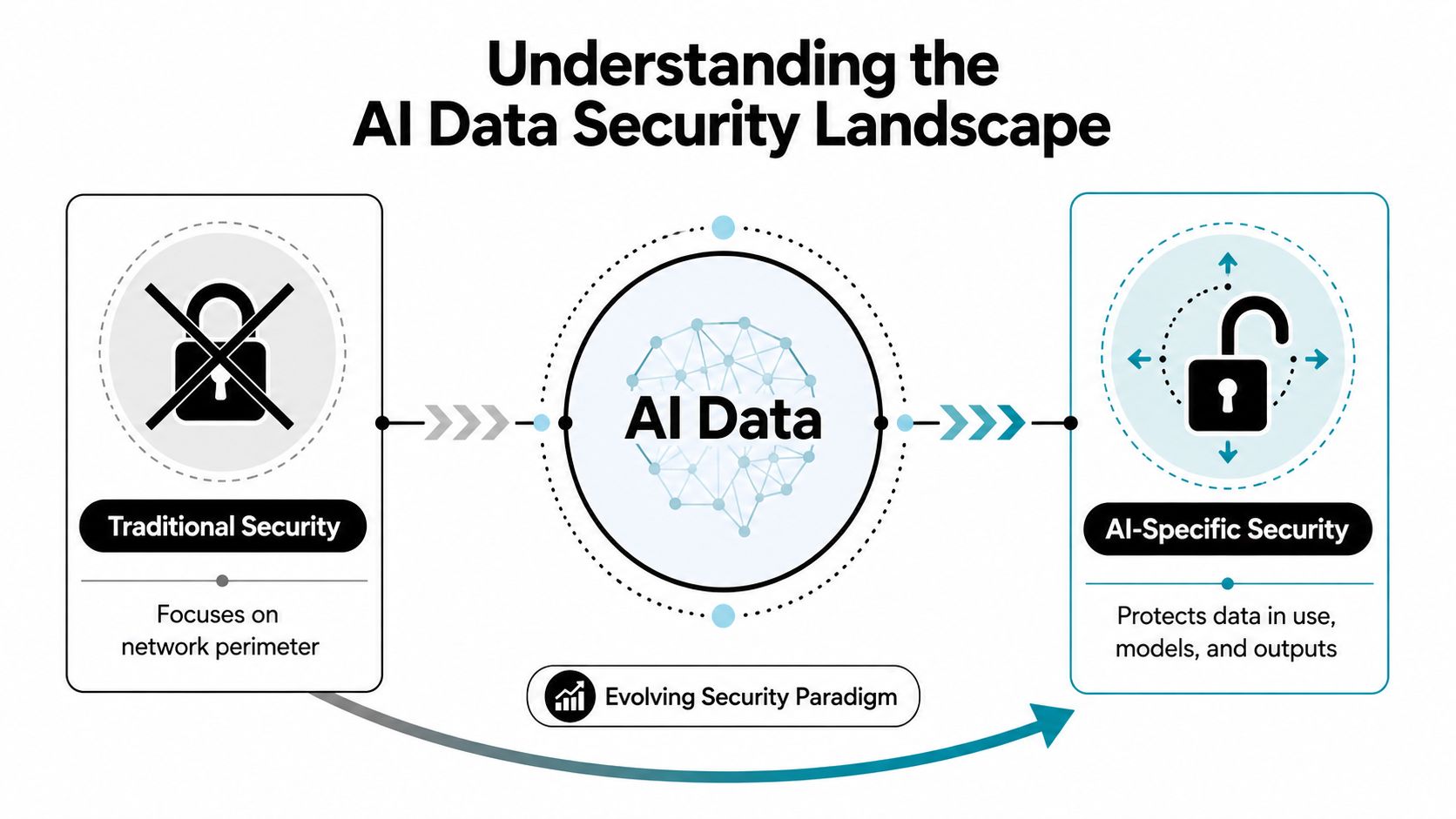
Traditional security still matters, but it was built for a world where data lived in files, databases, and network paths you could map. AI changes that operating model. Sensitive material now moves through training data, preprocessing outputs, embeddings, model weights, and inference endpoints, so the attack surface is no longer a single control point, it is the full pipeline.
A practical way to see the shift is to separate the model from the artifacts around it. The model may be protected, while a preprocessing export, feature store, or embedding cache still exposes customer content, business logic, or proprietary signals. Teams that treat those intermediate objects as temporary or harmless usually discover too late that they persist, get copied, and show up in places nobody planned to monitor.
The question is not only whether the model is protected. It is whether every intermediate object that fed the model is protected too.
The pipeline creates new places where data can leak
AI systems generate intermediate states at every step. Data enters, gets cleaned, tokenized, embedded, transformed, trained against, and queried later. Each stage can create an artifact that looks harmless on its own while still carrying sensitive context. The CSA AI environments guidance calls out intermediate states such as embeddings and preprocessing outputs as places where sensitive data can remain, which means encryption and lineage controls cannot stop at the final application layer.
That is where conventional controls fall short. Network perimeter tools can block an obvious file transfer, but they will not tell you whether a preprocessing job created a recoverable artifact, or whether an embedding store can reveal business-sensitive patterns. In production, that is the failure point I see most often. The system looks fine at the model layer while the surrounding artifacts expand exposure.
For B2B SaaS teams, the operational question is simple. Which intermediate outputs are created, where are they stored, who can read them, and how long do they stay available? If those answers are unclear, the control set is incomplete.
AI-specific threats need different controls
AI systems face threats that do not map neatly to classic data protection. ENISA calls out adversarial machine learning, prompt injection, evasion, poisoning, backdoors, model inference, and supply-chain risks in its AI cybersecurity publication. Those risks are different from ordinary data theft because the attacker may be trying to change model behavior, extract training data, or abuse the model as a trusted interface. The defensive work shifts from blocking only exfiltration to protecting the integrity and traceability of the whole AI workflow.
The implementation question is the same one raised in How to Implement AI in Business: what data is the system allowed to touch, and what happens after it does? A team that cannot answer that precisely is not ready to approve broad AI use.
Partner teams asking for Indiana business threat detection tips usually want the same thing, a way to spot suspicious behavior before it becomes an incident. In AI environments, that means watching for unusual artifact creation, unexpected access to embeddings or checkpoints, and preprocessing jobs that produce outputs outside the approved path.
Mapping the AI Threat Model Across the Pipeline
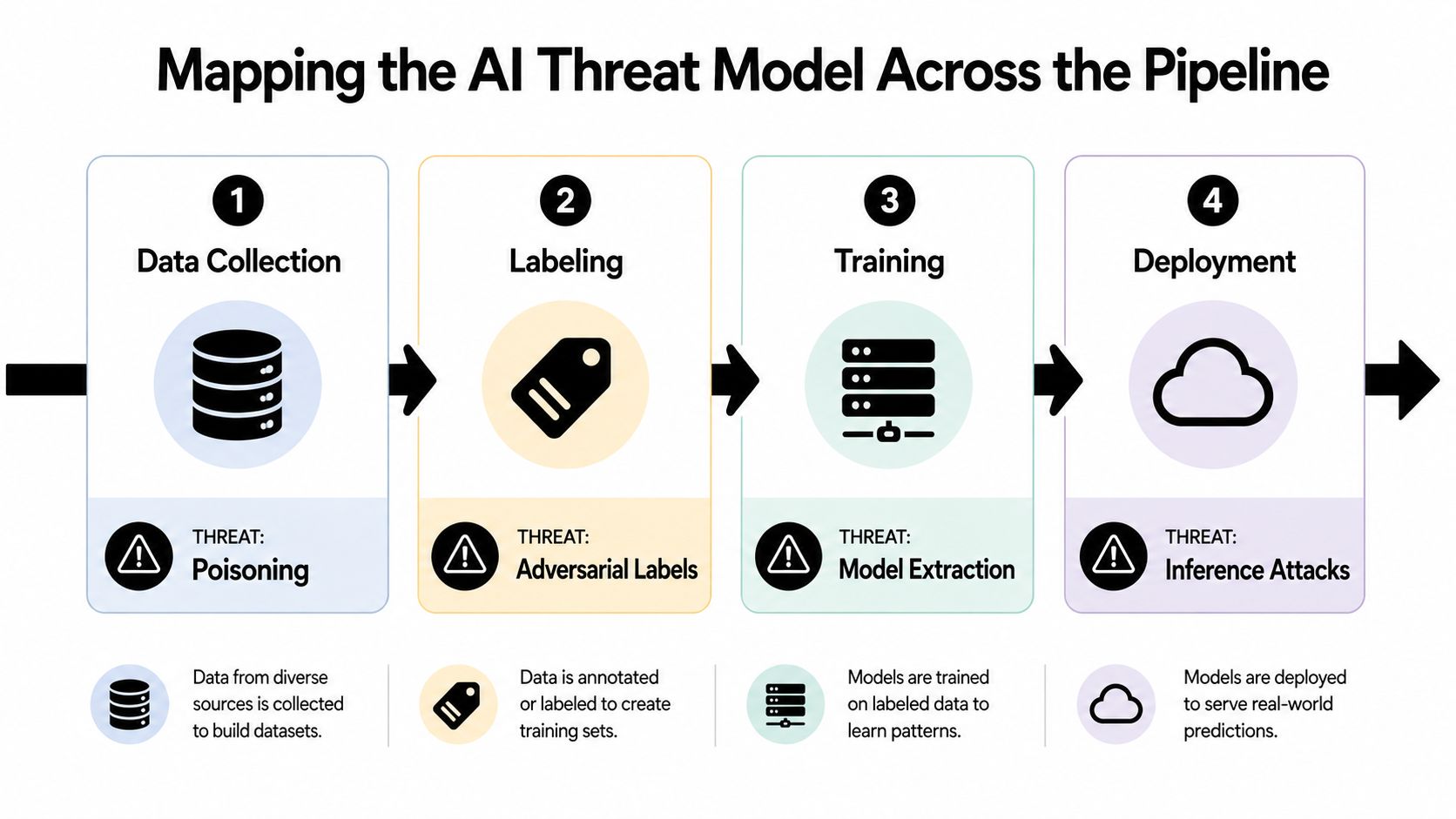
AI data security is easier to assess stage by stage. The reason is practical. Data changes form as it moves through collection, labeling, training, deployment, and use, and each point creates a different control problem. A review that only looks at the live model usually misses the earlier places where the risk is introduced.
Data collection and labeling are poisoning targets
Early pipeline stages are attractive to attackers because they are easier to influence. If an attacker can alter training inputs, inject bad samples, or tamper with labels, model behavior can be skewed long before anyone sees a production issue. That kind of compromise is hard to spot later because the system may still appear to work while carrying a hidden defect.
The warning signs are usually subtle. Label drift, duplicate samples, unexpected source files, and strange edge-case outputs deserve review. Teams that depend on crowd labeling, vendor labeling, or distributed contributor workflows need provenance checks and review gates, because the input set is the first place trust can fail.
Training and deployment expose intermediate artifacts
Once training starts, the focus shifts to checkpoint files, serialized artifacts, embeddings, and the infrastructure around the run. Those intermediate outputs are often treated as temporary, which is exactly why they get weak access control and inconsistent retention handling. In practice, they can hold sensitive data or preserve enough structure for an attacker to reconstruct useful information.
That matters because the model is not the only thing that needs protection. Preprocessing outputs, feature stores, and saved checkpoints often move between systems with less scrutiny than the source data itself. If those artifacts are stored in shared buckets, copied into experiment trackers, or exposed through build jobs, the risk follows them.
At deployment time, the failure modes are more visible, but not always easier to contain. Prompt injection, model extraction, and inference abuse can all happen through a legitimate interface. If the model can reach private context, retrieval layers, or internal documents, the endpoint becomes a data corridor, not just a response generator.
For teams that want a practical way to look for suspicious activity around AI systems, Indiana business threat detection tips is useful because it reinforces a basic rule, visibility has to start before the incident is obvious. That is the point many AI deployments miss.
Building an Enterprise AI Governance Framework
AI governance works only when ownership is explicit. If security thinks engineering owns it, engineering assumes legal owns it, and legal assumes product owns it, you don't have governance, you have polite confusion. The best operating model I've seen assigns clear responsibility for policy, data access, approvals, and review, then keeps those responsibilities visible in every tool and workflow.
Define owners before you define tools
An effective governance structure starts with an executive sponsor who can overrule cross-functional deadlock. Under that, the data protection function and any AI review board should define policy boundaries, while engineering, security, and legal handle implementation, monitoring, and exception handling. Data scientists and DevOps shouldn't be asked to invent policy, only to operate inside it.
The policy layer needs to distinguish between approved AI tools, experimental tools, and prohibited tools. It also needs a data classification scheme that reflects AI-specific sensitivity, not just ordinary document labels. A prompt containing customer records is not the same as a prompt containing public marketing copy, even if both originate in a browser.
Put shadow AI detection into the operating model
Visibility is the genuine governance bottleneck. CSA notes that 66% of companies lose track of data during AI adoption, which tells you how often organizations can't answer the most basic question, where did the data go? CSA AI security risks and poor data visibility In practice, that means you need discovery controls for unsanctioned tools, browser use, and endpoint use, not just a policy page in the wiki.
A strong SOP includes these elements:
- Intake review: every new AI tool gets a short risk questionnaire covering data types, retention, access, and integration scope.
- Approval path: security, legal, and the business owner sign off before the tool can touch internal data.
- Exception handling: any temporary allowance has an expiry date and a named owner.
- Audit trail: approvals, denials, and exceptions are logged for later review.
If your team already manages documentation-heavy compliance work, the discipline is similar to maintaining guide to e-waste compliance records, the point is traceability from start to finish, not just a signature at the end.
Implementing Technical Controls for AI Data Protection
A strong AI data security program starts with the pipeline, not the org chart. If you only lock down the final model endpoint, the most sensitive objects stay exposed. If you lock everything the same way, engineers work around the controls and the business drifts back into shadow tools.
Match controls to the stage of the data
The first layer is encryption and access control for data at rest, in transit, and inside model-related storage. That includes training datasets, embeddings, checkpoints, preprocessing outputs, and exported artifacts. Intermediate artifacts are where a lot of teams get burned, because they often sit outside the controls that protect the source system and the finished app. The Cloud Security Alliance guidance on AI environments points to encryption, strong IAM, lineage controls, and monitoring of training pipelines because insecure intermediate states can expose information even when the front-end application looks normal.
The second layer is identity. Data scientists need access to approved training sets, not broad access to production data. Model developers need model registry access, not unrestricted file shares. Production systems should use narrowly scoped service identities, with just-in-time elevation only when a sensitive training run or migration requires it. If your team already manages secrets and service credentials well, DevOps Secrets Management is the closest operational pattern, because AI artifacts are only as safe as the identities that can touch them.
The third layer is monitoring. Set alerts for anomalous data reads, unusual export patterns, sudden changes in training inputs, and unexpected inference behavior. That monitoring has to cover the artifacts people forget to inventory, not just the model API. I have seen teams spend months hardening prompts and endpoints while a stale checkpoint or preprocessing export stayed readable in a shared bucket.
| Pipeline Stage | Primary Controls | Implementation Priority | Complexity |
|---|---|---|---|
| Data ingestion | Classification, source validation, quarantine for unknown inputs | High | Medium |
| Preprocessing | Access control, encrypted storage, artifact lineage | High | Medium |
| Training | Isolated environments, scoped IAM, monitored runs | High | High |
| Deployment | Endpoint auth, prompt filtering, output logging | High | Medium |
| Model and checkpoint storage | Encryption, registry controls, integrity checks | High | High |
Operational rule: if a data scientist can't explain where a training artifact came from and who can load it, the artifact is not ready for production.
Add provenance before you add more tooling
The best teams I've worked with do not buy three more dashboards first. They make sure every important model asset has lineage, every privileged action has a log, and every sensitive repository has an owner. That is where production control usually breaks, because the artifact exists, the pipeline ran, and nobody can answer who touched the data between ingestion and deployment. For teams that also manage device retirement and media sanitization, secure electronics disposal options belong in the same control conversation, because retired hardware and exported data often create the same residual-risk problem.
Provenance also gives you a cleaner way to handle exceptions. If a checkpoint is copied for debugging, that copy should inherit the same classification, retention, and deletion rules as the original. If a preprocessing job creates a temporary output for labeling or evaluation, the output needs an owner, a storage location, and a deletion path before anyone runs it. Keep the control set small enough that people can follow it under pressure, and use the same disciplined approach you would use for endpoint secret handling.
The practical test is simple. Every model asset should answer three questions, where it came from, who can load it, and how it is removed when it is no longer needed. If that answer is unclear, the artifact is already a risk.
Real-World Implementation Scenarios and SOPs
The fastest way to make AI security usable is to turn it into routine decisions. Teams don't need more theory when they're onboarding a new AI tool, reviewing a model access request, or handling a prompt-injection event. They need a standard playbook that tells them who approves what, what gets logged, and when the system gets shut down.
Secure data labeling without raw data exposure
A workable SOP for labeling starts with data minimization. Labelers should see only the fields required for the task, with direct identifiers masked or removed before the dataset leaves the secure environment. Any vendor or contractor access needs the same controls as an internal worker, because the trust boundary is the data, not the payroll.
The approval matrix should be short and explicit.
- Public or synthetic data: business owner approval only.
- Internal operational data: business owner plus security review.
- Customer or regulated data: security, privacy, and legal approval.
- Unclear data classification: no access until classification is complete.
Treat model access like production access
Model access should not be casual. Developers often need enough access to test, debug, and review outputs, but they don't need unrestricted downloads of checkpoints or training exports. Access should expire automatically where possible, and any load of a serialized artifact should be logged with the user, system, and reason.
For incident handling, the response path should distinguish between accidental exposure and active compromise. If a user submitted sensitive data to an external AI tool, the immediate action is containment, account review, and policy correction. If you suspect poisoning, backdoors, or prompt-injection abuse, the model or workflow should be isolated until the asset review is complete.
A concise incident playbook should cover:
- Triage the source of the data or model artifact.
- Contain the path by revoking access or pausing the workflow.
- Preserve evidence from logs, prompts, and version history.
- Assess scope across dependent systems and downstream outputs.
- Reset controls before normal use resumes.
If your team is formalizing this kind of operating rhythm, How to Create SOPs is a useful operational companion because the mechanics of good procedures matter as much as the policy intent.
Your AI Data Security Implementation Checklist
The right checklist is boring on purpose. It should turn a broad risk problem into a sequence of accountable actions that security, engineering, and operations can finish. If a control can't be assigned, measured, and reviewed, it probably won't survive production pressure.
Immediate actions for critical risk reduction
Start by inventorying every sanctioned AI tool, plus any known unsanctioned tools used by employees. Then classify the data those tools can reach, especially internal documents, customer records, source code, and training artifacts. Close obvious gaps in access control, and require approval for any workflow that touches sensitive data.
Short-term foundations
Build logging for prompts, outputs, model loads, and artifact access. Create a review path for new AI tools, and make sure that path includes security, legal, and the business owner. Add lineage tracking for model inputs and checkpoints so you can trace where a compromised asset came from. That's also the right point to define quarterly reviews for policy exceptions and shadow AI findings.
Long-term maturity
Tie AI data security metrics to executive reporting, especially policy compliance, incident detection, and time-to-remediation for AI-specific issues. Mature teams also run periodic access recertification for training data and model repositories, not just human identities. The most useful program I've seen keeps a live AI asset inventory, because you can't govern what nobody can name.
If your AI stack changes faster than your review process, the review process is too slow.
For companies that need help turning this into repeatable operating workflows, MakeAutomation focuses on AI and automation process design, SOP development, and workflow documentation for B2B and SaaS teams. Use that kind of operational support to make the security rules executable, not just documented.
If you're ready to turn AI data security from a policy document into an operating system, work with MakeAutomation to define the workflows, approvals, and SOPs that your teams will follow. They help B2B and SaaS companies document AI-enabled processes, reduce manual drift, and build controls that fit real production work.