Lead Generation vs Prospecting for B2B Teams
Buyers who make digital self-service purchases are 1.65 times more likely to regret them than buyers using traditional, rep-led paths, according to Contentful's B2B buyer benchmark report. That reframes the lead generation vs prospecting debate: attracting buyers and letting them research independently isn't enough if they can't make a confident decision.
For B2B and SaaS leaders, the useful question isn't which activity wins. It's where direct sales involvement adds value that content, forms, and automated nurture can't provide. Treat prospecting as a selective supplement to lead generation, and you can allocate human attention according to buyer intent, account fit, and decision complexity rather than contact volume.
What Separates Lead Generation from Prospecting
Lead generation versus prospecting at a glance
| Criterion | Lead generation | Prospecting |
|---|---|---|
| Purpose | Create awareness and identify potential buyers | Evaluate, contact, and develop buyers into opportunities |
| Typical owner | Marketing, with sales defining acceptance rules | SDRs or account executives, fed by marketing data |
| Demand type | Captures existing demand through inbound channels | Creates demand inside named accounts |
| Control | Buyers control whether and when they self-select | Sellers have greater control over which accounts they approach |
| Primary output | Leads and marketing-qualified leads | Conversations, meetings, and qualified opportunities |
| Core metric | Speed-to-lead, lead-to-MQL, customer acquisition cost | Accounts researched per hour, connect rate, meetings, pipeline per rep-hour |
| Failure mode | A large unworked database | High activity with weak fit or no follow-through |
The distinction is operational, not just semantic. A review of sales-funnel research reports that 68% of surveyed firms had neither clearly defined nor properly assessed their funnel, while 79% of marketing-generated leads were never converted into customers.
Those historical findings aren't a forecast for your company. They illustrate why a database count can't tell a revenue leader whether acquisition is working: names can accumulate without anyone establishing fit, initiating a useful conversation, or accepting responsibility for progression.
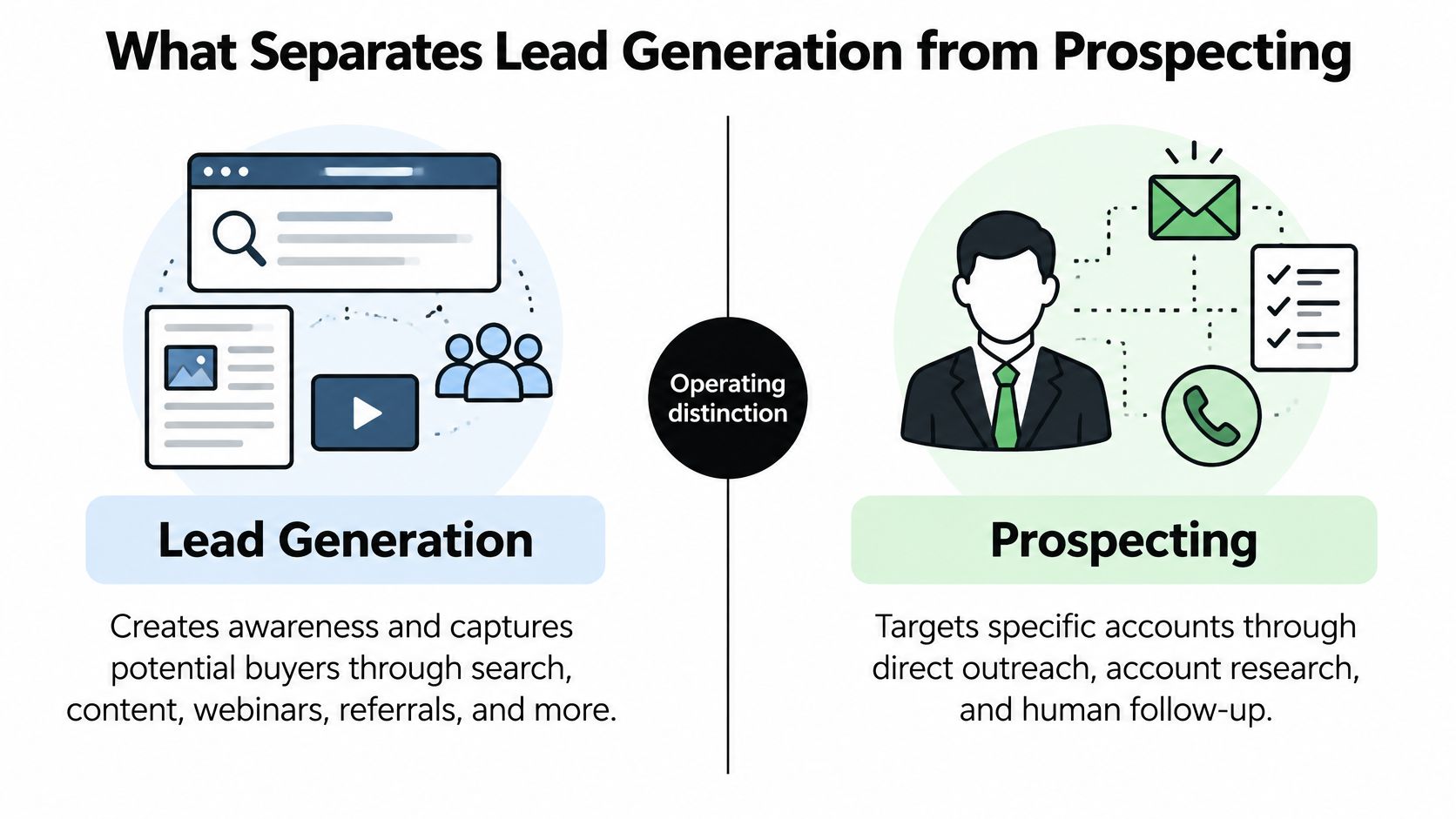
The operating differences are summarized visually below.
Assign work according to the next buyer decision
Lead generation includes search, content, webinars, referrals, and paid media that help potential buyers discover a problem and identify possible solutions. Its immediate output is an identifiable lead in a defined stage, not necessarily a sales-ready buyer.
Prospecting adds account research, qualification, direct contact, and follow-up. A rep should establish why this organization fits, which people matter, and what business problem would justify a conversation.
For example, a webinar registration might justify educational nurture. A relevant operations leader researching deployment constraints might justify an offer to discuss implementation. The form submission alone doesn't establish the difference.
When a qualified account lacks a usable contact record, SignalVan's verified decision-maker contacts for timely outreach can support the contact-discovery step. Contact availability should enable a justified conversation, not become the reason for starting one.
Count transitions rather than treating every name equally
Define ownership and exit criteria before comparing campaign performance. Marketing shouldn't declare success at capture while sales counts only meetings and leaves the intervening work unowned.
Track lead creation, qualification, contact, opportunity, and closed-won conversion separately. Generation expands the top of the funnel; prospecting determines which accounts deserve outreach and sales attention.
Funnel Benchmarks for Each Motion
Inbound and outbound benchmark bands
The planning bands published by Grou Global's inbound and outbound comparison distinguish inbound lead-to-customer conversion from outbound connection and qualification rates.
| Motion | Channel or step | Benchmark band | Optimize for |
|---|---|---|---|
| Inbound lead generation | High-intent search, content, webinars | 8%–12% lead-to-customer | Speed-to-lead and lead-to-MQL |
| Inbound lead generation | Referrals | About 10%–15% lead-to-customer | Fast capture and clean routing |
| Inbound lead generation | LinkedIn and paid social | About 3%–5% lead-to-customer | Offer fit and customer acquisition cost |
| Outbound prospecting | Targeted phone outreach | About 3%–8% connect rate | List quality and call timing |
| Outbound prospecting | Completed conversations | 5%–12% become an MQL | Qualification and talk track |
| Outbound prospecting | Outbound MQLs | 35%–50% accepted as opportunities | Handoff criteria and follow-up |
Use these as planning bands, not quotas or promises. High-intent inbound is an intent category, not evidence that every search visitor, webinar attendee, or content download belongs in the same conversion cohort.
The denominator matters just as much as the percentage. An outbound connect rate describes whether a seller reaches someone; an inbound lead-to-customer rate describes a much longer progression. Comparing them directly tells you nothing useful about channel quality.
Build separate operating scoreboards
For inbound, measure speed-to-lead, lead-to-MQL conversion, and customer acquisition cost. Segment by acquisition source and offer so a referral doesn't receive the same performance assumption as a paid-social download.
Keep the timestamp of the original inquiry, first response, qualification, and sales acceptance. A practical lead-generation funnel should make these transitions visible, including leads that stop progressing.
For prospecting, monitor accounts researched per hour, email deliverability, conversations, meetings held, and pipeline created per rep-hour. Meetings held deserve their own field because a calendar booking isn't proof that a useful conversation happened.
Use both activity and progression measures:
- Coverage: Which priority accounts have a researched contact and a relevant outreach hypothesis?
- Engagement: Which contacts connect, reply positively, or agree to speak?
- Acceptance: Which conversations meet the agreed opportunity criteria?
- Economics: How much qualified pipeline does the team create for the time invested?
Diagnose the missing denominator
A strong inbound conversion rate can coexist with poor market coverage. Say a SaaS company attracts buyers from a narrow segment that already understands its category. Excellent conversion among those buyers doesn't establish that the company reaches the rest of its target market.
Outbound has the opposite reporting trap. A rep can increase calls while producing fewer meaningful conversations, especially if the expanded list contains weaker-fit accounts. The activity total improves while the commercial result deteriorates.
Measurement rule: Never let a strong conversion percentage excuse inadequate coverage, or a high activity count excuse weak progression.
Don't multiply the published benchmark bands into a revenue forecast unless your stage definitions and cohorts clearly align. An MQL label in an outbound benchmark may not match the qualification standard your marketing team uses.
For the quarter, choose an inbound conversion rate and an outbound activity rate, such as lead-to-MQL and phone connect rate. Review their downstream consequences separately instead of averaging them into a blended funnel percentage.
Signals That Justify Human Prospecting
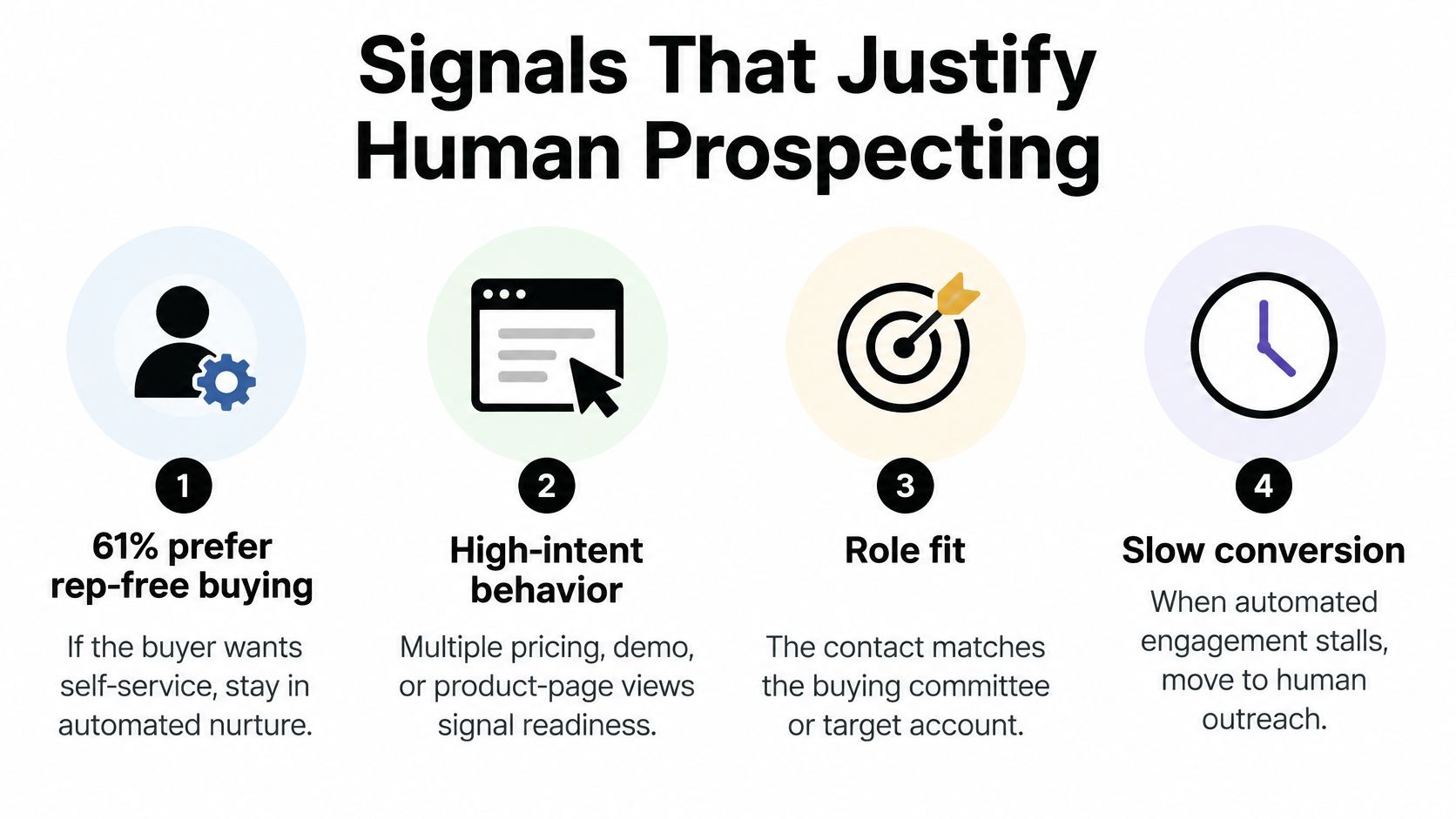
61% of B2B buyers prefer an overall rep-free buying experience, and 73% actively avoid suppliers that send irrelevant outreach, according to Gartner's B2B buyer survey. The same survey found that buyers prefer seller input for contextual tasks, such as determining whether an offering fits their organization.
The implication isn't to remove sellers. It's to distinguish information retrieval from contextual judgment. Buyers can read a feature list independently; deciding whether an integration will work within their operating constraints may warrant a conversation.
Use the following visual as a signal checklist, not an automatic instruction to contact everyone who pauses.
Require intent, fit, and a reason to help
A practical handoff rule combines behavioral evidence with account context. No isolated page view should establish buying readiness.
- Behavioral intent: Look for return visits, repeated pricing or integration-page activity, sustained engagement, and repeat research around the same use case.
- Account fit: Confirm that the organization matches the target profile and that the contact belongs to a relevant buying group.
- Business context: Identify the problem the buyer appears to be evaluating, rather than personalizing only with their job title.
- Task complexity: Escalate implementation uncertainty, security questions, customization needs, or stakeholder coordination.
Keep ordinary education in nurture. Move a person into the process when a seller can interpret an issue, reduce a specific risk, or help the buying group agree on requirements.
Slow conversion alone isn't enough. A stalled contact may lack urgency, budget, or fit; sending more messages won't resolve those conditions. Use prospect research to determine whether there's an identifiable question worth helping them answer.
Define acceptance before triggering outreach
Treat marketing-qualified engagement as a review state, not an automatic opportunity. Marketing supplies the account context and observed signals; sales accepts an opportunity only after confirming the business problem and a credible next step.
Write the handoff agreement around concrete requirements:
- Named ownership: Assign the reviewing rep and the fallback owner.
- Response expectations: Specify how quickly each inquiry type requires attention.
- Disposition: Record accepted, nurture, disqualified, or more information needed, with a reason.
- Buyer benefit: State what the proposed conversation will help the buyer decide.
Keep claims, pricing logic, integration details, and security information in a governed source of truth. A seller shouldn't improvise an answer that conflicts with the website.
For additional context on the prospecting discussion, the video below provides a separate viewing option.
The decision rule is selective: intervene when a qualified buyer has a contextual problem a person can resolve, not merely when automation detects activity.
Tooling That Connects Both Motions
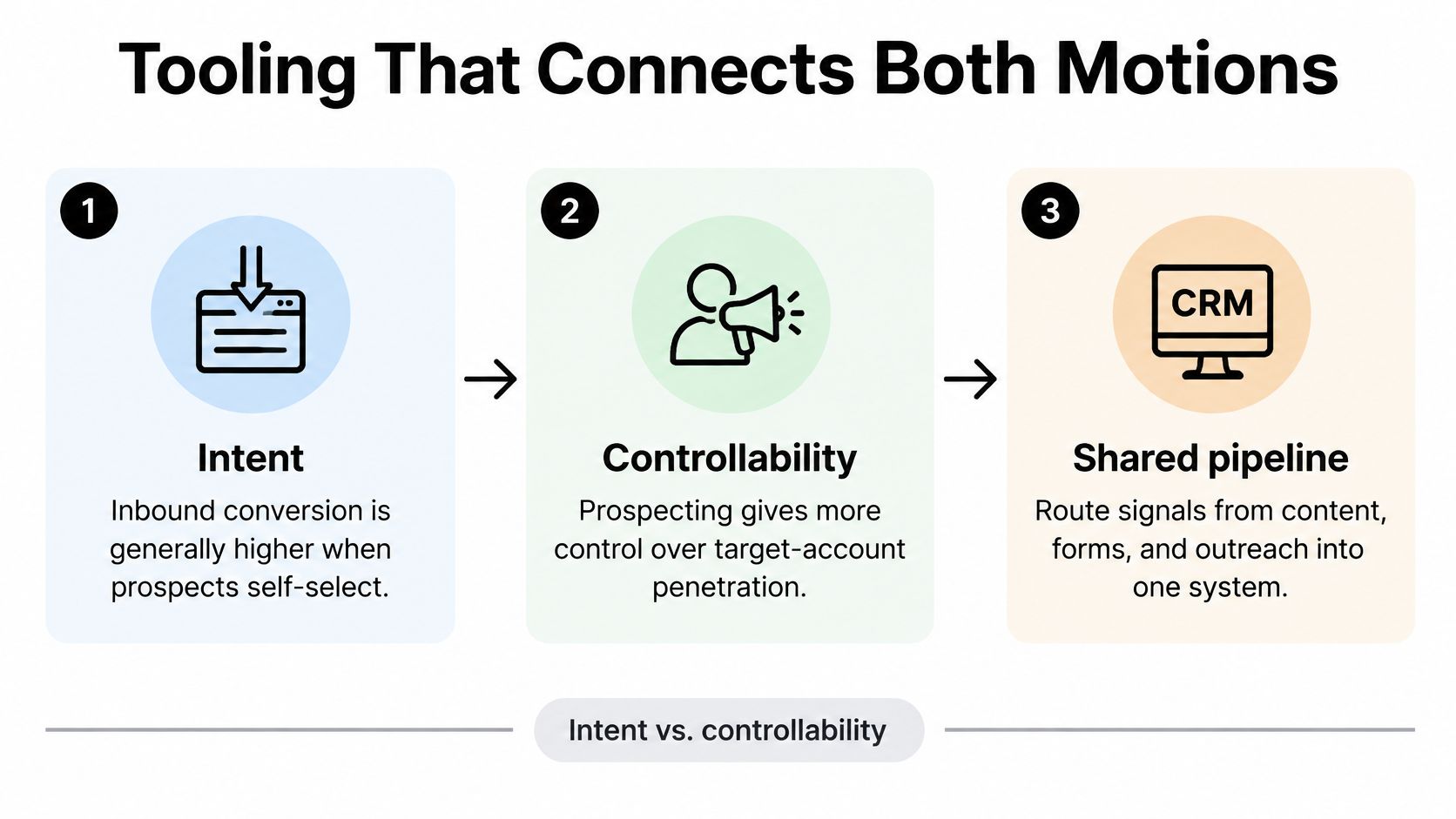
The technical distinction is intent versus controllability. Inbound lets buyers self-select; prospecting lets sellers choose the accounts they approach. A shared CRM should preserve that distinction while giving both teams access to the same account history.
LeanData's sales-pipeline benchmarking report surveyed 311 respondents in 2022, examining inbound and outbound pipeline across company sizes, contract values, and go-to-market models. That segmentation is a useful design principle: maintain separate motion-level reporting even when both motions operate in the same system.
The shared architecture should connect signals to an owned next action.
Enrich, score, and route in that order
Enrich the record first. Normalize company names, associate contacts with accounts, remove duplicates, and capture role, source, and relevant engagement. For missing outbound contact details, HarvestMyData's a founder's guide to finding business emails is a practical resource for the discovery step.
Score fit and behavior separately. A highly engaged poor-fit account shouldn't automatically outrank a suitable account with a clear implementation question. Preserve the inputs so a rep can understand why the record entered the queue.
Route to an accountable owner. High-fit inquiries should reach the appropriate rep with context attached. Outbound account prioritization should use compatible fit criteria, rather than a disconnected list-building model.
Our CRM and automation work uses HubSpot, Salesforce, Pipedrive, and GoHighLevel. Automated lead scoring, smart segmentation, behavior-triggered campaigns, and predictive analytics belong in the operational workflow, not an isolated spreadsheet.
Our lead-response automation answers inquiries within 60 seconds, 24/7, qualifies leads automatically, and books meetings without human intervention. Predictive lead scoring identifies the customer's hottest prospects automatically, while personalized follow-up sequences support contacts who haven't booked.
Measure incremental lift rather than model activity
Compare scored and unscored lead cohorts under comparable conditions. Test targeted and untargeted prospect lists without simultaneously changing the offer, audience, and follow-up process.
Use a compact evaluation set:
- Meeting rate: Does prioritization produce more held conversations?
- Sales-accepted opportunity rate: Do reps accept the resulting opportunities?
- Normalized pipeline value: Does pipeline improve relative to contact volume?
- Cost per qualified opportunity: Does the improvement justify the added expense?
A score is a prioritization aid, not proof of readiness. Keep contextual fit decisions, stakeholder politics, and unsupported product claims outside unattended automation.
How to Split Time Between Volume and Conversion
More prospecting can reduce the time available to convert prospects already in motion. Excessive conversion focus creates the reverse problem: sellers advance current deals but fail to replenish the pipeline.
A 2022 Journal of Business Research study, using the Motivation-Opportunity-Ability framework, identified this trade-off between prospecting efficacy and conversion efficacy. In the setting examined, more-experienced salespeople acquired fewer new customers than less-experienced salespeople, while advertising support and extrinsic rewards improved conversion efficacy more strongly among experienced sellers.
That doesn't justify assuming senior reps are weak prospectors. It challenges the assumption that experience or a higher activity quota automatically produces better acquisition results.
Audit where sellers actually spend time
Run a weekly time audit that distinguishes initiating new relationships from advancing existing ones. Record research, first touches, follow-up, discovery, proposal development, stakeholder coordination, and administrative work.
Don't force every activity into a simplistic inbound or outbound label. A conversation with an inbound buyer may require substantial prospecting work inside the account, while an outbound-origin opportunity may now need technical validation rather than another introductory message.
Use the audit to identify the constrained part of acquisition:
- Thin target-account coverage: Increase research and first-touch time where suitable accounts remain untouched.
- Slipping meetings or stalled proposals: Protect conversion time and inspect the unresolved buyer decision before adding another call block.
- Heavy administration: Remove avoidable logging, scheduling, and routing work before asking reps to increase either motion.
Adjust the split using progression
Review whether the changed allocation produces more qualified conversations and accepted opportunities, not just more completed tasks. For experienced sellers, test advertising and content support alongside incentives rather than relying exclusively on activity pressure.
The right allocation is the one that improves new-customer acquisition without leaving either future coverage or current opportunities unattended.
There's no defensible universal time split in the evidence. A manager should adjust effort according to the team's actual constraint, then watch generated leads, qualified prospects, meetings, opportunities, win rate, and acquisition cost as distinct measures.
Choose the Motion for Each Pipeline Situation
Choose the leading motion according to the work preventing progression. A response bottleneck, a coverage gap, and an enterprise evaluation problem require different interventions, even if all appear in the CRM as insufficient pipeline.
Leading motion by pipeline situation
| Situation | Leading signal | Motion to lead |
|---|---|---|
| Demo requests wait for hours | Healthy content traffic, lost demos | Lead generation with a response SLA |
| Strong inbound rate, thin coverage | Named-account list barely touched | Inbound for capture, prospecting for coverage |
| Multi-stakeholder enterprise deal | Return visits, integration pages, several stakeholders | Prospecting the buying group after signals |
| Small services team, multi-hour response | Every new lead effectively unworked | Automation qualifies and books first |
Fix the constraint before adding volume
A SaaS company attracts traffic but loses demo requests. Lead generation should lead, with a response service-level agreement before more cold outreach. Adding acquisition activity doesn't address the existing delay between a buyer asking for help and receiving it.
One B2B SaaS company we worked with was losing deals because its sales team couldn't respond to demo requests fast enough. Six months after implementation, qualified lead volume rose 340%, sales administration time fell 68%, lead-to-customer conversion improved 2.4x, and the company recorded $1.2 million in additional attributed revenue.
Those are case-specific outcomes, not expected returns for every implementation. The operational lesson is narrower: investigate handling and progression before concluding that the company needs more names.
The distinction matters when teams celebrate acquisition totals without examining what happens afterward.

Inbound converts well, but priority accounts remain untouched. Keep inbound capture running and make prospecting responsible for named-account coverage. Ask the outbound team to establish relevant relationships in the missing segment, not duplicate outreach to buyers already moving through an active sales process.
Success here means reaching suitable accounts the company otherwise wouldn't engage. Separate those accounts from inbound-assisted opportunities so leadership can see what coverage work contributes.
An enterprise buying group needs interpretation. Keep basic product education available for independent review, then assign a rep to coordinate the unresolved evaluation. A security stakeholder, implementation owner, and commercial sponsor may need different answers before they can agree.
The seller's task isn't to repeat the product page. It's to document requirements, identify disagreement, and coordinate the next validation step without making promises the delivery team hasn't approved.
A small services team leaves inquiries waiting. Prioritize automated qualification and booking before debating channel mix. In our marketing-agency case study, the team had 12 employees and a 4-hour average response time before automation.
For that situation, the first management question is whether each inquiry receives an appropriate response and an owned next action. A broader outbound campaign should wait until the team can reliably handle the interest it already receives.
Apply the verdict to your operating model
Let lead generation lead when the product is straightforward, intent is visible, and buyers can evaluate it independently. Reserve seller involvement for identifiable questions about pricing application, risk, or stakeholder alignment.
Let prospecting lead when the objective is named-account coverage, the buying process requires coordinated relationships, or suitable organizations aren't reaching the content engine. Give sellers useful evidence and consistent product information rather than expecting personalized outreach alone to establish credibility.
Run both with explicit responsibilities when the business needs demand capture and deliberate account development. Keep an active opportunity out of conflicting campaigns, preserve account-level context, and make nurture a managed state rather than a miscellaneous holding area.
In our B2B SaaS workflow, leads that don't book within 24 hours enter nurture sequences. They aren't marked lost because they didn't accept the first scheduling invitation.
Choose a primary motion for the quarter and a metric that reflects its immediate job. Then audit this week's pipeline for the highest-friction handoff, assign an owner, and fix that transition before increasing the workload around it.
MakeAutomation builds lead-handling, CRM, qualification, follow-up, and appointment-booking workflows that connect demand capture with selective prospecting. Visit MakeAutomation to book a free, no-obligation 15-minute discovery call covering your goals, current tools, bottlenecks, and what a successful outcome would look like.