Lead Generation and Appointment Setting: Automate for Growth
A dependable lead generation and appointment setting system responds in under five minutes, routes every inquiry to the right touchpoint, and measures qualification instead of celebrating raw meeting volume. The practical target is a sub-60-second automation trigger, a five-minute escalation threshold, and strict downstream metrics that prevent wasted sales hours.
You may recognize the current pattern: a prospect fills out a form, your CRM creates a record, and the notification sits unread while your team handles another call. By the time someone follows up, the buyer has researched a competitor, lost interest, or decided that your company is difficult to work with.
The solution isn't just more outreach. It's a unified system that connects demand capture, data validation, routing, follow-up, qualification, and scheduling. Automation handles the repetitive work, while people enter the conversation when their judgment adds value.
The Modern Reality of Lead Generation and Appointment Setting
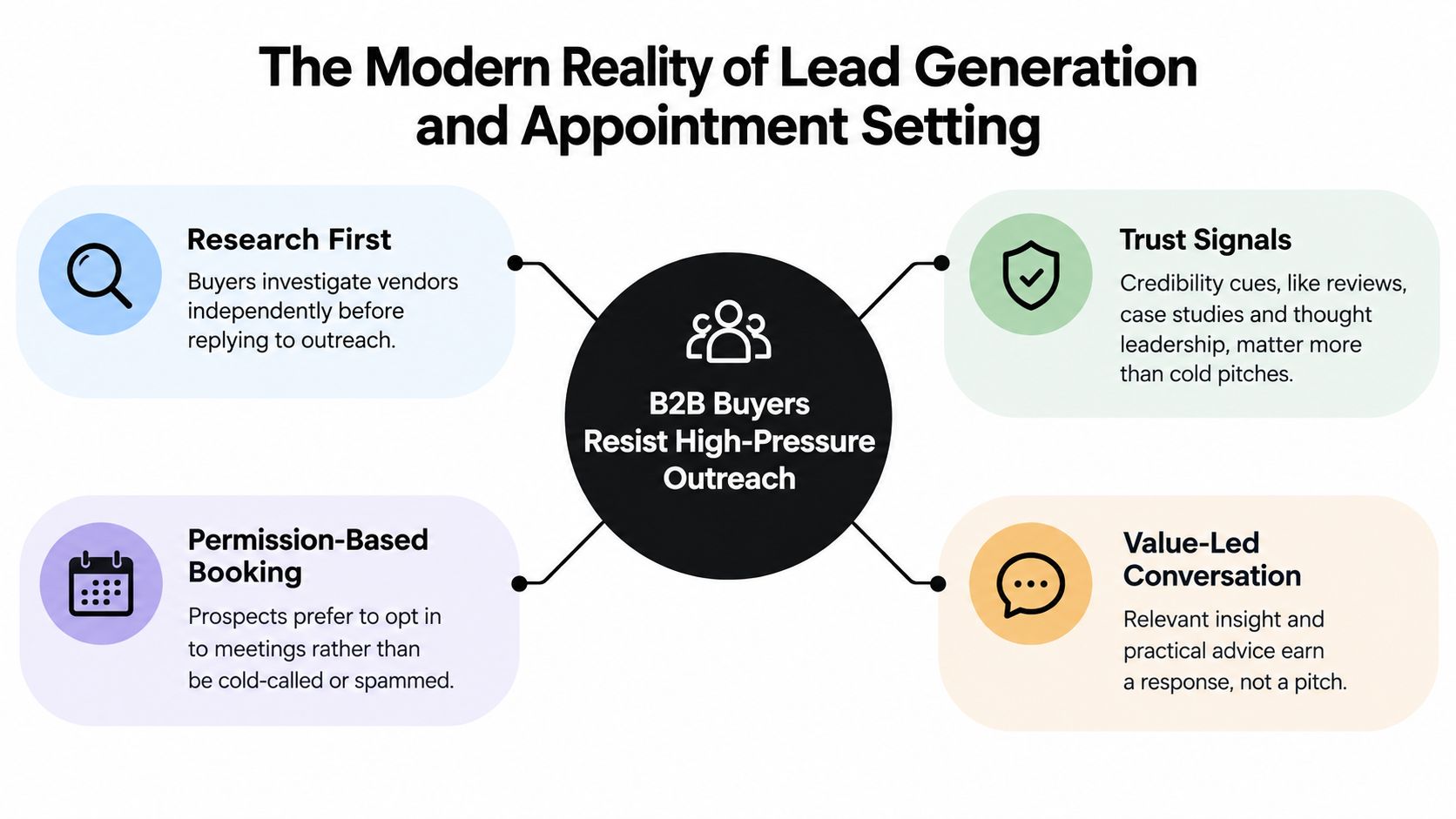
A buyer can arrive at your site after comparing vendors, reviewing implementation details, and forming a short list. A generic pitch at that moment wastes the signal. B2B buyers want to investigate options, assess fit, and decide whether a conversation will help. Gartner reports that 61% of B2B buyers prefer an overall rep-free buying experience, while 73% actively avoid suppliers that send irrelevant outreach. Gartner's buyer research also supports a practical conclusion: seller input earns attention when it adds context to a complex decision. Appointment setting must therefore earn access instead of assuming it.
Treat the meeting as a decision aid
Lead generation identifies possible demand. Appointment setting converts relevant interest into a qualified conversation. Both belong in one operating system, with automation connecting the signals, triggers, qualification rules, and human responses that determine whether a meeting deserves calendar space.
A form submission can mean curiosity, active research, or a request from someone outside the buying group. A meeting gains value only after the workflow assesses fit, intent, role, timing, and the question the prospect needs answered. That separation protects your sales team's calendar and gives unready buyers a better experience.
Build contact decisions around evidence:
- Research behavior: Repeated visits to product, pricing, security, or integration pages justify a useful message, but they do not prove purchase intent.
- Explicit questions: A prospect asking whether your platform supports a particular workflow creates a stronger reason for human assistance.
- Account engagement: Activity from several people at one company can indicate a broader evaluation, especially when their content interests concern implementation or fit.
- Permission to continue: A reply, chat request, or chosen meeting time gives your team a clear basis for engagement.
Practical rule: Do not send a calendar link after every interaction. Automate detection of useful moments, then match the response to the buyer's actual question.
For specialized teams, an AI sales agent for recruiters can handle repetitive qualification and follow-up while preserving a path to a human when a candidate, client, or hiring question requires judgment. The same principle applies elsewhere: use automation to remove delay, not to manufacture urgency.
Give buyers self-service assets that improve the eventual meeting. Integration documentation, implementation guidance, fit criteria, and answers to common objections let prospects educate themselves. When they reach out, the conversation can focus on context and decision quality rather than information already available on your website. Lead generation and appointment setting work best as one data-backed system, where each signal triggers the next useful action.
Engineering the Inbound Lead-to-Appointment Workflow
Inbound demand has a short commercial half-life. A person who submits a form or starts a chat is giving you a live signal, not placing a task in a queue for later. The workflow must therefore treat lead creation as an operational event that immediately activates validation, routing, and contact.
A practical sequence looks like this:
- Capture the event. Record the form submission, chat transcript, page context, campaign source, consent state, and timestamp.
- Validate the record. Check contact details, consent, duplicate status, company identity, and basic data completeness before assigning the lead.
- Enrich the account. Add the role, organization context, territory, relevant product interest, and timezone where available.
- Apply routing rules. Send the lead to the correct owner, queue, region, account team, or automated voice and messaging path.
- Start the first touch. Trigger a personalized email, call, or message that reflects the prospect's action.
- Escalate intelligently. If the workflow doesn't connect with the prospect, create a human task and preserve every timestamp.
The benchmark is uncompromising. Companies that contacted web leads within one hour were nearly seven times more likely to qualify them than companies that waited another hour, while responding after 24 hours reduced qualification odds by roughly 60 times. A practical implementation uses a sub-60-second automation trigger and a five-minute escalation threshold. The speed-to-lead analysis provides the rationale for treating response time as a qualification variable, not merely a service metric.
Remove the silent failure points
Most inbound systems don't fail because the team lacks effort. They fail because responsibility disappears between applications. A CRM queue goes unmonitored, a duplicate record receives no owner, a timezone rule sends a call at the wrong hour, or an automated email gets counted as a completed sales response.
Use event logs for lead creation, first attempt, connection, qualification, and booked meeting. If the system can't tell you when each event occurred, it can't show where revenue is leaking.
A landing-page workflow also needs a clean handoff from acquisition to sales operations. Teams using Leadpages, for example, may evaluate a Bragly platform for Leadpages users when they need to connect page activity with follow-up and reporting. The specific tool matters less than the discipline: every lead must have a validated record, an owner, a next action, and a timeout rule.
Your lead generation funnel should define what happens when a lead is unreachable, unqualified, duplicated, or ready to book. Don't leave those outcomes to individual memory.
Designing Effective Outbound Multi-Touch Sequences
Outbound appointment setting should be controlled, segmented, and easy to stop. A single cold email asks one message to do too much, while a high-volume sequence often creates noise without producing useful conversations. Build a sequence around a narrow ideal customer profile, a credible problem hypothesis, and coordinated touches that respond to prospect behavior.
Start with the list, not the copy. Define the companies you can serve well, the roles involved, the disqualifiers that make a conversation wasteful, and the business events that make your offer relevant. Segment by industry, company size, buyer role, trigger event, and known use case. A message to a technical leader evaluating integrations should not resemble a message to an operations executive trying to remove manual work.
Sequence logic matters more than touch count
A controlled sequence can combine email, phone, and professional-network activity, but each touch must have a reason. The first message can introduce a verifiable problem. A later call can reference the same business context without repeating the entire pitch. A professional-network interaction can support credibility rather than serve as another automated demand for attention.
The system must also suppress prospects immediately when their status changes:
- Reply received: Stop the sequence and create a response task.
- Opt-out recorded: Suppress future outreach and preserve the consent decision.
- Meeting booked: Cancel competing touches and launch confirmation messages.
- Qualified opportunity created: Move the contact into the sales process.
- Poor fit identified: Record the reason so future list-building improves.
Outbound appointment-setting guidance supports this multi-touch approach and emphasizes the importance of separating delivery, replies, connections, qualified conversations, meetings, attendance, and opportunities. Counting calendar bookings alone rewards the wrong behavior.
A sequence should become more relevant with each signal, not simply become more persistent.
Test one variable at a time. Hold the audience, persona, offer, and touch structure steady while changing the subject line, opening hypothesis, call to action, or voicemail use. Review positive replies and qualified conversations, not just activity volume. A B2B cold contact strategy for 2026 can provide additional planning context, but your own qualification and suppression rules should determine the final operating model.
Your outbound lead generation strategies should connect prospecting data to appointment-setting outcomes. If a campaign generates replies from companies you can't serve, the issue is targeting. If the replies fit but meetings don't progress, the issue is qualification, offer framing, or follow-up quality.
Building Trust Through AI-Ready Content and CRM Governance
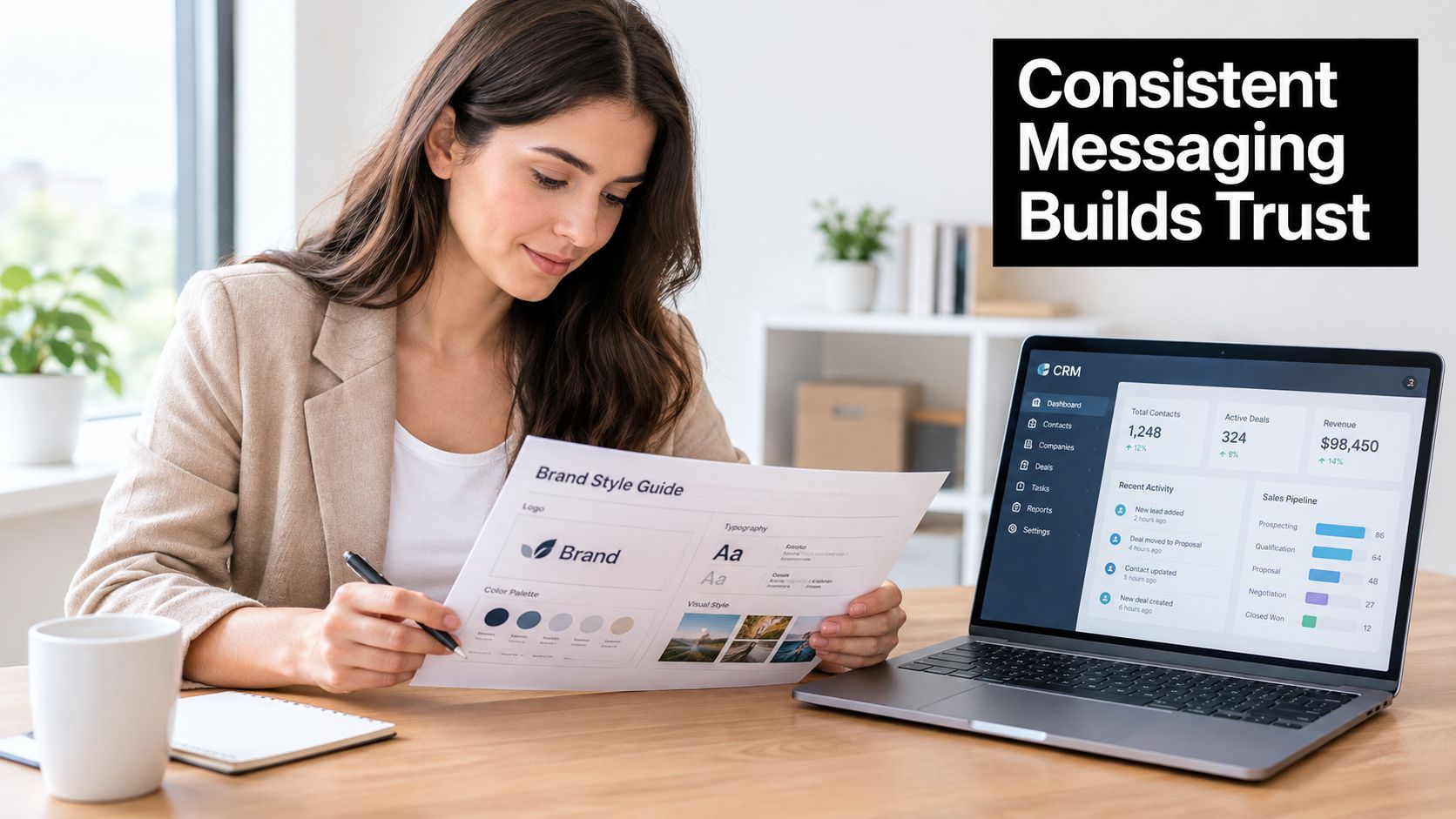
Automation amplifies whatever your company already communicates. If your website says one thing, your sales script says another, and your CRM contains an outdated description, an automated workflow spreads the contradiction faster.
AI-assisted buyers increasingly evaluate vendors through distributed information. They may compare your website, integration pages, documentation, review profiles, sales messages, and answers from AI tools before agreeing to speak with anyone. Your lead generation system can route the perfect account, but the opportunity still disappears if the prospect encounters conflicting claims.
Create one source of commercial truth
Demandbase reports that 77% of B2B buyers prioritize integration capabilities over standalone features, while Gartner found that 69% of buyers see inconsistencies between information on a sales organization's website and information provided by sellers. The Demandbase buyer report points to a practical priority: document how your product fits into the buyer's existing environment, then keep that information synchronized across every customer-facing system.
Maintain a structured trust layer containing:
- Integration facts: Supported systems, data exchanged, setup requirements, and ownership.
- Fit criteria: Company characteristics, workflows, roles, and use cases you support well.
- Implementation reality: Required effort, dependencies, handoff points, and likely internal stakeholders.
- Commercial logic: What affects scope, pricing conversations, packaging, or approvals.
- Escalation boundaries: Questions an AI agent can answer and questions that require a qualified human.
Store these facts in a controlled knowledge base and map them to CRM fields, sales enablement content, website pages, and agent prompts. Assign ownership for updates. A stale document isn't harmless if an automated agent uses it to qualify a lead or a salesperson relies on it during a call.
Governance protects the handoff
A useful data governance framework should define field ownership, update rules, validation checks, and audit visibility. Keep source-of-truth fields separate from free-text notes, and make important qualification outcomes structured enough to report.
When a prospect asks a complex question, the system should escalate rather than improvise. The handoff should include the original question, relevant account data, pages viewed, previous messages, and the reason for escalation. That gives the human representative context without forcing the buyer to start again.
The result is a more credible appointment. The prospect gets a consistent answer, and the salesperson enters the call prepared to discuss the actual decision instead of repairing confusion created by disconnected systems.
Measuring What Matters Beyond Booked Meetings
A full calendar can conceal a weak pipeline. Booked meetings are an input to sales, not proof that your lead generation and appointment setting system is working. The useful question is whether the system creates conversations that sales accepts, buyers attend, and opportunities can advance.
Track the journey as separate stages:
| Metric | What it reveals |
|---|---|
| Delivery rate | Whether the message reached the intended contact |
| Positive reply rate | Whether the offer created relevant interest |
| Connect rate | Whether the team reached the person |
| Qualified-conversation rate | Whether the interaction met your fit criteria |
| Meeting-booked rate | Whether qualified interest became a scheduled conversation |
| Show rate | Whether the prospect attended |
| Opportunity rate | Whether sales accepted the meeting as commercially meaningful |
This structure prevents a campaign from hiding poor qualification behind calendar volume. A sequence can book meetings while attracting the wrong roles. An inbound form can generate many records while producing few sales-accepted conversations. Those are different problems and need different fixes.
Segment performance by response time
The original Harvard Business Review study submitted test leads to 2,241 companies and found that companies responding within one hour were nearly seven times more likely to qualify a lead than companies waiting longer. The study report establishes why response time belongs in your conversion reporting.
Break inbound performance into 0–5 minutes, 5–30 minutes, 30–60 minutes, and 60+ minutes. Compare qualification rate and meeting rate across those bands instead of reporting one blended result. Then inspect the operational causes behind weak bands, such as routing delays, missed notifications, duplicate records, or inadequate coverage.
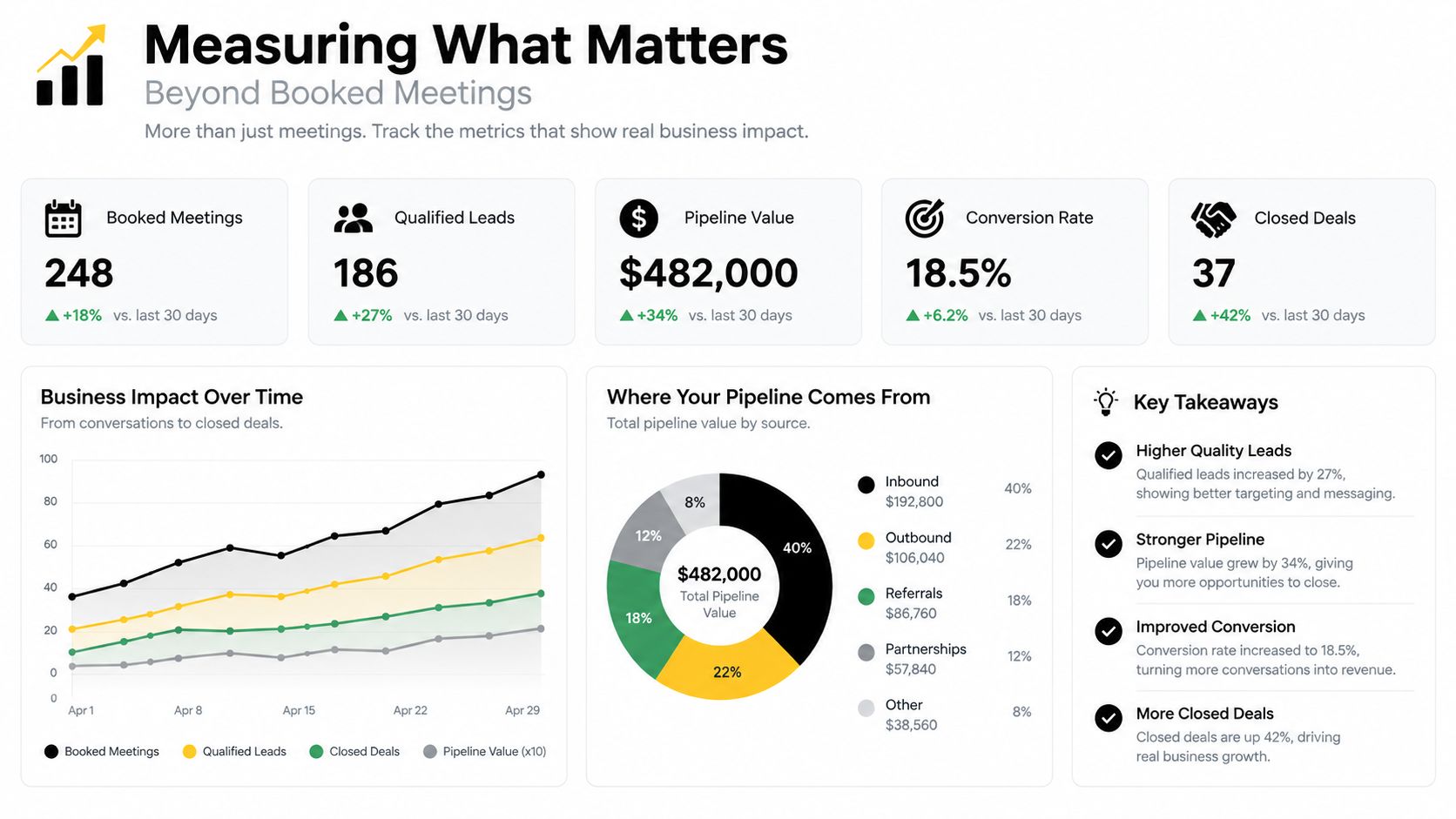
Use the dashboard to make resource decisions. If fast leads qualify but later leads collapse, improve routing and escalation. If response is fast but sales acceptance is weak, tighten the ICP and qualification questions. If meetings are qualified but attendance is poor, improve confirmation, context, and scheduling fit.
The following video can support your review of sales-performance measurement:
Implementing Your Automated Sales Framework
Start with an audit of the path from first signal to completed meeting. Don't begin by buying another outreach tool. First identify where data, ownership, timing, and messaging break.
Use this implementation checklist:
- Map every entry point. List forms, chats, inbound calls, referrals, campaigns, and manual imports. Record what each source sends to the CRM.
- Define qualification fields. Capture role, company fit, use case, urgency, consent, source, and disqualification reason.
- Set response controls. Trigger automation in under 60 seconds, escalate unanswered high-intent leads within five minutes, and log every timestamp.
- Build routing rules. Use territory, account ownership, product interest, timezone, and lead status to assign the next action.
- Connect the touchpoints. Link CRM updates, email, voice AI, professional-network tasks, calendars, and suppression logic.
- Create human escalation paths. Route objections, complex fit questions, pricing exceptions, and high-value accounts to the right person.
- Review downstream outcomes. Report qualified conversations, show rates, sales acceptance, and opportunities alongside meeting volume.
MakeAutomation can support this operating model with lead capture, CRM integration, automated follow-up, lead scoring, analytics, voice AI agents for inbound and outbound calls, and appointment scheduling workflows. Use it as part of a broader system that includes accurate data, clear positioning, and accountable sales ownership.
Run the first review with your actual records. Find leads that waited too long, meetings that lacked qualification context, and contacts who continued receiving outreach after replying. Each failure identifies a rule your system needs.
MakeAutomation helps B2B and SaaS teams connect lead capture, CRM routing, automated follow-up, voice AI qualification, and appointment scheduling into one operating workflow. Visit MakeAutomation to assess your current lead generation and appointment-setting process and turn its manual gaps into measurable automation rules.