Business Case Development: A Practical B2B Framework
Only 8.3% of respondents said their business cases always get approved, while 66.9% said most get approved, according to published business-case approval data. That approval gap isn't a presentation problem. It signals that many proposals reach decision-makers without a sufficiently credible baseline, defensible assumptions, or a clear plan for turning projected benefits into operating results.
Business case development works best when treated as a capital allocation process, not a persuasive memo. Finance wants to know what changes, how the change will be measured, what the organization must spend to achieve it, and what happens if the assumptions prove wrong. Procurement wants commercial risk exposed. Operations wants a plan that works under real constraints, not a spreadsheet that assumes perfect adoption.
Why Most Business Cases Fail Before They Start
A business case can fail before anyone reviews the funding request. In a UK asset-management transformation survey cited by Fluid Topics, 38% of projects that fail to begin do so because teams struggle to size the problem and define a clear, compelling business case. The failure often starts with a vague problem statement. “We need AI for efficiency” gives a CFO little to assess. “Manual invoice handling consumes finance capacity, creates rework, and delays approval” identifies an operating problem that can be measured.
The same weakness appears during delivery. Published benchmarks report that 49% of organizations experienced at least one project failure in a 12-month period, while 86% lost up to 25% of target benefits across the portfolio. These findings do not show that every proposal was poorly constructed, but they explain why finance teams discount unsupported benefit claims. Approval is only one test. The case must also survive implementation.
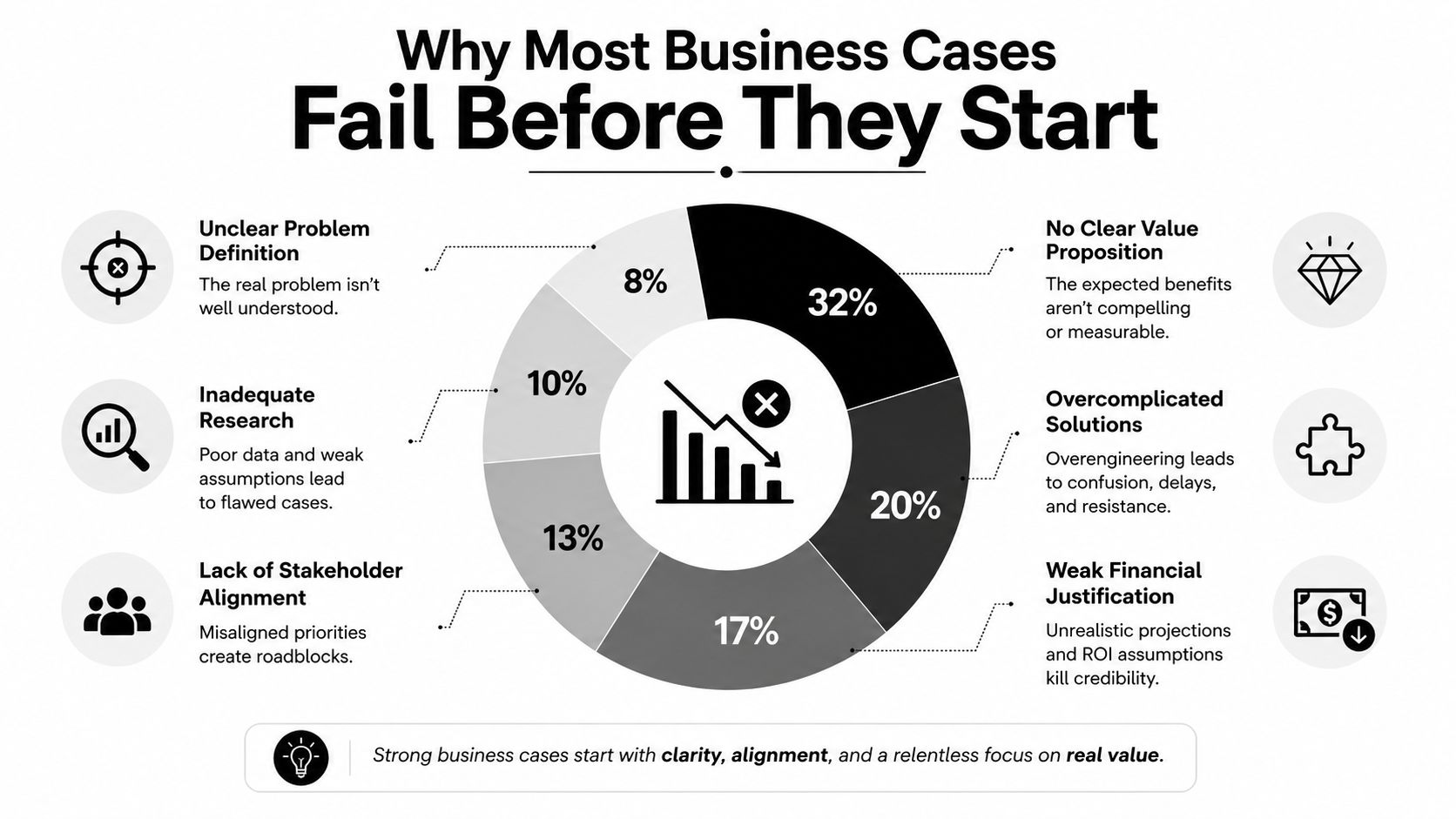
The three failure patterns
Inflated benefits are the most obvious problem. Teams model full adoption from the start, count every theoretical hour saved, and treat released labor capacity as an automatic payroll reduction. Finance challenges the assumptions, and the wider proposal loses credibility. An automation or AI case needs an adoption curve, a defined benefit mechanism, and a clear explanation of which capacity converts into financial value.
Incomplete costs create a quieter failure. Licensing may appear in the model while integration, data cleanup, training, process redesign, parallel operations, internal project time, and change-management support remain absent. Procurement often exposes these omissions later, after the organization has committed to a preferred option and has less room to adjust.
Late stakeholder conflict can stop approval or delay delivery. IT may object to security exposure, procurement may reject vendor terms, and operations may resist a workflow that changes ownership. If these objections surface for the first time in the approval meeting, the case appears unfinished and its risk controls are untested.
A credible business case makes uncertainty visible. It gives decision-makers a base case, downside conditions, named owners, and control points for stopping or correcting the investment before weak results become sunk cost.
The purpose is disciplined comparison, not persuasion at any cost. Decision-makers need to compare options, understand trade-offs, approve a controlled investment, or reject it for a documented reason. Conservative assumptions, transparent downside scenarios, and explicit accountability produce stronger decisions than optimistic storytelling, particularly when finance and procurement are testing whether projected returns can be verified in operations.
Defining the Case for Change and Screening Options
A useful case for change answers four questions:
- What problem requires a decision now?
- What does the current state cost in money, capacity, delay, risk, or customer experience?
- What outcome would show that the investment worked?
- What happens if leadership chooses to do nothing?
Build the baseline from internal evidence, including CRM records, finance reports, ticket data, process timings, error logs, interviews, and sample observations. If nobody can explain how a current-state figure was calculated, treat it as an estimate rather than a firm input. Name the evidence needed to validate it, who will collect that evidence, and when the estimate will be revisited.
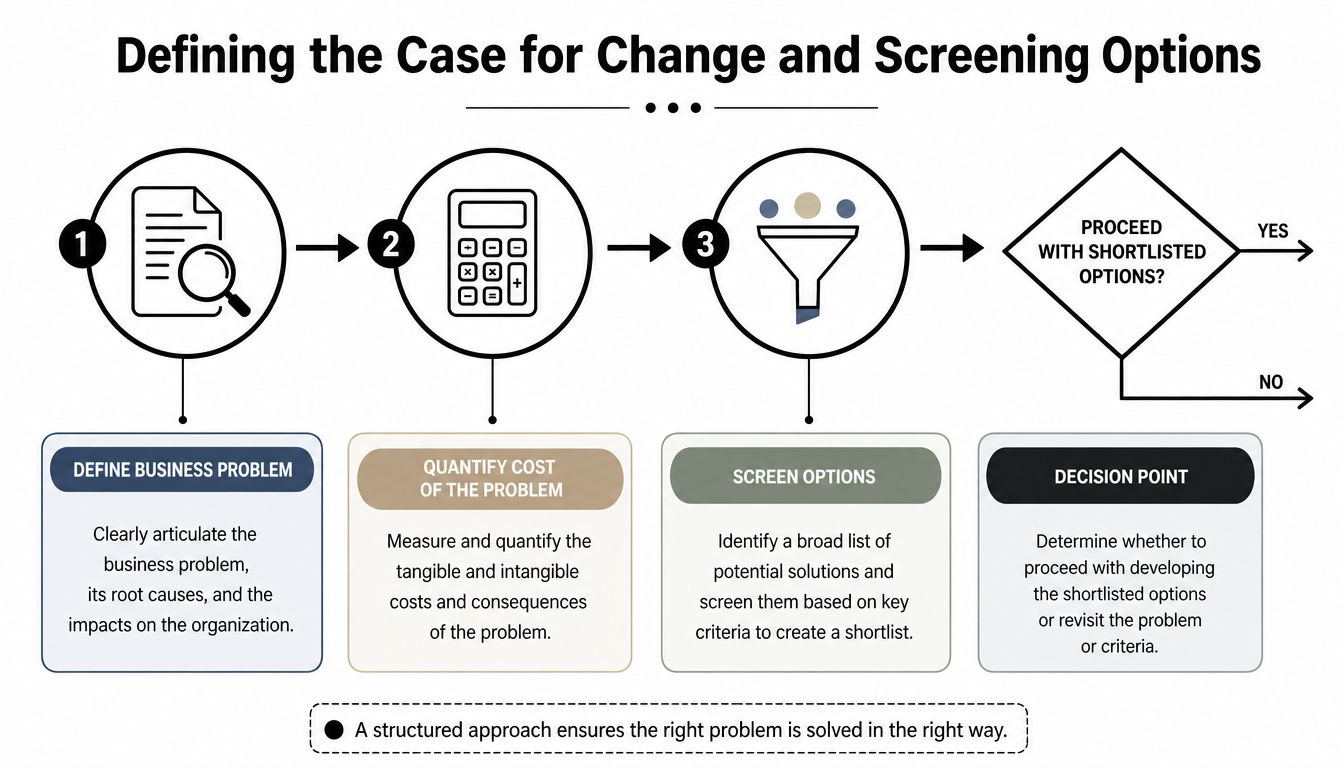
The staged workflow in Meat & Livestock Australia's business-case guidance moves from defining the case for change to prioritizing options through early screening measures such as benefit-cost ratio and ROI, then to capital budgeting and formal approval. Its ROI definition is:
(Anticipated Financial Value of Investment − Anticipated Project Cost) / Anticipated Project Cost × 100
The formula is only as credible as its inputs. “Financial value” needs a documented operational mechanism, such as reduced handling time, fewer errors, or additional capacity that the business can use. “Project cost” must cover the resources required to produce that result, not just the software invoice. Finance and procurement will test both assumptions, especially where an automation or AI proposal relies on projected efficiency rather than verified outcomes.
Screen before you model deeply
Do not build a detailed financial model around one preferred solution before comparing alternatives. For a CRM integration, assess buying a connector, building internally, extending the existing platform, or postponing the work while correcting data quality. For invoice processing, evaluate several vendors against the same requirements instead of selecting the tool with the strongest demonstration.
A lightweight screening matrix can assess each option against:
- Strategic fit: Does it address a stated priority or merely add capability?
- Evidence quality: Is the benefit supported by internal data, a pilot, or an untested assumption?
- Implementation complexity: What integration, process change, and specialist capacity will it require?
- Commercial exposure: Are pricing, renewal, dependency, and exit conditions clear?
- Preliminary return: Does it warrant deeper analysis compared with the alternatives?
The matrix is a filter, not a forecast. Its purpose is to remove weak paths early and reserve detailed analysis for options with a defensible evidence base. Record why each option was rejected and what information was available at the time. That record shows finance and procurement that the selected route was compared deliberately, while preserving clear conditions for further testing before approval.
Quantifying Costs and Benefits That Withstand Scrutiny
Finance rarely rejects a business case because the arithmetic is difficult. It rejects cases because the arithmetic describes an incomplete reality. Separate one-time implementation costs from ongoing operating costs, then connect every benefit to a specific change in the process.
Implementation costs may include software configuration, integration, data migration, security review, testing, training, project management, and temporary productivity loss. Ongoing costs may include subscriptions, support, administration, internal ownership, vendor management, model maintenance, and future enhancements. A useful model makes each cost visible by period instead of burying everything in one total.
Benefits need the same discipline. Labor capacity can be estimated from hours released and fully loaded employment cost, but released capacity isn't automatically a headcount saving. If employees use the time for additional customer work, faster delivery, or reduced backlog, model that outcome separately and explain how it will be measured. Revenue benefits require a credible causal path from the initiative to conversion, retention, expansion, or sales capacity.
Build the cash flow by year
The Meat & Livestock Australia framework emphasizes collecting cost and benefit data by year across the life of the project. That approach forces the model to reflect timing, ramp-up, renewal costs, and delayed benefits rather than relying on a single headline figure.
For example, a deployment with an initial cost of $150,000 and projected annual savings of $400,000 may sound compelling, but finance will ask when those savings begin, how much implementation consumes, and whether the same value has been counted twice. The table below is intentionally illustrative. It shows the structure, not a verified forecast for a particular company.
| Year | Implementation Costs | Ongoing Costs | Quantified Benefits | Net Cash Flow | Cumulative ROI |
|---|---|---|---|---|---|
| Year 1 | $150,000 | Defined from vendor and internal estimates | Discounted for ramp-up and adoption | Benefits minus all Year 1 costs | Cumulative net value divided by cumulative costs |
| Year 2 | $0 or approved enhancement costs | Subscription, support, and ownership costs | Validated operating benefits | Benefits minus ongoing costs | Cumulative net value divided by cumulative costs |
| Year 3 | Planned upgrade or expansion costs | Recurring operating costs | Benefits adjusted for measured performance | Benefits minus all Year 3 costs | Cumulative net value divided by cumulative costs |
For practical guidance on connecting workforce assumptions to financial value, the PEO cost benefit guide provides a useful way to organize cost and benefit categories. Teams modeling their own initiative can also use this ROI calculation framework to structure assumptions before presenting them for review.
Prevent double counting
Double counting often appears when a model claims both headcount reduction and productivity improvement from the same hours. Choose the primary benefit, or divide the capacity into distinct, evidenced uses. Apply scenario weights when certainty differs. A validated baseline deserves more confidence than a vendor estimate, and a pilot result deserves more confidence than a presentation slide.
Use NPV when timing and risk matter, and calculate payback only after including the full implementation burden. A short payback based on gross savings is less useful than a longer payback based on net, confidence-adjusted cash flow.
Building a Credible Automation and AI Business Case
Automation and AI proposals face a predictable credibility problem. Vendors often describe theoretical productivity, while finance evaluates realized capacity after integration, adoption, controls, and workflow redesign. The strongest case doesn't promise that every user will adopt the tool immediately. It models how adoption develops and what management must do to support it.
Use three layers.
First, establish the current-state cost. Identify the process steps, people involved, transaction volume, handling time, error or rework points, escalation effort, and existing technology costs. Separate avoidable cost from capacity that may be redeployed.
Second, model adoption realistically. Build a ramp rather than assuming full utilization from launch. Include training, exceptions, human review, and the possibility that teams continue using the old process during transition.
Third, include the complete delivery cost. Data cleanup, integration middleware, access controls, testing, vendor governance, change management, and post-launch support belong in the case. For AI, add monitoring, model evaluation, retraining, prompt or workflow maintenance, and escalation procedures.
The UK government business-case guidance centers the Five Case Model, including strategic fit, economic value, commercial viability, financial affordability, and management and assurance. That logic transfers well to private-sector automation. A proposal has to be desirable, valuable, buyable, affordable, and controllable.
Show the downside rather than hiding it
A finance committee should see what happens if adoption stalls, data quality is poor, the model requires additional retraining, or the process still needs human review. The exact assumptions depend on internal evidence, so avoid false precision. Present the optimistic and conservative cases side by side.
| Assumption Category | Optimistic Scenario | Conservative Scenario | Impact on NPV |
|---|---|---|---|
| Adoption | Rapid uptake across the intended user group | Gradual adoption with continued manual handling | Benefits arrive later and NPV falls |
| Automation rate | Most eligible work follows the automated path | Exceptions require human review | Savings are reduced |
| Implementation | Clean data and uncomplicated integration | Data remediation, middleware, and testing add effort | Costs rise and benefits are delayed |
| Change management | Training produces quick behavioral change | Teams need repeated support and workflow redesign | Ramp-up extends |
| Vendor economics | Stable pricing and predictable support | Renewal increases, dependencies, or exit work appear | Long-term cash flow weakens |
| AI performance | Consistent output within approved controls | Monitoring and retraining remain ongoing requirements | Operating costs increase |
A range doesn't weaken the recommendation. It tells the CFO what evidence would move the case from conditional approval to full funding. For broader operational examples, AI for operational efficiency can help frame automation around process outcomes rather than abstract capability.
Approval threshold: Fund the initiative only when the conservative case remains tolerable, the risk owners accept the controls, and the first measurement gate can validate the central assumption.
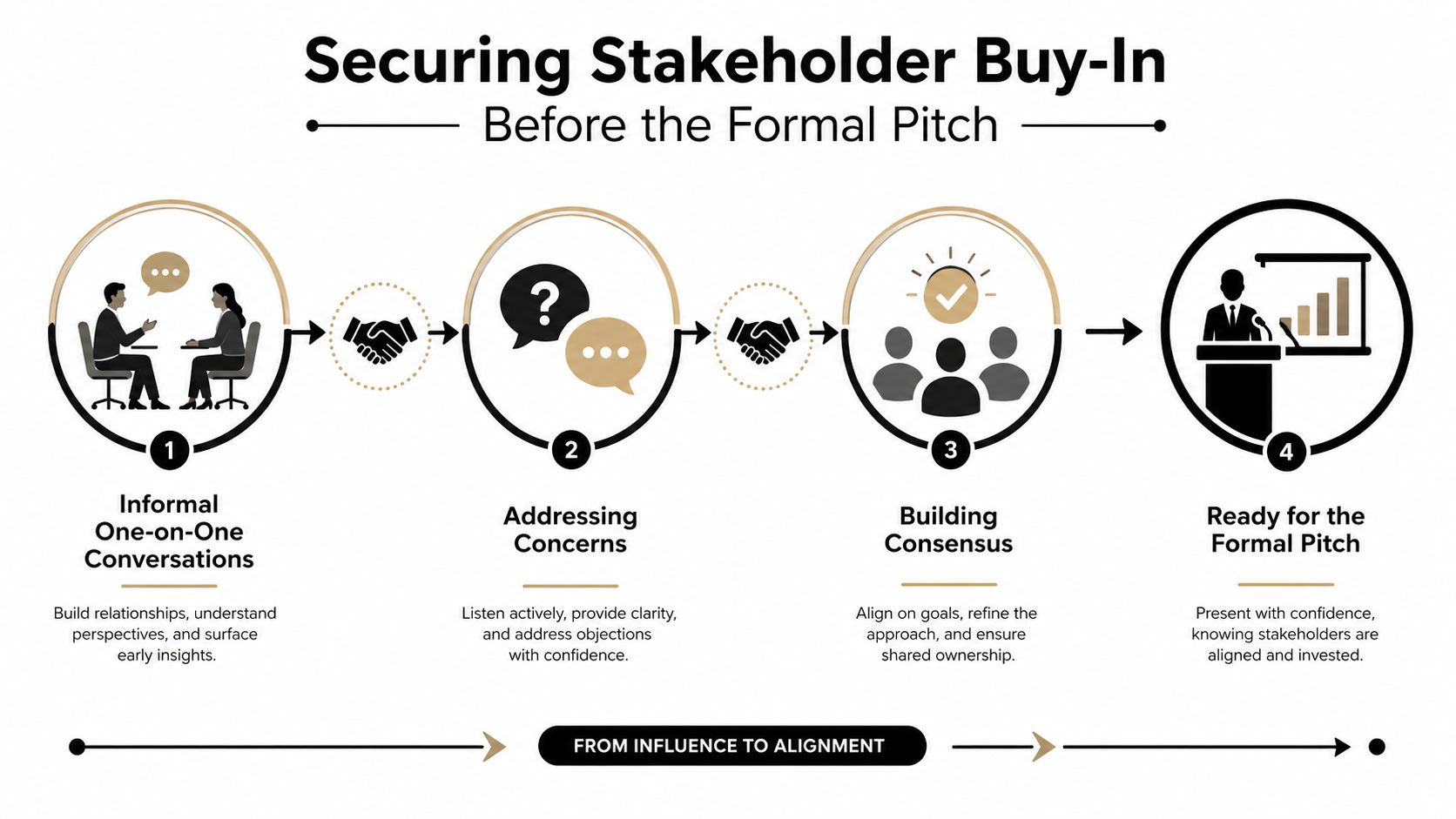
Securing Stakeholder Buy-In Before the Formal Pitch
The formal presentation is usually the visible end of the decision process, not the beginning. The CFO or P&L owner tests affordability and benefit timing. IT security tests data exposure, integration, and control. Procurement tests vendor dependence and contract risk. End users test whether the proposed process is workable.
Map those concerns before building the slide deck. Use one-on-one conversations to ask what could make the proposal unsafe, unaffordable, or difficult to implement. Avoid defending the idea too early. Private objections reveal evidence gaps that are harder to address in a formal approval meeting.
| Stakeholder | Influence | Typical concern | Useful evidence |
|---|---|---|---|
| CFO or P&L owner | High | Affordability and timing of benefits | Cash flow, scenarios, ownership |
| IT security and architecture | High | Data, integration, resilience, support | Architecture review, controls, exit plan |
| Procurement | High | Vendor concentration and contract exposure | Commercial comparison, renewal terms |
| Operations sponsor | Medium to high | Process disruption and workload | Process map, pilot findings, training plan |
| End-user lead | Medium | Usability and accountability | Workflow design, feedback, adoption measures |
Follow the interviews with a one-page decision brief. State the problem, baseline, options considered, preferred path, investment required, expected benefits, principal risks, and decision required. Ask stakeholders to mark disagreements, missing evidence, and assumptions they would not defend. Show useful changes in the next version, so participants can see how their input shaped the case.
Match the message to the objection
Procurement may support the solution while rejecting the contract. Bring a vendor comparison, renewal assumptions, data portability requirements, service obligations, and an exit approach. IT may support the outcome while rejecting an unmanaged shadow system. Bring architecture ownership, access controls, integration boundaries, and a support model.
The CFO may question whether benefits will arrive on schedule. Use staged funding and benefit gates. Initial approval can cover discovery or a controlled pilot, with later funding tied to measured evidence. This structure makes uncertainty governable instead of hiding it behind inflated ROI projections.
The accompanying video walks through a stakeholder alignment exercise that maps objections to evidence requirements before the formal meeting. Use the exercise to identify unresolved objections, assign owners, and specify what evidence each stakeholder needs before approval.
Listen, document objections, adjust assumptions, and confirm ownership before the formal meeting.
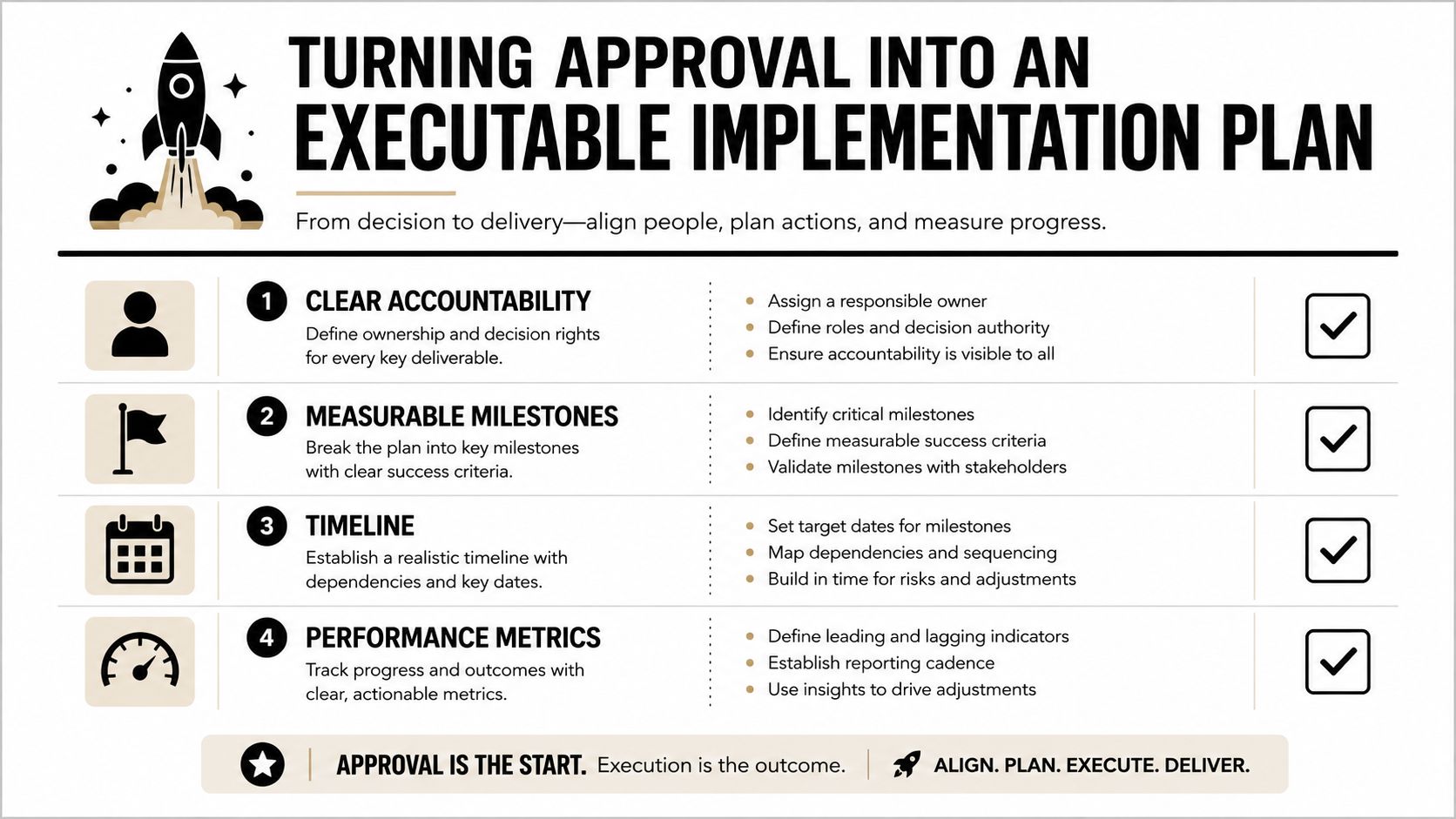
Turning Approval Into an Executable Implementation Plan
Approval is a funding decision, not proof of delivery. Before the meeting closes, attach the approved case to a working implementation package with named owners, dates, decision rights, and measurement rules.
A practical handoff includes:
- Phased delivery plan: Define discovery, design, build, testing, launch, and stabilization gates.
- Benefits tracker: Tie each approved benefit to a KPI, baseline, data owner, target direction, and review date.
- Risk register: Record the risk, owner, trigger, mitigation, contingency, and escalation path.
- Governance model: State who approves scope changes, commercial decisions, technical exceptions, and benefit resets.
- RACI assignment: Make the person who owns the operational outcome different from, or deliberately the same as, the person managing delivery.
The first 90 days should validate the central assumptions rather than attempt to perfect the entire program. Front-load a contained workflow, establish the measurement baseline, train the affected users, and review exceptions. A quick operational proof can reveal whether the process is mature enough for automation, whether data is usable, and whether the benefit mechanism works as modeled.
Keep ownership after approval
The business case owner shouldn't disappear once funding is granted. That person should remain accountable for the assumptions, while the delivery lead owns execution and the operational sponsor owns adoption. If responsibility changes, record the transfer formally.
A solid business operations system helps keep processes, ownership, and performance information visible after launch. For the delivery mechanics, use a defined project lifecycle with stage gates that connect implementation progress to the original investment logic.
Review benefits quarterly against the approved case. If performance is below plan, identify whether the cause is adoption, process design, data quality, vendor performance, or an incorrect assumption. Management can then remediate, rescope, pause, or stop the initiative with evidence instead of allowing the original forecast to become an unquestioned promise.
MakeAutomation helps B2B and SaaS teams map workflows, identify practical automation opportunities, document operating procedures, and connect AI initiatives to measurable capacity and process outcomes. Visit MakeAutomation to discuss a defensible business case and an implementation plan your finance, procurement, and operations teams can support.