

Data Quality Assurance: Best Practices for B2B and SaaS
Your automation probably isn't failing because Zapier, HubSpot, Salesforce, your warehouse, or your AI assistant is broken. It's failing because one rep entered “United States,” another entered “USA,” a form allowed blank company names, a lifecycle stage changed without notice, or two systems decided the same account deserved two different IDs.
That's the hygiene gap.
Most growth-stage SaaS companies hit it right after they've stitched together enough tools to feel efficient. Lead routing works. Enrichment runs. Customer onboarding triggers. Dashboards refresh. Then the cracks show up. Sales starts checking records by hand before outreach. Ops exports CSVs “just to be safe.” Marketing stops trusting campaign attribution. Product analytics and CRM reports disagree, and nobody knows which one to believe.
At that point, founders usually make the wrong choice. They either keep adding manual review, which doesn't scale, or they keep automating on top of inconsistent data, which scales the mess. Data quality assurance is the discipline that gets you out of that trap. It's not glamorous, but it's one of the few investments that improves every downstream system you already pay for.
Building a Foundation for Data Quality Assurance
A lead hits your CRM at 9:03. The company name is half-complete, the country field uses a value your routing rule does not recognize, and the account already exists under a slightly different name. Nothing crashes. The sequence still sends. The record still syncs. Your team only notices later, when ownership is wrong, attribution is muddy, and the pipeline report does not match what Sales thinks happened.
That is the hygiene gap. Growth-stage SaaS companies do not usually break because automation stops running. They break because automation keeps running on inconsistent inputs.
That is why data quality assurance deserves infrastructure-level attention.

What data quality assurance actually means
In a B2B SaaS company, data quality assurance is a repeatable control system that keeps the data feeding CRM, billing, support, analytics, and automation fit for operational use. It sets rules before data enters a system, checks records as they move between systems, and catches drift before bad inputs spread into reporting, outreach, or finance.
The discipline grew out of quality control, then matured as companies got better at storing, sharing, and managing data across business processes. The point is simple. Quality stopped being a final inspection step and became a lifecycle responsibility.
Use that standard in your company.
If your team waits for a dashboard to look wrong before investigating the inputs, you do not have assurance. You have late-stage damage control.
Build for consistency before scale
Founders often spend money connecting tools before they standardize the records moving through them. That order creates expensive messes. If two systems define the same account differently, or if key fields accept whatever users type, every sync spreads inconsistency faster. Good data integration best practices depend on explicit rules for identity, ownership, formats, and required values.
Start with the data products that run the business. For most SaaS companies, that means leads, accounts, contacts, opportunities, subscriptions, invoices, and support tickets. If a broken record in one of those objects can misroute work, distort reporting, delay cash collection, or trigger the wrong customer message, it belongs inside your quality program.
Then make five decisions early:
- Define system ownership: Assign one source of truth for each business-critical field, especially lifecycle stage, account status, plan, renewal date, and owner.
- Set entry controls: Require the fields, formats, naming rules, and duplicate checks that prevent bad records from landing in the first place.
- Document identity rules: Decide how records match across CRM, product, billing, and support so the same customer does not become three different entities.
- Assign accountable owners: RevOps, Engineering, Finance, and Support should each own the quality of the data they create or govern.
- Review workflows before launch: Any new automation should be checked for null handling, mapping conflicts, duplicate creation, and failed lookups before it goes live.
These are not admin details. They determine whether your company scales with trusted systems or with growing manual review.
The founder-level investment
You have two options. Keep paying people to inspect records after they break a workflow, or put controls in place that prevent the break in the first place.
The second option wins because it compounds. Clean inputs make routing more accurate, reporting more believable, billing cleaner, and automation safer to expand. Manual checking does the opposite. It hides the underlying problem, burns team time, and trains the company to tolerate unreliable systems.
The goal is not perfect data. The goal is a stable operating layer that catches preventable errors at entry, during sync, and before they reach decision-making systems. That is how you close the hygiene gap and make automation worth trusting.
Defining Core Dimensions and Trust Metrics
Your automation usually fails one layer earlier than teams admit. Lead routing, lifecycle updates, expansion alerts, and billing handoffs break because the underlying records do not agree on what a customer, owner, status, or timestamp is. That is the hygiene gap. If you do not define quality in concrete terms, your company ends up choosing between manual spot checks and automation nobody trusts.
A useful quality model separates trust into distinct dimensions instead of collapsing every complaint into “bad data.” As noted earlier, established data quality frameworks group trust around five areas: integrity, methodological soundness, accuracy and reliability, serviceability, and accessibility. In a SaaS company, those categories matter only if you translate them into operating rules your teams can measure.
The dimensions that matter in practice
Use the broad categories to define where trust breaks.
| Dimension | What it means in SaaS | What to check |
|---|---|---|
| Integrity | Teams trust that records were not silently changed, overwritten, or deleted | Audit lifecycle stage changes, ownership changes, billing status edits, and deletion events |
| Accuracy and reliability | The record matches reality and stays dependable across systems | Compare CRM values against product, billing, and support systems |
| Serviceability | Data arrives on the schedule the business needs | Measure refresh timing, issue resolution speed, and data availability during key workflows |
| Accessibility | Teams can find, understand, and use the data | Review field definitions, permissions, and whether people can locate the right object or report |
| Methodological soundness | The company uses one definition for core entities and metrics | Standardize what counts as a lead, qualified pipeline, active customer, renewal, or churn |
That table gives leadership a way to classify trust problems. Operators still need field-level checks they can act on this week.
Add operational dimensions your teams can actually manage
Map each broad trust dimension to a small set of operational checks.
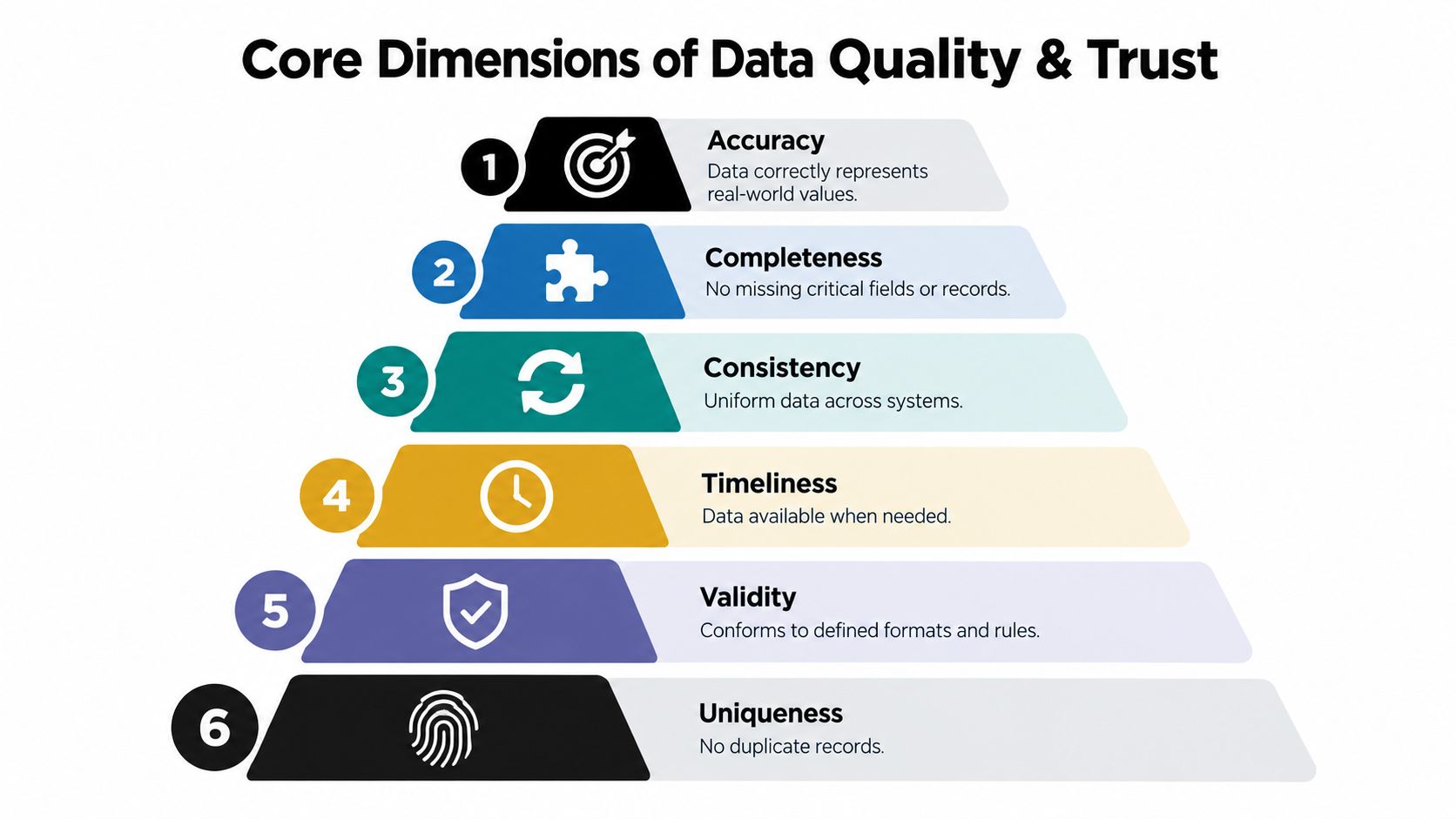
- Completeness: Are the fields required for routing, reporting, and customer handoff populated?
- Consistency: Does the same account, plan, segment, or status mean the same thing across systems?
- Timeliness: Is the record current enough for the workflow using it?
- Validity: Does the value match the format, rule, or allowed list you set?
- Uniqueness: Did weak matching create duplicate people, companies, or deals?
If you need a practical framework to define and monitor data quality metrics, use it to convert each dimension into named checks, thresholds, owners, and review cadence.
Trust comes from traceability. A score without a failure mode, threshold, and owner is dashboard decoration.
What founders should measure first
Start with the records that drive revenue, renewals, and customer experience. Ignore the rest until these are under control.
I would prioritize:
- Critical field completion for leads, accounts, contacts, opportunities, and subscription records.
- Duplicate rate for accounts and contacts before assignment, outreach, or enrichment.
- Cross-system consistency for fields that trigger automations, especially status, plan, owner, and renewal dates.
- Validation failure volume from forms, imports, enrichment tools, and sync jobs.
- Correction turnaround time so bad records do not sit long enough to poison downstream workflows.
These metrics do more than clean up reports. They show whether your company is building a scalable operating system or paying people to compensate for inconsistent inputs.
One language across teams
A good metric system reduces political noise. Sales stops saying the CRM is messy. Finance stops saying numbers look off. RevOps and Engineering stop debating symptoms.
Instead, teams can name the problem precisely: completeness failure, duplicate inflation, stale status sync, invalid value, inconsistent entity definition.
That is how you close the hygiene gap. You replace vague mistrust with shared definitions, measurable checks, and clear ownership.
Implementing the Data Quality Workflow
A lot of SaaS operators think quality starts when a record looks suspicious in the CRM. That's too late. Quality starts at design time, before data is captured, transformed, synced, or exposed to reporting.
A practical workflow used in large-scale survey and administrative data settings starts with planning and design validation, then moves through pre-tested sampling frames, instrument review, training, field monitoring, analytics on critical items, regular review meetings, and documented corrective actions, as described in the published framework on data quality assurance workflow design. The context is broader than SaaS, but the operating model is exactly right for a scaling company.
Start before the data exists
If your forms, event schemas, CRM objects, and enrichment mappings are sloppy, no downstream monitor will save you.
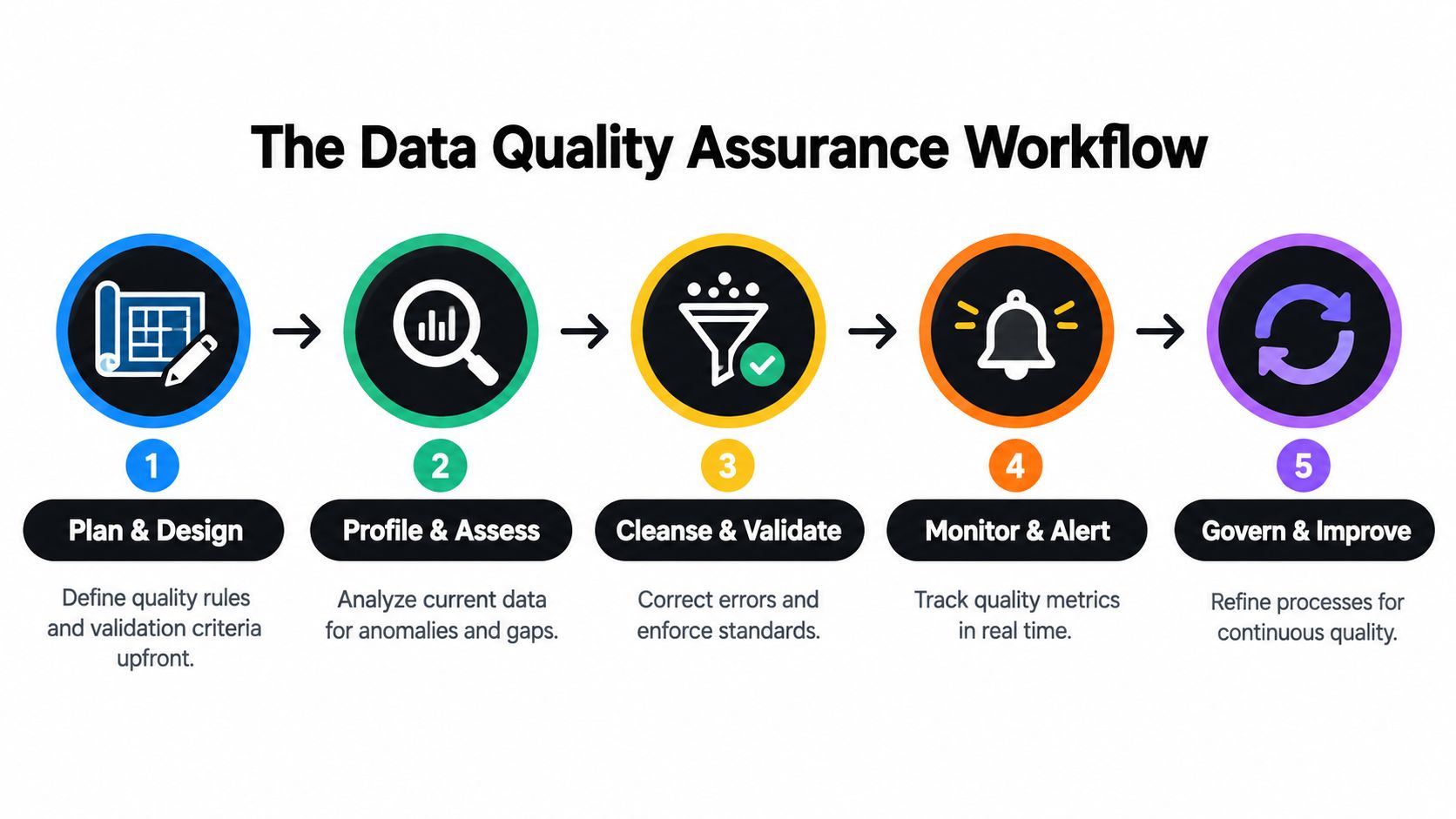
Use this workflow.
1. Plan and design
Define what “good” means before launch. For every important object, write the required fields, allowed values, source-of-truth system, sync rules, and exception paths.
Bad example: “Industry should be filled when possible.”
Good example: “Industry is required for ICP scoring. Accepted values come from the approved taxonomy. Website form submissions with no industry enter a remediation queue before routing.”
2. Profile and assess
Run a baseline review on current data. Look for missing values, duplicates, contradictory statuses, stale timestamps, and records that fail mapping logic.
This isn't glamorous work, but it shows you where the hygiene gap already exists.
Operator advice: Don't automate a broken object model. Profile first, then build controls.
3. Cleanse and validate
Fix the obvious defects, but also enforce standards at the point of entry. Validation should happen in forms, imports, API payloads, sync jobs, and internal editing workflows.
Use different controls for different risks:
- Format checks for emails, dates, country values, and IDs
- Reference checks for approved stages, segments, and owner mappings
- Conditional rules for fields that become required only in certain lifecycle states
- Duplicate matching before insert, not after damage spreads
A short walkthrough helps more than another checklist, so this explainer is worth keeping handy:
Monitor during collection, not after reporting
The survey-oriented framework emphasizes analytics on critical items during collection, regular review meetings, and documentation of corrective actions. In SaaS terms, that means your team should watch the actual intake paths where records are born or changed.
Run a living review cycle
I recommend a standing operating rhythm:
- Daily checks: Failed syncs, validation exceptions, duplicate insert attempts, missing critical fields on new records.
- Weekly review: Compare key distributions, owner assignments, stage movement, and source attribution for anomalies.
- Release-based review: Whenever Sales Ops, RevOps, Product, or Engineering changes a schema or workflow, review quality impact before and after deployment.
- Corrective action log: Every recurring issue needs root cause, owner, fix date, and prevention step.
Organize quality across three layers
That same framework explicitly organizes quality across institutional, survey-setting, and data-product domains. In a SaaS company, I'd mirror that structure like this:
| Layer | SaaS equivalent | Core question |
|---|---|---|
| Institutional | Governance, ownership, policies | Who is accountable when quality drops? |
| Operational setting | Forms, CRM workflows, integrations, imports | Where can bad data enter or mutate? |
| Data product | Dashboards, lead scores, routing, customer reports, AI workflows | Is the output fit for the decision being made? |
Document every correction
Teams get lazy. They fix the record and move on.
Don't. If you don't document the corrective action, you can't see patterns. If you can't see patterns, you'll keep funding the same preventable failure with human time.
Selecting Validation Strategies and Tools
Teams usually get seduced by shiny software. They assume the answer is “more AI.” It usually isn't.
You need a validation mix. Manual checks, scripted validation, and AI-assisted review each have a place. The mistake is using one method for everything.
A benchmark study of 274 code-related datasets found that 67.9% took no data quality assurance measures at all, 22.6% relied on manual checks, 2.2% used code execution, and 1.5% used LLM-based verification. Among benchmarks from 2023 to 2024, 81.8% had no contamination mitigation, according to the benchmark quality study on reproducibility and contamination control. Different domain, same lesson. Teams underinvest in reliable verification and overestimate informal review.
Use the right method for the right risk
Here's the decision logic I use.
| Validation method | Best use | Main weakness | My recommendation |
|---|---|---|---|
| Manual review | Spot checks, ambiguous merges, policy exceptions | Slow, inconsistent, expensive at scale | Keep it for high-risk edge cases only |
| Scripted validation | Required fields, format rules, duplicate checks, cross-system comparisons | Needs maintenance and clear specifications | Make this your default backbone |
| AI-assisted review | Pattern discovery, categorization support, anomaly triage | Can miss contamination, drift, or hidden logic errors | Use as a supplement, never the final authority |
Why code still wins on critical paths
If a workflow controls revenue routing, billing, entitlement, or customer communication, use deterministic checks first. A script can enforce exact logic. It can reject malformed payloads, compare source and destination values, and log failures predictably. That's what you want in systems that trigger business actions.
Manual review is still useful for record merges, account hierarchies, and weird edge cases where context matters. But if your team is manually checking routine fields every week, you've built a labor tax instead of a system.
AI can help surface patterns humans might miss, especially in free-text fields, support logs, and operational exhaust. It can also help classify suspicious records for review. But don't let it become the sole gatekeeper for data acceptance.
If a bad record can trigger money movement, customer messaging, or sales assignment, make the first check deterministic.
Pick tools based on control points
Don't buy a monolithic platform because the demo looks clean. Map tools to control points:
- At entry: Form validation, CRM field rules, import validators
- At movement: ETL tests, reverse ETL checks, API schema validation
- At storage: Warehouse tests, freshness checks, duplicate monitoring
- At use: Dashboard assertions, routing audits, AI input filters
If CRM hygiene is your biggest source of pain, start with a structured cleansing pass and durable prevention rules. This guide on CRM data cleansing workflows is aligned with that approach. If you need operational support implementing these controls across automations and CRM processes, MakeAutomation is one option alongside your internal ops stack and standard data tooling.
Don't over-automate fragility
A lot of founders automate exception handling too early. That's a mistake. If a process breaks because the business rules aren't settled, automation just hides the confusion. Stabilize definitions first. Then automate enforcement.
That order matters more than the software you choose.
Establishing Governance and Proactive Observability
Most quality programs fail for an organizational reason, not a technical one. Nobody owns the mess end to end.
Sales owns outcomes but not field definitions. Marketing owns forms but not downstream schema impact. Product emits events but doesn't review business meaning. Data teams inherit the damage and get blamed when dashboards look wrong. That's why data quality assurance stalls in growth-stage companies. Responsibility is fragmented, so quality becomes everybody's problem and nobody's job.
A recent industry analysis argues that many programs still focus on visible datasets while ignoring long-tail operational data used by AI workloads. It also notes that inconsistent quality definitions across Sales, Marketing, and Product create conflicting remediation efforts and slow adoption, as described in this analysis of the shift toward AI-native data quality governance.

Governance needs operating teeth
Good governance isn't a policy PDF. It's a set of enforceable controls tied to owners, thresholds, and response times. If your team is serious about this, build a lightweight model around executable rules and observability. Practical data governance automation patterns can help tie ownership to actual workflows instead of committee language.
I'd put five things in place:
Named owners for each critical dataset
One team owns lead records. Another owns account hierarchies. Another owns billing states. Shared ownership is usually disguised neglect.Executable data contracts
Define required fields, accepted values, freshness expectations, and downstream dependencies in a form that can be checked automatically.Centralized lineage for important workflows
You need to know which automations, reports, and AI systems consume each dataset. Without lineage, issue priority becomes guesswork.Operational SLAs for data quality incidents
Not every issue needs the same urgency. A duplicate webinar lead is not the same as a broken customer entitlement sync.Exception queues with business context
Don't flood teams with raw alerts. Route exceptions with owner, severity, likely impact, and suggested remediation.
Move from monitoring to observability
Monitoring tells you a rule failed. Observability tells you what changed, where it propagated, and what business process is now at risk. That difference matters.
A 2026 data-management review reports that 62% of professionals cite incomplete data, 58% report capture inconsistencies, and 57% report integration issues, according to Dataversity's review of current data-management trends. The same piece highlights a shift toward proactive observability, executable data contracts, centralized lineage, and operational SLAs.
That's the right direction. More checks alone won't save you if nobody can prioritize what matters.
Prevent alert fatigue
Founders often ask for “real-time alerts on everything.” Don't do that. Alerting should protect business-critical workflows, not create another inbox people ignore.
Use a simple severity model:
- Critical: Breaks routing, billing, entitlement, compliance, or customer communication
- High: Corrupts pipeline reporting, lifecycle logic, or account ownership
- Medium: Harms analytics quality but doesn't trigger direct operational damage
- Low: Cosmetic issues, taxonomy drift, or non-critical enrichment gaps
The right quality program doesn't create more alerts. It creates fewer surprises.
Close the hygiene gap at the team boundary
The hygiene gap usually appears at handoffs. Marketing sends records Sales can't trust. Product emits events analysts can't interpret. RevOps changes a picklist and downstream automations misbehave without warning.
You fix that by making quality definitions shared, enforceable, and visible before data enters the core systems. Once bad data lands in the center of your stack, cleanup is always more expensive.
Ensuring Continuous Improvement and Compliance
The strongest model for long-term discipline doesn't come from startup folklore. It comes from official statistics practice.
The UK government's statistical quality assurance process checks completeness, missing data patterns, duplicate records, contradictory information, and the quality of measures and participant characteristics for each release. Its methodology also describes repeated QA rounds, comparisons with previous publications, and validation against internal management information, as documented in the UK methodology report for statistical quality assurance. That's a serious model because it treats quality as a layered defense, not a one-time inspection.
B2B SaaS teams should copy that mindset. Your version might include duplicate detection before insert, completeness checks before routing, consistency checks before sync, and validation against source systems before executive reporting or AI execution.
A practical ongoing checklist
- Re-run critical checks on a schedule: Don't assume yesterday's clean dataset is still clean.
- Compare current outputs to prior periods: Not for vanity trends. For anomaly detection.
- Validate against source systems: If CRM, billing, and warehouse disagree, someone has to arbitrate.
- Review external and internal controls together: Quality and compliance shouldn't live in separate silos.
- Audit the exception backlog: Old unresolved issues are process debt.
If you're building this discipline into regulated or customer-sensitive environments, it helps to think about quality the same way security teams think about resilient security programs. The useful parallel is operational maturity. Strong systems rely on layered controls, documented ownership, and repeated verification.
Data quality assurance is never “done.” That's fine. The goal isn't perfection. The goal is a controlled system that catches issues early, contains them fast, and keeps your automation trustworthy as the business grows.
Start with an audit of your most business-critical records this week. Find where your team is still compensating with manual checks, then replace those habits with enforceable standards and repeatable controls.
MakeAutomation helps B2B and SaaS teams turn messy automations into reliable operating systems by tightening CRM hygiene, workflow logic, data governance, and AI-enabled processes. If your team is stuck in the hygiene gap between manual checking and scalable automation, visit MakeAutomation to see how those systems can be designed, documented, and implemented properly.