
How to Increase Sales Productivity with Proven Tactics
Boosting your sales team's productivity isn't just about hitting higher numbers. It's about getting your reps to spend their time on what truly matters: talking to customers and closing deals, not getting bogged down in administrative muck.
The best way I've found to do this boils down to a pretty simple philosophy: fine-tune your processes, use technology intelligently, and measure what actually moves the needle. This guide is your playbook for putting that "work smarter, not harder" idea into practice.
What Productivity Really Means in a Tougher Market
The days of "hustle culture" being the answer are long gone, especially with deal cycles stretching out and competition getting fiercer. Simply asking your team to work longer hours is a fast track to burnout, not better results.
Real productivity comes from building a sales engine that’s so well-oiled that every single action a rep takes is deliberate and impactful. It’s a complete mindset shift. We need to stop measuring success by the sheer volume of calls made or emails sent and start looking at the quality and effectiveness of those interactions. It’s about creating a system that gets out of your team's way so they can focus on what they're best at.
The Three Pillars of a High-Performing Sales Team
To get there, we're going to build our strategy on three core pillars. Think of them as the foundation for sustainable growth.
-
Smart Process Design: This is all about taking a hard look at your entire sales process, from lead to close, and ruthlessly cutting out the bottlenecks and time-wasters. A clean, efficient process is the roadmap your team needs to win.
-
The Right Tech & Automation: Good tools are game-changers. I'll show you how to use your CRM, outreach automation, and even AI to automate the soul-crushing repetitive tasks that kill your team's momentum.
-
Meaningful Performance Tracking: You can't fix what you can't see. This means ditching the vanity metrics and focusing on KPIs that give you a true picture of how efficient and effective your team really is.
The data backs this up. The market is getting tougher. We're seeing 34% of revenue teams report sales cycles that now drag on for one to two quarters. At the same time, win rates are dropping, which means every single activity and conversation has to count.
When you build your sales engine around these three pillars, productivity stops being a target you chase and becomes the natural outcome of a well-designed system. It gives your team the structure and tools they need to win, even when the market is throwing curveballs.
Getting your team fully equipped is a huge part of this. These 10 best practices for sales enablement offer a great framework for defining what a productive team looks like. And if you want to make sure your foundation is solid, our guide on sales operations best practices covers the essentials for building that efficient machine.
Now, let's dive into how to put each of these pillars into action.
Designing a Sales Process That Eliminates Friction
A clunky, inefficient sales process is the silent killer of productivity. It’s the invisible headwind that slows everything down, forcing your reps to spend more time fighting internal systems than actually talking to prospects. If you want to see a real jump in sales productivity, you have to start by paving a smoother road for your team.
This whole thing kicks off with a brutally honest audit of your current sales journey. I'm talking about mapping every single touchpoint, from the second a lead hits your system to the moment a contract gets signed. You need to ask the tough questions: Where do our deals consistently stall? Where do communication handoffs fall apart? And most importantly, where are my reps getting bogged down in busywork?
Mapping Your Sales Journey to Find the Bottlenecks
The best way to do this? Get your team in a room. Have them walk you through a typical deal, step by step, from their perspective. You’ll be amazed at the friction points you uncover that never show up on a dashboard.
Maybe the handoff from an SDR to an Account Executive is a mess, forcing the AE to re-ask a bunch of questions the SDR already covered. Or perhaps getting a proposal out the door involves a chaotic back-and-forth with legal and finance that adds a week to the process.
These little hurdles seem small on their own, but they add up. Fast. It’s a well-known stat that sales reps spend only about 39% of their time actually selling. The rest of that valuable time is eaten up by admin tasks and navigating these internal processes. Mapping the journey is your first real step to winning that time back.
This is all about building from the ground up: solid process first, then technology, then measurement.
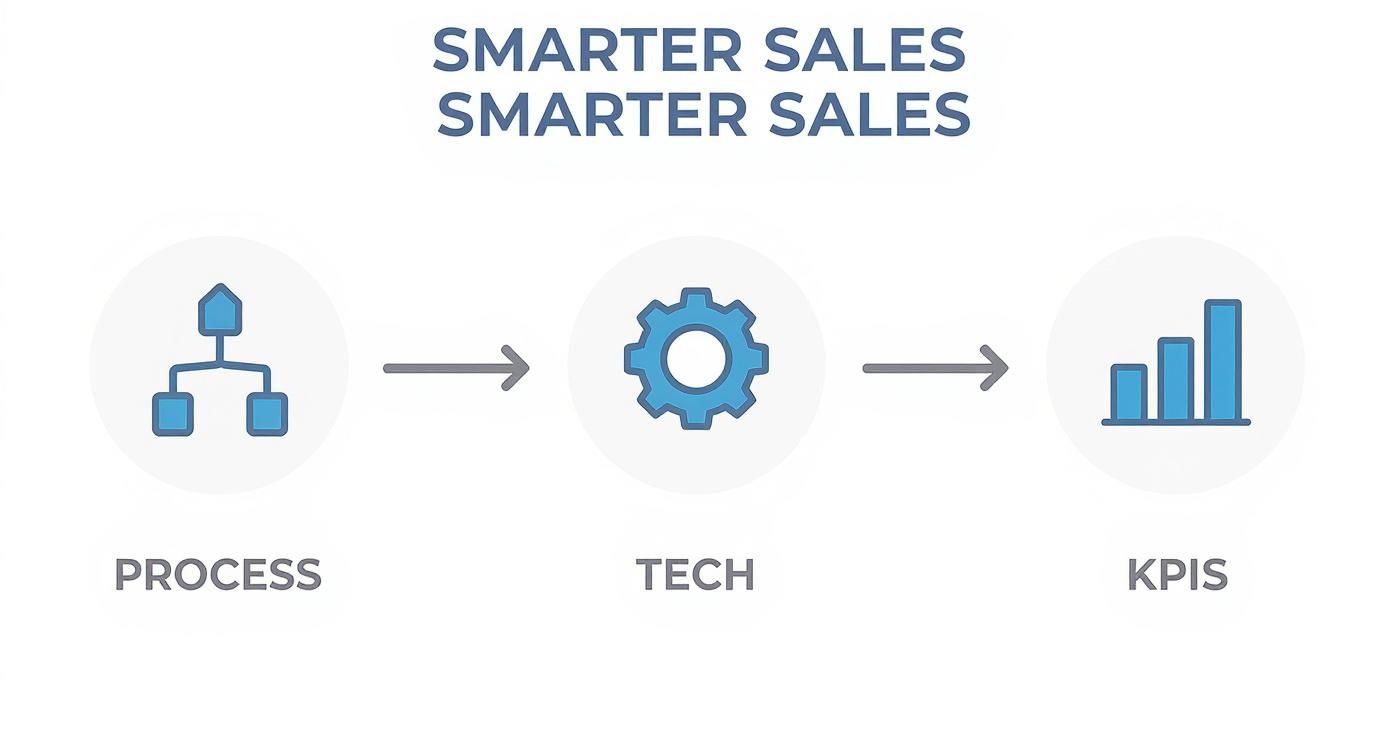
As the diagram shows, you can't just throw software at a broken process and expect magic. A great process is the foundation for everything else.
To help you pinpoint these issues, here's a look at some of the most common hangups I've seen in sales organizations and how to start fixing them.
Common Sales Bottlenecks and How to Fix Them
| Common Bottleneck | Key Symptoms | Actionable Solution |
|---|---|---|
| Messy Lead Handoff | AEs complain about poor lead quality; prospects have to repeat information; deals stall right after handoff. | Create a simple "Lead Handoff Checklist" in your CRM that SDRs must complete. Include key qualification notes, pain points, and next steps. |
| Inconsistent Discovery | Forecasts are inaccurate; reps are surprised late in the cycle; demos don't resonate with the prospect's actual needs. | Standardize 5-7 core discovery questions based on your Ideal Customer Profile (ICP). Make answering them a required field in the CRM to move a deal to the next stage. |
| Slow Proposal Generation | It takes days to get a quote or proposal to a prospect; deals lose momentum waiting for internal approvals. | Build pre-approved proposal templates for your most common deal structures. Use a tool like PandaDoc or Proposify to automate the creation process. |
| Chasing Unqualified Leads | Sales cycles are long with low win rates; reps waste time on prospects who can't buy. | Implement a clear qualification framework (like BANT or MEDDIC) and train the team on how to use it rigorously at the start of the sales cycle. |
Spotting these bottlenecks is half the battle. Once you know where the friction is, you can take deliberate steps to smooth things out.
Simplify and Standardize Your Core Workflows
After you’ve identified the roadblocks, it's time to simplify and standardize. The goal isn't to turn your reps into robots reading from a script. It's about creating a clear, repeatable playbook for the core parts of the job. This consistency is what lets you scale efficiently.
I recommend starting with the highest-impact activities:
- Prospecting: Get crystal clear on your Ideal Customer Profile (ICP). Create a simple SOP that outlines where and how your team should find and research these accounts.
- Outreach: Develop a library of approved email and LinkedIn message templates. These aren't meant to replace personalization, but to give reps a proven starting point so they aren't staring at a blank screen every time.
- Discovery Calls: Map out the key questions every rep needs to ask to properly qualify a lead and dig into their real pain points.
- Demos: Standardize the core flow of your product demo. Make sure every prospect sees the "wow" moments and key value props, every single time.
By building simple, smart SOPs for these stages, you take the guesswork out of the equation. Your reps can stop worrying about what to do next and pour all their energy into how to execute flawlessly for each unique buyer.
I once worked with a B2B SaaS company that realized their AEs were running three separate demos for most deals. It was just "how we've always done it." After we audited the process, we found the first demo was almost completely redundant. By merging the first two calls into a single, more powerful discovery-and-demo session, they slashed their average sales cycle by nearly three weeks. That’s the kind of impact smart process design can have.
Implement a Strong Qualification Framework
One of the biggest productivity drains is chasing ghosts—deals that were never going to close from the start. A strong qualification framework is your team’s filter, ensuring they spend their precious time on opportunities that actually have a chance.
Frameworks like BANT and MEDDIC give your team a structured way to vet leads.
- BANT (Budget, Authority, Need, Timeline): The classic. It's straightforward and great for initial qualification.
- MEDDIC (Metrics, Economic Buyer, Decision Criteria, Decision Process, Identify Pain, Champion): This one is much deeper and is a must-have for complex, high-value enterprise sales.
Putting a framework like this in place forces your reps to ask the tough questions early. It stops them from getting "happy ears" and wasting months on a prospect who, it turns out, has no budget or isn't the real decision-maker.
Ultimately, a well-oiled sales process is the backbone of effective sales pipeline management. It turns your pipeline from a hopeful wish list into a predictable revenue engine. By designing a process that systematically hunts down and eliminates friction, you give your team the freedom to move faster, focus on what matters, and close more business.
Building Your Sales Tech Stack for Peak Efficiency
Technology should be your sales team's secret weapon, not another chore on their to-do list. A solid sales process is your foundation, but the right tech stack is the engine that brings it to life. It’s what automates the grunt work and frees up your reps to do what they do best: build relationships and close deals.
The trick is to stop thinking in terms of individual tools and start building an integrated system. This isn't about chasing every shiny new app. It's about strategically choosing a few core platforms that make your entire process hum. For most B2B and SaaS teams, this really comes down to three essentials.
- A Well-Configured CRM: This is the heart of your entire sales operation, the single source of truth for all customer data and interactions.
- Outreach Automation: This is your workhorse, handling the tedious follow-ups and nurturing sequences so no lead ever gets forgotten.
- Sales Intelligence Tools: These give your team the inside scoop, providing the data they need to personalize outreach and pinpoint the best opportunities.

Just having these tools isn't enough, though. The real magic happens when you make them work for you. The data doesn't lie: high-performing sales teams use nearly 3 times more sales tech than their underperforming peers. A CRM alone can shorten sales cycles by 8-14%, and a staggering 94% of businesses see a direct jump in sales productivity after putting one in place.
Making Your CRM Your Productivity Hub
Your CRM should be so much more than a digital address book. When you set it up right, it becomes a personal assistant for every single rep on your team. The goal here is to kill the manual data entry and admin work that eats up a massive amount of their selling time.
Think about all the little, repetitive tasks your team does every day. I bet most of them can be automated with a few simple CRM workflows.
For instance, you can build a workflow that automatically creates a follow-up task two days after a rep sends a proposal. No more "Did I follow up on that?" moments. Or, when a lead from the finance industry fills out a web form, a workflow can instantly assign them to your FinTech specialist and pop them onto a "hot new lead" call list. It's about taking the thinking out of the process.
This is what a good dashboard in a CRM like Salesforce does. It turns raw data into a clear, at-a-glance view of the pipeline and daily priorities. Reps shouldn't have to dig for information; it should be served up to them, telling them exactly what to focus on next.
Automating Outreach Without Sounding Like a Robot
Outreach automation is a game-changer for staying top-of-mind with prospects, but it’s a double-edged sword. Use it carelessly, and you’ll sound like a generic, spammy robot, which can seriously damage your brand.
The secret is to use automation for persistence, not as a substitute for personalization.
Forget about writing a generic five-email "drip" campaign. Instead, build a sequence that strategically blends automated emails with manual, human-touch tasks.
Real-World Scenario: Let's say you're a B2B SaaS company selling to marketing managers. A smart, blended sequence might look like this:
- Day 1 (Manual): Your rep sends a highly personalized email. Maybe they reference a recent company acquisition or a great point the prospect made in a LinkedIn post.
- Day 3 (Automated): An automated email goes out sharing a case study that’s hyper-relevant to the prospect's industry.
- Day 5 (Manual Task): The CRM creates a task reminding the rep to connect with the prospect on LinkedIn and engage with their content.
- Day 7 (Automated): A final, low-pressure automated email is sent with a soft CTA, like an invite to an upcoming webinar.
This hybrid approach keeps the conversation feeling genuine and relevant, while the system does the heavy lifting of remembering when to follow up. It’s the perfect marriage of human insight and machine efficiency.
Choosing the Right Tools for the Job
The market is flooded with sales tools, and it's easy to get overwhelmed. My advice? Start by zeroing in on your biggest process bottlenecks.
Are your reps burning hours trying to find qualified leads? Prioritize a sales intelligence tool. Are deals dying on the vine because follow-up is inconsistent? An outreach automation platform is what you need.
A strong tech stack is vital for any modern sales team, but it's especially critical for lead generation. To help you cut through the noise, we've compiled a guide to the https://makeautomation.co/best-lead-generation-tools-for-b-2-b/ that you can plug directly into your workflow.
Ultimately, the best technology should feel invisible. It should just work, humming away in the background, supercharging the solid sales process you've built and giving your team back their most valuable asset: more time to sell.
Using AI to Give Your Sales Team Superpowers
Artificial Intelligence isn't some far-off concept from a sci-fi movie anymore. It’s here, it's practical, and it's ready to give your sales team an almost unfair advantage by automating grunt work and delivering sharper insights.
Think of AI as the ultimate sales assistant—one that never sleeps, instantly crunches data, and handles the tedious, repetitive tasks that drain your reps' energy and focus. This isn't about replacing your people; it's about augmenting their skills and giving them superpowers to spend more time actually closing deals.
The impact is staggering. We've seen automation tools reduce non-selling time by a massive 66%. This is a huge win when you realize most sellers spend only about 25% of their day on actual selling activities. If you want to dig deeper, it’s worth exploring the necessity of an AI Sales Assistant and how it reshapes workflows. In fact, AI has the potential to double the time your reps spend with customers.
Automate Prospect Research and Personalization
Let's be honest, prospect research is one of the biggest time sinks in sales. Before AI, a rep could easily burn 30 minutes digging through LinkedIn, company news, and annual reports just to find one relevant nugget for a personalized email.
Modern AI tools can do that in seconds. They’re constantly scanning the web for buying signals—a company hiring for a new department, a fresh round of funding, or a key challenge mentioned in a press release. This intel gets served up to your reps on a silver platter, giving them the perfect conversation starter.
- Here's how it plays out: An AI sales tool flags that a target account, a mid-sized logistics company, just announced a major expansion.
- The result? Instead of a generic "checking in" email, your rep sends a highly specific message: "Congrats on the expansion into the Southwest! As you scale up operations, managing your new fleet's data will be critical. Here's how we helped a similar company cut their onboarding time by 40% during their growth phase."
That’s the kind of instant, relevant personalization that turns a cold email into a warm conversation.
Draft Smarter Outreach and Summarize Meetings Instantly
We've all been there: staring at a blank screen, trying to craft the perfect follow-up email. It's a common productivity killer, but it's a problem that generative AI is exceptionally good at solving.
Reps can use simple prompts to generate solid first drafts for outreach, follow-ups, or even objection-handling responses. The rep is still the pilot here, using their expertise to refine the AI's draft into something that sounds authentic and human.
AI isn't writing the email for you. It's giving you a 90% finished draft in five seconds, so you can spend your time on the final 10% that makes it perfect.
This same tech is a game-changer after a call ends. Forget spending 20 minutes writing up meeting notes and trying to remember action items. An AI tool can transcribe the call, create a concise summary, and pull out the key next steps automatically. This frees up your rep to immediately jump to their next high-value activity, knowing the admin work is already done.
Uncover Coaching Opportunities with Conversation Intelligence
Ever wish you could just clone your top performer? The first step is to understand exactly what they do differently on their calls, and that's where conversation intelligence AI comes in.
These platforms record, transcribe, and analyze every single sales call, hunting for the patterns that lead to success.
- Does your top rep maintain a higher talk-to-listen ratio?
- Do they ask more open-ended questions at critical moments?
- Do they consistently use a specific customer story to handle a common objection?
AI can answer these questions with hard data, not just hunches from managers. It can flag specific moments in a call where a rep struggled or missed a buying signal, creating perfect, data-driven coaching opportunities. Suddenly, every call becomes a learning moment, giving your entire team the insights they need to operate at a higher level and turn wasted time into winning deals.
Measuring Performance with KPIs That Actually Matter

So, you’ve overhauled your sales process and brought in some slick new tech. Great. But if you can't measure the impact of those changes, you’re just flying blind. To really get a grip on sales productivity, you have to track the right Key Performance Indicators (KPIs).
This isn't about chasing vanity metrics, like how many calls someone logs in a day. It’s about digging into the data that shows you the true health of your sales engine. Without the right metrics, you can't spot bottlenecks, coach your team effectively, or make smart decisions about where to invest your energy.
The trick is to create a balanced view of performance. I've found the best way to do this is by splitting KPIs into two distinct, yet deeply connected, groups. This ensures you’re not just tracking how busy your team is, but how effective that busyness actually is.
Separating Activity from Outcomes
A truly productive sales team does two things exceptionally well: they consistently perform high-value activities, and those activities actually lead to deals. You absolutely have to measure both.
- Activity Metrics are all about the inputs—the daily grind of calls, emails, and demos. Think of these as leading indicators. They tell you if your team is putting in the right kind of effort to fill the pipeline.
- Outcome Metrics are the results. These are the lagging indicators, like win rates and revenue, that tell you if all that effort is actually paying off.
It's a classic scenario: a rep might make 100 calls a day (a fantastic activity metric) but have a 0% meeting book rate (a disastrous outcome). If you only looked at the call volume, you’d think they were a top performer. You need both sides of the coin to get the real story.
Building Your Sales Productivity Dashboard
Your CRM should be the command center for all this data. A well-built dashboard gives you an instant, at-a-glance view of individual and team performance, turning a flood of numbers into something you can actually use.
To get started, here are the core metrics I always recommend tracking. They provide a clear, balanced picture of what's really going on.
Essential Sales Productivity KPIs to Track
This table breaks down the crucial metrics into activity- and outcome-based categories. This framework helps you see not just what is happening, but why it's happening.
| KPI Category | Metric | What It Measures | Ideal Trend |
|---|---|---|---|
| Activity | Dials & Conversations | The volume of outreach and the number of actual conversations had with prospects. | Increasing |
| Activity | Demos Booked | The ability to turn initial interest into a formal product presentation. | Increasing |
| Activity | Proposals Sent | How many qualified opportunities are moving to a serious evaluation stage. | Increasing |
| Outcome | Lead Response Time | The speed at which your team engages with a new inbound lead. | Decreasing |
| Outcome | Sales Cycle Length | The average time it takes to close a deal from the first touchpoint. | Decreasing |
| Outcome | Win Rate % | The percentage of opportunities that convert into closed-won deals. | Increasing |
| Outcome | Average Deal Size | The average revenue value of each closed-won deal. | Increasing |
This balanced scorecard approach keeps the team focused on what matters. It creates a culture where reps understand that their daily hustle is directly connected to the company's bottom line.
The ultimate goal of tracking KPIs isn't to micromanage your team. It's to foster a culture of transparency and continuous improvement where data is used as a coaching tool, not a weapon.
When you see a rep's win rate dipping, a good dashboard lets you diagnose the problem. Are they struggling to book enough demos? Or are the demos they do book just not landing? The data points you directly to the skill gap that needs attention.
This data-driven approach turns performance reviews from subjective chats into collaborative problem-solving sessions. You can sit down with your reps, look at the numbers together, and identify specific areas for improvement—all backed by hard evidence. That’s how you build long-term, sustainable sales productivity. You empower your people to own their performance and master their craft.
Frequently Asked Questions
Putting new strategies into motion always brings up questions. Here are some straightforward answers to the common hurdles I see teams face when they’re trying to level up their sales productivity.
Where Should I Start if We're on a Tight Budget?
If you're watching every penny, the smartest move is to wring every last drop of value out of the tools you already have, especially your CRM. You’d be surprised how many powerful automation features sit there, completely unused.
Focus on building simple workflows that deliver a big punch. You can automatically assign new leads to the right rep, trigger follow-up tasks after a demo is completed, or clean up your data entry process. Also, look at free or low-cost browser extensions for things like email tracking and meeting scheduling. The biggest initial productivity gains almost always come from fixing broken processes, which costs you nothing but a bit of focused effort.
Your first and most powerful investment isn't a tool—it's a well-designed process. Map out your sales journey from start to finish, pinpoint where your team is wasting the most time, and standardize everything you can with templates. A solid process is the foundation you need before you even think about buying new tech.
How Do I Get My Sales Team to Actually Use the New Tools?
Getting your team on board is everything, and it takes more than a one-off training session. Real adoption is all about showing them the value and making them part of the solution from day one.
Start by involving your top reps in the selection process. When they have a say in choosing a tool or designing a new workflow, they instantly feel a sense of ownership. Next, you have to directly answer their unspoken question: “What’s in it for me?” Show them exactly how this new tool or process will:
- Slash their admin time and get rid of the grunt work they hate.
- Free them up to spend more time selling—on calls, in demos, building relationships.
- Help them close more deals and, ultimately, make more money.
Beyond that, you need practical, hands-on training and an internal "champion"—that one person on the team everyone can go to with little questions. And finally, leaders have to lead by example. If managers are living in the new CRM dashboard and referencing the new process in every meeting, the team will follow. It proves this isn’t just another temporary initiative; it’s the new way you do business.
How Long Until We See a Real Bump in Productivity?
It’s a marathon, not a sprint. You’ll see improvements in stages, so it’s crucial to set the right expectations with your team and leadership.
You can expect to see the first quick wins within 30 to 60 days. These usually come from simple process tweaks and getting people to use your existing tools correctly. You'll see it in the activity metrics—more demos booked per week, or reps telling you they’re spending less time on paperwork.
When you roll out a major piece of tech, like a brand-new CRM or a sophisticated sales engagement platform, it typically takes about 90 days to see a clear impact. That gives everyone enough time for training, getting comfortable with the new system, and ironing out the kinks.
But for all that new efficiency to translate into tangible business results—like shorter sales cycles and higher win rates—you’re usually looking at two to three quarters. It just takes time for those better-run deals at the top of the funnel to work their way all the way through to a final close.
At MakeAutomation, we build the automated systems and streamlined processes that let B2B companies scale. If you're ready to get rid of manual work and give your sales team the leverage they need to hit their numbers, let's talk. Learn more about how we can help at https://makeautomation.co.