
Predictive Analytics for Sales: A B2B Implementation Guide
Companies using predictive analytics for sales forecasting can achieve 10% to 20% improvements in forecast accuracy, according to Autobound's overview of predictive analytics for sales. That should get every B2B sales leader's attention, because forecast quality doesn't stay inside the RevOps spreadsheet. It shapes hiring, territory planning, and cash-flow decisions.
Sales organizations often don't have a forecasting problem. Instead, they have an execution problem caused by bad forecasting. Reps chase deals that were never likely to close. Managers overreact to a noisy pipeline. Leadership makes headcount and budget calls based on stage-weighted guesswork and rep optimism.
Predictive analytics for sales changes that by turning historical CRM activity, engagement patterns, and pipeline movement into forward-looking signals. Done well, it helps teams focus on the right accounts, identify risk earlier, and stop confusing activity with momentum.
The key point is practical. You don't need a data science team to get started. You need one useful business question, cleaner data than you had yesterday, and a rollout plan that fits how your sales team already works.
Beyond the Crystal Ball Why Predictive Analytics Matters Now
Sales forecasting used to be treated like a leadership art form. A strong VP could “read the quarter,” pressure-test the pipeline, and get close enough. That approach breaks down once your team has multiple segments, longer buying committees, self-serve signals, product usage data, and a CRM full of inconsistent field updates.
That's why predictive analytics for sales matters now. It gives you a way to move from static snapshots to probability-based decision support. The practical shift is simple. Instead of asking reps what they think will happen, you ask the data what usually happens when deals look like this.
What it solves in real sales environments
The biggest value isn't theoretical accuracy. It's operational clarity.
When a pipeline is messy, leadership usually sees the symptoms first:
- Quota misses that feel surprising: The team thought coverage was healthy until late-stage deals slipped.
- Lead prioritization drift: SDRs and AEs spend time on accounts that look active but don't fit historical conversion patterns.
- Territory and hiring mistakes: Leaders add capacity or shift coverage based on unreliable forecasts.
- CRM distrust: Reps update fields for inspection, not for decision-making.
Predictive systems help by looking at patterns in historical CRM and engagement data, then identifying signals tied to likely outcomes. That turns the CRM from a record of past activity into a forecasting engine.
Practical rule: If your forecast depends on heroic manager intervention every month, you don't have a forecasting system. You have a cleanup ritual.
There's also a strategic advantage in getting the team to think probabilistically. Sales leaders don't need certainty. They need a better baseline than instinct alone. That's where modern frameworks around DataTeams' predictive analytics insights are useful. They help frame predictive work as a business process, not just a modeling exercise.
This doesn't replace reps
Good sellers still matter. Managers still need judgment. Finance still needs context around unusual deals and market shifts.
But judgment works better when it's reacting to a stronger baseline. Predictive analytics for sales doesn't remove human decision-making. It removes some of the avoidable noise around it.
For B2B SaaS teams, that usually means fewer fantasy commits, earlier intervention on stalled deals, and better use of selling time.
Pinpoint Your First High-Impact Predictive Use Case
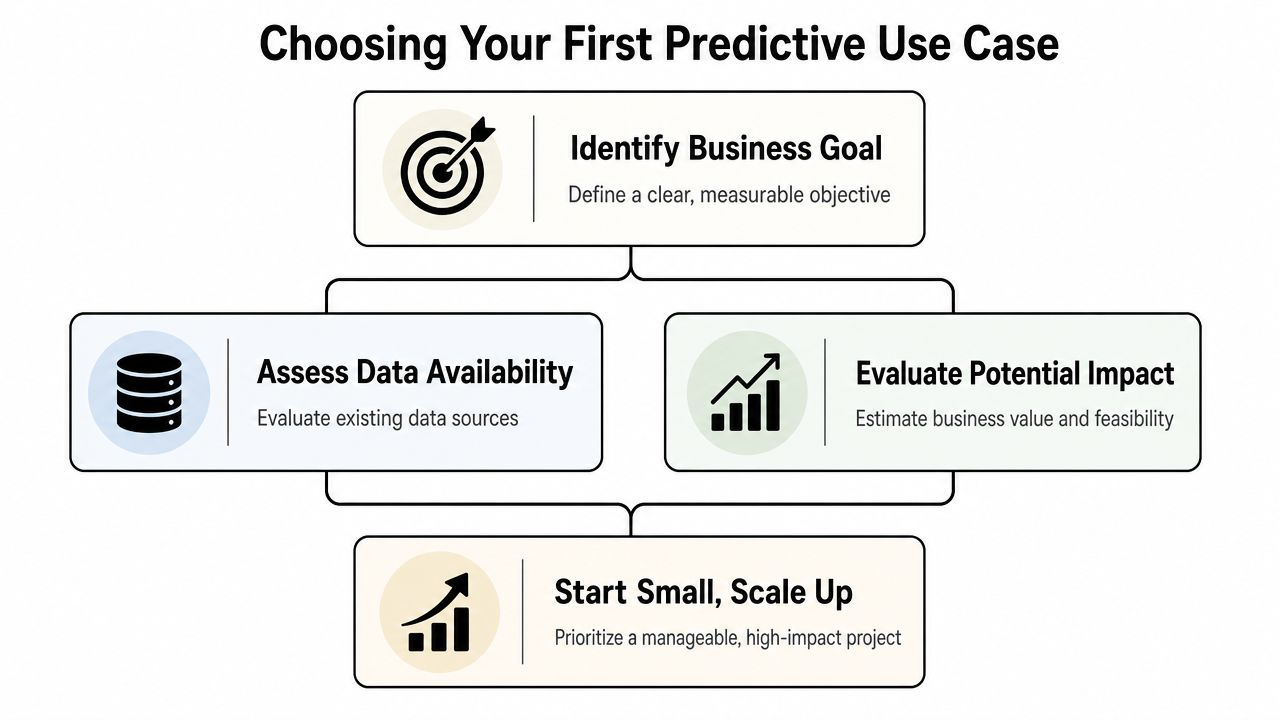
Most first projects fail because the team picks a broad ambition instead of a narrow business problem. “We want AI in sales” isn't a use case. “We want to identify which open opportunities need intervention this week” is.
If you're new to predictive analytics for sales, start where the pain is visible, the data already exists, and the workflow impact is easy to understand.
Recent practitioner guidance summarized by Valiotti on sales data analysis reports that companies using sales analytics see 15% to 20% higher win rates, 10% to 15% shorter sales cycles, and 25% to 30% better sales productivity compared with organizations relying on intuition. That's a strong case for starting, but only if the first use case is scoped tightly enough to prove value.
Three strong starting points
The best first project usually falls into one of these categories.
Opportunity forecasting
Best when leadership doesn't trust the current commit, best case, and pipeline roll-up. This use case predicts deal outcomes or pipeline quality more consistently than stage-based assumptions alone.Lead scoring
Best when inbound volume is high or SDR bandwidth is limited. If your team already debates which leads deserve fast follow-up, this is often the quickest path to visible impact. If you want the operational side of that workflow, this guide on lead scoring is a useful companion.Churn or expansion risk detection
Best when revenue retention matters as much as new logo growth. This use case works especially well when customer success, support, and product usage signals are already available.
How to choose without overthinking it
Use three filters.
- Business urgency: Pick the problem leadership already feels. Forecast credibility, wasted rep time, and hidden churn all qualify.
- Data readiness: Choose the use case with the cleanest existing signals. Don't force a churn model if your product usage data is scattered and unlabeled.
- Workflow fit: Pick the output your team can act on tomorrow. A rep can use a win probability score. They can't use an abstract model performance report.
Start with the question your managers already ask in pipeline review. That gives your model an immediate audience.
A simple decision lens
If your main issue is forecast instability, start with opportunity prediction.
If your team is overloaded with leads, start with lead scoring.
If renewals are slipping without warning, start with churn risk.
The common mistake is trying to launch all three at once. One good prediction embedded in one real workflow beats a broad AI initiative that never leaves the slide deck.
Build a Data Foundation That Drives Accurate Predictions
Most sales leaders underestimate this part because vendors make modeling look like the hard part. It usually isn't. In early projects, data quality determines whether the model becomes trusted or ignored.
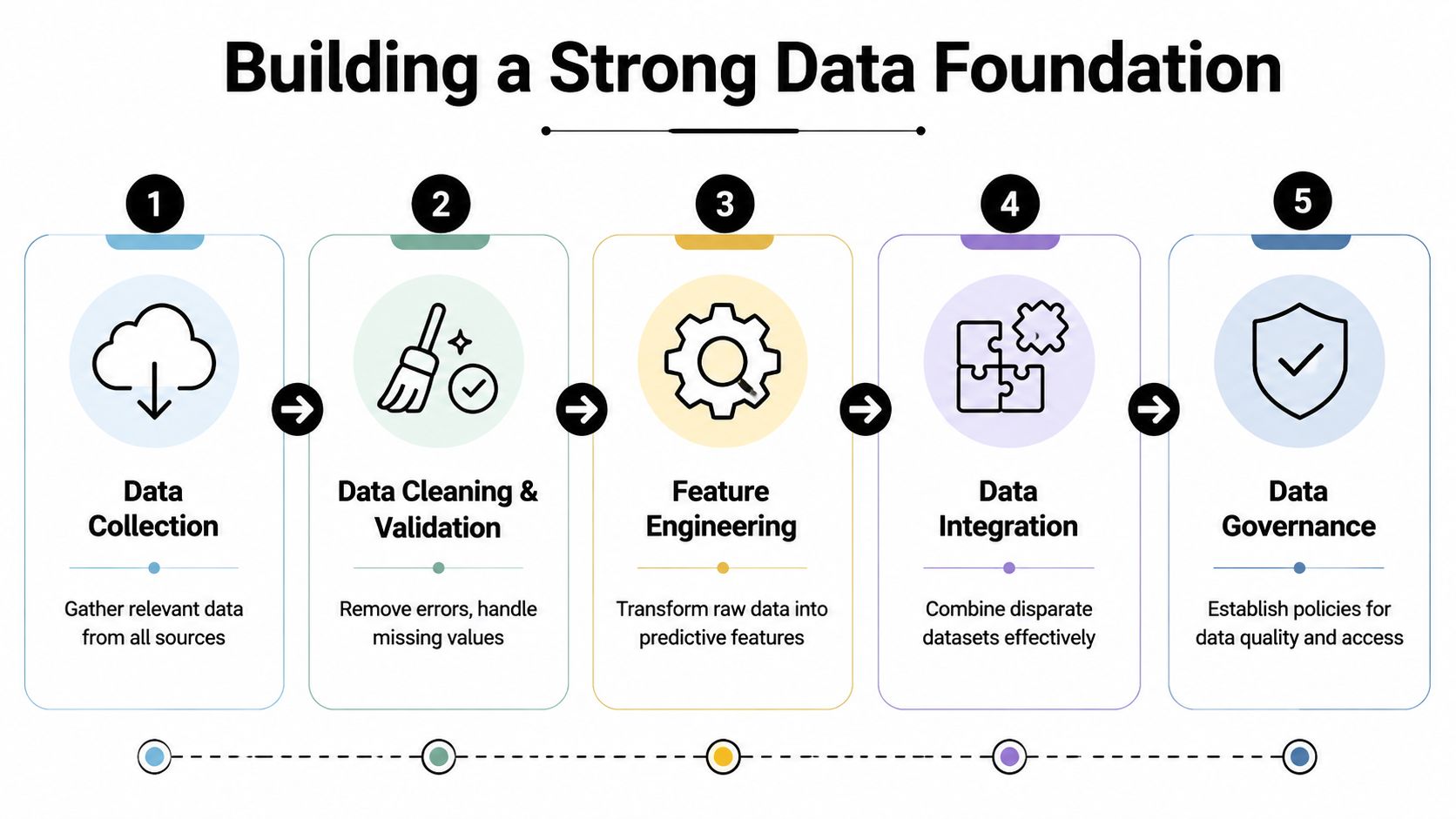
Vendor guidance summarized by Scoop Analytics on predictive analytics for sales forecasting says predictive sales forecasting can reach 85% to 95% accuracy with clean data and 2+ years of history, compared with 60% to 70% for manual forecasting. The same guidance also makes the main failure point clear: poor data quality is the most common reason for failure.
Start with the systems you already have
For most B2B SaaS teams, the core inputs are already sitting in operational tools:
- CRM data: Stage history, amount, close dates, owner changes, lead source, account fields
- Marketing automation data: Form fills, email engagement, campaign touches, webinar attendance
- Customer systems: Support tickets, onboarding progress, product usage, renewal status
- Rep activity data: Calls, emails, meeting cadence, sequence progression
You don't need every possible signal on day one. You need a minimum viable dataset that reflects how deals move through your actual funnel.
If your team enriches accounts with external firmographic or public profile data, consistency matters more than volume. A source like a social media API for LinkedIn can be useful when you need structured public-profile context, but only if you map those fields cleanly into your CRM and define who owns updates.
Clean the fields that affect outcomes
Don't launch into modeling with “mostly okay” CRM hygiene. Fix the fields that directly distort predictions.
Check these first
- Close dates: Reps often push dates forward without changing deal reality. That creates false recency and misleading pipeline timing.
- Stage definitions: If one rep's “proposal” means verbal alignment and another's means a PDF was sent, the model learns garbage.
- Duplicate accounts and contacts: Duplicate records split engagement history and hide account-level context.
- Missing values in key fields: Industry, segment, lead source, product line, and owner often matter. Blank fields reduce signal quality.
A practical governance pass usually includes validation rules, required-field logic, and deduplication workflows. It also includes social alignment. Sales managers need to enforce the same field meanings every week, not just during system cleanup projects.
Feature engineering without jargon
Feature engineering sounds technical, but in sales it's often just turning raw fields into useful indicators.
Examples include:
- Deal velocity: How quickly an opportunity moves between stages
- Revenue per customer: Useful when predicting likely deal size or expansion patterns
- Engagement score: A combined signal from activity, meetings, responses, or product interactions
- Time since last meaningful touch: Helpful for identifying stale pipeline risk
- Stage aging: Whether a deal has sat longer than similar wins usually do
The model rarely fails because the algorithm was too simple. It fails because the inputs didn't reflect how your sales process actually works.
Governance is part of the model
A predictive project isn't finished when the dashboard loads. It's only stable when new records enter the system cleanly enough to keep the output trustworthy.
That means assigning clear owners for field definitions, source syncs, exception handling, and regular QA. In practice, the best data foundation is the one your ops team can maintain without a rescue mission every quarter.
Choose the Right Predictive Model for Your Sales Goal
You don't need to become a machine learning specialist to make good decisions here. You only need to match the model type to the sales question.
At a high level, most first projects fall into two buckets. Some predict a category, such as whether a lead is likely to convert or whether an account is at risk. Others predict a value, such as likely deal size or expected revenue.
The easiest way to think about model choice
A classification model answers yes-or-no or category questions.
A regression model predicts a numeric outcome.
That's enough to get through most vendor demos and internal planning conversations without getting lost in terminology. If you want a broader primer on the concept, this explanation of predictive modeling gives the right foundation.
Matching Predictive Models to Sales Use Cases
| Sales Goal | Best Model Type | Example Question |
|---|---|---|
| Prioritize inbound leads | Classification | Which new leads are most likely to become opportunities? |
| Predict whether an open deal will close | Classification | Is this opportunity likely to close in the current period? |
| Flag churn or renewal risk | Classification | Which accounts need proactive outreach from customer success? |
| Estimate likely deal size | Regression | What revenue range is this opportunity likely to produce? |
| Forecast expansion potential | Regression | Which existing accounts are likely to grow, and by how much? |
What works well in practice
Classification is often the best starting point because the output is easier for revenue teams to use. High, medium, or low likelihood is immediately actionable. Reps can prioritize. Managers can coach. Customer success can intervene.
Regression becomes more useful once the organization wants finer planning inputs, such as estimating value bands or refining revenue expectations across segments.
Trade-offs to watch
- Classification is easier to operationalize: It's clearer for frontline teams.
- Regression can be harder to trust at first: Numeric predictions feel precise, so users may overread them.
- More complexity isn't always better: A simpler, explainable model often wins more adoption than a black-box score nobody understands.
- Feature relevance matters more than model hype: Good stage aging, engagement, and account-fit inputs usually beat fancy modeling on weak data.
Pick the model your managers can explain in pipeline review. If they can't explain it, reps won't use it.
For a first deployment, the right model is usually the one that produces a believable signal tied to one decision your team already makes.
Integrate Predictions into Your Sales Team's Workflow
A predictive score that lives in a standalone BI tool won't change behavior. Reps work inside the CRM, their inbox, their sequencing tool, and their manager's pipeline review. That's where the prediction has to show up.

Many predictive analytics for sales projects often stall. The model is technically sound, but the output arrives too late, in the wrong system, or with no clear action attached.
Put the score where decisions happen
In most B2B sales environments, that means embedding predictions directly into CRM objects and workflows.
A few examples work well:
- Opportunity records: Add a win-probability field, risk flag, or confidence band on the deal record.
- Lead and account views: Rank records by predicted priority, not just by latest activity date.
- Manager dashboards: Show likely-to-slip deals, stage aging exceptions, and forecast risk in one place.
- Automated alerts: Trigger tasks or notifications when an account's risk profile changes meaningfully.
The important part isn't just visibility. It's actionability. Every prediction should imply the next step. Review now. Re-engage this account. Escalate this renewal. Requalify this pipeline entry.
Don't ask reps to change everything at once
Adoption improves when predictive output supports current routines instead of replacing them overnight.
For example, if SDRs already work from a daily call list, sort that list using a predictive score. If AEs already attend weekly deal reviews, add a “model risk” checkpoint to the review. If your outbound program depends on inbox health and sequence performance, supporting deliverability basics like email warmup for sales teams can help the surrounding workflow perform consistently enough for the predictive signals to stay useful.
Good rollout pattern
- Start with one team: Pick a segment or region where managers are engaged.
- Add one visible output: One score, one risk flag, or one ranked list.
- Define one action: Tell users exactly what to do when the score changes.
- Collect feedback weekly: Reps will spot data issues and workflow friction faster than the dashboard will.
According to Varicent's guidance on predictive analytics for sales forecasting, teams should run the predictive model side by side with the current forecast in a 30 to 60 day test window and begin with one high-impact use case before scaling. That's the right discipline. A side-by-side pilot creates confidence because it compares decisions, not just abstract model outputs.
What a useful pilot looks like
A pilot should answer three practical questions:
- Are the predictions directionally better than the current method?
- Do managers and reps use the output?
- Does the output help them intervene earlier or prioritize better?
This walkthrough is a helpful visual reference for thinking about how analytics, forecasting, and workflows connect in practice:
If you can't show changed behavior during the pilot, don't scale yet. Fix placement, training, or data issues first.
Measure Real Business Impact and Avoid Common Pitfalls
Teams often obsess over model accuracy and ignore the harder question. Did the sales organization perform better because of the model?
That's the right test. Predictive analytics for sales should improve decisions, not just produce better math.
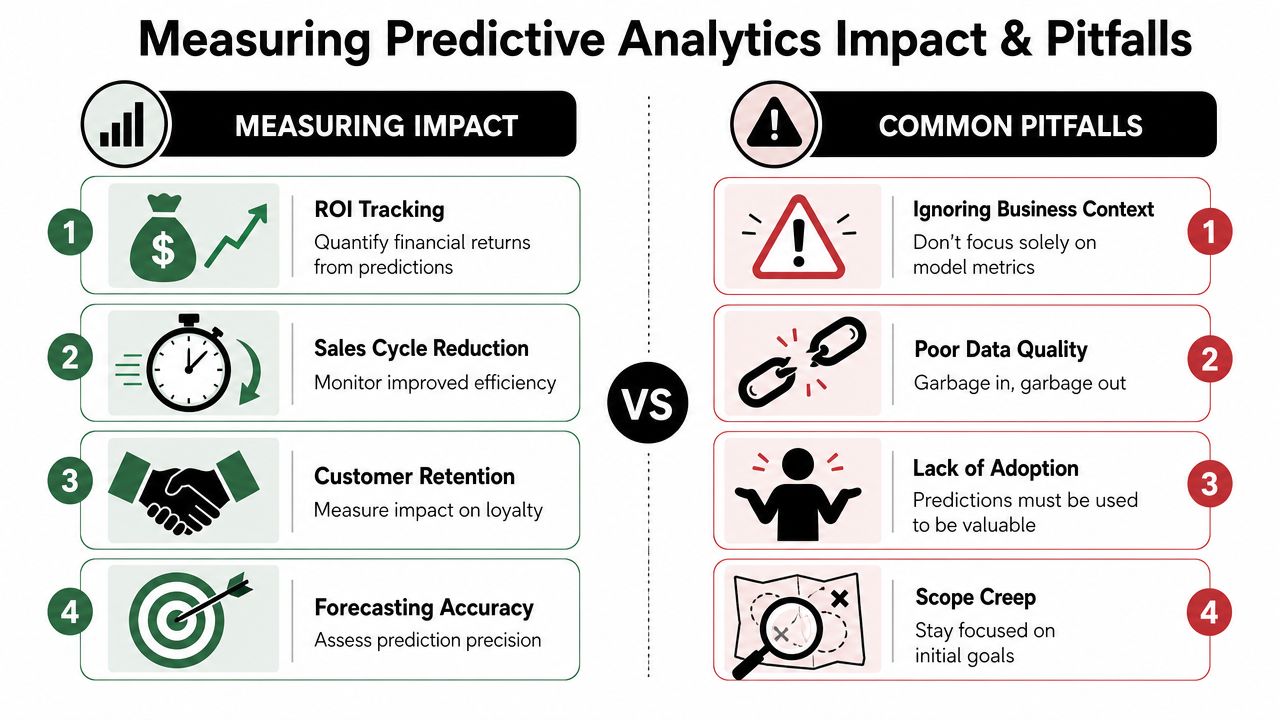
Research summarized by the American Marketing Association on predictive sales analytics ROI shows that success depends heavily on salesperson traits and their ability to use the tool. The same research notes that effectiveness improves when expectations about algorithm accuracy are realistic.
Measure business outcomes, not just model outputs
Start with the operating metrics your leadership team already trusts. For most B2B teams, that means looking at forecast quality, win rates, sales cycle movement, rep prioritization behavior, and retention or expansion outcomes where relevant.
If your baseline process is still fuzzy, this explainer on sales forecasting is worth revisiting before you define success criteria.
A practical measurement approach includes both of these:
| What to track | Why it matters |
|---|---|
| Forecast quality | Shows whether the organization can plan with more confidence |
| Win rate movement | Indicates whether better prioritization is improving conversion |
| Sales cycle movement | Reveals whether teams are acting earlier on risk and momentum |
| Rep adoption | Confirms whether the output is actually being used |
| Manager intervention quality | Shows whether coaching becomes more targeted and timely |
The pitfalls that sink otherwise good projects
The technical issues get attention. The human issues usually do more damage.
- Overtrusting the model: Teams sometimes treat the score as truth instead of input. That leads to missed context and lazy qualification.
- Underselling uncertainty: If leadership presents the model as flawless, frontline users will reject it the first time it misses an obvious deal.
- Ignoring user differences: Some reps naturally use structured tools well. Others need manager reinforcement and clearer workflows.
- Chasing scope creep: Once one use case shows promise, teams try to expand into everything at once and lose focus.
A prediction has no ROI until a salesperson or manager changes a decision because of it.
Set realistic expectations early
The healthiest adoption pattern is “use the model, then apply judgment,” not “obey the model” and not “ignore it unless it confirms your opinion.”
Managers should coach from that middle ground. Reps need to know what the score is based on, where it tends to help, and where human context still matters. That's how predictive analytics becomes part of a revenue system instead of a dashboard people politely avoid.
Start Your Predictive Sales Journey Today
The strongest first move isn't buying the most advanced platform. It's picking one revenue question your team struggles to answer consistently, then solving it with cleaner data and a workflow your reps will use.
Predictive analytics for sales works when it's grounded in reality. Start with one use case. Put the output inside the CRM. Run it beside your current process. Keep the model honest, and keep the team involved.
The payoff isn't just a smarter forecast. It's a sales organization that makes better decisions earlier.
If you want help turning this into a working system, MakeAutomation helps B2B and SaaS teams design and implement practical AI and automation workflows across CRM operations, lead management, forecasting processes, and sales execution.