
SOP Requirements for B2B and SaaS Teams
A common SOP recommendation is simple: document every workflow in the same level of detail, place each manual in a shared folder, and review everything on a fixed schedule. That advice sounds safe, but it creates a predictable operational failure. Low-risk procedures become burdensome to write, high-change workflows become outdated, and employees stop trusting the repository. SOP requirements for a B2B or SaaS company should be based on process risk, not document volume.
A useful SOP isn't a long file that proves a team has written something down. It's a controlled operating asset that tells the right person, system, or AI agent what to do, how to recognize a valid result, what to record, and when to escalate. The strongest programs balance execution speed, auditability, and change control instead of treating them as competing priorities.
Rethinking Documentation Depth and Proportionality
Every workflow doesn't need a compliance-style manual. A lightweight internal process, such as preparing a recurring team meeting, rarely needs the same approval chain and evidence requirements as a workflow handling customer data, revenue recognition, security access, or employee safety.
That position aligns with ISO guidance on documented information. ISO 9001:2015 requires organizations to maintain the documented information necessary to support process operation and retain evidence that processes are carried out as planned. It doesn't require every organization to maintain an identical, exhaustive manual of procedures. The practical test is whether documentation makes critical work controlled, repeatable, and verifiable.
Start with process exposure
I classify workflows using three questions:
- What could go wrong? Consider financial loss, customer impact, security exposure, regulatory consequences, data quality, and employee safety.
- How often does the process change? A stable finance-control workflow can support formal review, while an experimental growth workflow may change frequently.
- How much judgment does execution require? A simple checklist needs less explanation than a decision tree involving exceptions, approvals, and multiple systems.
This produces proportional documentation. A low-risk workflow might use an owner-maintained playbook with a purpose, trigger, steps, and escalation contact. A high-impact process needs controlled versions, named approvers, training evidence, access restrictions, quality checks, and retained records.
Avoid compliance theater
Over-documentation creates its own risk. If an SOP takes too long to read, employees work from memory. If an approval process is too slow, operators create unofficial copies. If a rapidly changing process requires a formal review for every minor wording change, the published version falls behind the live workflow.
Practical rule: Document the controls that protect the outcome, not every movement a person makes while completing the task.
For SaaS teams, the most valuable distinction is between a playbook, a formal SOP, and a controlled procedure. A playbook supports judgment and speed. A formal SOP defines a repeatable operational method. A controlled procedure governs work where an error must be detected, escalated, and evidenced. The same company may need all three.
The right question isn't, “Have we documented everything?” Ask instead, “What minimum level of control allows this process to run safely and consistently?” That answer should determine the document's depth, approval authority, review approach, and evidence requirements.
Mandatory Structural Elements for Every SOP
A formal SOP needs more than a title and a list of steps. Each section should remove a specific source of ambiguity for employees, contractors, reviewers, and automation systems. The structure should also make it obvious which parts are instructions, which parts are controls, and which parts are records.
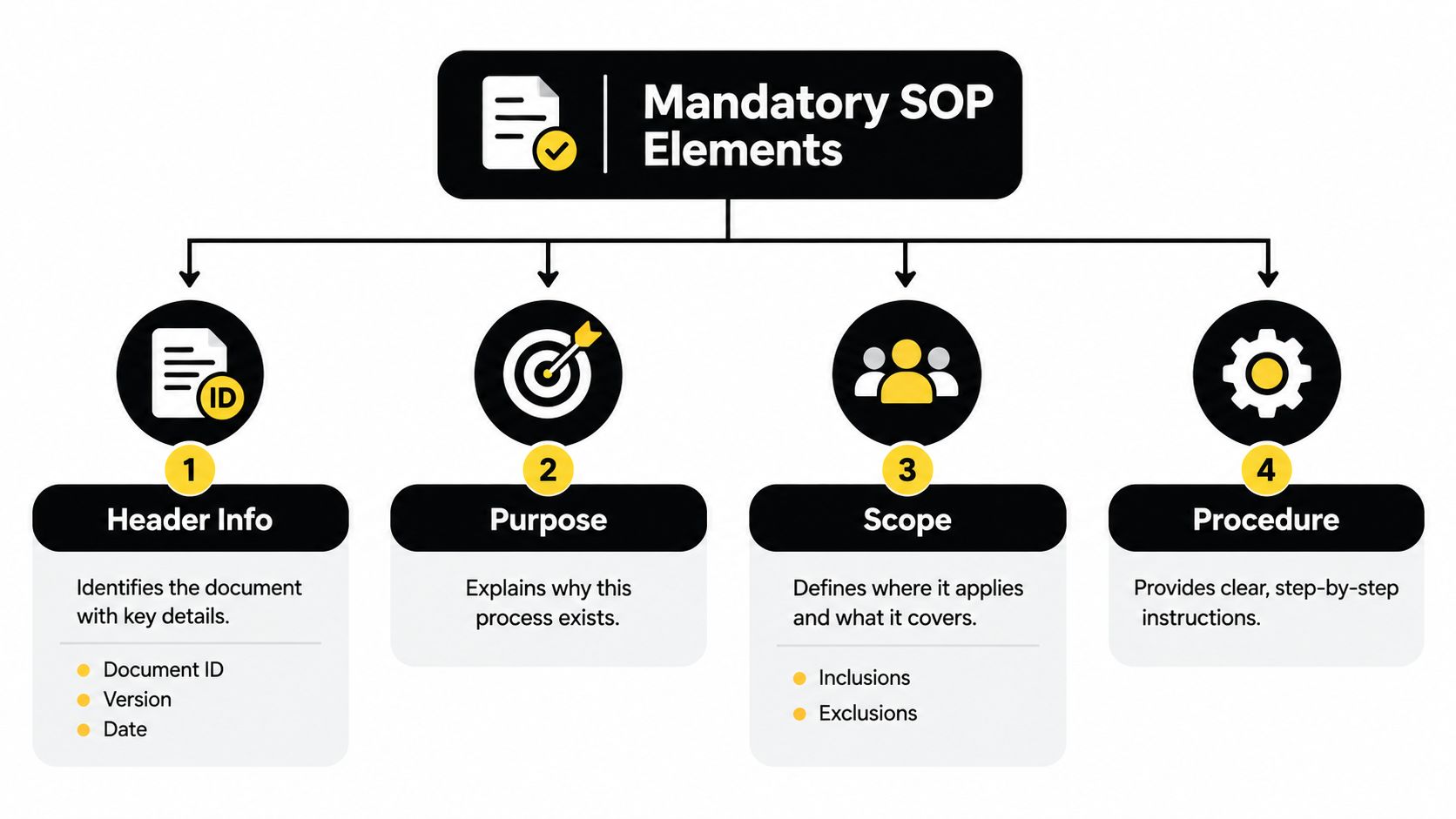
Build the document around four anchors
Header information establishes identity. Include the SOP title, document ID, owner, version, effective date, last review date, approver, and status. Without these fields, a user can't reliably determine whether the file is active or obsolete.
Purpose explains the intended outcome. It should state why the process exists and what successful execution protects or produces. “Manage leads” is too vague. “Route qualified inbound leads to the correct regional owner while preserving source data” gives the reader a usable operating objective.
Scope defines the boundaries. State which teams, systems, regions, records, and scenarios are included, then list meaningful exclusions. Scope prevents an automated workflow from acting on a record type that the procedure was never designed to handle.
Procedure contains the execution logic. Write actions in the order they occur, use the actual names of tools and fields, and identify decision points. Each step should answer who acts, what they do, what input they use, and what evidence they leave behind.
Add the control sections that prevent ambiguity
A formal SOP should also define responsibilities, definitions, tools and inputs, exceptions, quality checks, records, references, and approval history. These aren't decorative additions. They make ownership visible and give a new operator enough context to act without relying on tribal knowledge.
Use definitions for terms that vary across departments. “Qualified lead,” “activated account,” “high-risk customer,” and “screened candidate” should have one operational meaning inside the procedure. List exceptions beside the relevant step rather than hiding them in a distant appendix.
For teams building an integrated management system, the guida al SGI per aziende can provide useful context on how separate operational requirements fit into a coordinated management structure. The principle applies to SaaS documentation too: related SOPs should connect through shared terminology, records, and ownership.
A useful final test is to give the SOP to someone who knows the business but hasn't performed the task. If they can't identify the trigger, complete the normal path, recognize an exception, and locate the required evidence, the document isn't operationally complete.
Formatting Standards and Version Control Mechanics
A polished SOP can still create operational risk if its instructions are outdated. Treat the repository as a control system, not a document shelf. It should show the active version, limit unauthorized edits, preserve the change history, and connect every revision to a clear operational reason.
The active copy must be unmistakable. Use one canonical location rather than circulating attachments through email or chat. Each document header should identify the document ID, version, owner, effective date, review status, and approval state. A consistent template helps teams find information quickly, while predictable structure also lets automation tools and AI agents locate the relevant instruction without relying on visual interpretation.
Formatting should support execution:
- Use stable headings: Apply a predictable hierarchy so operators can scan procedures and automated systems can parse sections.
- Separate action from explanation: Put the instruction first, then add rationale or notes where they support a decision.
- Show decision paths clearly: Use tables, numbered steps, or flow diagrams when a condition changes the next action.
- Label evidence fields: State exactly what the operator or agent must record and where that record belongs.
- Make exceptions visible: Place failure handling near the affected step instead of hiding it in dense paragraphs or footnotes.
Teams comparing repositories and tooling can review SOP documentation software for structured process management. The product matters less than the operating rule: users and automated agents need one trustworthy source of truth.
Version changes are operational events. The record should state what changed, why it changed, who reviewed it, who approved it, and when it became effective. Archive the superseded copy as read-only, with a clear status label that prevents users from confusing it with live guidance. Older versions remain useful for audits and incident investigations.
A change to a CRM field, API, integration, prompt, permission model, or handoff rule requires impact assessment beyond a spelling review. Check affected inputs, outputs, exception paths, records, and training. For AI agents, also review the allowed tools, escalation boundaries, retrieval sources, and conditions under which the agent must stop. Test the revised procedure before release, then verify that production behavior matches the approved version.
The ICH Q10 guideline offers a mature model for management responsibility, process monitoring, corrective and preventive action, change management, and management review. SaaS teams do not need to reproduce a pharmaceutical quality system. They can adopt its control loop and apply it to automated workflows.
Version-control rule: If a workflow can change without someone assessing the SOP, the business has undocumented change management.
Calendar reviews suit stable processes, but high-change automation needs event-based triggers. Start a review when a system changes, an incident occurs, an exception repeats, a metric deteriorates, or an owner finds a mismatch between the documented and actual workflow.
Defining Measurable Acceptance Criteria
Most weak SOPs describe activity instead of quality. They say “review the record,” “route the request,” or “check the output,” but they don't define what a reviewer should accept, reject, measure, or escalate.
An acceptance criterion turns a narrative instruction into a test. It defines the expected result, the evidence required, and the condition that triggers investigation. That distinction is central to reliable B2B operations because a completed task can still produce a wrong customer record, an incomplete handoff, or an unsafe automated decision.
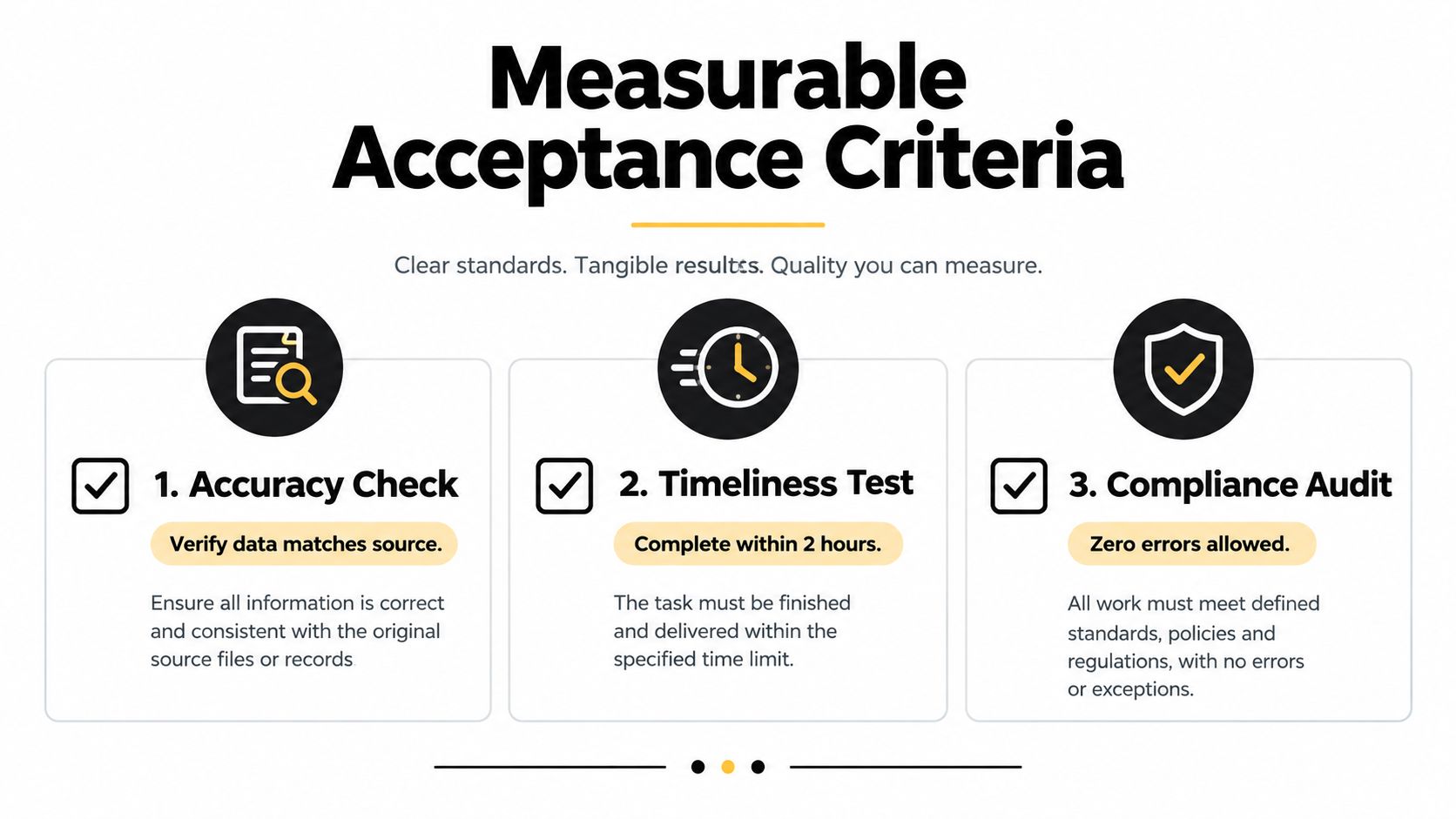
Define what “correct” means
For each critical step, specify four things:
- Input condition: What must be present before the step starts?
- Action: What does the operator or system do?
- Expected output: What should exist after completion?
- Evidence and escalation: What gets recorded, and who responds when the result falls outside the requirement?
For example, a lead-routing SOP might require the source field, region, company size, and consent status to be present before assignment. The output might be a named owner, a recorded routing reason, and a task in the correct queue. A missing field should create an exception, not a silent assignment based on guesswork.
Use controls that match the process
Regulated laboratory operations show how detailed these controls can become. FDA requirements make laboratory manuals and SOPs related to performed procedures immediately available in each laboratory area. FDA guidance also describes statistical limits set at a 99% confidence interval and control-limit evaluation using no fewer than seven to ten data points gathered across different conditions, as stated in its facility operation guidance.
A SaaS team may not need the same statistical design, but the lesson transfers: define the sampling method, acceptance threshold, measurement characteristic, reviewer, and response. Don't use “check periodically” when the process needs a named review trigger.
Useful measures include:
- Accuracy: Does the result match the source record and business rule?
- Completeness: Are mandatory fields, approvals, and evidence present?
- Timeliness: Was the work completed within the agreed service expectation?
- Exception rate: How often does the standard path fail?
- Rework: How often must another person correct the result?
- Escalation quality: Did the operator route the problem to the right owner?
Acceptance criteria should be demanding enough to protect the outcome but practical enough to measure consistently. A threshold nobody can observe becomes a policy statement, not a control.
Governance Models and Process Ownership
A version number does not create control. The person accountable for the operational result must own the process, approve meaningful changes, and investigate evidence that execution no longer matches the intended design.
Assign the process owner to the person who can change the outcome, rather than the person who drafted the SOP. A RevOps leader may own lead routing, a customer operations leader may own onboarding, and a security leader may approve workflows involving privileged access. The author can maintain the file, but authorship and accountability remain separate responsibilities.
Governance works best when each role has a defined decision boundary:
- Owner: Maintains the procedure, monitors results, and starts revisions.
- Approver: Confirms that the process is safe and suitable for release.
- Operator: Performs the work or supervises the automation.
- Reviewer: Examines samples, exceptions, and supporting evidence.
- System owner: Assesses technical changes that could alter execution.
Keep this assignment with the workflow, not with a department name alone. Otherwise, the SOP may remain assigned to a former employee or a team that no longer controls the process. The owner also needs authority to pause automation when production behavior diverges from the approved procedure.
Review frequency should follow process volatility and operational risk. A stable, low-risk procedure may need only an owner review. A workflow tied to customer data, financial reporting, security, or an automated decision path needs approval and event-triggered review. Triggers can include a CRM migration, API change, new data field, revised regulatory obligation, security incident, repeated exception, or a noticeable shift in an AI agent's behavior.
A documented process standardization framework can turn informal operating knowledge into consistent workflows. Standardization should preserve the intended control while allowing the execution method, tools, and agent logic to change under review. Versioning must therefore record the affected process, decision owner, implementation change, validation evidence, and rollback path.
Ownership principle: A procedure without an accountable owner is not controlled, even if it has a version number.
Before release, require impact assessment, testing, approval, and communication to affected operators. Link training evidence to the released version. After release, assess both adherence and outcome. People may follow every documented step while the procedure still produces a poor result because its assumptions are wrong. Governance must ask two questions: “Did people follow it?” and “Did following it produce the intended result?”
Adapting Requirements for AI and Automation Agents
AI does not need a shorter SOP. It needs a different control surface. A person can ask a colleague to clarify an ambiguous instruction. An AI agent or automation will follow the available logic, infer missing context, or continue along a plausible path until a downstream system rejects the result.
That makes agent governance a process-control problem, not only a documentation task. Human-facing procedures and machine-facing specifications should connect, while serving different purposes.

Define the human and machine contracts
The human SOP should explain purpose, responsibilities, decisions, exceptions, and required evidence in language operators can apply. The agent specification should remove ambiguity from the execution layer by defining:
- Trigger definition: Which event starts the workflow, and which similar events must be ignored?
- Input schema: Which fields are required, which formats are valid, and what happens when values are missing?
- Prompt or rule logic: Which instructions control classification, extraction, prioritization, or response generation?
- Tool permissions: Which systems may the agent access, and which actions may it perform?
- Handoff parameters: What information must pass to the CRM, ticketing system, email platform, or human reviewer?
- Exception path: What happens when confidence is low, an API fails, a field is missing, or a request falls outside scope?
- Audit record: Which prompt version, input, output, decision, and human override must be retained?
“Escalate an uncertain request” may be enough for an operator. Machine instructions should specify how uncertainty is identified, which queue receives the item, what status is recorded, and what the reviewer sees.
Treat changes as controlled releases
A prompt change can alter outcomes even when the visible SOP remains unchanged. The same risk applies to model configuration, API responses, CRM fields, routing rules, and authentication scopes. Record these dependencies with the procedure, then test representative normal and exception paths before release.
Teams implementing these controls can use AI agent best practices for controlled automation as a practical reference. Operators should be able to reconstruct an automated decision after an error, rather than treating the process as a black box.
Monitor completion accuracy, exception frequency, human overrides, failed handoffs, and unexpected outputs. When behavior shifts, capture the actual input and output, compare them with the approved instruction set, and assign the correction to the right layer: prompt, workflow logic, data validation, or SOP. This keeps version control tied to observed behavior instead of limiting it to document edits.
Quick Reference Matrix for Process Categorization
A process classification system helps operations leaders decide where to spend documentation effort. Start with business impact, then consider regulatory exposure, data sensitivity, change frequency, and the consequences of an incorrect result.
The matrix below is a practical starting point. It isn't a substitute for a legal or regulatory assessment, but it prevents teams from applying the same controls to every internal workflow.
SOP Proportionality Matrix
| Risk Tier | Process Examples | Documentation Depth | Review Cadence |
|---|---|---|---|
| Low | Internal meeting preparation, routine team updates, simple knowledge sharing | Owner-maintained playbook with purpose, trigger, steps, tools, and escalation contact | Owner review when the workflow changes or users report confusion |
| Moderate | Lead enrichment, campaign handoffs, standard project intake, routine customer administration | Formal SOP with scope, definitions, responsibilities, decision points, exception handling, records, and acceptance checks | Review after system or ownership changes, recurring exceptions, or evidence of quality decline |
| High | Customer onboarding involving multiple systems, access provisioning, recruitment screening, sensitive support workflows | Controlled SOP with named approver, version history, permissions, training evidence, sampled checks, and retained records | Event-triggered review plus an owner-led effectiveness review appropriate to the process |
| Critical | Financial reporting, security access, regulated activity, customer data handling, safety-related work | Audit-ready controlled procedure with impact assessment, approval, validation, evidence retention, escalation, corrective action, and superseded-version archive | Formal review tied to control requirements and immediate review after material changes or incidents |
Apply the matrix without overcomplicating it
First, identify the consequence of failure. A wrong internal meeting agenda and an incorrect customer-data export shouldn't enter the same governance queue.
Second, identify the process's volatility. A low-risk workflow that changes frequently may need a short, searchable playbook rather than a long manual. A stable high-risk procedure needs deeper control even if its steps rarely change.
Third, assign the minimum evidence needed to prove execution. That could be a completed checklist, an approval record, a system log, a quality sample, or an exception register. Evidence should be proportionate, searchable, and linked to the procedure version.
Finally, revisit the classification when the process expands. A lead-routing workflow may start as a moderate-risk process, then become high impact when it assigns enterprise accounts, controls customer communications, or uses sensitive enrichment data. Risk tiers describe the process as it operates today, not as it existed when someone first documented it.
Practical Examples for Core SaaS Workflows
The difference between a usable SOP and a decorative one becomes clearer in live workflows. Three common SaaS processes show how the same structural principles produce different controls.
Automated lead routing
The SOP begins with a clear trigger, such as a new inbound record that meets the workflow's inclusion conditions. Its scope excludes existing opportunities, test records, and records lacking the minimum data needed for assignment.
The procedure defines field validation, enrichment, territory logic, ownership assignment, duplicate handling, and the notification sent to the receiving team. Acceptance criteria verify that the assigned owner matches the routing rule, the reason is recorded, and the source data remains intact. A missing region or conflicting account match creates an exception for a named RevOps owner.
Governance changes when the CRM schema, territory model, enrichment provider, or assignment logic changes. The owner tests normal and exception paths before release and updates the version history.
Customer onboarding
Onboarding usually crosses sales, implementation, support, finance, and the customer. The SOP should define the handoff trigger, required contract and customer data, implementation milestones, approval points, and the record that confirms each stage.
A useful acceptance model checks that the correct plan and contacts are recorded, required access is provisioned according to policy, customer-facing commitments are visible to the delivery team, and unresolved blockers have an owner. It should also state what happens when the customer doesn't provide required information or when the implementation path needs to depart from the standard sequence.
Companies that use external remote staffing services should make the same ownership and evidence requirements explicit for contractors. The person performing a step may be external, but the internal process owner remains accountable for access, quality, escalation, and record retention.
AI-assisted recruitment screening
An AI-assisted screening SOP needs more than a prompt. It should define permitted inputs, prohibited data use, the screening criteria, the human review point, candidate communication rules, and the record retained for each decision.
The acceptance criteria might verify that the agent uses only approved job requirements, preserves candidate information accurately, flags uncertain cases for human review, and never makes a final decision where policy requires human judgment. The exception path should cover ambiguous resumes, missing information, model failures, and candidate requests for clarification.
Any change to the prompt, evaluation criteria, connected applicant-tracking fields, or human approval step should trigger an impact assessment. The SOP must show which version governed a decision so the team can investigate an outcome without guessing which instructions the agent received.
Measuring Operational Effectiveness and Assurance
The final test of an SOP isn't whether the file exists. It's whether people and systems can execute the process correctly, produce the intended outcome, and surface deviations early enough to correct them.
A 2025 healthcare compliance benchmark identified keeping pace with regulatory change as a leading challenge, with organizations emphasizing documentation updates, training, monitoring, and audits. The same benchmark reported that nearly two-thirds of organizations relied primarily on internal audits, compared with only about one-fifth using independent assessments, as described in the 2025 Healthcare Compliance Benchmark Report. For SaaS operators, the broader lesson is that internal confidence isn't enough. Teams need evidence that the documented process is being followed and remains effective.
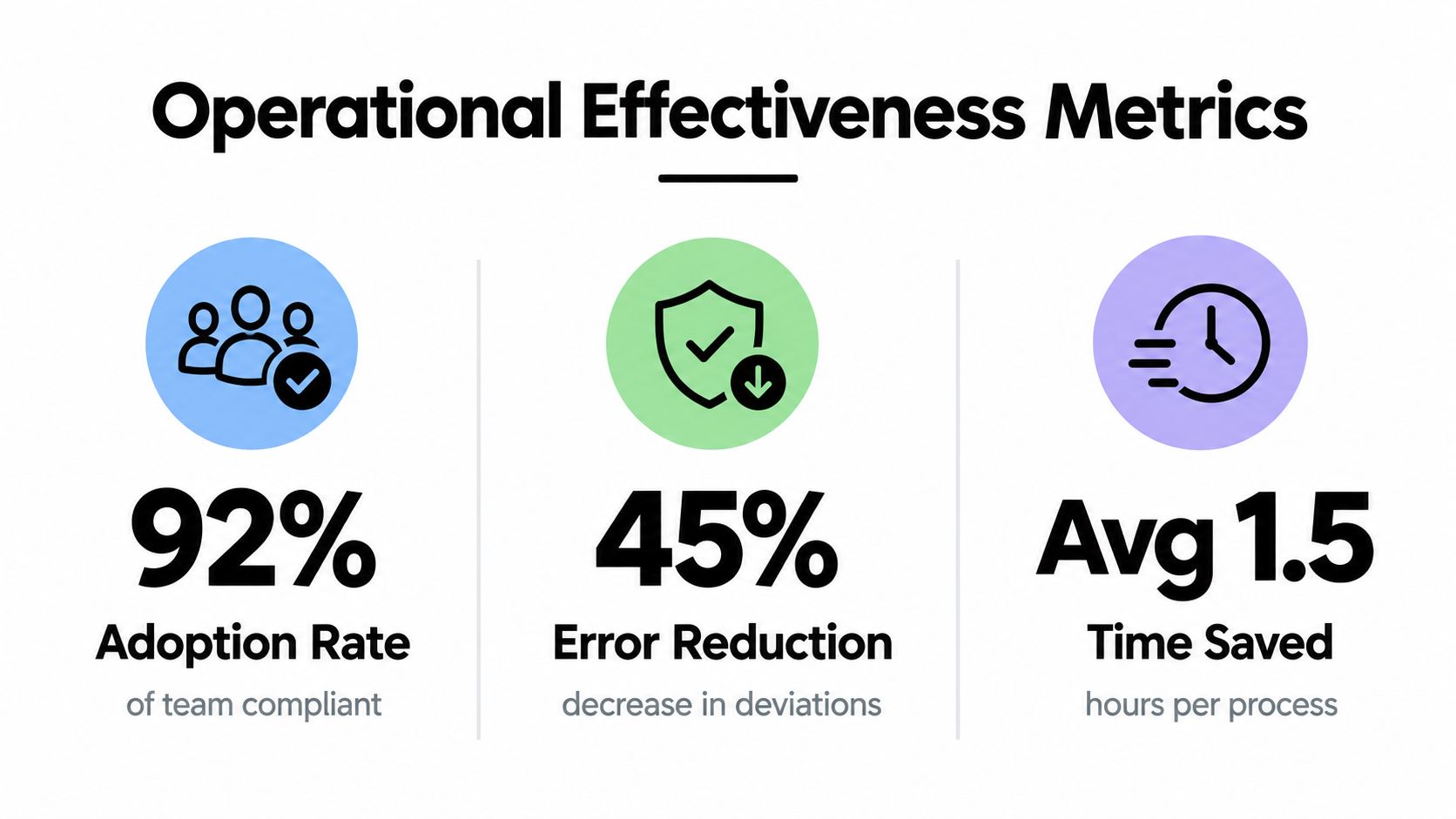
Measure adoption and execution
Track whether the people responsible for a workflow can find the active SOP, complete version-linked training where required, and follow the documented path. Don't treat a training completion record as proof of competence. Sample actual work and compare it with the procedure.
Useful operational indicators include:
- Completion accuracy: Whether required fields, approvals, and actions are present.
- Cycle time: How long the process takes from trigger to accepted outcome.
- Exception rate: How often the standard path fails or requires judgment.
- Rework: How frequently another person must correct the result.
- SLA adherence: Whether work arrives within the defined service expectation.
- Automation failures: Whether integrations, agents, or handoffs produce errors.
- New-operator proficiency: How quickly a new employee can complete the process correctly with the available guidance.
Connect metrics to review triggers
A metric matters only when it changes what the owner does. Define the condition that starts an investigation, the person responsible for reviewing evidence, and the possible corrective actions. A recurring exception may require clearer input validation. Rising rework may indicate an ambiguous step. A sudden change after an integration release may require rollback, retraining, or a new version of the SOP.
Maintain an exception log that captures the date, process version, failure type, impact, owner, resolution, and follow-up action. Use sampled quality checks rather than relying only on self-attestation. For high-impact workflows, independent review can expose blind spots that a team auditing its own routine may miss.
Assurance test: An effective SOP leaves behind enough evidence to explain what happened, who acted, which version governed the work, and whether the result met the acceptance criteria.
This is the shift from document production to dynamic process control. The SOP becomes one part of a loop involving execution data, exception handling, change management, training, and corrective action. That loop gives operations leaders a defensible way to scale automation without allowing outdated instructions to multiply errors.
MakeAutomation helps B2B and SaaS teams design, document, test, and hand over automated workflows, including SOPs, recorded walkthroughs, and team training. Visit MakeAutomation to discuss a controlled process framework for your CRM, AI agents, recruitment workflows, or customer operations.