What Is B2B Lead Generation? a Complete Guide for 2026
B2B lead generation is the structured process of attracting potential business customers, capturing their contact or qualification data, and moving them toward a sales conversation. Because a typical B2B purchase involves 13 to 17 stakeholders and SMB B2B SaaS funnels convert roughly 2.7% of raw leads into customers, effective programs focus on building account-level momentum rather than collecting email addresses.
Why do so many B2B teams celebrate doubling their monthly form fills, only to watch closed revenue stay completely flat? That gap shows up when organizations treat what is B2B lead generation as a volume game built around gated ebooks and cold contact lists. Pulling more low-fit contacts into a CRM can shrink your pipeline, because reps spend their week chasing non-buyers while real prospects wait for a reply and key decision-makers inside target accounts never hear from you. Building a lead program that works starts with separating real commercial interest from simple web traffic.
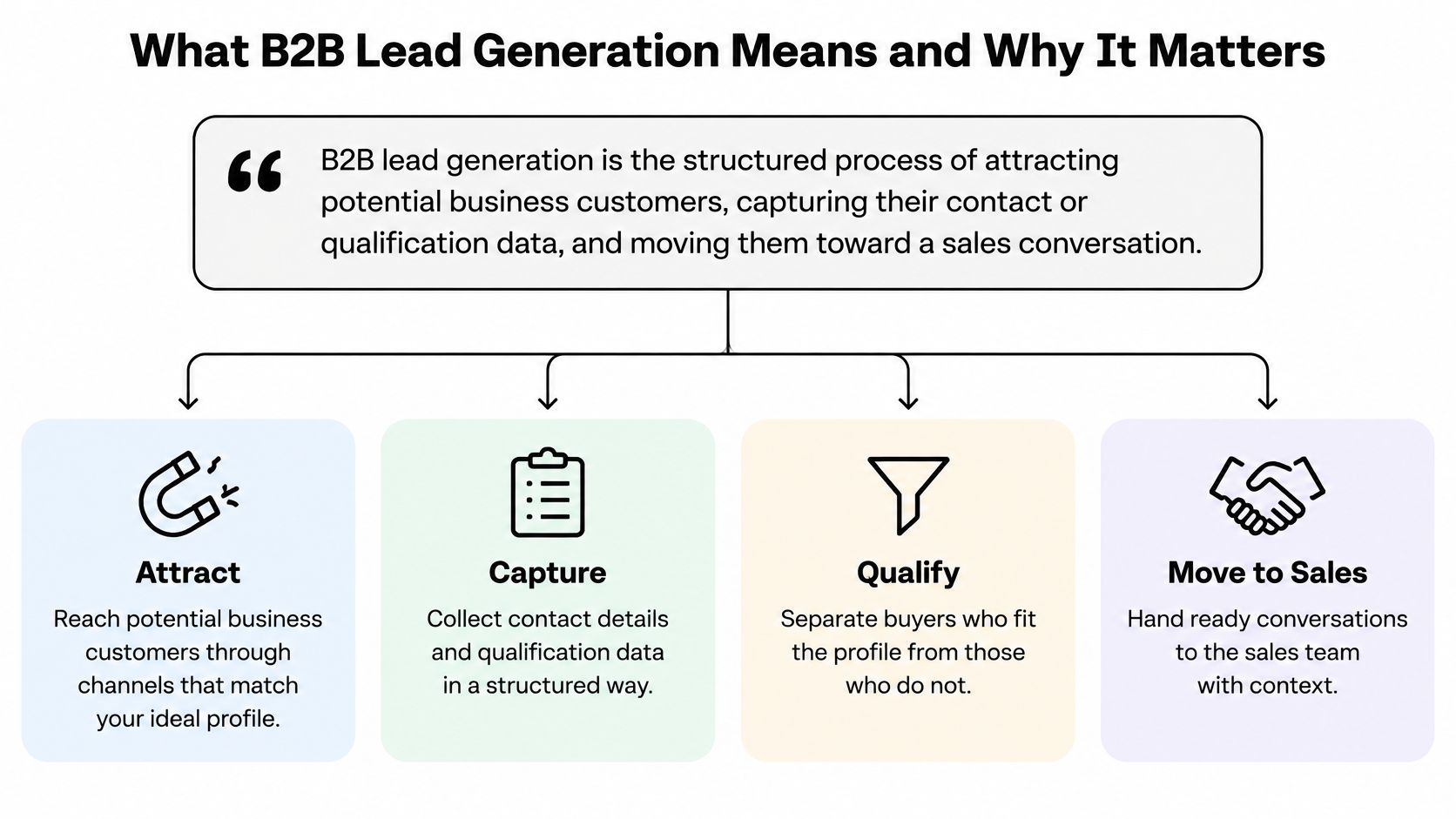
What B2B Lead Generation Means and Why It Matters
B2B lead generation is the structured process of attracting potential business customers, capturing their contact or qualification data, and moving them toward a sales conversation.
Think of a B2B lead program like running a booth at an industry trade show. A crowded booth with bright signage looks impressive on paper, yet all that foot traffic costs money and delivers zero return unless your team captures a visitor's business card, learns what operational problem brought them over, and agrees on a relevant follow-up. Attention without identity is just noise, and identity without context gives your sales team nothing useful to say.
Three Elements That Make a Lead Commercially Usable
Not every name sitting in a database qualifies as a lead. A record only becomes commercially usable when your team can connect three specific pieces of information inside your CRM:
- An identifiable person and company: You need a real business contact tied to a verifiable organization, not a generic inbox like info@company.com or a disposable personal address.
- A relevant business need: The organization should match the type of problem your product or service solves, supported by role, industry, or company-size signals.
- A consent or engagement signal with context: You need permission to follow up plus a clear record of what the prospect viewed, downloaded, or asked, so the first outreach feels timely rather than intrusive.
Consider the difference between two form submissions that both appear as "new leads" on a marketing dashboard. In the first case, a graduate student downloads an industry report using a personal Gmail address to finish a class paper; they hold no budget and no buying role. In the second case, a named operations director at a 120-person logistics company downloads a pricing comparison sheet and ticks the box for a consultation. One entry creates wasted rep time, while the other opens a genuine commercial conversation.
Why Independent Research Widened the Channel Mix
Relying on a single "Contact Us" page stopped working years ago because business buyers educate themselves long before raising a hand. In a 2011 Google and Compete study, 73% of B2B customers used search engines when researching potential purchases, compared with 51% who used brand websites, 45% who used online reviews, and 42% who used professional-association websites. The same study found that 68% considered online information important during business-purchase research, surpassing peer and colleague opinion at 59%, while one in four B2B customers from C-suite executives to small business owners used mobile phones for online business research.
Those habits mean a B2B or SaaS company can't wait at the bottom of the funnel for a form submission. You have to show up where buyers already investigate options, including search results, educational articles, review platforms, peer communities, events, referrals, and targeted outreach, while making every mobile capture form fast to complete. Teams that want their search presence, site structure, and content to work together often review integrated execution approaches like Verbatim Digital services to connect brand discoverability with structured lead capture.
Try a quick audit before changing any campaign: export your last 50 CRM leads and count how many records contain all three elements (identifiable target buyer, relevant business need, and clear engagement context). That single number tells you immediately whether you have a traffic problem or a qualification problem.
How the B2B Lead Generation Process Works Stage by Stage
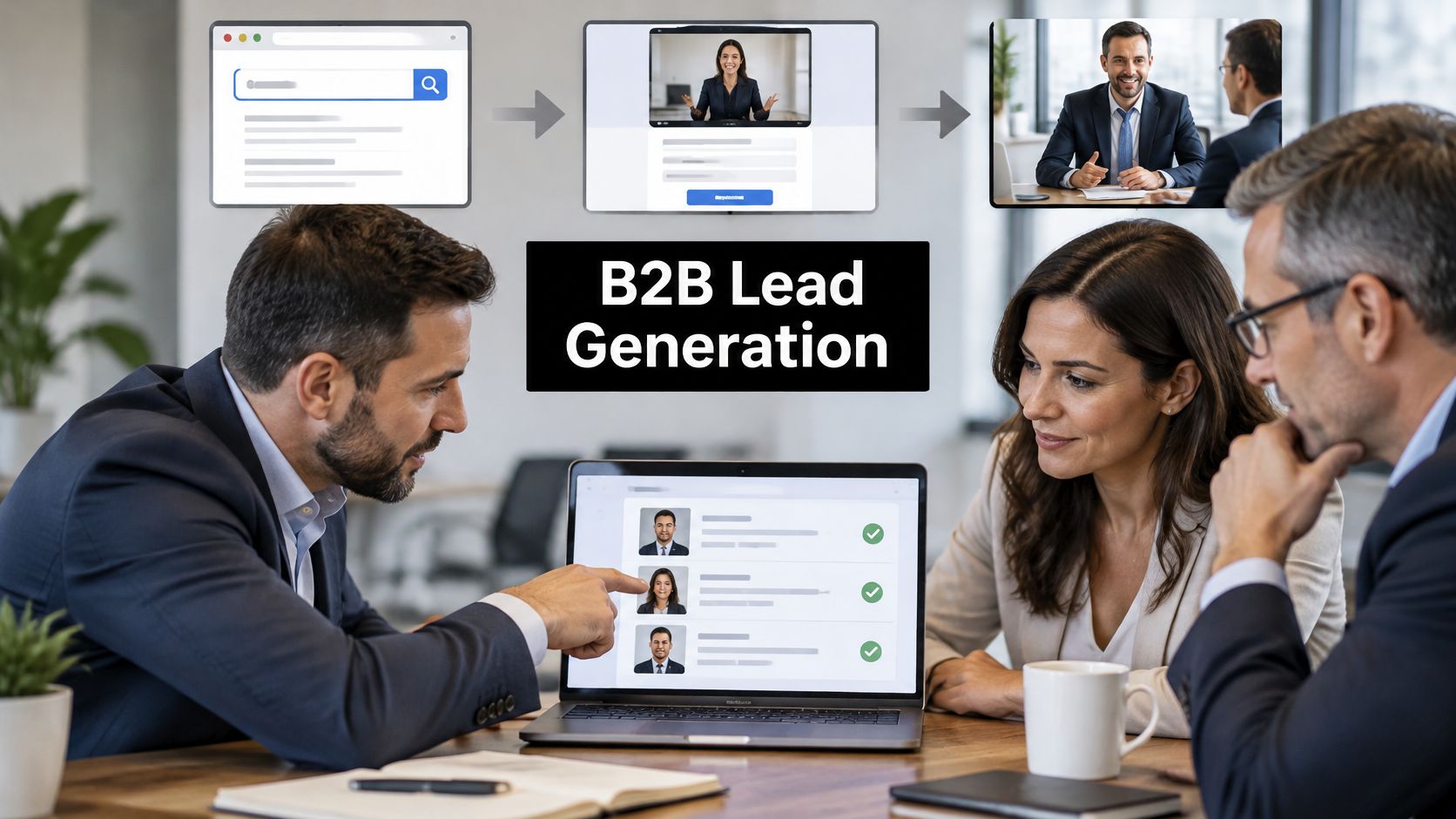
A healthy lead program runs like an assembly line where every handoff has a named owner and required CRM fields. The visual below shows how top-of-funnel attention narrows into captured, qualified demand before reaching sales.
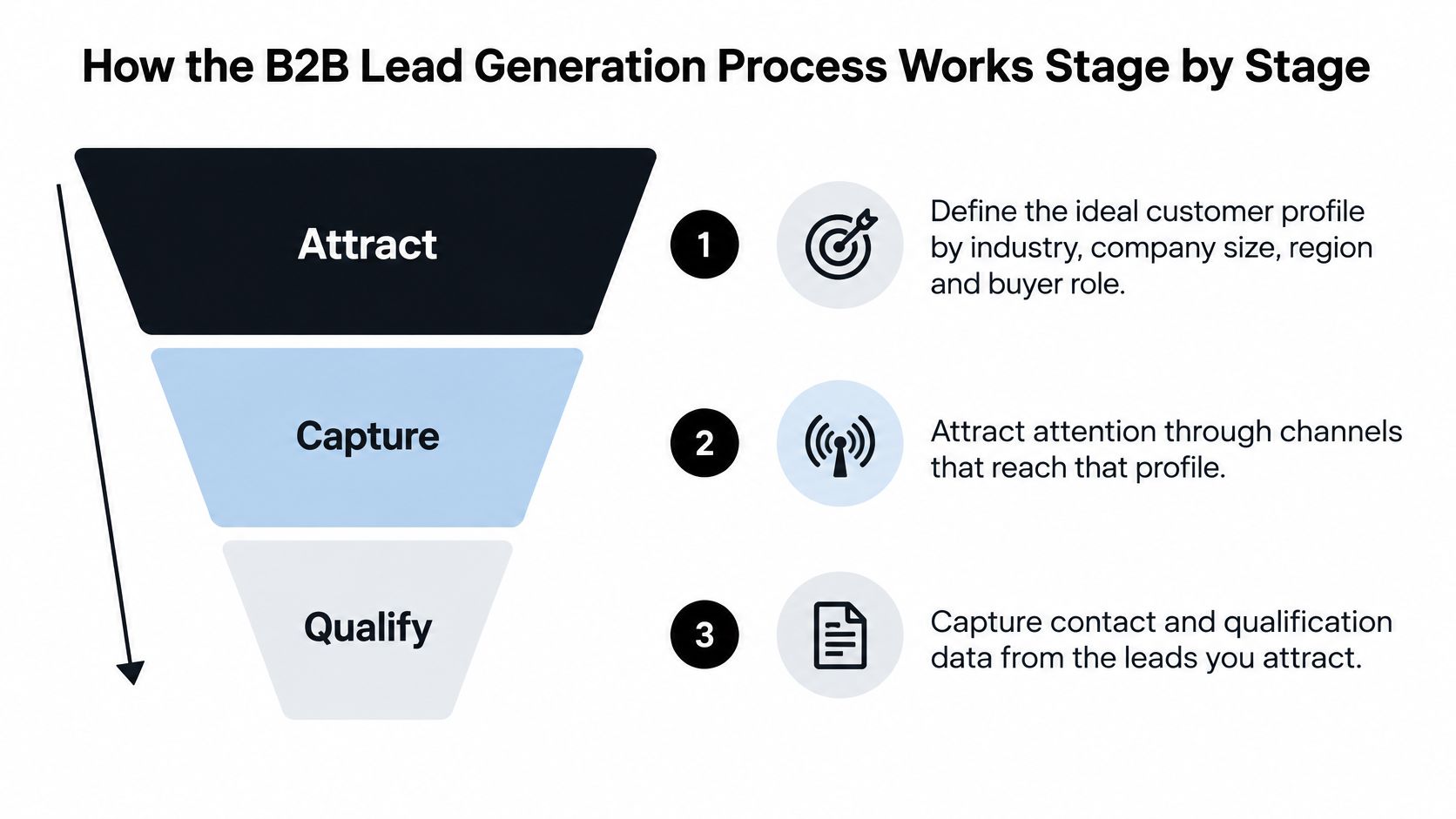
Six Operational Stages From Target Account to Customer
When a B2B lead program breaks down, the failure usually hides at the boundary between stages rather than inside a single ad campaign. Following a strict six-step sequence keeps marketing, sales, and operations aligned on what gets recorded in tools like HubSpot, Salesforce, or Pipedrive:
- Define the ideal customer profile (ICP): Marketing and sales leadership jointly specify target industries, employee headcount, geography, revenue band, and key buyer roles. Operations codifies those exact attributes as structured picklist fields inside the CRM so every future record can be checked against them automatically.
- Attract target attention: Marketing publishes search content, runs targeted campaigns, hosts educational sessions, and supports outbound outreach aimed squarely at the defined profile. The CRM and analytics stack record the acquisition channel, campaign name, UTM parameters, and landing page URL.
- Capture identity and consent: Prospects convert through web forms, live chat widgets, meeting schedulers, or webinar registrations. Operations ensures every capture point writes the contact's work email, company domain, job title, opt-in status, and conversion asset directly into the CRM without manual copy-pasting.
- Score and promote to marketing-qualified lead (MQL): Marketing operations evaluates each captured record on profile fit and engagement depth, advancing records that clear the threshold to MQL status. The CRM logs the fit score, activity score, MQL timestamp, and triggering action.
- Review and accept as sales-qualified lead (SQL): Sales development reps or account executives verify the MQL within an agreed timeframe and accept viable prospects as SQLs. Sales records the acceptance date, discovery notes, or a mandatory disqualification reason if the lead gets returned to marketing.
- Convert into opportunities and closed customers: Account executives run discovery to confirm an active business problem, budget, and timeline, moving valid deals into the opportunity stage and working them through to signature. Sales tracks projected deal value, target close date, participating stakeholders, and closed-won or closed-lost outcomes.
For a concise visual walkthrough of how teams structure these acquisition and qualification stages in practice, watch the breakdown below before reviewing conversion benchmarks.
Reading SMB SaaS Funnel Benchmarks Without Broken Forecasts
Once your stages are defined, benchmarks help you spot where prospects drop out. According to the LeadSpot B2B benchmark guide, SMB B2B SaaS funnels report approximately 31% conversion from raw lead to MQL, 13% from MQL to SQL, 47% from SQL to opportunity, and about 2.7% from raw lead to customer.
| Funnel stage | Benchmark conversion | What the transition means |
|---|---|---|
| Raw lead to MQL | about 31% | The lead matches the ideal customer profile and shows engagement |
| MQL to SQL | about 13% | Sales reviews the lead and accepts it as worth active follow-up |
| SQL to opportunity | about 47% | A real need, budget and timeline are confirmed in conversation |
| Raw lead to customer | about 2.7% | End-to-end benchmark; validate against your own CRM before forecasting |
Read each row as a diagnostic check on a specific handoff rather than a formula you can blindly chain together. Funnel stage rates are multiplicative, not additive, and the math reveals an important trap. If 10,000 raw leads enter the funnel, multiplying those stage rates (31% times 13% times 47%) produces roughly 1.9% from raw lead to opportunity, or about 3,100 MQLs, 403 SQLs, and 189 opportunities.
Yet applying the cited 2.7% raw-lead-to-customer rate independently to those same 10,000 raw leads implies roughly 270 customers, which is impossible when only 189 opportunities exist. Because the stage-by-stage averages and the end-to-end estimate don't reconcile mathematically, you should treat them as separate reference points, pick one consistent cohort denominator in your CRM, and validate every transition against your own historical records before forecasting revenue. Pumping extra raw leads into the top of a weak funnel only creates more MQLs on a slide deck unless fit scoring and sales handoff standards improve alongside volume.
Channels That Bring B2B Leads Into the Funnel
Channel strategy starts with how quickly buyers move once they decide to look for a vendor. In a 2025 Google and National Research Group study surveying 2,063 senior U.S. business leaders who had recently purchased technology, software, web services, or retail products, 94% of surveyed buyers who searched online for a product used Google Search, and 59% of U.S. B2B buyers used social media during research. Nearly three-quarters finished their purchasing journey within 12 weeks or less, and 58% of buyers who made a B2B purchase during the prior six months also switched vendors during that period.
Those numbers show two things at once. Buyers compare alternatives across search and social channels well before filling out a demo form, and they make switching decisions inside a tight window. Your channels therefore need to build familiarity early, and your landing pages must convert research visits into real inquiries. Even a polished site falls flat if its messaging hides the next step, a dynamic Operosus breaks down clearly in its analysis of why tidy websites produce few enquiries.
| Channel | Best for | Typical lead quality | Effort required |
|---|---|---|---|
| Search and SEO content | Buyers researching a problem or solution | High intent when the page matches the query | Several months to build |
| LinkedIn and social distribution | Reaching multiple roles in a buying group | Medium, tied to audience targeting | Ongoing weekly posting and outreach |
| Webinars and events | Mid-funnel education and attendee capture | High when attendance and questions are tracked | Planning and promotion per event |
| Referrals and partner networks | Warm introductions to target accounts | High, often shorter sales cycles | Relationship management, slow to scale |
| Outbound prospecting | Named target accounts in a defined segment | Mixed, tied to prospect list quality | Daily sequences and list upkeep |
| Paid search and display ads | Fast reach when demand already exists | Mixed, tied to landing page fit | Budget, testing and monitoring |
| Review sites and comparison pages | Late-stage vendor shortlisting | High intent, competitive | Profile upkeep and review requests |
Choosing Two Channels You Can Sustain
Every channel in the table plays a distinct role across the buying timeline. Search articles and comparison pages intercept prospects actively typing problem statements into Google, while paid search captures existing demand immediately if you have budget to test landing pages. Webinars and partner events work best in the middle of the funnel because a buyer who spends 45 minutes asking technical questions signals far stronger interest than someone who clicks a display banner.
For teams selling into complex organizations, social platforms help you reach beyond a single job title. Combining role-focused content with structured LinkedIn B2B lead generation lets you stay visible in front of finance, operations, and IT leaders inside the same target accounts before a shortlist even forms. Meanwhile, review directories like G2 and Capterra often decide late-stage shortlists, so keeping customer reviews current directly protects your conversion rate.
Channel selection alone still won't build pipeline if captured leads sit unworked. CRM enrichment, automated routing, instant alerts to reps, and consistent follow-up determine whether digitally generated interest turns into booked meetings while buyer intent is still active.
Channel selection rule: Start from the exact places your target buyers already research, then commit to two channels you can execute every week rather than six channels you run once and abandon.
Qualifying Leads and Mapping the Buying Group
Qualification is the filter that protects your sales team's calendar and ensures high-intent buyers hear back immediately. Rather than judging leads on gut feel, score every contact across four concrete questions:
- Fit: Does the company match your ideal customer profile across employee count, industry, region, and tech stack?
- Need: Has the prospect shown or stated a specific operational problem that your product solves?
- Authority: Does this person control budget, evaluate technical requirements, or hold internal influence over the buying decision?
- Timing: Is there an active trigger event, such as an upcoming software renewal, a regulatory deadline, or a new executive mandate?
Build your CRM scoring model on two separate tracks: a fit score and an engagement score. Set one combined threshold for MQL and a stricter one for SQL, requiring a minimum fit score before any contact reaches sales. Separating those two numbers prevents a common failure where a solo freelancer who downloads six checklists hits the MQL threshold and lands on an account executive's calendar, instead of staying inside an automated educational sequence.
Speed to first contact belongs inside your qualification rules, not outside them. In one real operational case, a B2B SaaS company was losing deals because its sales team could not respond to demo requests fast enough. Solving that gap required pairing rapid routing with a safety net: the B2B SaaS lead workflow enrolls leads in nurture sequences if they do not book within 24 hours, keeping warm prospects engaged instead of letting them vanish into an ignored queue.
Coordinating Multi-Stakeholder Buying Committees
Traditional lead scoring breaks down when teams act as if one form submission equals a ready buyer. According to Passive Secrets' B2B lead generation statistics summary, a typical B2B purchase can involve 13 to 17 stakeholders, and more than half of surveyed professionals expect a decision later than 12 months. A single whitepaper download tells you someone started researching, not that a company is ready to sign this quarter.
That reality exposes two expensive misconceptions in B2B marketing. First, lead generation isn't the business of collecting email addresses. Second, generating more individual leads doesn't automatically create more revenue when fit scoring and handoff mechanics stay loose. Generating fewer raw leads often drives stronger growth when your system identifies the right target accounts and moves the full buying group forward.
To put account-level momentum into practice, roll contact signals up to the company record in your CRM. Map the roles engaging with your brand (for example, an operations manager reading setup guides, a CFO viewing ROI calculators, and an IT lead checking security documentation). When one junior analyst downloads a blog checklist, keep the account in nurture; when three distinct roles from a target account visit pricing and integration pages in the same week, alert sales to run coordinated multi-threaded outreach. That protects deals if your initial champion lacks budget authority or changes jobs mid-evaluation.
Five First-Call Questions That Determine the Next Action
When an account finally reaches a live discovery call, five focused questions separate active opportunities from long-term nurture accounts:
- What prompted you to look at this problem right now? A concrete trigger like an expiring vendor contract justifies scheduling a customized demo; general curiosity points toward a structured nurture track.
- Where does the current workflow break down, and what does it cost the team? Clear operational friction lets you build a business case; vague dissatisfaction signals you need deeper discovery before quoting.
- Who else inside the company evaluates budget, security, or daily rollout? Identifying the rest of the buying committee lets you supply role-specific material (compliance docs for IT, payback math for finance) right away.
- What happens over the next two quarters if nothing changes? A tangible cost of inaction confirms urgency; if staying put carries no penalty, lower the timing score and book a future check-in.
- What target date are you working toward for a rollout? A committed go-live window converts the SQL into a scoped opportunity, while an open-ended timeline keeps the account in steady educational follow-up.
How Lead Generation Drives Business Growth
Picture two B2B software companies with identical products and strong customer retention. Company A depends almost entirely on founder referrals: it closes four large contracts in Q1, scrambles to onboard them, and enters Q2 staring at an empty pipeline while sales reps wait for warm introductions. Company B pairs steady organic search traffic with monthly educational webinars that attract qualified accounts every week, allowing leadership to forecast quarterly pipeline, plan account executive hiring months ahead, and evaluate new marketing channels with confidence.
Predictability beats occasional spikes because steady lead flow links marketing spend directly to sales capacity and revenue planning. When qualified opportunities arrive at a reliable pace, executives stop making panicked budget cuts during slow months and stop burning out reps during unexpected surges.

Five Pipeline Metrics That Track Real Growth
Activity counts like website sessions or raw form fills flatter marketing reports without proving commercial progress. Revenue leaders rely on a tight group of lead generation KPIs that measure pipeline quality and efficiency:
- Cost per SQL: Divides total channel spend by sales-accepted leads, immediately flagging low-cost campaigns that deliver high volume but zero real buyers.
- Opportunity creation rate: Measures how many SQLs advance into qualified pipeline with verified need and budget, testing whether marketing and sales share the same definition of quality.
- Average sales cycle length: Tracks the days between first qualified conversation and signed contract, showing whether multi-stakeholder education is shortening internal approvals.
- Win rate: Calculates the percentage of qualified opportunities that become paying customers, confirming that your channels attract accounts where your offer beats alternatives.
- Lead-to-opportunity time: Monitors how quickly a newly captured contact progresses into an active deal, surfacing slow follow-up or clunky handoffs before deals cool off.
Over time, educational search content, comparison pages, and recorded webinars also compound in value. Paid ads stop producing inquiries the moment you pause daily spend, whereas well-positioned guides and buyer tools continue generating qualified accounts months after publication, lowering your blended acquisition cost quarter after quarter.
Growth does not come from owning the biggest email list. It comes from generating a predictable number of sales-ready conversations at a known acquisition cost.
Confirm Your Lead Process Before You Scale Spend
Increasing ad spend or hiring extra outbound reps before auditing your intake and routing mechanics only magnifies existing leaks. Run this six-step operational check before adding budget to any channel:
- Pull last quarter's stage counts using one consistent denominator: Export raw leads, MQLs, SQLs, opportunities, and closed customers from the same cohort window so every conversion rate is accurate and comparable.
- Set and measure a first-contact response target: Commit to a strict standard, such as one business day for general inquiries and minutes for demo requests, and inspect rep compliance every Monday.
- Assign a named nurture owner and review cadence: Give every not-yet-ready lead a defined email and content path with one responsible owner and a quarterly review date to clear stale messaging.
- Add account-level tracking beside contact views: Configure CRM dashboards that roll individual actions up to the company record, showing which buying roles are active, which accounts are shifting from research to evaluation, and which belong in long-term nurture.
- Lock down shared MQL and SQL definitions: Put exact fit rules, intent triggers, and disqualification codes in one document signed off by both marketing and sales, then audit rejected leads together every two weeks.
- Scale only channels whose downstream rates hold up: Shift new spend exclusively into acquisition sources that prove themselves through opportunity creation and closed revenue in your own CRM, not sources with the lowest top-of-funnel cost per lead.
Where Automation Removes the Follow-Up Bottleneck
Any B2B team can execute the six checks above using native workflows inside HubSpot, Salesforce, or Pipedrive. Manual routing starts breaking down, however, when inbound inquiries arrive after hours, across time zones, or faster than reps can enrich company records and check calendars.
Modern lead response automation responds to inquiries within 60 seconds, 24/7, qualifies leads automatically, and books meetings without human intervention. The downstream impact can be substantial when paired with clean scoring and pipeline stages: in a case study for a B2B SaaS company, six months after implementation qualified lead volume rose 340%, sales admin time fell 68%, lead-to-customer conversion improved 2.4x, and $1.2M in additional attributed revenue was recorded. If your team wants hands-on support building lead handling, CRM automation, or lead scoring around these steps, MakeAutomation builds these workflows for B2B and SaaS teams, though it's one practical option and the audit checklist works regardless of whether you implement it in-house or with outside help.
If your B2B or SaaS team wants to turn manual lead capture, slow follow-up, and disconnected CRM data into a reliable pipeline engine, MakeAutomation designs and implements end-to-end lead enrichment, automated scoring, instant response workflows, and sales handoff systems aligned with how your team sells. Explore how structured AI and CRM automation can help you convert more of the demand you already generate by visiting MakeAutomation.