What Is Agentic AI and How It Works for B2B Growth
Agentic AI is an AI system that plans, uses tools, and acts toward a goal with minimal human supervision. In the enterprise market, it's moving from $5.25 billion in 2024 toward a projected $199.05 billion by 2034, and some forecasts expect 33% of enterprise software applications to include it by 2028, up from less than 1% in 2024 (market projection and adoption outlook).
If you're a founder, that probably sounds less like a trend line and more like a relief valve. The promise is simpler, an agent can keep working across steps, systems, and edge cases after a chatbot would've stopped at a single answer.
What Agentic AI Means in 2026
A sales team feels the friction first. One person qualifies inbound leads, another chases the follow-up, someone else updates the CRM, and a deal stalls because the next step depends on a human remembering to do it. Agentic AI is built for that kind of work.
Agentic AI is a system that takes a goal, breaks it into steps, uses tools, watches what happened, and adjusts until the task is complete with minimal supervision. That makes it useful anywhere the work is more like a chain of decisions than a single answer.
The cleanest mental model is the perceive → reason → act → learn loop. The system perceives signals from forms, inboxes, calls, or software, reasons about what matters, acts by calling tools or APIs, then learns from the outcome and continues. IBM describes this as a closed-loop control system with perception, reasoning, memory, and action working together, which is the architectural difference from conventional generative AI that usually ends after one response (IBM on agentic AI architecture).
Practical rule: if software only answers, it is assistive. If it can choose the next step and execute it inside defined boundaries, it is behaving like an agent.
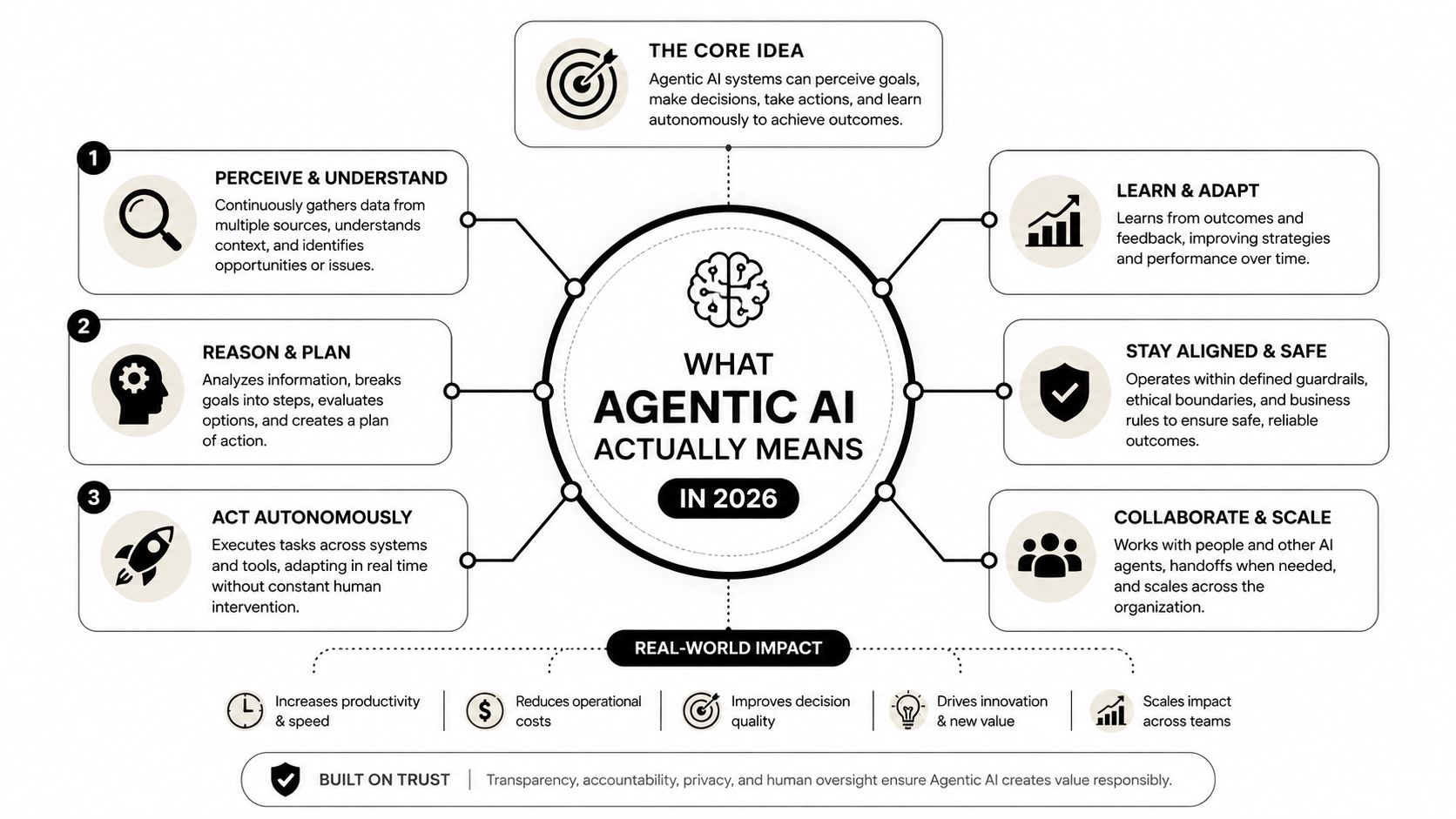
A simple way to explain the shift is this, agentic AI is goal-driven software that can work through a task instead of only replying to a prompt. That distinction matters because B2B workflows are rarely one-shot questions. They are chains of small decisions, exceptions, handoffs, and follow-ups, which is why founders are now looking at systems such as 2026 multi-agent design changes when they plan how different agents should cooperate inside one workflow.
For a founder, the point is not abstraction. A lead-gen agent can check form fields, enrich a prospect, route the lead, and draft the right follow-up. A voice agent can capture intent from a call and hand off the next action to the right system. A CRM agent can update records, flag missing data, and keep the pipeline moving without waiting for a rep to remember every step.
Agentic AI vs Traditional AI Assistants
Traditional AI assistants are useful, but they're mostly reactive. You ask, they answer. You prompt, they generate. Then your team still has to paste the output into the CRM, launch the sequence, or trigger the next workflow.
Agentic AI changes the job description. It still answers questions, but its real value is in memory, tool use, and multi-step planning. It can carry context forward, select an action, and keep working until the goal is achieved inside the permissions you gave it.
| Dimension | Traditional AI Assistant | Agentic AI System |
|---|---|---|
| Autonomy | Responds to a prompt and stops | Pursues a goal across multiple steps |
| Memory | Usually limited to the current exchange | Retains context across tasks and sessions |
| Tool use | Often minimal or manual | Chooses and uses tools or APIs to act |
| Planning | Single response, then handoff to humans | Breaks work into steps and adapts as it goes |
A B2B example makes the difference obvious. A chatbot might draft a follow-up email after a demo. An agent can qualify the lead, check CRM status, book the next meeting, update the record, and draft the follow-up without waiting for five separate prompts.
That difference is why founders should stop comparing agentic AI to “a smarter chatbot.” The better comparison is between an answer engine and a workflow operator. One helps a rep think faster. The other helps the business move faster.
A team gets the biggest lift when the software can cross systems, not just produce text.
The distinction also matters for customer-facing operations. A support assistant can suggest a reply. An agentic system can inspect the issue, retrieve account context, trigger the right backend action, and send the result to the customer. Postman's technical framing captures this shift well, with agentic systems combining planning, tool use, adaptation, memory, and evaluation (Postman on agentic AI capabilities).
The Four Core Components Every Agentic System Needs
An agentic system needs more than a model and a prompt. It needs parts that let it decide what to do, remember what's happening, and reach outside the model to take action. Without those pieces, you're just wrapping automation language around a chatbot.
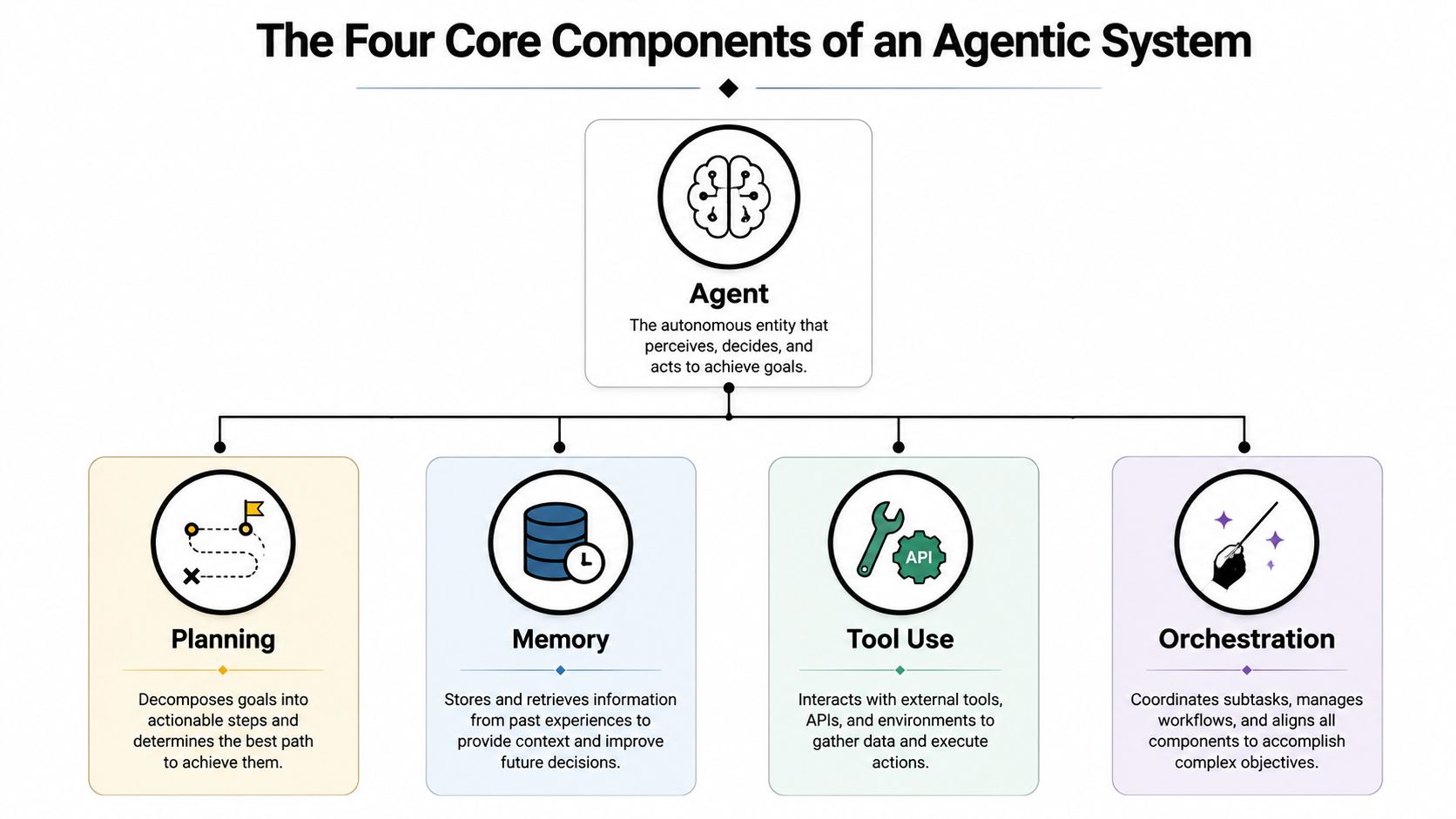
Agent, planning, memory, and tool use
The agent is the worker. It receives the goal and decides what matters next. In a lead gen workflow, that might be the component deciding whether a prospect deserves a manual sales touch or an automated nurture path.
Planning is the to-do list the agent creates from the goal. If the goal is “qualify inbound demand and schedule demos,” the plan may include checking form data, enriching the lead, scoring intent, choosing a route, and sending a scheduling link.
Memory is what lets the system keep context alive. For a CRM workflow, memory can hold conversation history, qualification status, and prior objections so the agent doesn't treat every touch like a fresh interaction.
Tool use is the action layer. That's where the agent calls Salesforce, HubSpot, email systems, telephony, calendars, or internal APIs. Tool access is what moves the system from “helpful text” to “real work.”
The practical test is simple. If a platform can plan but can't store context, it'll forget too much. If it can remember but can't use tools, it can only talk about work. Real agentic systems need both.
Architecture check: if memory is missing, continuity breaks. If tool access is missing, the agent can't do anything useful.
For teams comparing platforms, that's why orchestration matters too. The system has to coordinate one or more agents across subtasks, not just answer a prompt. If you're evaluating a build path, it helps to look at platforms that tie reasoning to execution, such as the kind of workflows described in MakeAutomation's AI agent studio, where action and workflow design are treated as one system.
Real B2B and SaaS Use Cases Worth Piloting First
A useful pilot usually starts where work already crosses systems and people keep repeating the same coordination steps. That is why the strongest early wins are often ordinary revenue and operations workflows, not flashy demos. They sit in the middle ground between content generation and full automation, where judgment matters and the system still needs to take action.
Lead generation that does more than scrape lists
A lead generation agent can watch for signals, enrich contacts, score fit, and route prospects to the next step. Instead of relying on a rep to remember each handoff, it can move from signal to action, then update the pipeline after the handoff.
In practice, that can mean a founder or growth lead asks for a target account list, the agent gathers context, drafts first-touch messaging, and flags which leads need human review. The benefit is not only speed. It also keeps the process consistent across a function that usually gets handled differently by each rep.
Voice agents for inbound and outbound calls
Voice is another strong pilot because calls already require fast context switching. A voice agent can answer, identify intent, ask qualifying questions, and route the conversation based on what it learns. When a live rep needs to take over, the agent can hand off with useful notes instead of making the caller repeat everything.
If your team is evaluating customer-facing automation, the use case map in AI agent for customer service is a good proxy for how these systems behave once they are connected to support and service workflows.
Outreach automation and CRM workflow chains
Outreach is where many teams overestimate what a simple sequence can do. A true agent does more than send a message. It can decide whether the lead is ready, personalize the draft from live context, trigger the send, and then update CRM status so the next person sees the history.
That is also why CRM automation is such a natural fit. Sales teams lose time when statuses drift, tasks go stale, and notes sit in inboxes. An agent can keep the record current while the rep stays focused on the conversation.
The best pilots usually sit at the boundary between sales work and systems work.
For teams comparing implementation patterns, how teams build apps faster with AI shows how dynamic workflows get assembled around actions rather than static prompts. For founders, that is the right lens. You are not buying a smarter sentence generator. You are designing a software worker that can follow through.
How to Decide If a Workflow Should Be Agentic
A workflow should become agentic only when the task needs judgment, tool use, and follow-through at the same time. If the work is stable, repetitive, and easy to verify, a rule-based automation is usually the better fit. If the hard part is reading messy input, summarizing it, or extracting meaning, generative AI can often do the job without handing over control.
McKinsey's filter is useful for founders and operators: rule-based automation for repetitive structured work, generative AI for unstructured extraction or synthesis, and AI agents only when the workflow needs multistep decision-making with highly variable inputs and contexts (McKinsey on when to use agentic AI).
A simple decision test
A founder can pressure-test a workflow with three questions. Does the process follow fixed rules from start to finish? If yes, keep it simple. Does it require judgment across changing conditions, such as different customer replies, shifting account data, or incomplete records? That is where agentic AI starts to make sense. Would a wrong action create cost, compliance exposure, or customer harm? If yes, the workflow needs clear guardrails before anyone gives it autonomy.
The safest way to read a candidate workflow is to match the control level to the work itself.
- Low variability, clear steps: use RPA, scripts, or an API workflow.
- Unstructured text, summarization, extraction: use generative AI.
- Changing inputs, multiple systems, and decisions along the way: consider agentic AI.
That boundary matters because “more AI” is not the same as “better automation.” A stable process often works best with a fixed rule set, while an autonomous system can add failure points if the workflow never needed judgment in the first place. A clean approval flow, for example, should not be turned into an agent just because the team wants it to feel modern. For teams that want to see how action-based workflows get assembled in practice, how teams build apps faster with AI is a useful reference point.
A founder's first-quarter roadmap
Start with one workflow that already causes delays, manual handoffs, or inconsistent follow-up. Map the trigger, the decision points, the tools the agent would need to touch, and the exact stop conditions before anything runs in production. If the workflow cannot be described clearly on one page, it is probably too early to make it agentic.
Use human-in-the-loop automation guidelines to decide where the agent should pause for review, where a person should approve an action, and where the system should fail closed. That gives you a practical boundary between assistance and autonomy.
Measure whether the pilot reduces manual steps, shortens turnaround time, and keeps the workflow reliable when inputs change. If those gains do not show up, the problem may not be the model. It may be that the process was better suited to a simpler automation from the start.
Governance, Risks, and Metrics That Make or Break Deployment
Agentic systems change the risk profile because they can act, not just recommend. The UK government describes agentic AI as software agents that can make decisions and operate cooperatively or independently, while MIT notes these systems can access other software, send and receive money, and interact with the internet (MIT on agentic AI governance and operating reach). That's a very different conversation from a normal chatbot deployment.
The controls that matter before launch
A serious deployment needs audit logs, role-based permissions, approval thresholds, and human-in-the-loop checkpoints. If the system can touch customer data, send messages, or trigger spend, those boundaries need to be explicit before it ever reaches production.
The other must-have is failure containment. That means defining what happens when the agent is unsure, when tool output looks wrong, or when the task drifts away from the original goal. If you can't explain the stop condition, you don't really have governance.
The metrics founders should watch
Accuracy alone won't tell you whether the system is working. Measure whether the agent finishes the task, how often it escalates to a human, how much time it saves, and whether the workflow contributes to pipeline or revenue movement. Those are the metrics that connect autonomy to business value.
You also need quality monitoring for hallucination and goal drift. If an agent starts making confident but incorrect assumptions, the issue isn't just model quality. It's operational trust, and that gets expensive fast.
Good governance shrinks the scope first, then expands it. That's usually safer than giving broad autonomy and hoping monitoring catches problems later.
For teams building the operating model, human-in-the-loop automation is the right place to think about approval design, escalation logic, and when a person should take over. The strongest deployments don't remove people. They remove unnecessary repetition and reserve human judgment for the steps that need it.
Your First Quarter With Agentic AI
Start with one of three workflows, lead generation, inbound voice qualification, or CRM updates. Those are the places where agentic AI can prove value without needing to replace an entire operating model on day one.
If you build in-house, keep the first version narrow. If you buy a platform, make sure it supports tool use, memory, and logging. If you partner, look for a team that can wire the workflow into your sales or ops stack instead of selling you a demo that never reaches production.
A realistic first quarter usually looks like this, pilot one workflow in weeks 1 to 4, review exceptions and human handoffs in weeks 5 to 8, then decide whether to expand autonomy in weeks 9 to 12. If the workflow keeps needing manual rescue, it probably isn't ready yet.
The founders who win here won't try to agentic-ize everything. They'll pick the workflow with the clearest pain, the cleanest boundaries, and the most obvious value, then they'll let the system earn more autonomy over time.
If you want help turning one of these workflows into something real, MakeAutomation builds AI automation, CRM workflows, and voice AI agents for B2B and SaaS teams. They can help you scope the right pilot, add the right guardrails, and implement the pieces without turning your stack into an experiment.