Driving B2B Growth with Human Ai Collaboration
Most advice about human AI collaboration starts with the wrong promise, that putting a person and a model in the same workflow automatically improves results. The evidence says it doesn't work that way. In a 2024 meta-analysis in Nature Human Behaviour, human AI teams beat humans alone on average, but the pooled synergy effect was negative, and decision tasks were where performance fell apart while creation tasks benefited (Nature Human Behaviour, 2024). That's the essential starting point for leaders, because the question isn't whether to use AI. It's how to design collaboration so it helps instead of weakening judgment.
That urgency is no longer theoretical. In 2026, KPMG reported that 58% of employees were regularly using AI tools for work, and 66% used AI regularly for personal, work, or study purposes (KPMG executive summary, 2026). Human AI collaboration has moved out of pilot programs and into everyday behavior. The companies that win now will be the ones that treat AI as part of a workflow design problem, not a gadget problem.
Beyond the Hype of AI Copilots
The popular story says AI copilots make every employee faster by default. That's too simple. The latest research shows that collaboration can help in one kind of work and hurt in another, so the same AI tool can raise output in one process and drag it down in the next (Nature Human Behaviour, 2024).
Adoption is not the same as collaboration
High usage doesn't mean high-quality teamwork. KPMG's 2026 numbers show how common AI use has become, but they don't tell you whether the work is structured well, whether people trust the output, or whether the human still knows how to make the decision when the model is wrong (KPMG executive summary, 2026). That gap matters in B2B settings because wasted motion looks productive for a while. Drafts get generated, summaries get produced, and tasks get checked off, but the business may still be carrying hidden risk in the form of weak judgment, sloppy escalation, or over-dependence.
Practical rule: if a workflow cannot tell you who is deciding, who is executing, and who is reviewing, it's not collaboration yet. It's just assisted work.
That's why the best operators don't ask, “Where can we add AI?” They ask, “Which parts of this workflow should stay human-led, which can be delegated, and what should never be left to a model without oversight?” The answer changes by task type, and that's the point. A workflow built for creative drafting shouldn't be designed the same way as one built for pricing, hiring, approval, or risk review.
For a practical baseline on workflow structure, the core mechanics of human-in-the-loop automation are worth studying because they make the review point explicit, not accidental. That's the difference between a useful AI system and a brittle one, and it's what separates profitable adoption from expensive experimentation.
What True Human-AI Collaboration Means
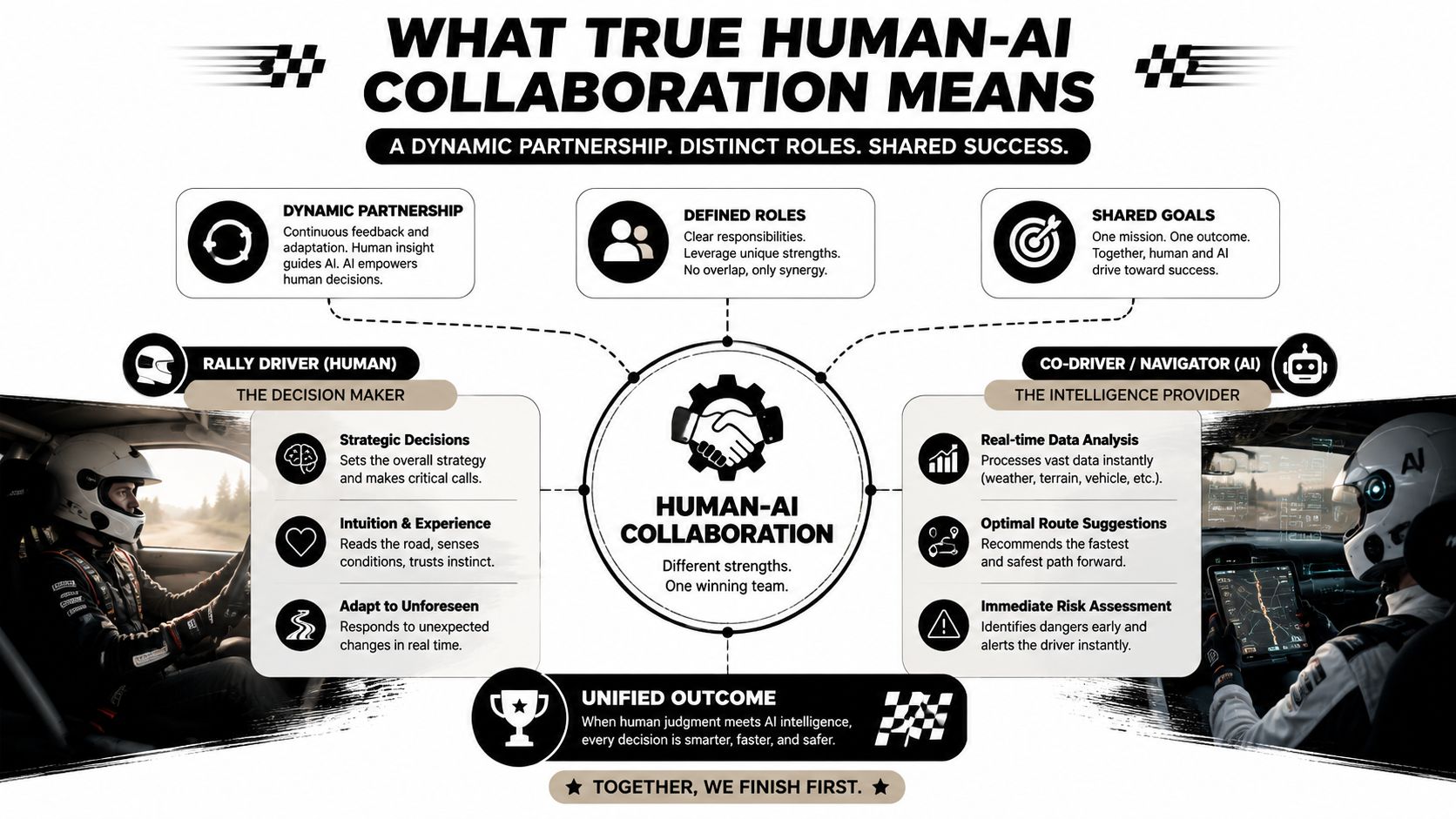
True collaboration is a working partnership, not a passive service relationship. Think of a rally driver and a co-driver. The driver reads the road, adjusts to surprise, and makes the final call. The co-driver brings pace notes, warnings, and route intelligence at exactly the right moment. AI should play the co-driver role when the human still needs to steer.
The collaboration loop has to be designed
A 2024 review of human AI collaboration breaks effective systems into goals, interaction, and task allocation (arXiv, 2407.19098v1). That framing is useful because it forces clarity on three questions. What outcome are we optimizing for, how often does the system exchange information, and who owns the final decision? Without those answers, people end up using AI as a suggestion engine with no governance around what happens next.
That's also why the most effective systems aren't always the most automated. In creative work, AI can expand option space and speed up drafting, which fits the augmentation pattern described in the 2024 meta-analysis (Nature Human Behaviour, 2024). In decision work, the same collaboration can reduce quality because the human starts leaning on the model instead of reasoning through the choice. The practical lesson is simple. Collaboration should be structured around the task, not around the novelty of the tool.
Operational insight: if the model is good at generating possibilities, let it generate possibilities. If the cost of a bad answer is high, keep the human in charge of validation.
The deeper shift is cultural as much as technical. There is a prevalent tendency to talk about “using AI” when the focus should be on designing negotiation points between human judgment and machine output. That's why a rally style model works so well. The co-driver never replaces the driver, but the driver also never pretends the notes are optional. Human AI collaboration works when both sides have defined responsibilities, shared intent, and a repeatable way to correct each other.
Four Models of Collaboration for Your Business
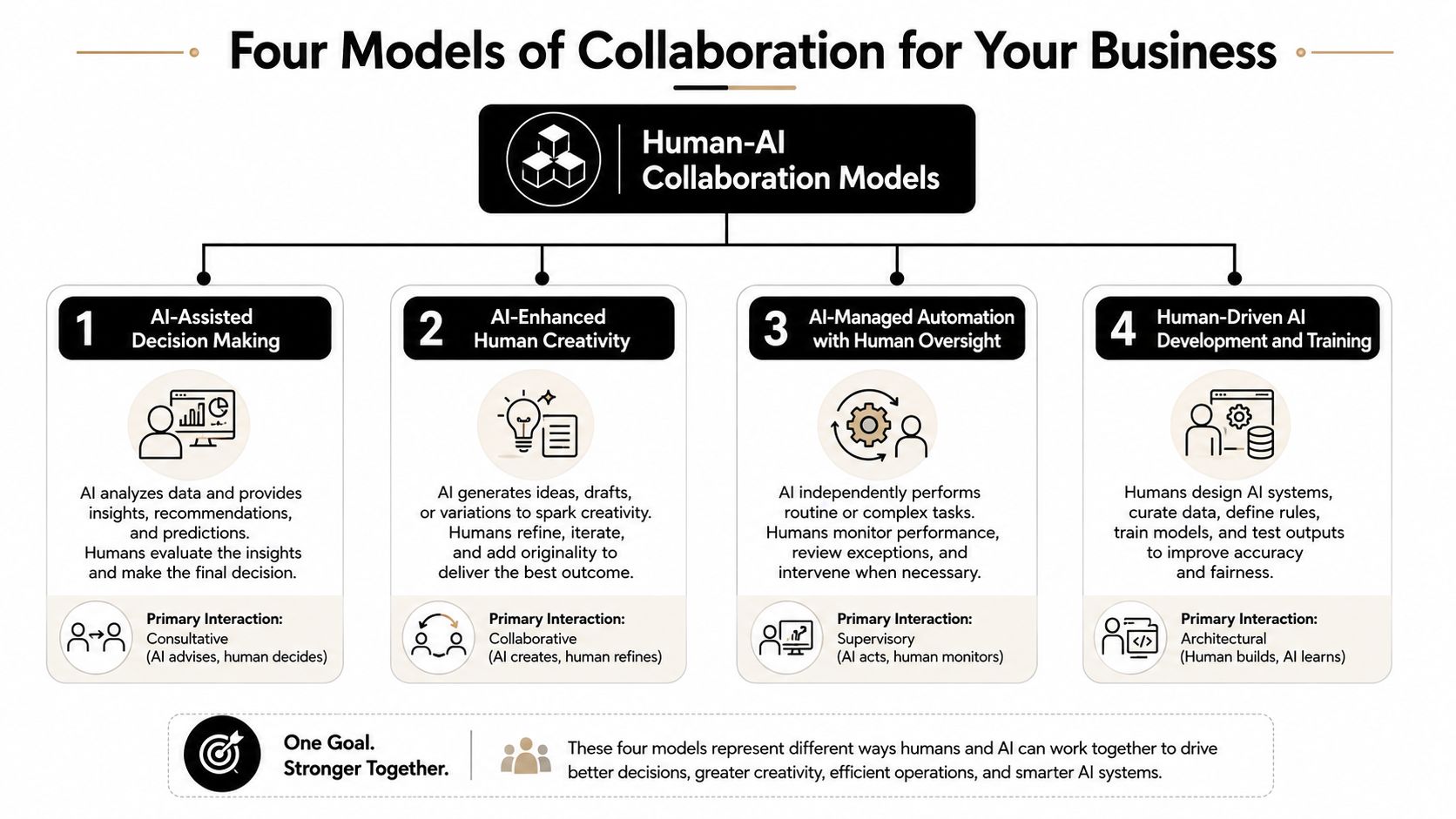
The most useful way to think about human AI collaboration is to classify workflows by authority. Who decides, who executes, and who checks the result? Once you answer that, the implementation becomes much clearer. A lot of confusion disappears when leaders stop treating every workflow like a generic copilot use case.
Assistant, augment, partner, supervisor
The first model is AI as an Assistant. The human decides and does the work, while AI supports with research, drafting, summarizing, or retrieval. This fits situations where the task is familiar but time-consuming, and the risk of a wrong output is moderate. The strength is speed. The limitation is that the human can still become a bottleneck if every step requires manual handling.
The second model is AI as an Augment. Here, the human still decides, but the AI executes part of the workflow. That works well when output volume is high and the steps are repetitive, like content adaptation or channel-specific formatting. The human's job is to set the direction and inspect the result for alignment, brand voice, or commercial fit.
The third model is AI as a Partner. The model proposes options, and the human validates and executes. This is strong for sales messaging, account planning, and creative ideation, where the best output comes from rapid iteration between machine suggestions and human judgment. It can fail if the team trusts the proposal too quickly or lets the tool's confidence blur the review standard.
The fourth model is Human as a Supervisor. AI decides and executes, while humans monitor exceptions. That belongs in lower-risk, rules-based environments where escalation is clear and mistakes are caught quickly. It's efficient, but only if exception handling is designed in from the start.
The framework from the collaboration research is explicit here, effective systems need clear goals, interaction protocols, and task allocation (arXiv, 2407.19098v1). If you want a practical orchestration layer for that kind of structured workflow, MakeAutomation's AI agent orchestration platform is one option that fits the conversation because it centers workflow roles and handoffs rather than treating AI as a standalone feature.
Real-World Use Cases for B2B Growth
Sales teams usually get human AI collaboration wrong in one of two ways. They either use AI to blast generic outreach faster, or they hand over messaging quality to a model and hope the result sounds human enough. The better pattern is the AI as Partner model. The system drafts account-specific angles, the SDR validates tone and relevance, and the human still owns the final send. That keeps personalization grounded in real account knowledge instead of whatever the model can infer from public snippets.
Marketing looks different. Here, the AI as Augment model often works better because the hard part is not the first draft, it's distribution complexity. A team may need one core message translated into channel-specific assets, repurposed for different audiences, and queued across multiple workflows. AI can handle the execution layer, while the marketer holds brand judgment and decides which assets are fit for launch. For teams evaluating customer-facing automation, AI tools for customer service is a useful reference point because it shows how AI support needs to fit into a broader service design, not sit on top of it.
Operations teams need a firmer boundary. In many process-heavy environments, the Human as Supervisor model is the right fit because the system can handle routine routing while the operator watches for exceptions. That's especially useful in task assignment, deadline monitoring, and handoff management, where the value comes from consistency and the cost of missed exceptions is real. The human's role is not to do every task manually. It's to define escalation rules and intervene when the workflow breaks its own logic.
What each team should protect
- Sales: protect account context and final message judgment.
- Marketing: protect brand standards and campaign sequencing.
- Operations: protect exception handling and ownership clarity.
Practical AI deployment becomes a process design exercise. If your team is exploring lead workflows, DMpro's AI lead generation playbook is a good complement because it makes lead gen feel operational rather than abstract. The broader lesson is that profitable collaboration comes from matching the collaboration model to the business risk, not from using the same pattern everywhere.
How to Implement a Collaboration Framework
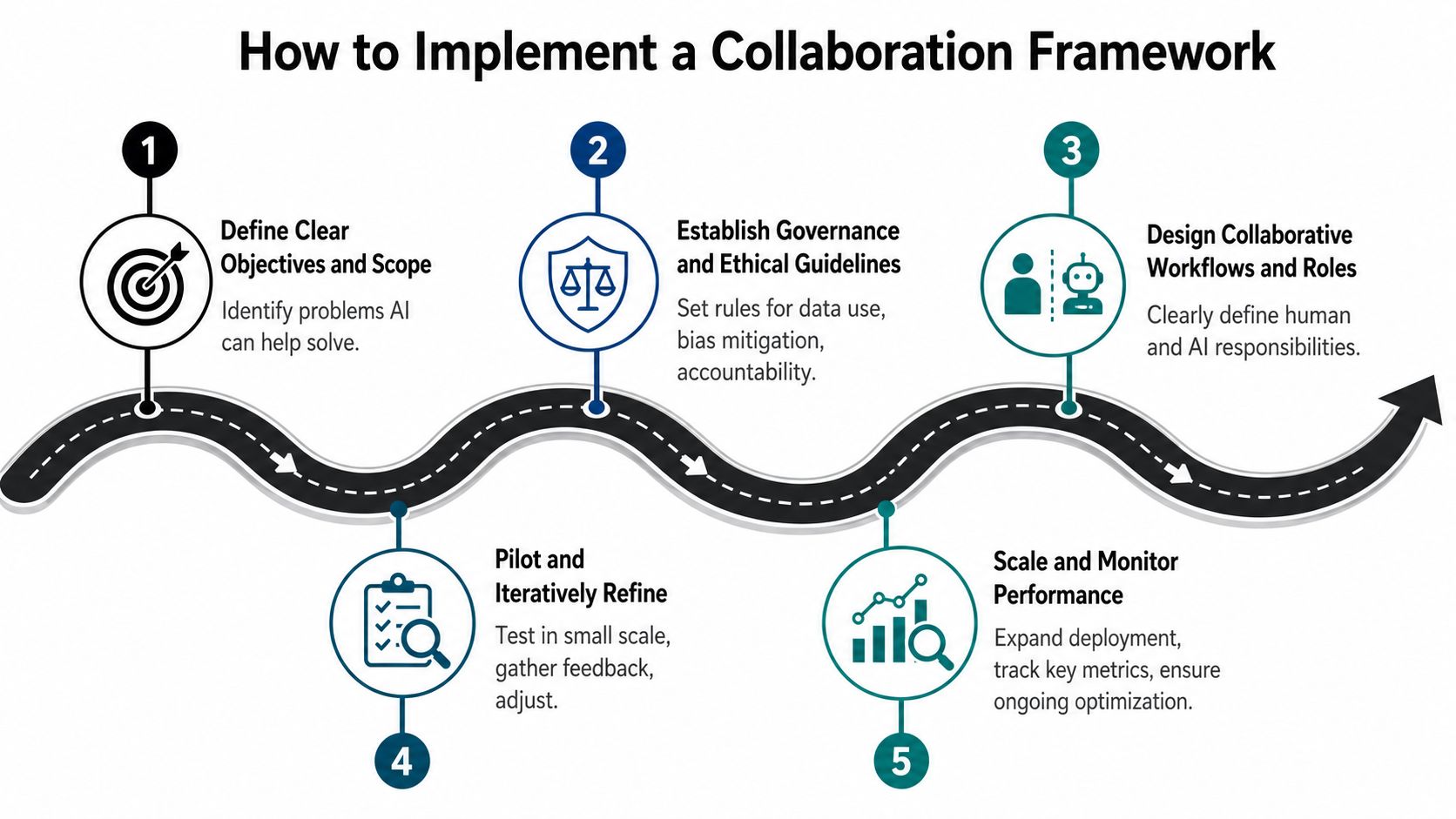
Most AI rollouts stall because teams buy tools before they define operating rules. That's backwards. The framework has to come first, because governance is what turns raw model output into business value. Without it, the team ends up with more content, more suggestions, and more confusion.
Start with the workflow, not the tool
Begin by auditing where work slows down. Look for repetitive approvals, fragile handoffs, review-heavy tasks, and places where experts spend time on low-impact drafting or sorting. The goal is to identify where collaboration can remove friction without reducing judgment. That matches the current research concern that many systems are still “not very collaborative yet” and too often collapse into one-way assistance (Frontiers in Computer Science, 2024).
Next, assign roles with uncomfortable precision. Name the human owner, name the AI's responsibility, and define the override path. If the AI makes a recommendation, who validates it? If the AI generates an exception, who sees it first? If the output conflicts with policy, who resolves the conflict? The design gets much cleaner when those answers are written down.
Governance rule: if no one owns the exception, the exception becomes the process.
Then build a human-in-the-loop review protocol. That does not mean reviewing everything forever. It means deciding which steps require approval, which only need sampling, and which can move forward automatically once confidence is high. One practical way to think about it is to treat AI like a junior analyst, helpful, fast, and capable of mistakes that a senior operator needs to catch.
Finally, write rules of engagement for failure. If the system produces a bad draft, a biased recommendation, or a conflicting action, what happens next? The answer should include rollback, escalation, and feedback capture, because those failures are also training signals for the workflow. Teams that leave this vague end up with trust problems later, usually after the first visible mistake.
For a governance-oriented lens on that operating discipline, AI governance best practices are relevant because they remind leaders that controls, accountability, and exception handling are part of the product, not an afterthought. The strong implementations are rarely the flashiest ones. They're the ones where the human and the model know exactly where each one starts and stops.
Measuring Success and Avoiding Common Pitfalls
Usage metrics can fool you. A lot of teams celebrate adoption because people are opening the tool, but that doesn't tell you whether the business is getting better decisions, cleaner outputs, or safer execution. The smarter question is whether the workflow is producing better work with less rework.
Measure the outcome, not just the activity
The most useful KPIs are tied to business decisions. Decision Quality Score tells you whether the human AI pair is making better calls than the previous process. Error Reduction Rate shows whether the workflow is cutting avoidable mistakes. Time to Competency matters for onboarding, because a good collaboration system should help new hires get useful faster without turning them into passive button-pushers.
The tradeoff is real, especially in decision-heavy work. MIT Sloan notes that human AI teams can excel at content creation while performing worse on decision-making tasks, which is exactly where the erosion of human skills and excessive dependence become dangerous (MIT Sloan, 2024). If a team leans on AI for every judgment call, people stop practicing the very skill they'll need when the model is uncertain, biased, or wrong.
Prevent skill atrophy before it shows up
The fix is operational, not philosophical. Run periodic manual drills so people still know how to complete the task without model help. Require review of AI-generated outputs on a sampled basis, even when the system seems reliable. Reward employees for catching bad outputs, because that keeps critical thinking socially valuable instead of treated like friction.
The same discipline helps preserve trust calibration. If employees only see AI as a shortcut, they'll either overuse it or work to circumvent it. If they see it as a governed partner, they're more likely to use it where it fits and resist it where it doesn't. That's the balance the latest research points toward, not blanket adoption, not blanket skepticism, but structured use with clear human oversight (MIT Sloan, 2024).
A practical governance posture matters here, and it should include a place for human AI collaboration governance in your internal playbook if you're serious about scaling safely. The teams that last won't be the ones that use AI the most. They'll be the ones that keep people sharp while letting the model do the right kind of work.
If you want to turn human AI collaboration into a reliable operating system instead of a loose collection of tools, MakeAutomation helps B2B and SaaS teams map workflows, define review points, and build automation that fits real business roles. Visit MakeAutomation to explore how structured collaboration can support sales, marketing, operations, and AI workflow design without turning your team into spectators.