B2B Lead Generation and Appointment Setting: A 2026 Guide
75% of B2B buyers prefer a sales-representative-free experience, according to Gartner's B2B buying report. That changes the job of B2B lead generation and appointment setting. Your outreach doesn't earn attention just because you can offer a demo. It needs to answer something the buyer can't confidently resolve alone.
Lead generation identifies and attracts potential buyers. Appointment setting turns relevant interest into a conversation that advances a buying decision. Neither requires treating every reply as a reason to open a calendar.
The useful unit of progress is a held, qualified meeting, not a booking. Build the system around that distinction, and your targeting, messages, automation, and reporting become much harder to game.
Map the Six Stages From Target to Opportunity
Build the funnel as explicit handoffs: target the account, enrich and segment its contacts, run outreach, classify replies, confirm the booking, and prepare the account executive to hold a useful conversation. Enrichment belongs inside target preparation; opportunity creation follows the held meeting rather than a calendar acceptance.
Buyers use an average of 10 interaction channels, compared with 5 in 2016, according to McKinsey's 2024 B2B Pulse, so a single email rarely explains a deal.
Funnel stages, triggers and owners
| Stage | Entry trigger | Exit criterion | Owner |
|---|---|---|---|
| Target | Account matches the ideal customer profile and shows a buying trigger | Named buyer roles are confirmed | Marketing operations |
| Outreach | Verified contact enters a sequence | Positive or negative reply received | SDR or automation |
| Reply handling | Any reply arrives | Reply tagged sales-ready or information request | SDR with qualification rules |
| Booking | Sales-ready reply received | Meeting on the calendar and confirmed | Calendar automation with CRM owner |
| Show and prep | Meeting booked | Meeting held and agenda confirmed | Account executive |
| Opportunity | Held meeting qualifies | Opportunity created in the CRM | Sales lead |
These are forward-movement criteria, not permission to leave everyone else waiting. An account without a valid contact returns to enrichment. An unanswered sequence exits into a defined nurture or closed-out state. A negative reply receives a disposition, and an opt-out stops outreach.
Keep account status separate from contact status in HubSpot, Salesforce, or Pipedrive. An account can remain relevant after a contact leaves, while a contact's enthusiastic reply doesn't prove the account fits. Mixing those objects creates duplicate prospecting and misleading pipeline counts.
Make every handoff observable
The usual failure isn't a missing automation feature. It's a positive reply sitting in a shared inbox because the SDR assumes an account executive owns it, or a booking that never receives a useful confirmation.
Require every stage transition to write the owner, timestamp, next action, and disposition into the CRM. If an integration fails, send the record to an exception queue rather than skipping it. Someone must own that queue too.
Operating rule: A stage needs a forward exit, a rejection exit, and an owner. Otherwise, it becomes storage for leads nobody intends to work.
Before changing your tooling, draw the current funnel. Mark every place where a lead could sit overnight without a named owner, then assign responsibility and an escalation rule. Fix those gaps before adding accounts.
Target Accounts and Build a Multi-Channel Sequence
Start with the account list, not the message. A clever opener won't rescue a campaign aimed at businesses that don't have the problem, buying capacity, or implementation conditions your offer requires.
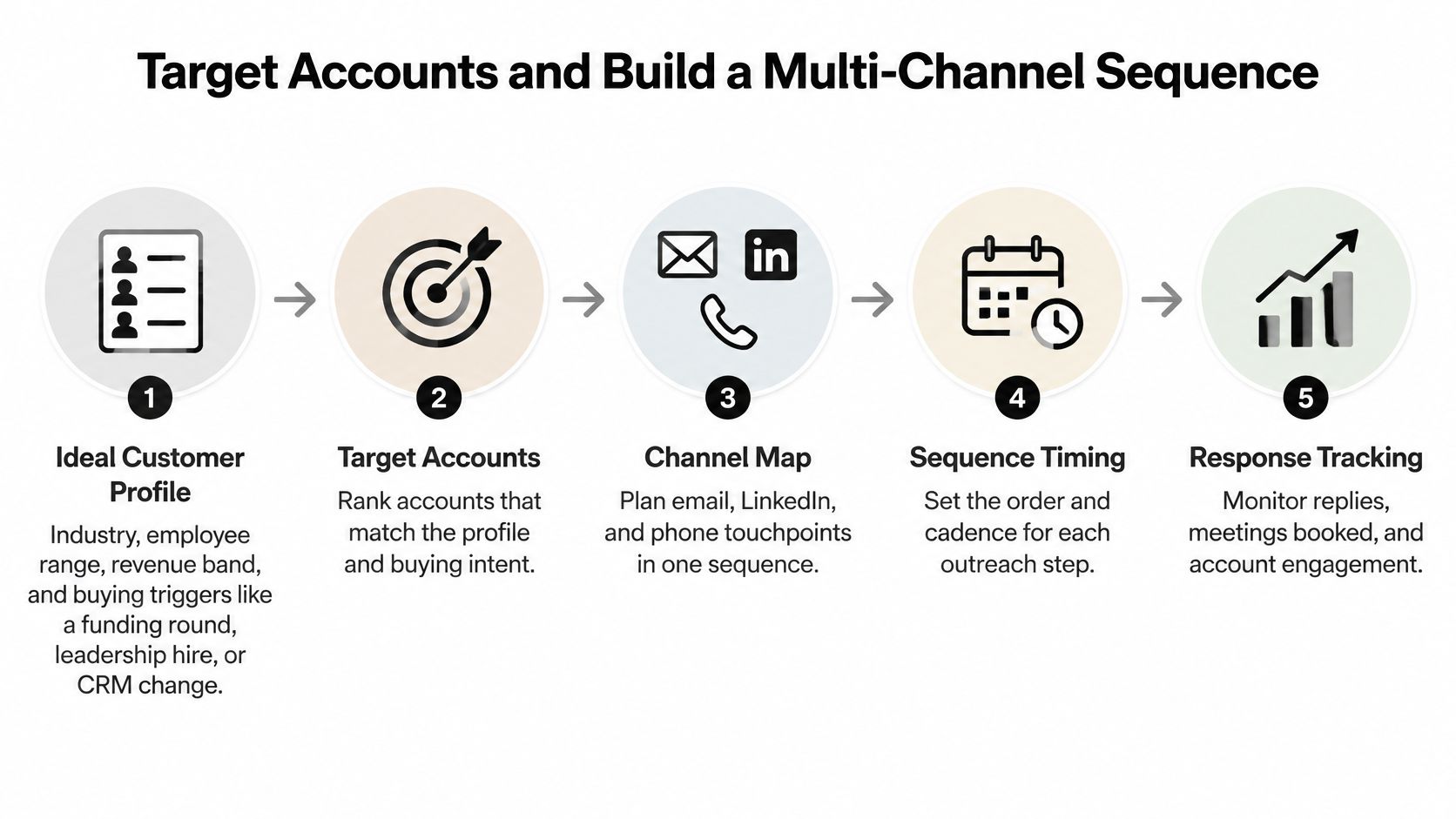
Use this process map to keep account selection ahead of channel execution.
Build the list and launch deliberately
Define the ideal customer profile. Specify industry, employee range, revenue band, buyer seniority, and a buying trigger such as a leadership hire or CRM change. Use an ideal customer profile framework to write explicit exclusions too, such as businesses without the CRM your implementation requires.
Validate contacts before enrollment. Verify email addresses with a service such as NeverBounce, confirm current roles, and deduplicate against the CRM using email and company domain. Suppress existing customers, active opportunities, and opted-out contacts before the sending platform receives the list.
Segment by pain and urgency. A SaaS operations lead dealing with slow demo routing needs a different message from an agency director reconciling manual reports. Record the evidence behind the segment assignment so your SDR can distinguish an observed trigger from a guess.
Coordinate email, phone, and LinkedIn. Call data summarized by Wiza's sales prospecting statistics associates even an unanswered call with subsequent email reply rates increasing from 1.81% to 3.44%. Use the example cadence below as a starting hypothesis, not a promise of conversion.
Give unbooked interest a destination. Our B2B SaaS lead workflow enrolls leads in nurture sequences if they don't book within 24 hours. Apply that rule to eligible interested leads, not every untouched account, and pause active prospecting so nurture doesn't collide with the SDR's messages.
Review performance by segment. Check delivery, positive replies, and downstream meeting quality on a regular review day. Pause a weak segment long enough to diagnose contact quality and message relevance rather than compensating with more sends.
Twelve-day outreach cadence for one account
The following is an illustrative operating schedule, with timings to test against your audience.
| Day | Channel | Purpose |
|---|---|---|
| Day 1 | Open with a specific trigger and one question | |
| Day 2 | Phone | Short call; leave a voicemail under 20 seconds |
| Day 4 | Connection request that refers to the email | |
| Day 6 | Share one documented customer result relevant to the segment | |
| Day 9 | Phone | Call at a different time of day |
| Day 12 | Close the loop with one resource and a clear opt-out |
Stop scheduled touches when a person replies. Classify out-of-office messages separately, and resume only when appropriate. Don't make prospects answer the same outreach on every channel.
For accounts discussing the problem in public communities, Bazzly's resource on Reddit lead generation can help evaluate listening approaches. Use those discussions to understand language and objections, not as permission to scrape identities or send unsolicited private pitches.
The trade-off is operational complexity. More channels create more context to reconcile, so synchronize replies and suppression centrally rather than letting each tool run its own campaign.
Message Templates and Follow-Up Tips That Earn Replies
A useful cold email answers three questions: why this account, why this problem, and why this conversation? Keep the subject short, identify a checkable trigger, describe the operational consequence, add relevant evidence, and make a single ask.
Research the account before drafting. The objective is a message that remains specific even after you remove the company name.

Write around evidence, not enthusiasm
For a hypothetical SaaS operations lead whose company has announced sales hires, the message could read:
Subject: Routing after your hiring
Your hiring announcement mentions an expanded sales team. Are demo requests still assigned manually?
Manual assignment can leave new reps waiting while interested buyers wait for a response.
In our marketing agency case study, lead response time fell from 4 hours to 60 seconds. It's a different business model, but the routing workflow may be relevant.
Would Tuesday morning or Thursday afternoon work for a short routing review?
That proof point is documented, and the message states its limitation rather than implying the agency was a comparable SaaS customer. Add actual dates, times, and the recipient's timezone when sending. Never manufacture a more convenient customer result.
Use the structures in these B2B cold email templates as drafting aids, then replace generic claims with account evidence. A template should preserve the argument, not force every buyer into the same story.
Answer the buyer's existing research
Marketing Graham's technology buyer behaviour report describes buyers using AI assistants to research vendors before supplier contact. Your prospect may arrive with a shortlist, integration assumptions, and a comparison your team has never seen.
Match the proposed meeting to what remains unresolved. A research-stage buyer needs help defining the problem; a validation-stage buyer needs implementation, security, and integration evidence; a procurement-stage buyer needs commercial and operational clarity.
Use video as a complementary format when written explanations aren't enough.
Follow-ups should make the next decision easier:
- Add information: Send a relevant implementation note, customer example, or limitation instead of repeating the booking request.
- Remove interchangeable sentences: Cut anything that could go unchanged to an unrelated company.
- Make evidence accessible: Don't require a meeting to answer a straightforward integration or pricing question.
- Keep the ask consistent: Don't switch from a workflow review to a full product demo without explaining why.
For alternative follow-up structures, use Yalc's cold email follow-up guide without copying language that doesn't fit your buyer.
Take the first email you're sending today. Replace every generic benefit with a specific, checkable claim, and delete claims you can't support.
Qualify Replies and Book Meetings That Actually Happen
Every positive reply should enter a structured workflow as soon as it arrives. Capture the business problem, current process, urgency, authority, timing, and agreed meeting objective. Store unknown answers as unknown, not as assumptions generated from a job title.
An automated acknowledgment can repeat the requested topic and offer suitable slots in the prospect's timezone. A human escalation task should fire when the conversation stalls or the reply requires judgment. Acknowledging a message isn't the same as answering it.
Sales-ready replies versus information requests
| Criterion | Sales-ready when | Information request when |
|---|---|---|
| Business problem | Names a process that is slow or costly | Asks only for pricing or a brochure |
| Authority | Buyer owns or shares the budget | Sender cannot say who decides |
| Urgency | Points to a deadline or a trigger | No timeline is mentioned |
| Timing | Free for a call within the next week | Asks to check back later |
| Meeting objective | States what the call should decide | Only asks to learn more |
Use these signals together, not as rigid gates. A technical evaluator without budget authority can still be essential to a buying group. A pricing question can come from a serious buyer, so answer it before demanding a discovery call.
Choose lightweight sales qualification frameworks that fit the deal. For a straightforward workflow project, a clear problem and access to the decision process may suffice; complex deployments need stakeholder and implementation checks.
Engineer attendance and preparation
The Starr Conspiracy's outsourced B2B lead-generation benchmark summary reports 15–30% no-show rates for cold-booked B2B meetings and a 23% no-show rate for meetings booked eight or more days ahead. Those reference points support offering near-term availability, not assuming a calendar acceptance guarantees attendance.
Send a calendar invitation with the prospect's stated problem, the proposed decision, attendees, and an easy rescheduling path. Use reminders that add practical information rather than a stack of identical notifications. Give the account executive the original reply and qualification notes before the call.
Map qualification answers to CRM properties, not just free-text notes. Assign a named owner and a fallback owner when the assigned rep is unavailable.
A booking rate that rises while qualification falls isn't progress. The setter has transferred unfinished work to the account executive.
Response ownership matters commercially too. A B2B SaaS company in our case work was losing deals because its sales team couldn't respond to demo requests fast enough. That's a routing and coverage problem, not a reason to buy more leads.
For reporting definitions, Franchise Foundry's guidance to track lead qualification metrics that matter is a useful companion. Align setter and closer definitions before evaluating either team, and record why held meetings fail qualification.
Metrics That Show Whether Your Meetings Are Worth Booking
Booked calls can rise while qualified pipeline stays flat. Buyers may also research vendors without leaving a clear attribution trail: Sopro's demand-generation statistics reports that 51% of B2B software buyers started vendor research with AI assistants. Outreach now has to answer research buyers may have begun before they reply or fill out a form.
Website conversions still matter, but they show only part of demand. Connect them to account activity, meeting outcomes, and closed revenue. Judge appointment setting by meetings that are held and qualify, not by bookings alone.
Funnel metrics with formulas and baseline methods
Use external references as context, not as performance commitments. Set an internal baseline for your segment, offer, and qualification rules, then use the same definitions when comparing results.
| Metric | Formula | How to set your baseline |
|---|---|---|
| Dial-to-meeting rate | Meetings booked divided by dials | For a consistent reporting period, divide meetings booked by dials made in that period. |
| Booked-to-held rate | Meetings held divided by meetings booked | Divide held meetings by bookings from the same source and booking period. |
| No-show rate on cold bookings | Meetings missed divided by meetings booked | Count missed meetings against bookings, and track cancellations and reschedules separately. |
| Held-to-qualified rate | Held meetings that become opportunities divided by held meetings | Divide meetings accepted as opportunities by all held meetings in the same cohort. |
| Opportunity-to-close rate | Closed-won deals divided by opportunities | Divide closed-won deals by opportunities created in the cohort, allowing time for the sales cycle to mature. |
| Revenue per held meeting | Closed revenue divided by held meetings | Divide attributable closed revenue by held meetings in the same originating cohort, after its opportunities have had time to mature. |
Read the funnel from top to bottom. A weak dial-to-meeting rate points to contact validity, access, targeting, or the opening proposition. A weak booked-to-held rate calls for examining commitment and logistics, rather than adding more outreach.
If held-to-qualified is low, check whether setters are mistaking curiosity for a buying problem. If opportunity-to-close is low, examine product fit, stakeholder access, commercial terms, and competitive losses. More activity will not resolve those issues.
Revenue per held meeting connects appointment setting to economics, but only when cohorts are consistent. Do not compare revenue from older opportunities with meetings booked this week. Group meetings by a consistent originating period and give the associated opportunities time to mature.
Separate observed actions from inferred intent
Label signals verified or inferred. Attendance and a substantive conversation make a held meeting verifiable. An increase in branded searches may suggest interest, but it does not identify a buyer or establish purchase intent.
Join the following records using account and contact identifiers:
- CRM activity: Ownership, stage changes, opportunities, closed outcomes, and disqualification reasons.
- Outreach records: Deliveries, replies, calls, suppression, and sequence exits.
- Call notes: Problems, alternatives, stakeholders, research sources, and agreed next steps.
- Website behaviour: Identifiable visits and content engagement, keeping anonymous activity separate.
- Offline signals: Event attendance, referrals, and conversations recorded by the responsible rep.
Ask buyers how they built their shortlist, then preserve their wording in call notes. Record an AI-assistant mention as a self-reported discovery source. It does not prove that a particular answer caused the purchase.
Measurement discipline: Unknown attribution is more useful than confidently assigning revenue to the wrong touchpoint.
Review funnel metrics weekly, split by source, segment, and rep. Read disqualification reasons alongside win rate, and show raw counts beside percentages so small samples are not mistaken for a stable result. A channel with fewer leads may still merit investment when its opportunities fit better and close profitably.
Start a Pilot Segment Before You Scale Outreach
Pilot a single segment and scale only when its funnel holds. Don't expand because the sending platform has spare capacity or because an SDR's calendar looks busier. Expand when attendance and qualification remain stable without extra manual rescue work.
For example, you could run a 30-day pilot across roughly 100 accounts, using the illustrative outreach cadence and a shared qualification definition. Those are test-design choices, not industry benchmarks. Choose a segment narrow enough that the same problem and evidence apply across its accounts.
Write the decision rules before launch
Keep the offer, target roles, qualification criteria, and CRM definitions fixed while testing a message or timing change. Otherwise, you won't know whether an improvement came from better copy or an easier audience.
Use a short pilot checklist:
- Hypothesis: Name the problem, the buying trigger, and why a conversation would help.
- Variable: Test an opening trigger or call timing, not the entire sequence at once.
- Evidence: Compare held meetings and qualification outcomes, not just replies.
- Scale gate: Require booked-to-held and held-to-qualified rates to remain steady across consecutive reviews.
- Stop condition: Pause when contact quality, complaints, or poor fit make continued outreach inappropriate.
Don't declare a winner from a handful of responses. Keep an inconclusive test inconclusive, and continue observing rather than manufacturing certainty from a dashboard.
Fix the response layer before buying reach
The gap to inspect first is what happens after interest arrives. If the prospect asks a question and nobody owns the answer, more prospecting only creates more neglected conversations.
Our lead response automation responds to inquiries within 60 seconds, 24/7, qualifies leads automatically, and books meetings without human intervention. Automation still needs escalation boundaries for unsupported questions, unusual requirements, and prospects who want a person.
A short pilot can validate routing, message relevance, and meeting quality without proving the full revenue case. Keep tracking its opportunity cohort after outreach ends, especially when the buying cycle outlasts the experiment.
Before Monday, write down your pilot segment and the first funnel metric you'll inspect. Assign the person who will act if that metric deteriorates. That makes B2B lead generation and appointment setting an accountable operating process rather than a recurring campaign launch.
MakeAutomation offers a free 15-minute discovery call for HubSpot consulting to help connect lead handling, qualification, booking, and CRM reporting. Visit MakeAutomation with your current funnel and its weakest handoff, and discuss which workflow to fix before scaling outreach.