
How to Deploy an AI Voice Agent for Outbound Calls
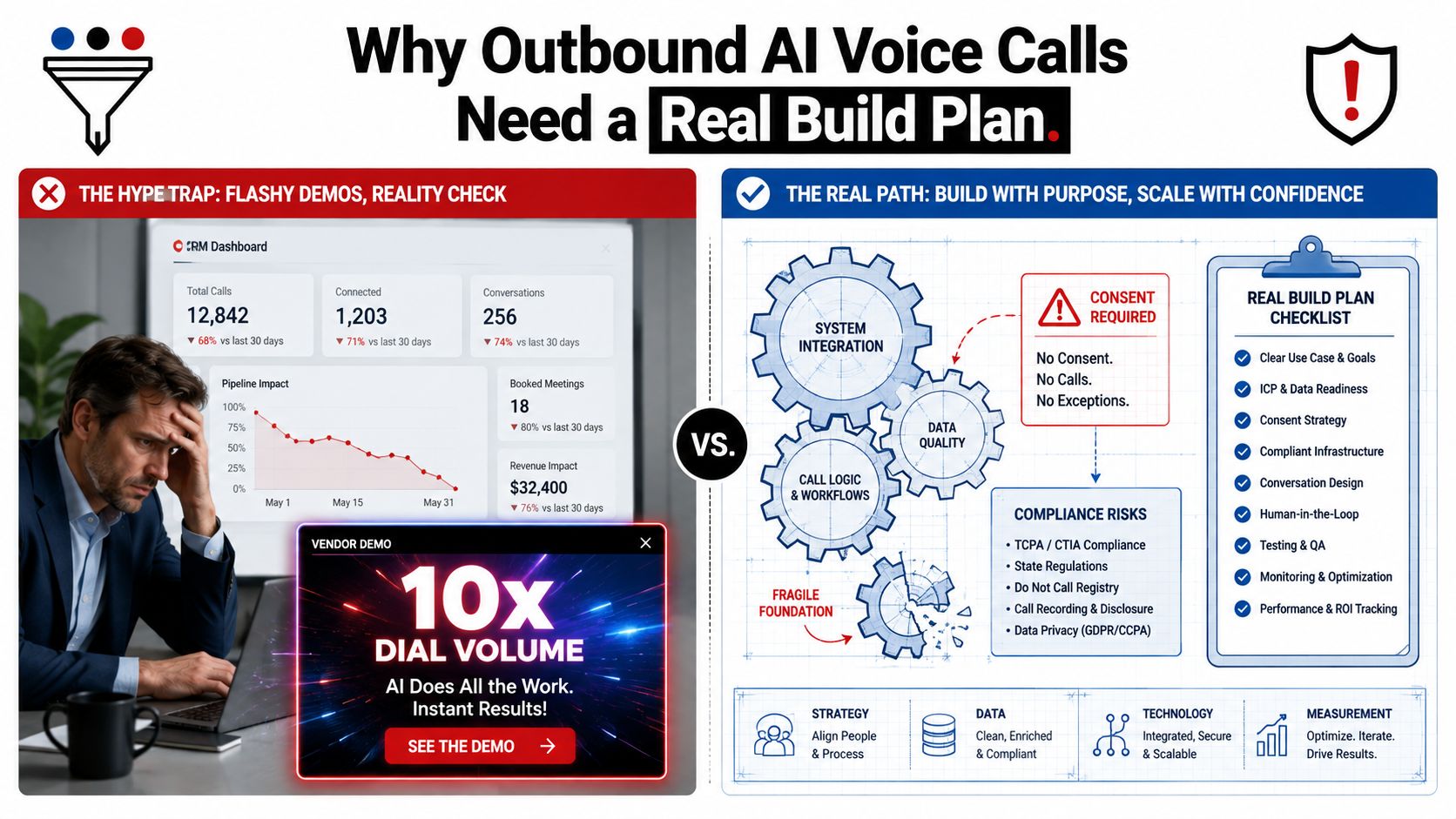
Your pipeline is stalled, the SDR team is spending hours dialing contacts who never answer, and a vendor demo is promising dramatically more conversations with an AI voice agent for outbound calls. The demo sounds convincing because it shows the easy part: a polished greeting, fast responses, and a clean CRM update.
Production exposes the harder questions. Did the contact consent to an AI-generated voice call? Did the agent identify itself clearly? What happens when a prospect interrupts, asks for a human, reaches voicemail, or requests removal? Can finance distinguish a qualified conversation from a connected call that ended in silence?
Outbound voice automation works when it's treated as an operating system for a funnel, not as a dial-volume feature. The practical build starts with the use case, consent record, call script, telephony events, CRM permissions, handoff rules, and ROI definition. Vendor selection comes after those decisions.
Why Outbound AI Voice Calls Need a Real Build Plan
A sales leader usually encounters AI dialing at the wrong point in the buying process. The pipeline has slowed, reps are under pressure, and a vendor shows an agent placing calls at a pace no human team can match. The temptation is to compare platforms by parallel calling capacity or voice quality.
That comparison misses the operational risk. A bot can place calls efficiently and still produce poor business results if the list contains stale numbers, the consent history is incomplete, or the CRM receives unreliable dispositions. It can also create legal exposure if the opening disclosure and opt-out handling weren't designed before launch.
Industry coverage published for 2026 reported 34% enterprise adoption of AI phone calling, up from 18% in 2024, with organizations using AI voice agents reportedly achieving 2.8 times higher contact rates and 47% lower cost per acquisition than traditional call-center operations. The same summary cited a median 312% ROI within 14 months and projected that 60% of enterprise outbound calling volume could be AI-initiated by 2028. These figures are directional benchmarks, not a substitute for your own cohort data, and they come from the 2026 AI phone calling statistics and ROI summary.
Sequence the build around the funnel
Start by defining the business event the call must produce. A reminder call may need a confirmed appointment. A reactivation call may need a verified buying signal. A prospecting call may need a qualified transfer, not merely a completed conversation.
Then specify the system around that event:
- Target outcome: Define what counts as success before writing the prompt.
- Eligible audience: Restrict calls to contacts with a verified number and documented permission.
- Conversation boundary: Decide what the agent may answer and where it must transfer.
- System of record: Map every call event and disposition to an existing CRM field.
- Financial model: Include telephony, licensing, enrichment, human transfers, and exception handling.
A modern platform may handle 5,000-plus parallel calls, according to CloudTalk's coverage of AI voice-agent statistics. That capacity matters only when the queue is lawful, the script is narrow, and the CRM can absorb the resulting events.
Practical rule: More dials are useful only when each downstream stage is instrumented. Otherwise, automation multiplies unqualified activity and makes the reporting harder to trust.
Picking the First Use Cases Worth Automating
The right first use case sits where the funnel is wide, the message is predictable, and the cost of a mistaken answer is limited. High-volume re-engagement, webinar reminders, post-event follow-ups, appointment confirmations, and simple payment nudges usually fit that profile. The agent has a defined purpose, a small set of likely responses, and a clear exit condition.
Complex cold outreach to senior enterprise buyers is different. The contact may ask about pricing, security, architecture, procurement, or a competitor in the same conversation. An agent can support research or routing, but a human should usually own the interaction when interpretation and negotiation determine the outcome.
Read the funnel one stage at a time
The outbound sequence should be measured as answer rate, connect-to-conversation rate, qualified-call rate, and cost per qualified call, rather than one blended success number. That sequence is recommended in the AI voice-agent benchmarking framework from Desi Labs, which also emphasizes server-side logging for ringing, answer, transfer, hold, and hangup events.
A call that reaches voicemail isn't a successful conversation. A connected call that the agent fails to contain isn't a qualified outcome. A useful definition of containment requires the task to be fully resolved, not just left without a transfer.
| Use Case | Call Volume | Script Variability | Compliance Risk | Human Handoff Need | AI Fit Score |
|---|---|---|---|---|---|
| Post-event follow-up | High | Low | Moderate | Moderate | High |
| Appointment confirmation | High | Low | Moderate | Low | High |
| Lead reactivation | High | Medium | Moderate | Moderate | High |
| Net-new enterprise prospecting | Variable | High | High | High | Low |
| Complex renewal discussion | Moderate | High | High | High | Low |
| Payment reminder | High | Low to medium | High | Moderate | Conditional |
Use matched cohorts when comparing AI with human outreach. The benchmark guidance recommends matching by lead source, hour of day, previous touches, queue priority, and caller intent. Without that control, an AI queue can appear stronger because it received easier contacts.
The best launch candidate is usually not the most glamorous one. It's the workflow where a short call can produce a clean disposition, a clear handoff, or a confirmed next action.
Compliance, Consent, and Disclosure Architecture
Compliance isn't a review step after the agent has been built. It's part of the call architecture, alongside the phone number, prompt, CRM lookup, and transfer logic. In the United States, the FCC has treated AI-generated voices as artificial voices under TCPA-style rules, making consent and disclosure requirements central to outbound design.
The compliance position described in the supplied 2026 coverage includes a January 27, 2025 requirement for written, single-seller consent in many telemarketing contexts and California's AB 2905 requirement for a verbal AI disclosure at the start of automated calls. Review the 2025 guidance on what's allowed for AI sales calls with qualified counsel before operating across jurisdictions, because state requirements and call purposes can change the workflow.
Build the consent record before the prompt
The agent should receive a contact only when the system can retrieve a usable permission record. Store the source, timestamp, called number, seller identity, campaign purpose, and any applicable restrictions. Consent should be checked against the exact number being dialed, not merely the contact ID.
DNC controls need the same operational treatment. Scrub the audience before enrollment, maintain suppression records, and make an opt-out update immediately when a recipient asks not to be called again. State-level mini-TCPA requirements can add another layer in markets such as Florida, Oklahoma, Washington, and Maryland, so routing logic should identify the applicable jurisdiction before the call starts.
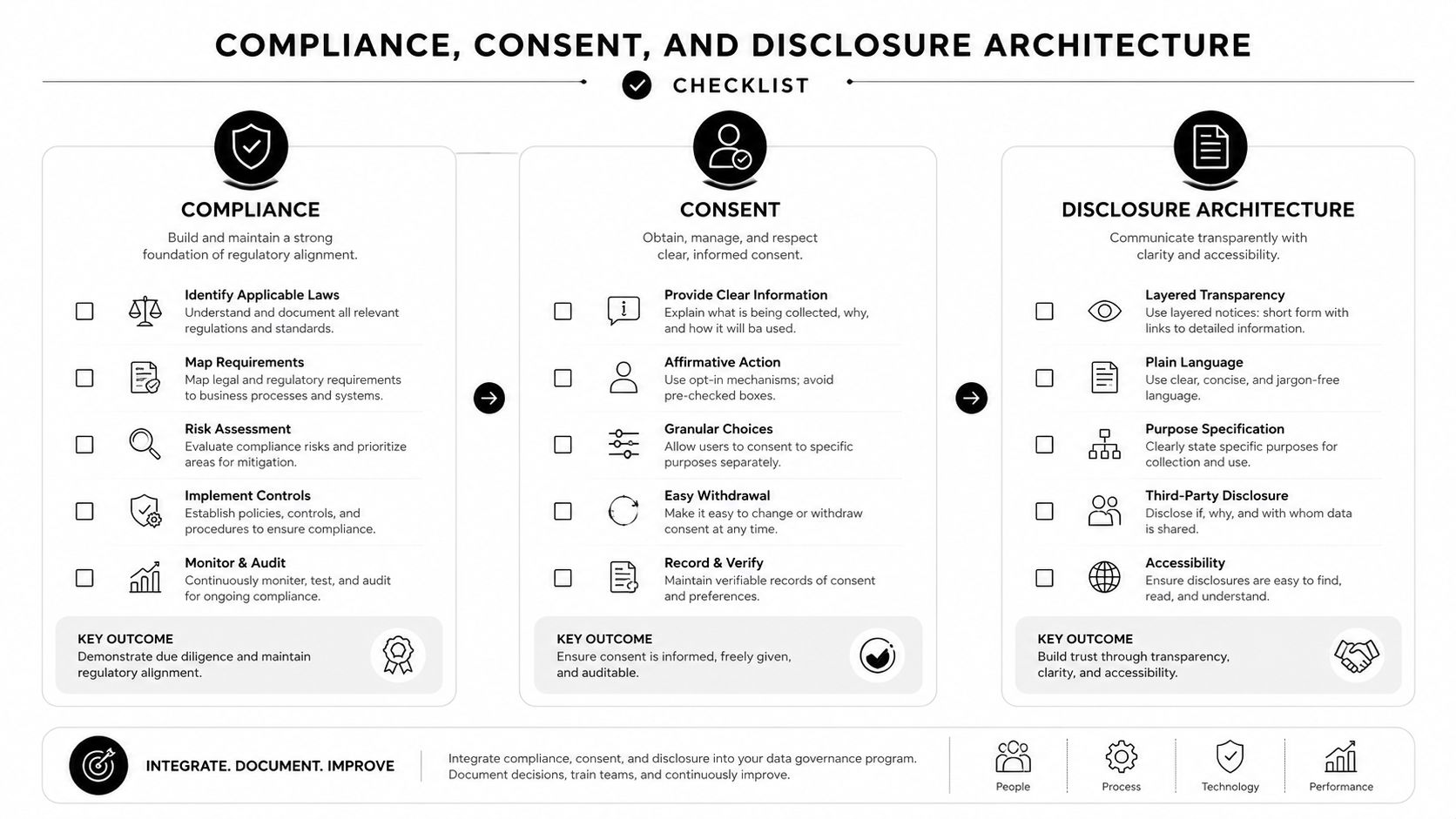
A practical verification flow looks like this:
- Retrieve the permission record: The orchestration layer pulls the consent source and timestamp from the CRM.
- Match the destination: The system compares the consented number with the number queued for dialing.
- Apply campaign rules: The campaign checks seller, purpose, jurisdiction, quiet hours, and suppression status.
- Deliver the disclosure: The agent identifies itself as AI at the beginning of the call in clear language.
- Offer immediate opt-out: The recipient can request removal without navigating a complicated menu.
- Write the event back: The system stores the disclosure, consent decision, opt-out result, and disposition.
The disclosure belongs in a version-controlled prompt component, not in a sales manager's editable copy block. That separation lets legal review the required language while operations refine the qualification questions.
Conversation Design, Prompts, and Fallback Paths
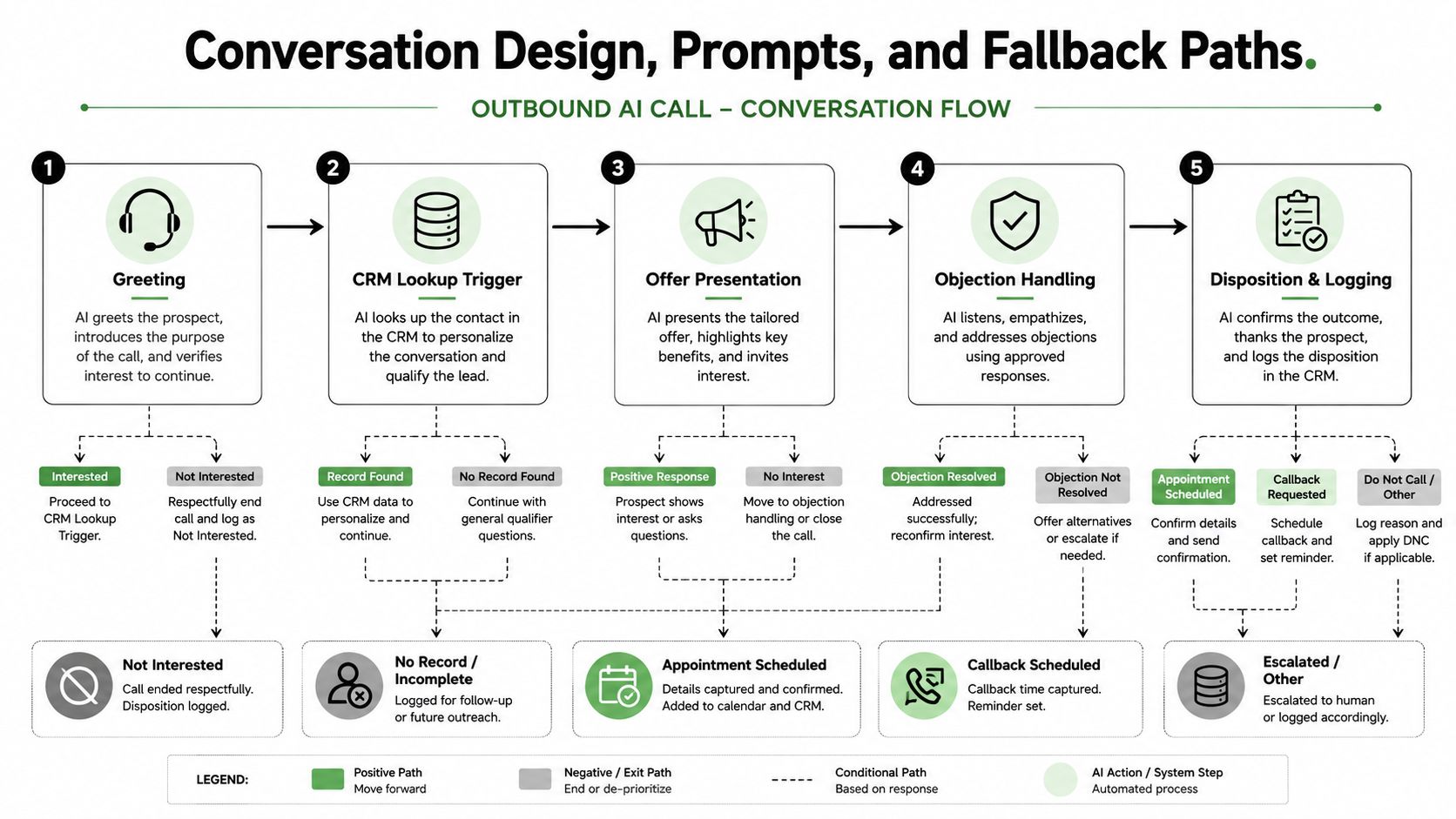
A productive call feels less like an open-ended chat and more like a controlled state machine. The agent needs enough context to sound relevant, but every branch should lead to a known action.
Consider a follow-up call to a contact who requested information. The first turn identifies the agent, names the company, states the purpose, and pauses. The agent shouldn't launch into a pitch before the recipient has acknowledged the interaction and accepted the conversation.
A representative call flow
Greeting: “Hello, may I speak with [name]?” The system should detect whether a person or voicemail answered before continuing.
Purpose and disclosure: “I'm an AI voice assistant calling on behalf of [company] about your request for [resource].” The prompt should require a pause for an explicit response.
CRM lookup: Once the person confirms identity, the agent retrieves the relevant campaign context, prior touchpoint, product interest, and assigned owner. It shouldn't expose unrelated CRM fields or read sensitive data aloud.
Qualification: Ask one focused question at a time. If the answer meets the defined criteria, offer a transfer or scheduling path. If it doesn't, record the reason and close respectfully.
Fallback: Silence should trigger a short re-prompt, not an improvised monologue. Interruptions should stop speech immediately. An objection outside the knowledge boundary should lead to a human transfer, a message, or a clear close.
For teams designing intent branches, intent recognition in automation workflows provides a useful reference point for separating qualification, objection, opt-out, and handoff states. An on-demand character audio guide can also help teams hear how voice pacing, interruption, and turn-taking affect the experience before they commit to production audio.
Make hard stops deterministic
Words such as stop, remove, and do not call shouldn't rely on the language model's interpretation alone. Map them to a hard-stop function that ends the sales path, updates the suppression list, and writes the event to the CRM.
Version prompts by component. Keep the greeting, disclosure, qualification questions, objection library, transfer policy, and disposition schema separate. If the disclosure changes, legal should be able to approve that component without forcing a rewrite of the entire conversation.
Integrating with Your CRM and Sequencing Stack
The integration should be wired in the order the data moves. Start with a clean contact record, then trigger the call, then return structured events. Reversing that order produces attractive demos and unreliable operations.
The CRM record needs a phone number, consent details, prior touches, owner, timezone, campaign identity, and suppression status. A sequence enrollment event can then send the eligible contact to the voice platform through a webhook. The voice platform should return call status, disposition, transcript, recording reference, transfer result, and any meeting details through authenticated event callbacks.
The handoff needs two-way confirmation
Calendar booking is a common failure point. The agent must use the contact's timezone, check live availability, create the meeting, and confirm the final time in the same call. The CRM should receive the booking result only after the calendar system confirms it, otherwise reps may follow up on meetings that were never created.
For Outreach, Salesloft, or another sequencing tool, place the AI call as one controlled step in a multi-touch cadence. Respect quiet hours, pause rules, ownership changes, and reply signals. If a human rep has already responded, the voice step should be removed or held rather than acting on stale enrollment data.
| Source | Destination | Data Passed | Trigger |
|---|---|---|---|
| CRM | Voice platform | Number, consent record, owner, campaign context | Sequence enrollment |
| Sequencing tool | Orchestrator | Step status, timing, suppression state | Eligible call step |
| Telephony platform | Event service | Ringing, answer, hangup, transfer | Call lifecycle events |
| Voice platform | CRM | Disposition, transcript, recording reference | Call completion |
| Calendar | CRM and sequencer | Meeting ID, time, timezone, confirmation | Booking success |
| CRM | DNC service | Opt-out number and reason | Hard-stop request |
Teams handling event-heavy workflows can use real-time data processing patterns to reason about webhook order, retries, and duplicate events. The two common sync patterns have different weaknesses. Pull-then-call can use stale data if the contact changes after retrieval, while webhook-driven calling can fail when delivery is delayed or duplicated.
Protect the integration with narrow permission scopes, idempotent event handlers, PII redaction in logs, recording access controls, and a dead-letter queue for failed CRM writes. A call that occurred but never reached the system of record is an operational exception, not a successful automation.
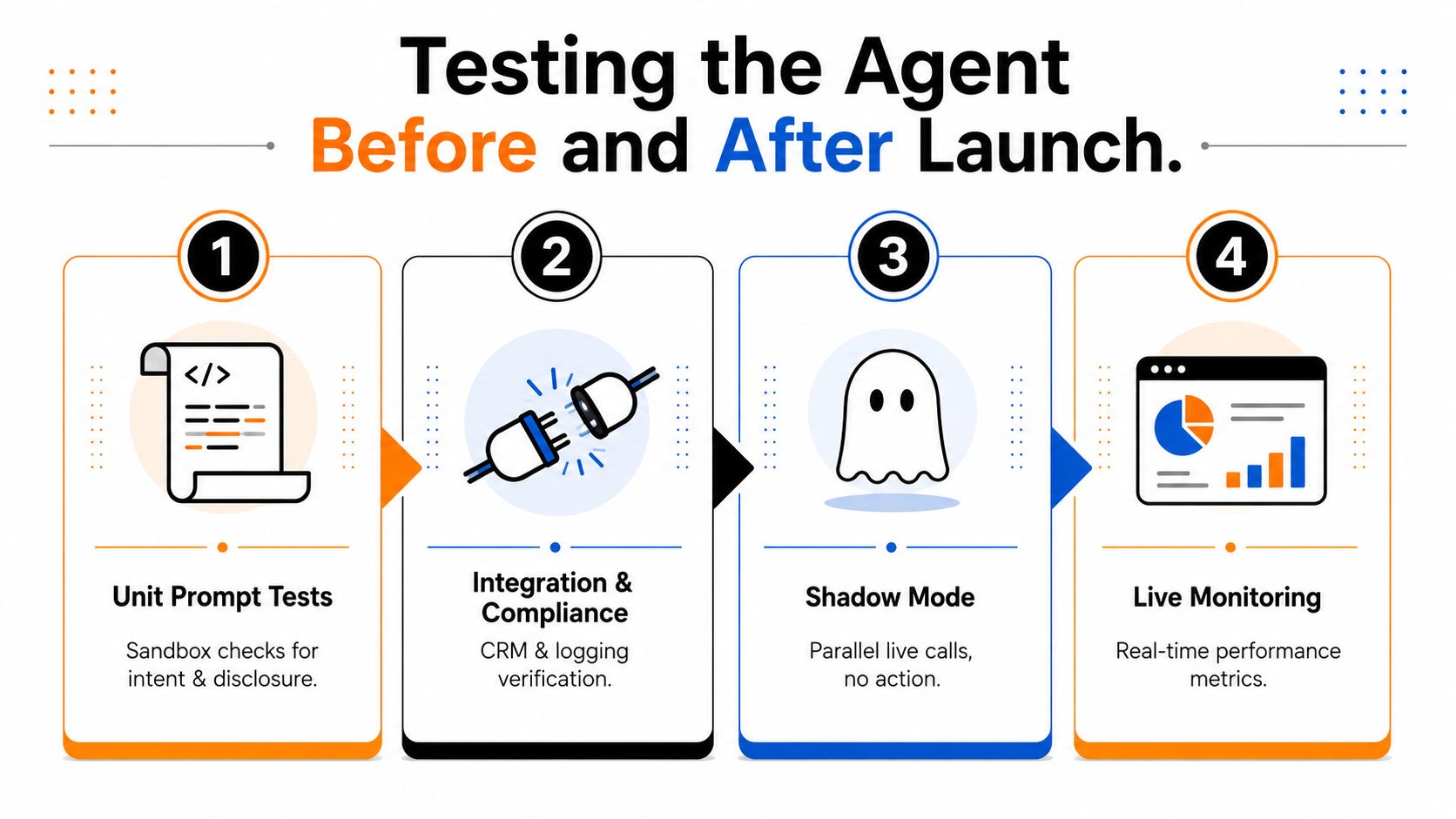
Testing the Agent Before and After Launch
Testing should create gates that block deployment when the agent violates a required behavior. A broad instruction such as “test the bot thoroughly” doesn't tell legal, RevOps, or engineering who owns the decision or what evidence is sufficient.
Four gates for a defensible launch
Gate one, unit prompt tests. Use synthetic contacts and scripted turns in a sandbox. Check identity handling, disclosure delivery, consent rejection, qualification classification, silence behavior, interruption handling, voicemail branching, and human requests. Each test needs an expected intent and an expected action.
Gate two, adversarial testing. Ask the agent to reveal private CRM fields, continue after an opt-out, skip the disclosure, invent product capabilities, or misrepresent its identity. Log every attempt and assign pass or fail criteria before testing begins. Legal should approve the compliance cases, while RevOps owns disposition and routing cases.
Gate three, closed pilot. Use a consented list and have a human listener shadow calls. The observer should record disclosure compliance, transfer quality, incorrect CRM writes, and cases where the agent continued beyond its authority. Scaling should wait until the owner signs off on the pilot evidence.
Gate four, post-launch regression. Sample transcripts weekly, monitor intent drift, review suppression events, and maintain a kill switch that can pause the campaign or route every call to humans. A prompt update, telephony change, carrier change, or CRM schema edit should trigger regression tests again.
Assign an owner to every exit decision
Engineering owns system health and event delivery. RevOps owns funnel definitions and CRM integrity. Legal or compliance owns disclosure, consent, recording, and suppression requirements. Sales leadership owns the business threshold for transfer quality and qualified outcomes.
The pilot dashboard should distinguish technical failure from conversational failure. A dropped call, an unrecognized voicemail, an incorrect qualification, and a valid opt-out are different events. Combining them into a single “failed call” metric hides the decision you need to make.
Monitoring KPIs and Proving ROI
A finance-ready dashboard starts with the funnel, not with the vendor's activity counter. Track answer rate, connect-to-conversation rate, qualified-call rate, cost per qualified call, transfer rate, meeting outcome, and CRM write success. The AI voice-agent benchmarking framework from Desi Labs recommends explicit event instrumentation across telephony, transcription, call tags, and CRM write-back, including transcription confidence.
The dashboard should also show how many calls reached voicemail, IVR, abandonment, or a real conversation. Treating every non-transfer as containment exaggerates performance. A contained call should represent a resolved task, such as a confirmed reminder, completed qualification, or successfully booked meeting.
Build the cost model from qualified outcomes
Compare cost per qualified meeting, not cost per dial. On the AI side, include telephony, carrier charges, platform licensing, transcription or model costs, recording storage, CRM enrichment, integration maintenance, human transfers, and exception review. On the human side, use fully loaded rep time, including dialing, waiting, disposition, research, follow-up, and management overhead.
| Metric | Human SDR Baseline | AI Voice Agent | Delta / Notes |
|---|---|---|---|
| Answer rate | Measure by matched cohort | Measure by matched cohort | Compare equivalent lists and calling windows |
| Conversation rate | Record after answer | Record after answer | Exclude voicemail and IVR |
| Qualified-call rate | Apply shared criteria | Apply shared criteria | Keep qualification definitions identical |
| Cost per qualified call | Fully loaded rep cost | Platform and operating cost | Include transfers and exceptions |
| Meeting quality | Human-validated outcome | Human-validated outcome | Review downstream acceptance |
| CRM write success | Audit manually and automatically | Audit event delivery | Missing records are exceptions |
| Compliance exception rate | Log manually | Log automatically | Any breach should trigger review |
Review weekly cohorts, but don't let one noisy period decide the program's future. Compare equivalent lead sources, campaign intents, call windows, prior touches, and queue priorities. Scale when qualified outcomes remain reliable and the human team can accept the handoffs. Pause when opt-out handling degrades, CRM writes fail, qualification quality falls, or transfer volume overwhelms the receiving team.
A CFO summary should be short and auditable:
- Deploy cost: Platform, implementation, telephony, integration, and training.
- Gross meetings: All meetings attributed to the calling workflow.
- Net meetings: Meetings remaining after qualification and attendance validation.
- Payback period: Time required for contribution margin to recover deployment cost.
- Compliance exception rate: Calls requiring investigation, suppression correction, or campaign pause.
For a structured way to pressure-test those assumptions, use the AI voice agent ROI calculator. MakeAutomation can also implement inbound and outbound voice agents, connect qualification workflows to CRM systems, and document the operating rules that keep the automation measurable and reviewable.
If your team is evaluating an AI voice agent for outbound calls, start with one narrow workflow, a verified consent path, and a finance-ready definition of success. Visit MakeAutomation to discuss implementation, CRM integration, and the workflow documentation needed to move from a vendor demo to a defensible production system.