
API Authentication Methods: B2B SaaS Guide 2026
You're probably making this choice while several other priorities are fighting for attention. The product team wants integrations live, sales wants enterprise deals unblocked, and engineering wants something that won't become technical debt six months from now.
That's why API authentication decisions go wrong. Teams treat them like a narrow implementation detail, pick the fastest option, and only later discover they've created a support problem, a security problem, and an architecture problem at the same time.
For a B2B SaaS platform, authentication affects more than request validation. It shapes partner onboarding, workflow reliability, incident response, internal service trust, and how painful future migration will be when customers ask for delegated access, auditability, or stronger controls.
Why Your API Authentication Choice Is a Critical Business Decision
A founder usually asks the wrong first question. They ask, “What's easiest to ship?” The better question is, “What can we still live with when this platform has more customers, more integrations, and more risk?”
That shift matters because weak authentication still sits at the center of a large share of API failures. In the past year, 99% of organizations reported an API security issue, and 29% of observed vulnerabilities were directly linked to insecure authentication methods like basic auth and unsecured API keys according to Levo's API authentication analysis.
If your product moves lead data, customer records, billing events, or workflow actions between systems, the authentication layer isn't just guarding access. It's protecting business continuity. A broken or compromised auth model can stop automations from firing, expose tenant data, or force a rushed migration under pressure from customers and auditors.
What founders often underestimate
The technical method you choose becomes an operating model.
- Support burden: Simple schemes are easy to issue, but they're often harder to rotate cleanly.
- Product flexibility: If partners need delegated access later, some methods become dead ends.
- Security response: Revoking one credential is simple. Revoking access across many services and tokens is not.
- Developer experience: A method can be secure on paper and still create enough friction that customers misuse it.
Authentication is one of the few platform decisions that affects security, product design, and revenue at the same time.
For B2B SaaS, that's especially visible in automation-heavy environments. A CRM sync, outbound sequencing engine, onboarding workflow, or enrichment pipeline may make thousands of calls without human supervision. If auth is brittle, those automations don't fail gracefully. They fail in production, often after data has already moved to the wrong place or stopped moving entirely.
The Authentication Landscape A High-Level Overview
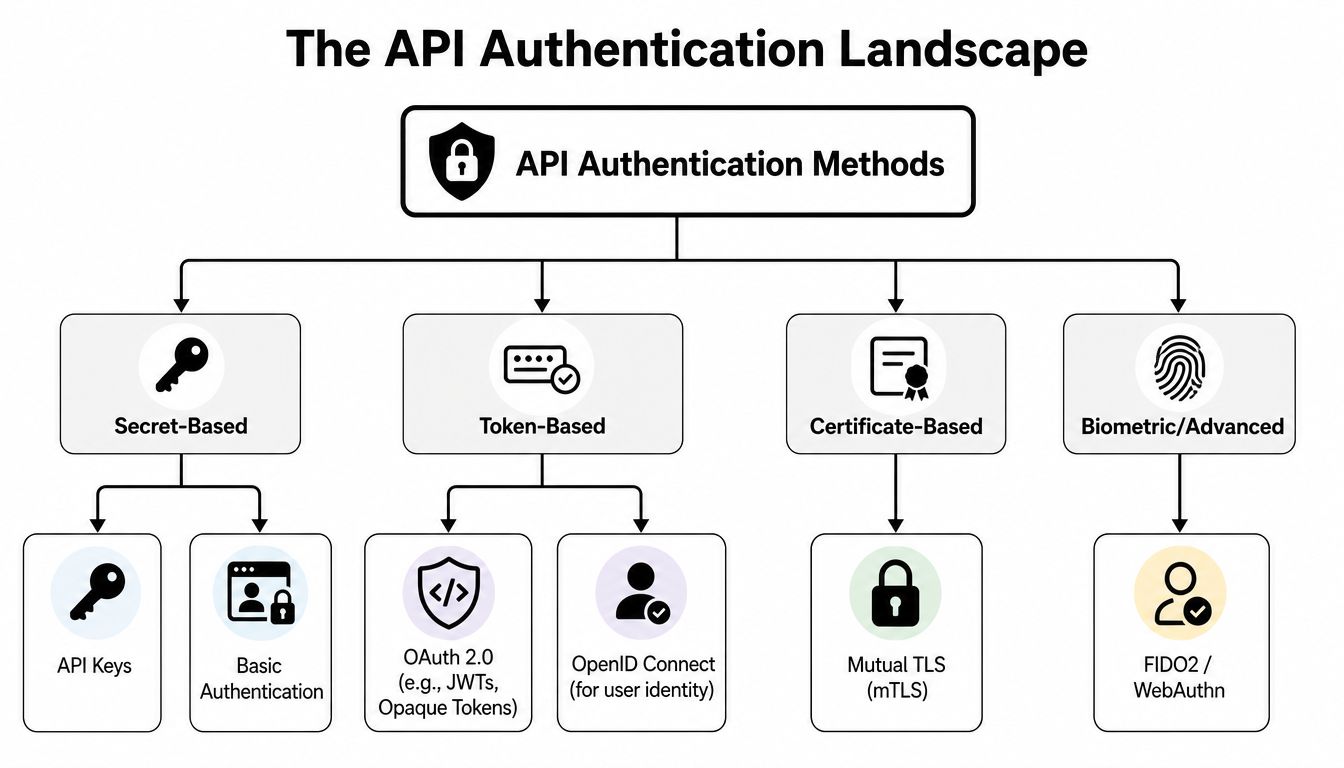
The easiest way to understand API authentication methods is to group them by what they rely on: a shared secret, a token, or cryptographic proof.
Secret-based methods
This family includes API keys and Basic Authentication. They're the closest thing to a standard door key. If the caller presents the right string, the API lets them in.
That simplicity is why teams still use them. They're easy to generate, easy to document, and easy to test with tools like Postman, cURL, or Insomnia. For internal prototypes or narrow server-to-server connections, they can feel good enough.
The problem is that shared secrets don't carry much context. They usually answer “who has this secret?” but not “what exact permissions should apply right now?” That makes them operationally convenient at first and governance-heavy later.
Token-based methods
OAuth 2.0 and JWT-based approaches are prominent here. Think of token-based access as a valet key, not a master key. The token grants a specific kind of access for a limited period, ideally with defined scope.
OAuth 2.0 is widely recognized as the most secure and standard method for securing APIs, especially when third-party applications need access without exposing user credentials, as described in Akamai's API authentication overview. That's why “Sign in with Google” style flows became familiar. The application gets controlled access. The user's main password stays out of the integration.
JWTs often appear alongside OAuth 2.0, but they solve a different problem. A JWT is a token format. OAuth 2.0 is an authorization framework. Teams often blur those together, which leads to design mistakes later.
Certificate-based and advanced methods
Mutual TLS (mTLS) belongs in a different class. Instead of trusting a secret or bearer token alone, both sides prove identity with certificates. That's useful when the system must know not just that a request is authorized, but that the calling service itself is a verified participant.
A fourth category is emerging around stronger user authentication standards such as OpenID Connect, FIDO2, and WebAuthn. These matter most where APIs sit behind human login journeys, admin portals, or high-risk workflows.
If your platform supports partner integrations, customer-facing apps, internal microservices, and admin users, you probably won't use one authentication method everywhere.
That's normal. Mature platforms usually combine methods by context rather than forcing a single answer onto every endpoint.
Detailed Comparison of Core Authentication Methods
Most B2B SaaS teams end up comparing three practical options first: API keys, OAuth 2.0, and JWT-based access patterns. The right decision depends less on abstract purity and more on your product model, your integration surface, and how much operational discipline your team can sustain.
Here's the quick view.
| Method | Security Model | Best For (Use Case) | Scalability | Key Weakness |
|---|---|---|---|---|
| API Keys | Shared secret presented by client | Simple server-to-server integrations, internal tooling, low-complexity partner access | Moderate at small scale, weaker as partners and permissions grow | Weak lifecycle control and limited permission granularity |
| OAuth 2.0 | Delegated token-based authorization | Third-party apps, marketplaces, user-consented access, B2B integrations across tenants | High, especially for partner ecosystems and platform growth | More moving parts, more implementation complexity |
| JWT | Signed stateless token format | Microservices, session propagation, high-throughput APIs | High for distributed systems and stateless services | Easy to misuse if validation and revocation strategy are weak |
| Basic Authentication | Username and password sent with requests | Legacy systems only | Poor for modern SaaS | Weak security posture and poor fit for modern integrations |
| mTLS | Mutual certificate verification | High-trust service-to-service communication, regulated environments | Scales selectively, but with heavy ops overhead | Certificate issuance, renewal, and distribution complexity |
API keys
API keys are attractive because they minimize ceremony. A customer creates a key, pastes it into their integration, and starts sending traffic. For simple internal automation, that can be enough.
A typical request looks like this:
Authorization: Bearer YOUR_API_KEY
or sometimes:
X-API-Key: YOUR_API_KEY
The trouble starts when the platform grows. You need to know who owns the key, what system uses it, when it was last rotated, what permissions it should have, and how to replace it without breaking production jobs. A lot of tutorials skip those realities and jump straight from generation to usage, like the examples you'd see in guides focused on specific tools such as using a Slack API key for automation.
Most important differentiator: API keys identify a client. They don't model delegated user consent well.
OAuth 2.0
OAuth 2.0 is the best long-term choice when your platform needs delegated access. That means one application can act on behalf of a user or tenant without ever handling the user's primary credentials.
A request commonly looks like this:
Authorization: Bearer ACCESS_TOKEN
That header looks similar to an API key, but the operating model is different. The token is usually short-lived, scope-bound, and issued through a formal authorization process. That's why OAuth 2.0 fits partner ecosystems, app marketplaces, customer integrations, and enterprise procurement expectations far better than raw shared secrets.
OAuth 2.0 earns its complexity when users, tenants, and third-party developers all need controlled access boundaries.
If you expect your API to power customer-facing integrations, choose OAuth early unless there's a strong reason not to.
JWTs
JWTs are often praised because they're stateless and efficient. The server can validate a signed token without keeping per-session state in a database, which makes JWTs useful in distributed architectures and microservice environments.
A JWT-based bearer token still travels like this:
Authorization: Bearer eyJ...
What changes is what's inside the token and how your services validate it. JWTs can carry claims such as roles, subject identifiers, and expiry details. That helps at scale, but it also creates a false sense of safety when teams assume “signed” means “secure enough.”
A JWT is compact and fast. It is not a substitute for authorization logic.
Basic Auth and why it rarely survives growth
Basic Auth still appears in legacy integrations because it's trivial to understand. But benchmark comparisons consistently place HTTP Basic Authentication and API keys below token and certificate-based methods from a security standpoint, while mTLS is often cited as one of the most secure approaches because both client and server present certificates, according to Zuplo's comparison of API authentication methods.
For a modern SaaS product, Basic Auth is usually a transitional compatibility layer, not a platform strategy.
High-Security and Specialized Methods Explored
When the stakes get higher, the comparison changes. You're no longer asking which method is easiest for developers to adopt. You're asking which threat model you need to defeat, and what complexity you're willing to absorb to do it.
Mutual TLS for service trust
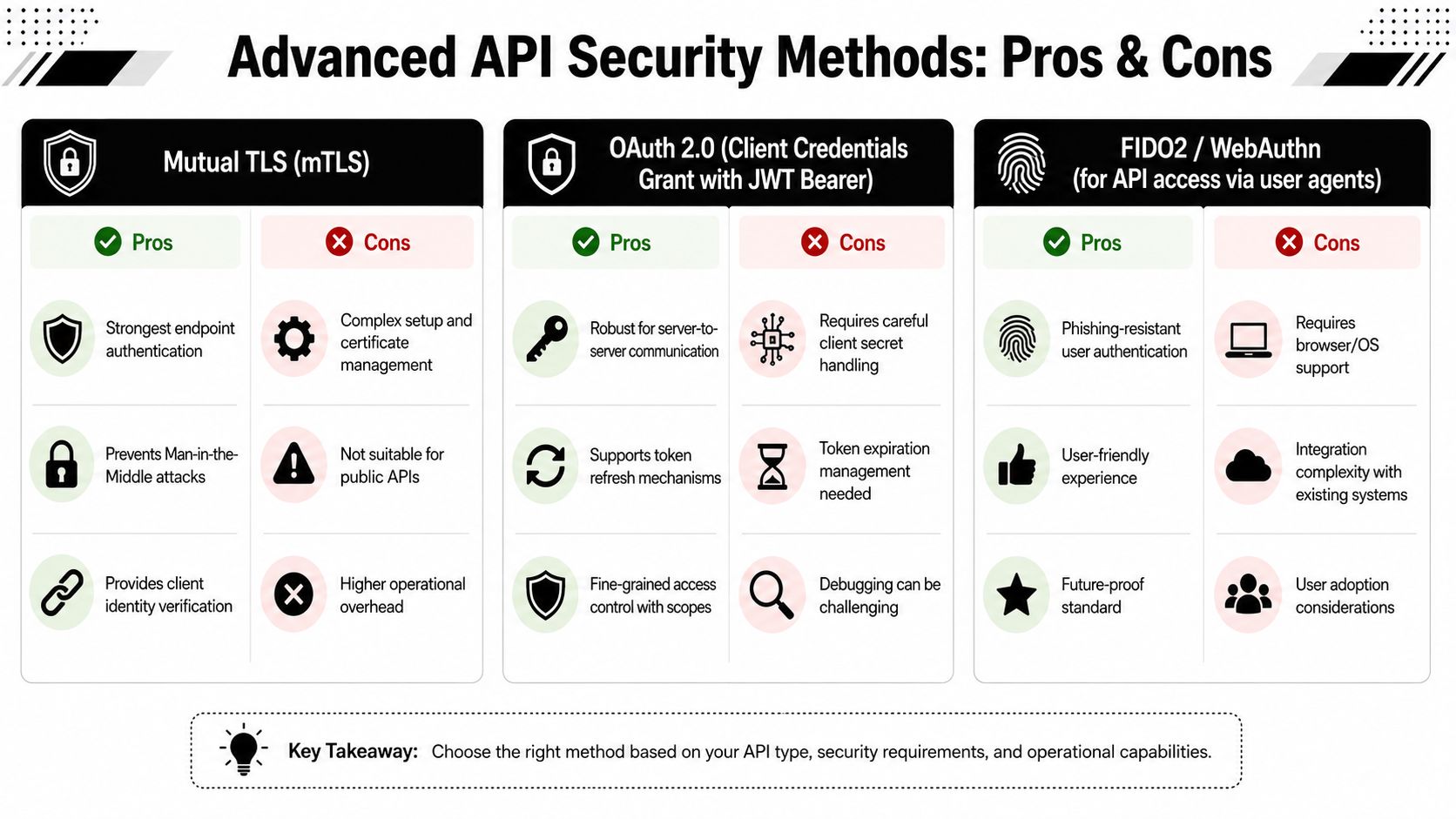
mTLS works well when both sides of the connection must prove identity. It's less like presenting a badge at reception and more like a private facility where both the guest and the guard verify each other before any conversation starts.
That makes mTLS valuable for:
- Internal service meshes where one compromised service shouldn't impersonate another
- Highly sensitive partner links between known organizations
- Regulated workloads where cryptographic identity matters as much as credential possession
The trade-off is operational. Performance benchmark data indicates that JWTs are the most lightweight option for high-performance systems, while mTLS demands significantly more computational resources because of certificate verification overhead, according to this authentication performance benchmark.
So the question isn't whether mTLS is strong. It is. The question is whether your team is ready for certificate issuance, renewal, revocation, trust-store management, and debugging across environments.
HMAC for message integrity
HMAC doesn't get as much attention in mainstream API discussions, but it solves a specific problem well. It helps the receiving system verify that the request wasn't modified in transit and that the sender possessed the signing secret when the message was created.
That can be useful in webhook delivery, transaction signing, or command execution workflows where request integrity matters as much as caller identity. It's particularly relevant when replay protection and tamper detection must work together.
A team might use HMAC on top of another method rather than instead of it. That's common in payment-like flows, webhook systems, and sensitive automation actions.
Use specialized methods for specialized risks. Don't deploy mTLS because it sounds more enterprise. Deploy it because you need mutual cryptographic identity.
Where FIDO2 and WebAuthn fit
FIDO2 and WebAuthn aren't direct replacements for machine-to-machine API authentication, but they matter when humans administer or approve API-connected workflows through browsers and devices. They reduce reliance on passwords and improve phishing resistance for user-facing access.
If your platform includes admin consoles, customer dashboards, or approval steps before automations run, it's worth understanding how passwordless patterns fit the broader identity model. AppLighter's biometric guide is a useful primer if you want a practical explanation of biometric authentication and where it intersects with modern identity flows.
Avoiding Common Implementation Pitfalls and Security Gaps
Most tutorials explain how to authenticate one request. Very few explain how to keep that system safe after months of production use, staff changes, customer growth, and nonstop automation traffic.
That's where real failures happen.
Credential rotation is not an edge case
Teams often issue a key, confirm the integration works, and move on. Months later, nobody knows which script, connector, customer environment, or contractor still depends on that credential.
That's dangerous. The UK's NCSC explicitly warns, “Avoid using long-term access keys which may grant indefinite access if compromised” and recommends credentials protected from replay via signed JWTs or certificates. The same guidance is cited alongside the finding that 42% of API breaches in B2B sectors stem from unrotated credentials older than 90 days in NCSC guidance on API authentication and authorisation.
For automation-heavy businesses, this problem gets worse because background jobs don't complain until they fail. A stale secret in a CRM sync, lead routing workflow, or outbound enrichment process can either keep working long past its intended lifetime or break undetected after an emergency rotation.
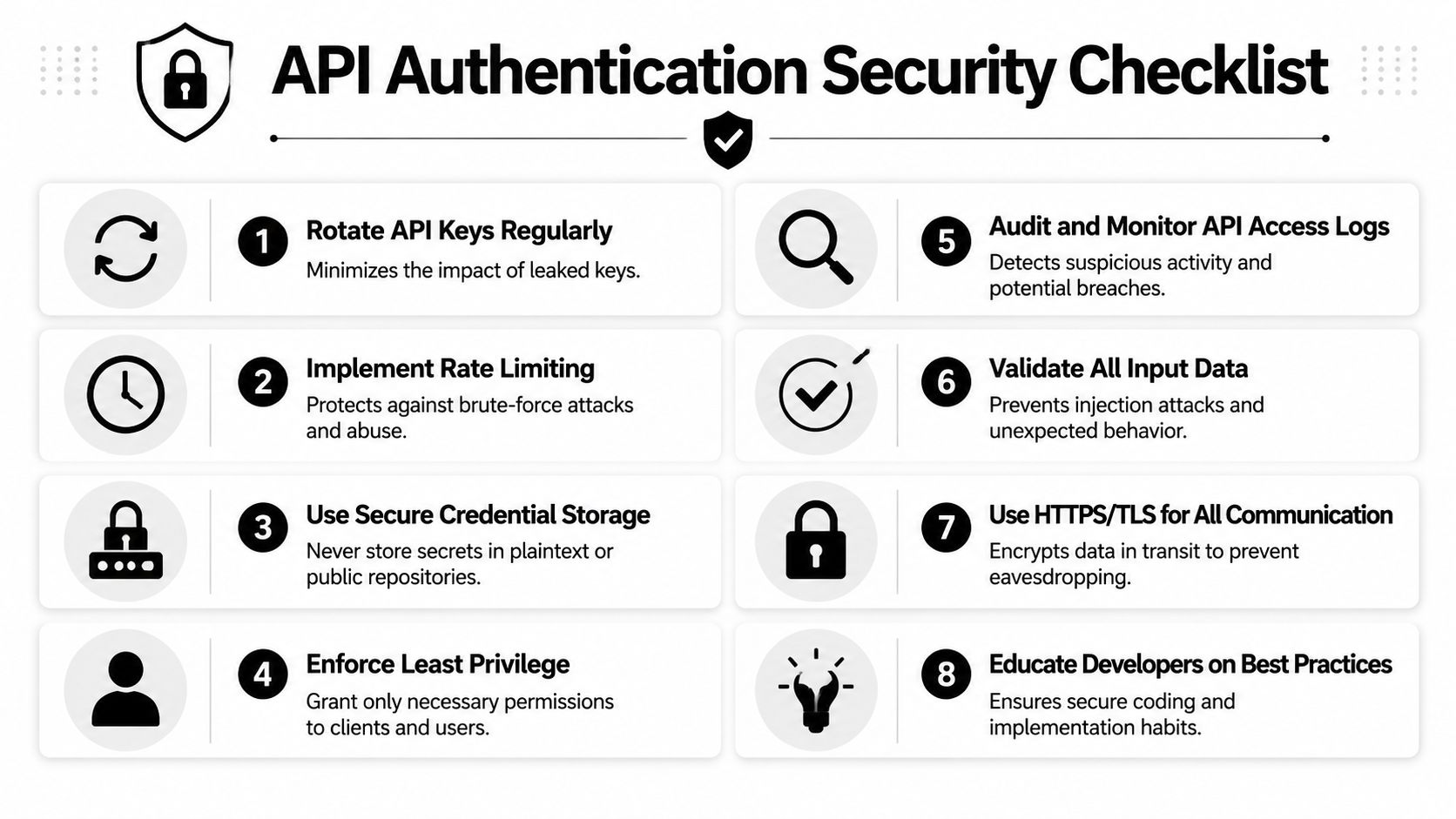
A practical operating model usually includes:
- Named credentials: Every key should map to a system, owner, and purpose.
- Dual-key rollover: Allow old and new credentials to overlap briefly so production jobs don't stop instantly.
- Usage visibility: Log where credentials are used before forcing revocation.
- Centralized storage: Secrets belong in managed vaults and controlled deployment paths, not in code, docs, or shared spreadsheets.
Teams that need a stronger operational pattern usually benefit from formal DevOps secrets management practices, especially once multiple environments and automation tools enter the picture.
Stateless does not mean secureless
JWT adoption often fails for a subtle reason. Teams hear that JWTs are stateless and conclude that the server can trust whatever is inside the token until expiry.
That's the wrong model.
If your platform changes a user's role, revokes an integration, suspends a tenant, or narrows permissions after a token was issued, the API still needs to enforce current policy. Signature validation alone doesn't answer whether the action should still be allowed.
Practical rule: Validate token signature, expiry, audience, issuer, and effective permissions on every request that matters.
That's especially important for admin actions, customer data access, tenant-bound resources, and automation endpoints that can trigger side effects.
What solid implementation looks like
A secure setup usually combines architecture and operations:
- Short-lived credentials where possible: Limit the blast radius when something leaks.
- Rate limiting and anomaly controls: Slow brute force and misuse.
- Revocation strategy: Know how you'll invalidate tokens or secrets before you need to.
- Permission checks close to the resource: Don't rely only on gateway-level acceptance.
- Audit logs with enough context: Record credential identity, tenant context, and action type.
Most breaches blamed on “auth” are really failures in credential lifecycle, validation discipline, or permission modeling.
The Decision Matrix Choosing Your Method for B2B and SaaS
The right choice gets clearer when you stop asking which method is best in general and start asking which one fits the job in front of you.
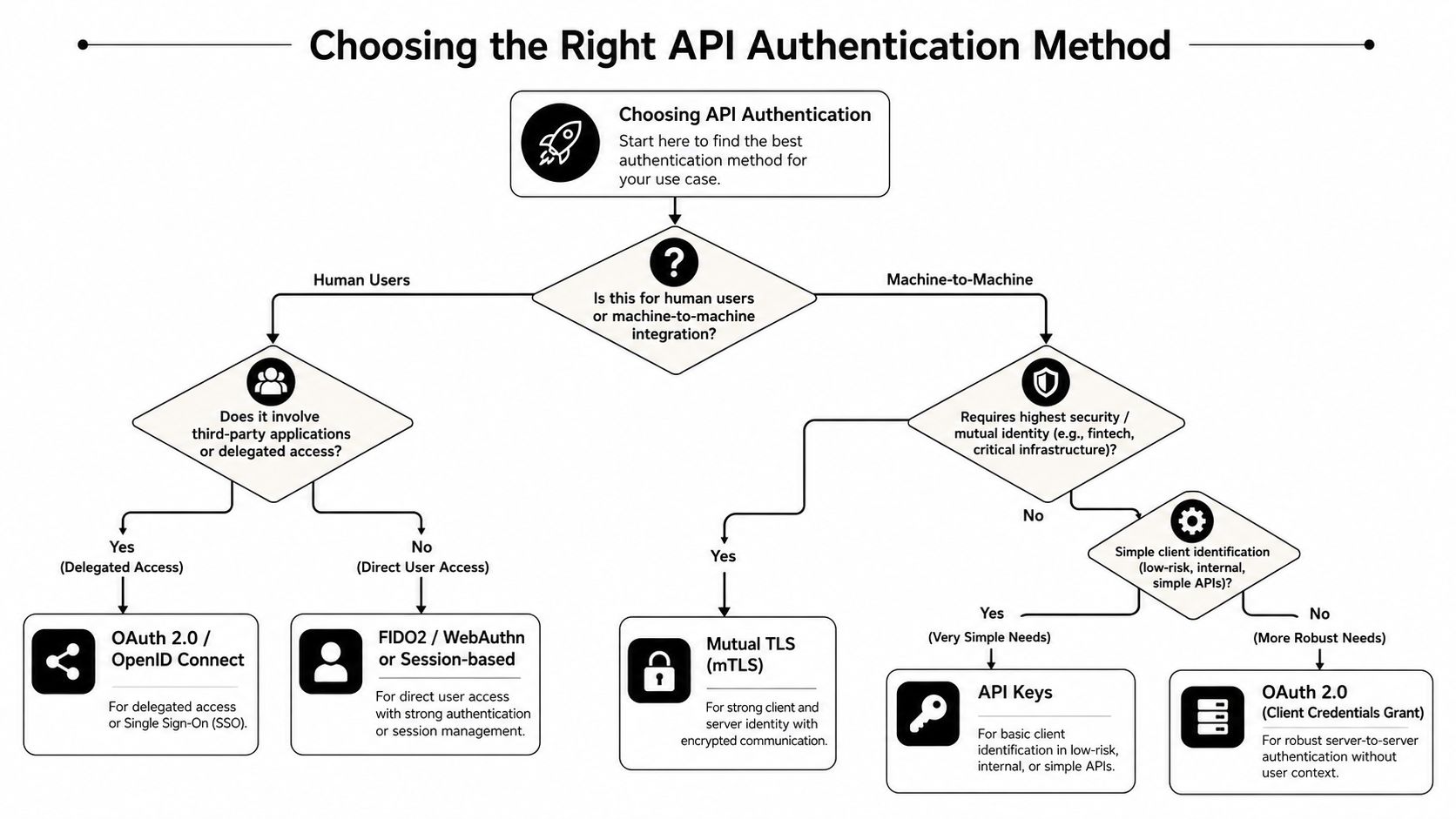
Start with one split: are you authenticating humans, systems, or both? A lot of platforms need separate answers.
If humans are in the loop
If users are signing into your product, approving integrations, or letting third-party apps access their data, OAuth 2.0 often becomes the right foundation. Add OpenID Connect when identity itself is part of the flow.
That's especially true for:
- customer-facing app ecosystems
- SSO-like experiences
- delegated access across tenants
- user-consented integrations
If the primary need is direct user authentication into a web application, stronger login standards such as passkeys, WebAuthn, or session-based approaches may make more sense than forcing pure API-centric thinking. For leaders planning broader identity architecture, identity solutions for IT leaders offers a useful view into how external identity decisions differ across B2B and B2C contexts.
If machines are talking to machines
Many SaaS products live most of the time in this context.
Use this lens:
- Choose API keys when the integration is simple, tightly scoped, low risk, and you control both sides well enough to manage lifecycle properly.
- Choose OAuth 2.0 client credentials when services need stronger control, auditable scopes, and cleaner long-term governance.
- Choose JWT-backed service auth when internal distributed systems need stateless validation and throughput matters.
- Choose mTLS when the system must verify both parties cryptographically and the cost of impersonation is unacceptable.
A lot of founders underestimate how fast “simple partner integration” turns into a product surface with provisioning rules, tenant boundaries, environment isolation, and admin controls. If you already know your SaaS platform will support browser apps, customer portals, or token-handling front ends, architectural choices in the web layer matter too. Even implementation patterns in frameworks like Angular can shape how securely tokens move through a single-page application, which is why teams building frontend-heavy products often look at patterns discussed in SPA architecture with Angular.
Here's a simple decision set I use with product teams:
| Question | Strongest default answer |
|---|---|
| Will third-party applications access customer data on your platform? | OAuth 2.0 |
| Is this internal service-to-service traffic at scale? | JWT, sometimes with OAuth client credentials |
| Is the connection high-trust and high-sensitivity? | mTLS |
| Is this a narrow, low-complexity server integration? | API key, with strict lifecycle controls |
A short walkthrough can help if your team wants a visual overview before deciding:
The best answer for B2B SaaS is often not a single method. It's a layered model. OAuth for partner and customer integrations. JWTs inside the platform. mTLS where service identity is paramount. API keys only where the simplicity is worth the governance cost.
Planning for Migration and Future-Proofing Your API
A lot of platforms start with API keys because they're fast to launch. That's reasonable. The mistake is treating that first choice as permanent.
If your customer base is growing, partners want delegated access, or enterprise buyers are asking security questions your current model can't answer cleanly, migration should start before the old method becomes a liability.
A sane migration path
The least disruptive approach is phased.
- Add the new method before removing the old one. Run both schemes in parallel for a defined transition period.
- Segment by customer type. New customers can start on OAuth 2.0 or stronger service auth while existing customers migrate on their own schedule.
- Expose clear tooling. Give developers token issuance flows, revocation controls, test environments, and docs that match real production behavior.
- Log old-method dependency. Before sunsetting API keys or Basic Auth, identify which customers, endpoints, and automations still rely on them.
- Communicate deadlines with practical examples. Customers need more than a policy notice. They need migration guides, sample requests, and fallback contacts.
Design for the next upgrade too
Future-proofing doesn't mean predicting every standard. It means avoiding hard-coded assumptions.
Build your auth layer so that:
- Multiple schemes can coexist per endpoint or client type
- Permissions are policy-driven rather than buried inside application code
- Token validation rules are centralized
- Credential metadata is observable, including issuer, audience, owner, expiry, and last use
That flexibility matters when you later add customer-managed integrations, stronger admin login methods, or machine identity controls.
What to optimize for long term
For most B2B SaaS founders, the winning posture is straightforward. Start simple only if you can migrate cleanly. Use OAuth 2.0 when third-party or customer-delegated access is part of the roadmap. Use JWTs carefully inside distributed systems. Reserve mTLS for trust boundaries that justify the overhead.
The best API authentication methods aren't the ones with the most features. They're the ones your team can secure, rotate, monitor, and explain under pressure.
If your team is choosing between API keys, OAuth 2.0, JWTs, or mTLS and you want an architecture that won't break under real automation load, MakeAutomation can help you design the auth model, credential lifecycle, and workflow implementation around the way your SaaS operates. That includes secure automation patterns for CRM syncs, lead-gen systems, client portals, and AI-driven operations where reliability matters as much as security.