

Marketing Automation B2B: The Practical Operating Playbook
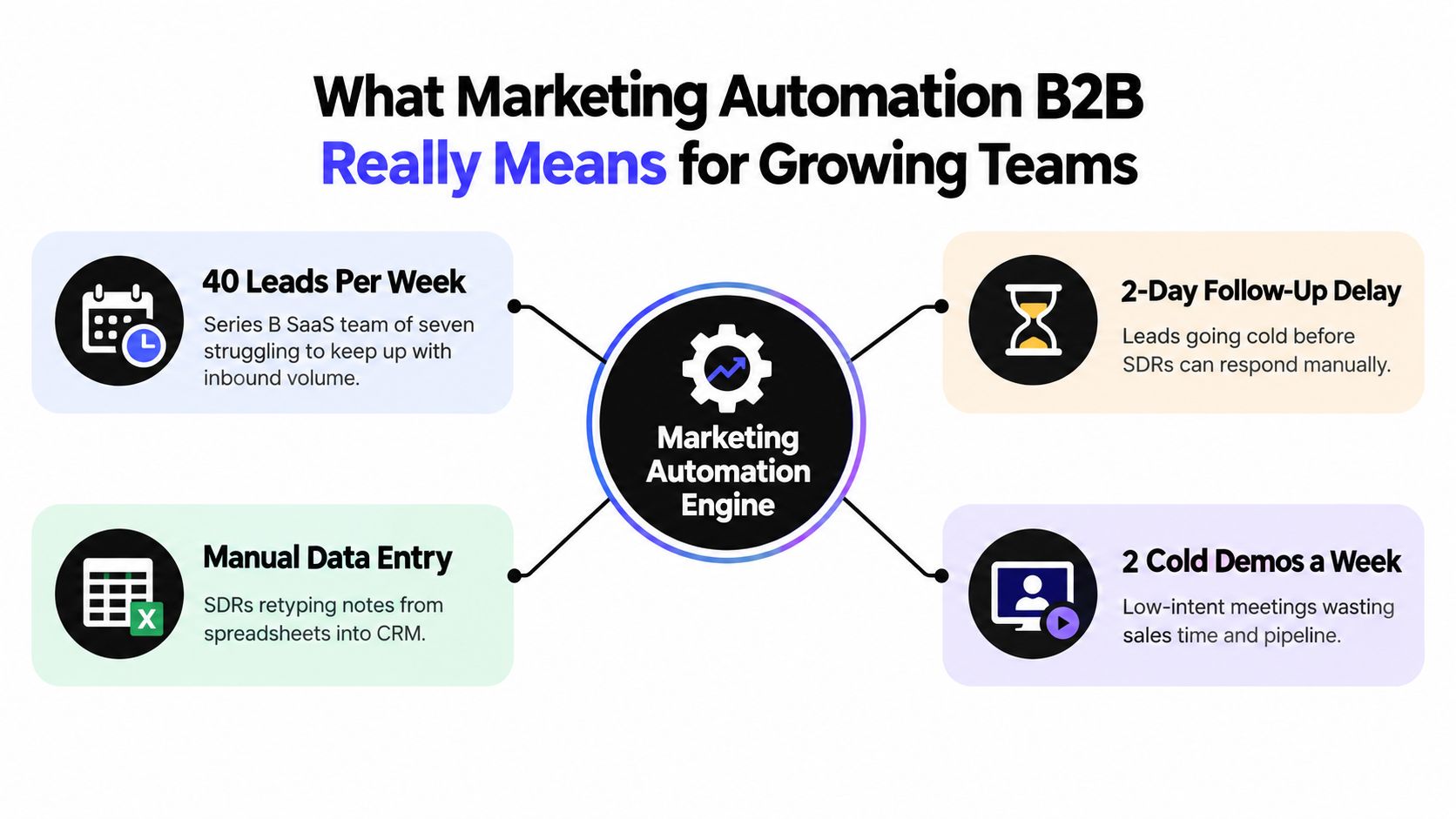
A Series B SaaS team with seven marketers can generate a manageable stream of inbound interest and still lose revenue in the gaps. Forty leads arrive during the week, follow-up slips by two days, SDRs retype spreadsheet notes into Salesforce, and cold demos consume time that should go to qualified opportunities. The problem isn't a lack of activity. It's the absence of a reliable operating layer between buyer behavior and sales action.
B2B marketing automation closes that gap when it connects segmentation, behavioral data, scoring, CRM ownership, and coordinated outreach. The platform matters, but the workflow design matters more. A useful system makes the next action clearer for marketing, sales, and the buyer.
What Marketing Automation B2B Really Means for Growing Teams
Marketing automation B2B means turning a buyer signal into a consistent business action without asking a person to triage every record manually. A form submission can create a known contact, enrich the account, assign a segment, update a score, enroll the contact in a relevant sequence, and alert the right SDR when intent crosses an agreed threshold.
That definition is more useful than a vendor category. HubSpot, Salesforce Marketing Cloud, Marketo, Customer.io, and other lifecycle tools use different labels, but the operating question stays the same: what should happen next, who owns it, and what evidence should remain in the CRM?
The operating layer between systems
A CRM such as Salesforce is the system of record for accounts, contacts, opportunities, ownership, and pipeline stages. Marketing automation handles rules, journeys, segmentation, and communications. Product analytics captures in-app behavior, while sales engagement tools support personalized outbound execution.
These systems overlap, but they shouldn't be confused. The CRM shouldn't become a dumping ground for every raw event. Product analytics shouldn't decide whether an SDR owns a lead without the agreed lifecycle logic. A sales engagement platform shouldn't send a contact into a sequence while a marketing workflow is still treating that person as an early-stage subscriber.
A practical operating layer coordinates the systems:
- Capture: Store the source, consent, account, and initial conversion context.
- Interpret: Combine firmographic fit with meaningful behavior.
- Orchestrate: Select the right message, channel, and timing.
- Handoff: Create an owned sales action with enough context to be useful.
- Measure: Preserve campaign and lifecycle data so pipeline influence can be reviewed.
A widely cited B2B automation benchmark reports that 56% of B2B companies use a dedicated marketing automation platform, while median time-to-value for a new platform is 4.7 months. The same benchmark reports a median B2B cost per MQL of $198 and a 30.8% average email open rate in B2B automation programs, reinforcing that these systems now support core lead nurturing rather than occasional campaign execution. See the B2B marketing automation benchmark details.
Practical rule: Automate the decision and the handoff before automating the message volume.
For teams evaluating the broader operating model, this B2B SaaS marketing playbook offers useful context on connecting acquisition, lifecycle processes, and growth execution. The immediate test, however, is simple: can your team respond faster, follow up consistently, and show where automation influenced pipeline?
The Four Core Components Every B2B Automation Stack Needs
A dependable stack isn't a feature checklist. It is four connected systems that share definitions and pass context from one stage to the next.
1. Lead capture
Capture begins before the workflow. Forms, demo requests, trial registrations, event scans, content downloads, product events, and enrichment feeds should create records with a known source and usable consent status. A form that creates an email address without account, role, source, or lifecycle context may increase database volume while weakening downstream routing.
The output should be a clean record that automation can interpret. If the source says “content download” but doesn't identify the asset, campaign, or landing page, later analysis becomes guesswork.
2. Lead scoring
Scoring combines fit and behavior. Fit might include industry, role, company size, geography, or technology environment. Behavior can include a pricing visit, repeated product research, integration activity, or a direct request for sales contact.
Don't let a scoring model reward every click equally. A low-intent email interaction shouldn't outweigh a strong disqualifier or a clear purchase signal.
3. Nurturing workflows
Nurture logic should branch on lifecycle stage and behavior, not run as a fixed calendar sequence for everyone. A first-time educational download needs a different path from a prospect comparing integrations or requesting pricing.
Each workflow needs entry criteria, branch logic, suppression rules, an owner, and exit criteria. Without those controls, automation creates message fatigue and conflicting outreach.
4. CRM handoff
A handoff isn't an alert that says “new MQL.” It should preserve the source, relevant behavior, score rationale, account context, owner, and required next action. Salesforce or HubSpot should show why the lead was routed, not force the SDR to reconstruct the story across tools.
| Component | Primary Inputs | Primary Outputs | Common Failure Mode |
|---|---|---|---|
| Lead capture | Forms, demo requests, trials, events, enrichment | Known record, source, consent, lifecycle entry | Incomplete fields and unclear origin |
| Lead scoring | Fit attributes, behavioral events, negative signals | Score, segment, qualification status | Scores don't reflect sales judgment |
| Nurturing workflows | Stage, intent, content, suppression rules | Timely messages and stage movement | One sequence treats every lead alike |
| CRM handoff | Threshold, ownership, activity history, SLA | Sales task, record update, feedback loop | Sales receives no useful context |
The dependencies are strict. A scoring model is only as reliable as the signals feeding it. Nurture is only relevant when the segment and stage are accurate. CRM handoff is only actionable when the upstream workflow preserves context.
The four components need one shared data definition. If marketing, sales, and operations use different meanings for “qualified,” “active,” or “recycled,” pipeline leaks at every seam.
Best B2B Use Cases and Where Automation Pays Back Fastest
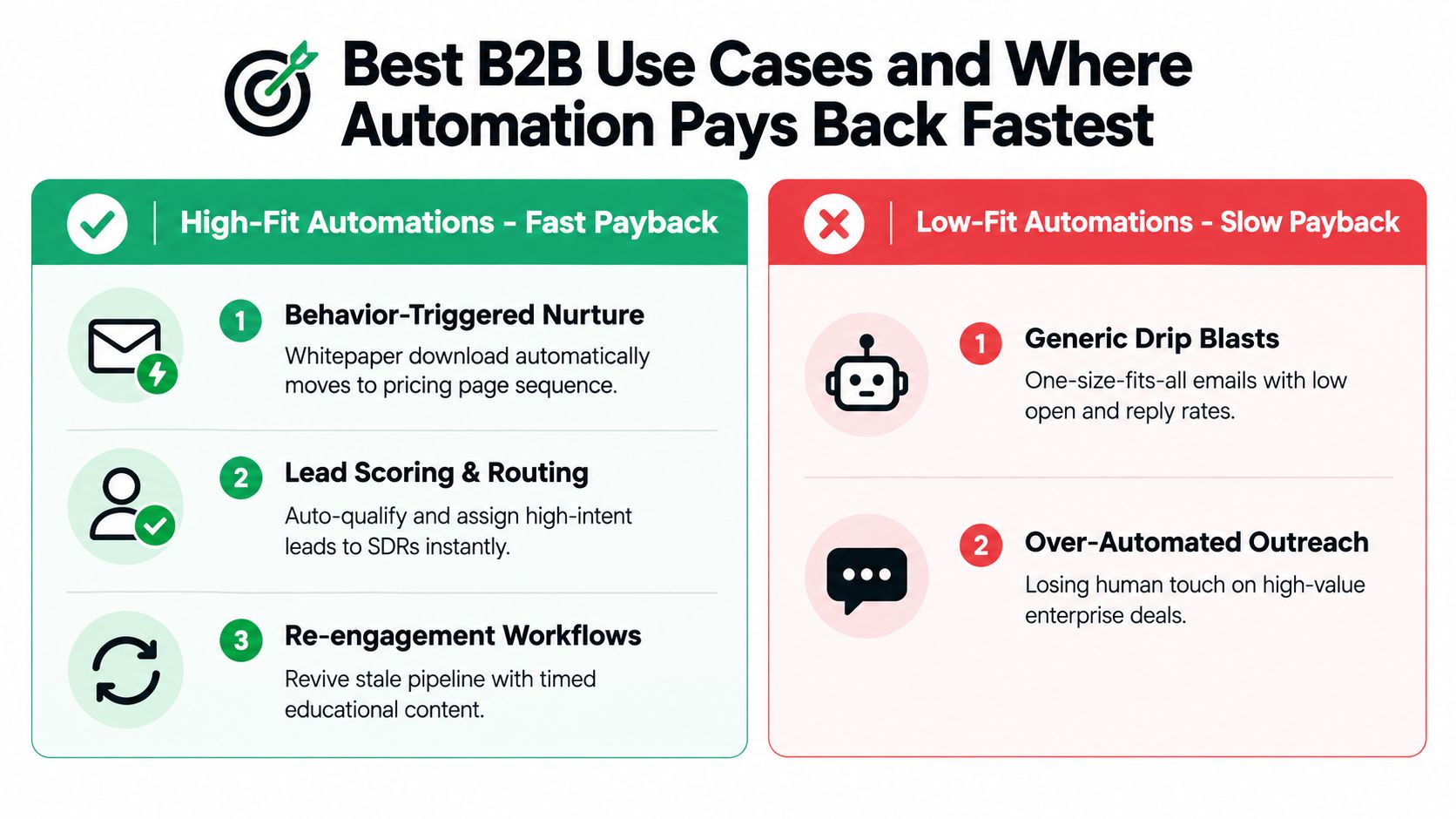
The best starting use case has three characteristics: the trigger happens often enough to matter, the signal is easy to interpret, and the action sits close to revenue. That combination usually favors event-driven workflows over broad campaign automation.
High-fit use cases
Behavior-triggered nurture is a strong fit because the buyer has supplied context. A whitepaper download can start an educational sequence, then branch when the contact visits pricing or an integration page. The measurable outcome might be improved MQL acceptance, cleaner SDR prioritization, or more useful sales conversations.
Lead scoring and routing pays back when response time and ownership are inconsistent. A qualified demo request can update the lifecycle stage, assign the correct territory, create an SDR task, and start an SLA timer. Marketing shouldn't need to inspect a shared inbox to determine whether a sales-ready lead has an owner.
Trial-to-paid messaging works when product events expose intent. A user who completes setup, invites colleagues, or reaches a usage milestone should receive different guidance from someone who registered but never activated. Marketing, product, and sales can coordinate around activation rather than sending the same promotional email to every trial user.
Re-engagement and customer-risk workflows extend automation beyond acquisition. A dormant opportunity can receive relevant educational content, while a customer showing reduced usage can trigger a customer success review. These workflows should surface signals for human action, not attempt to replace account judgment.
Low-fit use cases
Generic blasts to unscored lists create activity without useful context. A broad webinar funnel can also underperform when every attendee receives the same follow-up regardless of role, attendance behavior, or buying stage. Social scheduling disconnected from CRM and pipeline data may save publishing time, but it rarely clarifies which accounts need attention.
The distinction is not email versus non-email. It is contextual trigger versus undifferentiated broadcast.
Use marketing automation for lead generation when the acquisition workflow has a clear conversion event and a defined next action. Don't automate a broken acquisition process just because the platform makes it easy to add steps.
The market context is significant. Independent summaries estimate the global marketing automation market at about $6.65 billion in 2024, with a projection of roughly $15.58 billion by 2030. The same reporting cites automation use among 91% of mid-market B2B companies and its use as the primary lead nurturing system among 67% of enterprise marketing teams. Review the cited marketing automation market benchmarks. Adoption doesn't prove that every workflow works. It does show why execution quality now matters more than owning a platform.
Designing Lead Scoring and Segmentation That Sales Trusts
Lead scoring is a sales alignment problem disguised as a math problem. A model that sales ignores is less valuable than a simple model that consistently identifies the right conversations.
Start with segments built around ICP tier and buying stage. A strategic enterprise account in early research belongs in a different track from a strong-fit mid-market account requesting a demo. Broad buckets such as “marketing lead” or “website visitor” don't tell the team what to do.
Layer fit and behavior
Explicit fit answers, “Should we want this account?” Behavioral intent answers, “Why might this account be ready now?” Keep both dimensions visible so a contact doesn't become qualified through engagement alone when the company is outside your market.
| Dimension | Signal Examples | Weight Range |
|---|---|---|
| Fit | Industry, company size, role, geography, technology stack | Relative weighting set with sales, from low to high |
| Behavior | Pricing visit, repeat product research, integration exploration, demo request | Relative weighting set by intent strength |
| Negative fit | Competitor, unsupported region, personal email, disallowed use case | Negative weighting or disqualification |
| Recency | Recent activity versus stale engagement | Decay applied over time |
The table deliberately avoids universal point values. Your weights should come from conversion history and sales judgment, not a template copied from another SaaS business. Set negative scores for disqualifiers, then define the MQL threshold with sales before launch.
Calibrate the model in the CRM
Run sample records through the model with SDRs and account executives. Ask whether each record deserves action, what context is missing, and which signals feel misleading. After launch, compare accepted, rejected, closed-won, and closed-lost records, then update the rules on a regular operating cadence.
The hygiene rules matter as much as the weights:
- Define identity: Separate anonymous visits, known contacts, and duplicate records.
- Track recency: Let old engagement lose influence instead of allowing historical activity to qualify a dormant lead forever.
- Preserve rejection reasons: A recycled lead should carry a reason, not disappear from reporting.
- Document ownership: Someone must maintain field mappings and lifecycle transitions.
Teams building more advanced forms for AI-assisted workflows can use resources such as build lead capture forms for AI workflows to think through the information captured at the first interaction. The form still needs to respect conversion friction and data quality, though. More fields aren't automatically better.
For a practical review of model design and governance, see these lead scoring best practices. The operating test remains whether an SDR can look at a score and understand the reason for the handoff.
Building a Real Nurture Workflow for SaaS and B2B Pipelines
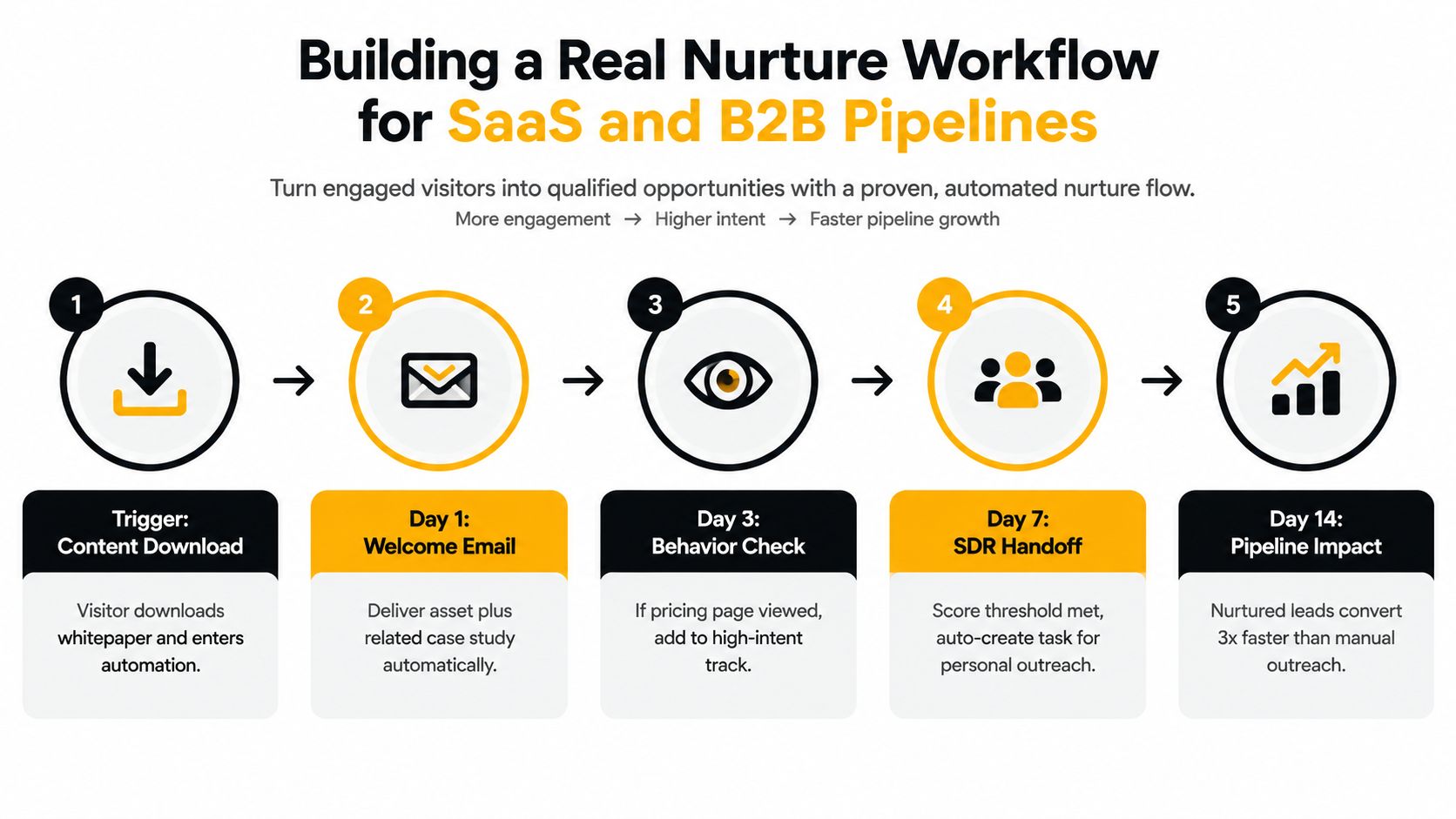
A mid-market SaaS company often reaches a point where MQL volume outpaces SDR capacity. Manual outreach still works for the highest-intent requests, but the team needs a structured path for everyone else. The right response isn't to send more generic emails. It's to create a behavior-triggered workflow with clear branches.
The workflow
A visitor downloads a comparison guide. The automation stores the asset, source, account, and lifecycle stage, then sends the promised resource with a relevant follow-up. The content matrix maps the next message to the buyer's likely question, rather than pushing a demo immediately.
The workflow then listens for behavior. A pricing-page visit moves the contact into a high-intent track. An integration-page visit can send technical proof or implementation material. No meaningful activity keeps the contact in an educational sequence, while an explicit demo request exits nurture and enters the sales handoff path.
A practical sequence includes:
- Entry: Confirm the trigger, consent, source, and segment.
- Content mapping: Match the asset and next message to stage and role.
- Behavior check: Recalculate intent after meaningful page or product activity.
- Sales handoff: Create an owned task when the agreed threshold is met.
- Recycle or suppress: Exit contacts who convert, opt out, become customers, or need a slower path.
Suppression lists protect the experience. Exclude open opportunities from prospecting nurture, remove customers from acquisition sequences, and stop promotional messages when a sales conversation is active. A workflow that doesn't know when to stop is not advanced. It's noisy.
A team should also document the SLA between marketing and SDRs, the content matrix, rejection and recycle rules, and the fields required in Salesforce or HubSpot. Use this marketing automation workflow guide as a practical reference when turning the logic into an implementable process.
What stabilization looks like
At 60 days, focus on execution quality: trigger accuracy, enrollment errors, suppression behavior, SDR acceptance, and message relevance. At 90 days, examine stage movement, opportunity creation, sales feedback, and whether the workflow deserves expansion to another segment.
Don't promise a universal lift. The result depends on traffic quality, content relevance, sales follow-up, and the integrity of the underlying data.
Measuring ROI Across Long B2B Buying Cycles
Open rates and clicks help diagnose message delivery, but they don't justify an automation budget on their own. CFO-level reporting needs to connect program activity to sourced pipeline, influenced pipeline, stage conversion, sales-cycle movement, cost per opportunity, and revenue.
Long buying cycles make that difficult. Recent reporting says only 52% of companies measure ABM ROI, while teams struggle with attribution across 12 to 18 month sales cycles involving 6 to 10 decision-makers. Read the cited B2B marketing reporting on measurement and attribution. A lead-based report can miss the account-level effect when several stakeholders engage before one opportunity closes.
Separate diagnosis from business proof
Use engagement metrics to troubleshoot. Use pipeline metrics to defend investment.
| Metric | What It Tells You | Limitations |
|---|---|---|
| Opens and clicks | Whether messages generated initial interaction | Privacy controls and shallow engagement can distort meaning |
| MQL volume | Whether qualification rules are producing records | Volume says little about sales acceptance or revenue quality |
| MQL-to-SQL conversion | Whether marketing qualification aligns with sales judgment | Can shift when definitions or routing change |
| Sourced pipeline | Opportunities that began through the program | Understates influence on existing demand |
| Influenced pipeline | Opportunities with meaningful program engagement | Can over-credit broad programs without touch quality |
| Stage conversion | Where nurtured accounts progress or stall | Requires consistent lifecycle and opportunity definitions |
| Cost per opportunity | Efficiency of generating sales opportunities | Needs reliable program cost allocation |
| Revenue per program | Commercial outcome tied to the workflow | Closed revenue may arrive outside the reporting window |
A pragmatic attribution model uses first-touch and last-touch views, then adds a transparent weighted middle layer for meaningful interactions. Don't chase perfect precision before fixing source data, campaign membership, contact roles, and opportunity associations.
For deals that close later, use cohorts and program-level reporting. Compare accounts entering a workflow with comparable accounts that didn't, while clearly documenting the limits of the comparison. Choose three to five quarterly metrics, assign one owner, and review both performance and data quality. Consistency over several review cycles will usually produce more confidence than a complex model nobody trusts.
Why Most B2B Automation Programs Stall Before They Scale
More software doesn't create more automation value. Recent reporting identifies strategy creation as the biggest 2025 challenge for 51% of marketers, followed by data quality at 49% and budget or resource limits at 43%. The same reporting points to underused capabilities such as journey orchestration and AI-driven personalization, while martech utilization has fallen to 49%. Review the cited 2025 B2B marketing automation research.
The practical lesson is uncomfortable: many teams pay for capabilities they haven't operationalized.
Four stall points
Untrusted scoring: Marketing changes weights without sales review, then SDRs reject the resulting leads. The smallest fix is a documented calibration session with sales and a recurring review of accepted and rejected records.
Orphaned nurture: Marketing launches a sequence, but sales never explains which objections appear in live calls. Assign a sales counterpart to each workflow and capture feedback in a shared operating document.
Drifting CRM fields: Lifecycle stages, ownership fields, and campaign values change across teams. Give one person responsibility for field mapping, sync monitoring, and change approval.
Marketing-only MQL definitions: A threshold created in a marketing meeting rarely survives contact with the sales process. Define MQL and SQL criteria jointly, then record what happens when sales accepts, rejects, or recycles a lead.
Automation amplifies the process you feed it. If the process is broken, the platform accelerates the breakage and makes the results harder to diagnose.
The operational cost appears in several forms: duplicated records, conflicting messages, delayed response, poor sales confidence, and dashboards that report activity without commercial meaning. A smaller stack with clean definitions can outperform a larger stack that nobody owns.
A Practical Rollout Plan You Can Start This Quarter
Choose one workflow before selecting a long list of features. The strongest candidates usually have visible volume, a clear revenue connection, and a sales partner willing to test the handoff. Inbound demo follow-up and trial activation often meet those criteria, but the right choice depends on your motion.
The four-week rollout
| Week | Focus | Deliverables | Owner |
|---|---|---|---|
| Week 1 | Discovery and data audit | Current-state map, source inventory, lifecycle definitions, field-gap list | Marketing operations and sales operations |
| Week 2 | ICP and handoff alignment | Segment definitions, fit and intent signals, MQL rules, SLA, rejection path | Marketing and sales leadership |
| Week 3 | Build and test | Workflow branches, scoring logic, CRM actions, suppression rules, QA records | Automation owner with RevOps |
| Week 4 | Pilot launch | One-segment launch, monitoring dashboard, SDR feedback process, issue log | Marketing owner and assigned SDR team |
Keep the strategic decisions in-house. Your team should own scoring logic, lifecycle definitions, sales handoff rules, suppression criteria, and the decision about what counts as pipeline influence. Those choices encode your go-to-market motion and shouldn't be outsourced to a contractor who lacks sales context.
Outsource production work when it speeds execution without taking away control. Template design, technical integrations, data cleanup, QA support, and list hygiene can be handled by specialists if documentation and access controls are clear.
Exit criteria for expansion
Don't scale because the workflow has been published. Scale when the pilot has clean enrollment, reliable CRM synchronization, understood ownership, usable SDR feedback, and a reporting view that connects the workflow to stage movement. If the team can't explain why a lead entered, why it was routed, and what happened afterward, add no new use case.
Independent benchmark reporting cited by The Starr Conspiracy says enterprise B2B companies see an average 14.5% increase in sales productivity after implementing marketing automation platforms. Review the enterprise B2B platform benchmark. Treat that as an external benchmark, not a promise. Your pilot should establish the operational baseline that makes any improvement credible.
Another benchmark reports automated nurturing can produce 50% more sales-ready leads at 33% lower cost per lead. See the cited lead nurturing benchmark summary. The useful takeaway is not to copy the result. It's to test whether segmentation, scoring, and trigger-based sequencing improve your own sales acceptance and opportunity economics.
MakeAutomation helps B2B and SaaS teams design and implement automated lead follow-up, CRM workflows, AI-enhanced operations, and documented SOPs that connect marketing activity to repeatable execution. Visit MakeAutomation to discuss a practical automation rollout built around your sales handoff, lifecycle rules, and pipeline measurement.