

Mastering Jest Mock Module for Robust Tests
Your automation code passes locally. Then CI runs the suite and everything gets weird. One test posts junk contacts into HubSpot, another hangs on a Stripe SDK call, and a third fails only when it runs after a different file. The business logic might be fine. The test boundaries aren't.
That’s where jest mock module work stops being a testing trick and starts becoming engineering hygiene. If your code touches CRMs, outbound email tools, payment providers, AI APIs, internal analytics, or queue workers, you need a deliberate strategy for replacing those dependencies in tests. Otherwise you’re validating network behavior, SDK quirks, and timing noise instead of your actual workflow logic.
Why Mastering Module Mocking Is Non-Negotiable
Jest didn’t bolt mocking on later. Its mock module system shipped with the project’s initial release in 2014, and by 2026 Jest is projected to power testing for over 23 million weekly npm downloads according to this Jest mock guide. That same source notes jest.mock() has been central from the start and cites official benchmarks saying the approach resolves 95% of circular dependency issues in tests.
That matters because business workflow code is usually dependency-heavy. A lead routing service might call a scoring model, write to PostgreSQL through a repository layer, send an event to Segment, and create a follow-up task in Salesforce. If your unit test hits any of those for real, you’ve already lost control of the test.
What module mocking actually protects
A good unit test isolates one decision. It should answer a narrow question such as:
- Routing logic: Does a high-intent inbound lead go to the enterprise queue?
- Retry behavior: Does the worker retry on a transient API error?
- Guardrails: Does the workflow stop before creating a duplicate CRM record?
- Sequencing: Does the enrichment step run before outreach copy is generated?
None of those require a real CRM connection or an actual email send. They require predictable collaborators.
Practical rule: If the dependency is outside your process, expensive to set up, or capable of side effects, mock the module in unit tests.
When teams skip this, they usually get three symptoms at once. The suite runs slowly, tests fail intermittently, and developers stop trusting failures. At that point, the test suite becomes a tax instead of a safety net.
Deterministic tests beat realistic noise
A lot of mid-level engineers over-index on realism. They want a test to feel close to production, so they keep real SDKs and real module behavior everywhere. That sounds disciplined, but it blurs test intent.
Use real dependencies when you’re proving integration boundaries. Use mocks when you’re proving your code’s decisions.
That distinction is especially important in automations. If you’re testing an AI-powered outreach workflow, the unit test shouldn’t send emails, hit OpenAI, or create activities in a CRM. It should verify that when the model classifies a prospect a certain way, your code picks the correct branch and invokes the right collaborator with the right payload.
The strategic shift
The goal isn’t to mock everything. The goal is to mock the right layer.
For most automation-heavy applications, that means:
- Mock third-party modules at the edge.
- Keep pure business logic real.
- Replace only the unstable or side-effecting dependency, not every function in sight.
That last point is where many Jest test suites improve fast. Engineers often reach for a full mock when a partial mock or spy would produce a cleaner test and preserve useful real behavior.
The Foundation Using jest.mock for Core Scenarios
It is common to start with jest.mock() because it solves the main problem fast. You import a module, replace it, and keep your test focused on business logic instead of external behavior.

Here’s a simple example using an internal analytics client in a sales workflow.
// analytics-client.ts
export async function trackEvent(name: string, payload: Record<string, unknown>) {
  // sends to analytics vendor
}

export function buildLeadPayload(lead: { email: string; source: string }) {
  return {
    email: lead.email.trim().toLowerCase(),
    source: lead.source,
  };
}
// workflow.ts
import { trackEvent, buildLeadPayload } from './analytics-client';

export async function processLead(lead: { email: string; source: string }) {
  const payload = buildLeadPayload(lead);
  await trackEvent('lead_processed', payload);
  return payload;
}
Auto-mocking when you need a clean break
The fastest version is plain auto-mocking.
import { processLead } from './workflow';
import { trackEvent } from './analytics-client';

jest.mock('./analytics-client');

test('tracks processed lead', async () => {
  await processLead({ email: 'TEST@Example.com ', source: 'webinar' });

  expect(trackEvent).toHaveBeenCalledWith('lead_processed', undefined);
});
This is useful for a total isolation pass, but it also exposes the downside immediately. buildLeadPayload is mocked too, so your real formatting logic disappears. That means the test no longer exercises a meaningful part of the workflow.
Auto-mocking is best when the whole module is an edge dependency, such as:
- Payment SDKs: Stripe clients, billing gateways, webhook helpers
- Messaging providers: Twilio, SendGrid, Slack adapters
- Heavy infra clients: S3 wrappers, queue publishers, telemetry sinks
If every export is side-effectful or external, a full mock is fine.
Factory mocks when the default is too blunt
When you need control, pass a factory to jest.mock().
import { processLead } from './workflow';
import { trackEvent } from './analytics-client';

jest.mock('./analytics-client', () => ({
  trackEvent: jest.fn(),
  buildLeadPayload: jest.fn(() => ({
    email: 'normalized@example.com',
    source: 'webinar',
  })),
}));

test('uses mocked analytics module', async () => {
  const result = await processLead({ email: 'TEST@Example.com ', source: 'webinar' });

  expect(trackEvent).toHaveBeenCalledWith('lead_processed', {
    email: 'normalized@example.com',
    source: 'webinar',
  });

  expect(result).toEqual({
    email: 'normalized@example.com',
    source: 'webinar',
  });
});
Factory mocks are better when your test needs a specific response shape or branch condition. They’re also easier to read when one export should throw, another should resolve, and a third doesn’t matter.
If you want more grounding on mock behavior at the function level, this guide on Jest mock function patterns pairs well with module-level work.
The partial mock pattern most teams actually need
The more practical move is often to keep real helpers and replace only the risky function. Jest documents this with jest.requireActual(), and the docs note that partial mocks are important when modules mix real logic with isolated endpoints. That same documentation says full mocks can lead to 70-80% test flakiness in large codebases when dependent functions break unexpectedly, as described in the Jest mock functions documentation.
import { processLead } from './workflow';
import { trackEvent } from './analytics-client';

jest.mock('./analytics-client', () => {
  const original = jest.requireActual('./analytics-client');
  return {
    ...original,
    trackEvent: jest.fn(),
  };
});

test('keeps payload formatting real while mocking event delivery', async () => {
  const result = await processLead({ email: 'TEST@Example.com ', source: 'webinar' });

  expect(trackEvent).toHaveBeenCalledWith('lead_processed', {
    email: 'test@example.com',
    source: 'webinar',
  });

  expect(result).toEqual({
    email: 'test@example.com',
    source: 'webinar',
  });
});
This is the pattern I reach for most in automation systems. It protects the network edge while preserving useful real logic in the same module.
Keep formatting, parsing, mapping, and validation code real when it helps prove business behavior. Mock the send, write, publish, or charge operation.
That matters in a CRM client too. If crm-client.ts exports both formatCompanyPayload() and createContact(), mocking only createContact() lets you verify your mapping rules without creating junk records.
Named exports and default exports trip people up
Named exports are straightforward. Default exports need more care because the factory has to mimic the module shape.
// mailer.ts
export default async function sendEmail(to: string, body: string) {
  // real provider call
}
import sendEmail from './mailer';

jest.mock('./mailer', () => ({
  __esModule: true,
  default: jest.fn(),
}));

test('sends follow-up email', async () => {
  await sendEmail('lead@example.com', 'hello');
  expect(sendEmail).toHaveBeenCalledWith('lead@example.com', 'hello');
});
Without __esModule: true, default-imported modules often fail in confusing ways, especially in TypeScript projects.
A short walkthrough can help if you want to see the mechanics in action:
When jest.mock() is the right first move
Use plain jest.mock() when the module is mostly an integration boundary and the test only cares about interaction. Good examples include an ad platform SDK, a Slack notifier, or a file storage adapter.
Use a factory when the test needs the dependency to behave in a specific way.
Use jest.requireActual() when the module mixes pure helpers with side-effectful functions. In workflow code, that’s often the best balance between isolation and confidence.
Advanced Control with Manual Mocks
Inline factories are fine until you write the same mock six times. Then the duplication starts to rot. One file returns { status: 'ok' }, another returns { success: true }, and a third forgets to mock the failure path entirely. That’s when manual mocks earn their keep.

Jest supports reusable manual mocks through a __mocks__ directory. The official docs describe them as the advanced-control option for complex modules, and note 90% adoption in enterprise Jest setups, with 60% less setup time versus inline factories, while also warning that stale manual mocks can drive 25-35% of test failures if they fall out of sync, according to the Jest manual mocks documentation.
A realistic manual mock for an SDK
Suppose your app uses a billing gateway wrapper:
// billing-sdk.ts
export async function createCustomer(email: string) {
  // real SDK call
}

export async function createInvoice(customerId: string, amount: number) {
  // real SDK call
}

export async function refundInvoice(invoiceId: string) {
  // real SDK call
}
You can create a reusable mock here:
// __mocks__/billing-sdk.ts
const actual = jest.createMockFromModule('../billing-sdk') as object;

module.exports = {
  ...actual,
  createCustomer: jest.fn().mockResolvedValue({ id: 'cust_test_1' }),
  createInvoice: jest.fn().mockResolvedValue({ id: 'inv_test_1', status: 'paid' }),
  refundInvoice: jest.fn().mockResolvedValue({ id: 'ref_test_1', status: 'refunded' }),
};
Then in tests:
import { createCustomer, createInvoice } from './billing-sdk';
import { onboardAccount } from './onboard-account';

jest.mock('./billing-sdk');

test('creates billing records during onboarding', async () => {
  await onboardAccount({ email: 'ops@example.com', planAmount: 5000 });

  expect(createCustomer).toHaveBeenCalledWith('ops@example.com');
  expect(createInvoice).toHaveBeenCalled();
});
This is cleaner than rewriting a factory in every test file. It also makes the default mock behavior consistent across the codebase.
Where manual mocks fit best
Manual mocks shine when all three conditions are true:
- The module is used everywhere: database clients, SDK wrappers, cloud storage adapters
- The default test behavior is stable: most tests want a successful response shape
- The mock surface is annoying to repeat: many methods, nested return objects, or setup boilerplate
They’re common for modules like axios, repository layers, or a wrapped @aws-sdk/client-s3 adapter.
If you’re also working with class-based collaborators, this walkthrough on mocking classes in Jest can help when modules export constructors rather than plain functions.
A manual mock is a shared test dependency. Treat it like production code. Name responses clearly, keep defaults boring, and review changes when the real module changes.
Use the real module selectively with unmock
Global reuse is great until one test needs reality. Jest gives you jest.unmock() for that case.
jest.unmock('./billing-sdk');

const { createCustomer } = require('./billing-sdk');

test('integration test uses real billing module', async () => {
  // this file or test can now use the real implementation
});
That’s useful when you keep most unit tests isolated but maintain a narrower integration suite that verifies wiring against the actual wrapper.
The maintenance trap
The biggest risk with manual mocks is drift. The actual module gains a new parameter, changes a return shape, or renames a method, and the shared mock keeps lying to your tests. Then unit tests stay green while production code breaks.
A few habits prevent most of that:
- Build from the actual module shape with
jest.createMockFromModule()where possible. - Keep return objects minimal so they’re easier to update.
- Mirror critical fields exactly for anything your business logic branches on.
- Avoid fantasy responses that the actual SDK would never produce.
Here’s a bad mock:
createInvoice: jest.fn().mockResolvedValue({ okay: true })
If production code reads invoice.status, this mock hides the actual contract.
Here’s the better version:
createInvoice: jest.fn().mockResolvedValue({ id: 'inv_test_1', status: 'paid' })
Automock is powerful and dangerous
You can also enable automock in Jest config, but I rarely recommend it for application code. It flips the default from explicit to implicit. New engineers won’t know what’s mocked without reading config and import behavior carefully.
That tends to reduce clarity, especially in mixed suites where some tests expect real helpers and others expect generated mocks. Explicit jest.mock() calls keep intent visible in the file that needs the replacement.
Manual mocks work best when they reduce boilerplate without hiding test meaning. If the test becomes harder to read because the behavior lives elsewhere, you’ve gone too far.
Choosing Your Mocking Strategy
The technical API matters less than the decision behind it. The fundamental question is simple. What are you trying to prove in this test?
If you’re proving that a workflow called a dependency correctly, jest.mock() is usually enough. If you’re proving that a real helper ran but want to observe usage, jest.spyOn() is cleaner. If you need a reusable fake for a noisy module across dozens of files, manual mocks win.
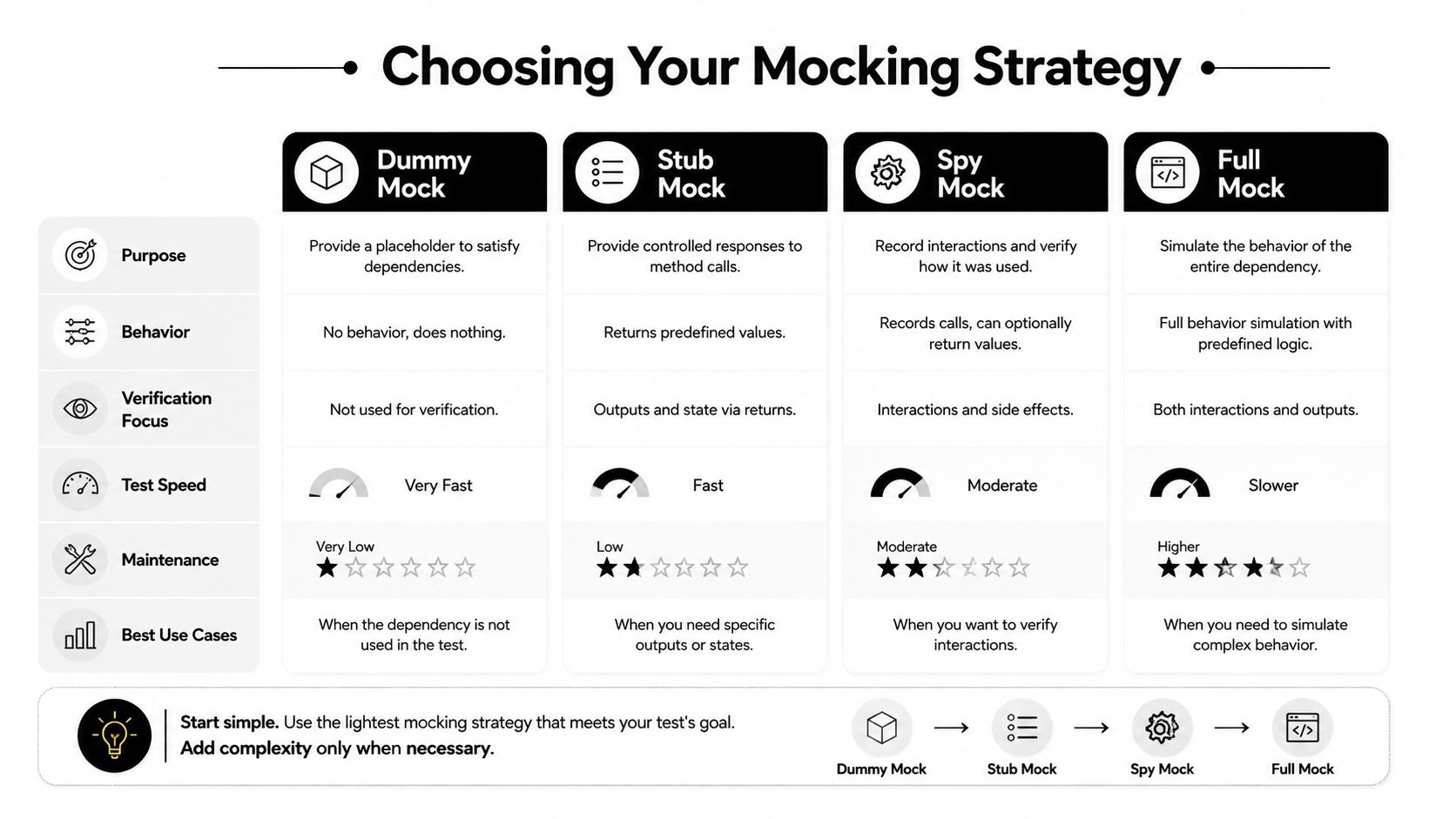
A quick decision guide
| Technique | Best For | Key Feature | Common Pitfall |
|---|---|---|---|
jest.mock() |
Replacing full module dependencies like SDK wrappers or API adapters | Intercepts imports and swaps implementation | Over-mocking helper functions that should stay real |
jest.mock() with factory |
Targeted behavior in one test file | Fine-grained control over return values and errors | Verbose setup that gets duplicated |
Partial mock with jest.requireActual() |
Modules that mix pure helpers with side effects | Keeps most of the module real | Forgetting module shape details for default exports |
jest.spyOn() |
Observing calls without replacing logic by default | Tracks usage on real objects or modules | Not restoring the spy after the test |
| Manual mocks | Shared mocks for complex modules used broadly | Centralized reusable fake implementation | Mock drift when the real module changes |
For teams tightening test discipline across releases, these testing best practices in agile delivery map well to deciding where unit, integration, and mock-heavy tests belong.
jest.spyOn() is often the least disruptive option
A spy lets the actual implementation run unless you override it. That’s useful when the function is safe to execute but you still want to verify interaction.
import * as formatter from './lead-formatter';

test('formats lead before queuing', () => {
  const spy = jest.spyOn(formatter, 'normalizeLead');

  const result = formatter.normalizeLead({
    email: ' SALES@Example.com ',
    company: ' Acme ',
  });

  expect(spy).toHaveBeenCalled();
  expect(result.email).toBe('sales@example.com');

  spy.mockRestore();
});
This is cleaner than mocking the whole module when the formatting logic is exactly what you want to test.
Use a spy when replacement would hide behavior you actually care about.
Manage the mock lifecycle or your suite will leak state
A lot of “Jest is flaky” complaints are really “our mocks leak between tests.” You need to clear, reset, or restore intentionally.
mockClear()removes call history and instances, but keeps the current mock implementation.mockReset()removes call history and also resets implementation.mockRestore()puts the original implementation back, which matters for spies.
A practical pattern:
beforeEach(() => {
  jest.clearAllMocks();
});
Use clearAllMocks when you want stable default implementations across tests but fresh call history. Reach for reset or restore when a test changes behavior and shouldn’t leak that customization.
Match the technique to the dependency type
Here’s the strategic version I use for workflow-heavy systems:
- API client modules: partial mock the network call, keep payload builders real.
- Database repository modules: full mock for unit tests, real DB only in integration suites.
- Third-party SDKs: manual mock if many files need the same fake.
- Utility modules: avoid mocking unless the utility itself is the source of instability.
- Logging and analytics: usually full mock or spy, depending on whether side effects matter.
If your test setup feels heavier than the business assertion, that’s a signal the mocking choice is wrong.
Modern JavaScript and TypeScript Mocking Patterns
A lot of older Jest examples assume CommonJS. Many current codebases don’t. They use ESM, TypeScript, dynamic import(), and scoped packages in monorepos. That’s where basic jest mock module examples stop being enough.

The rough edge shows up fast with ESM. A developer follows a CommonJS example, writes a mock, and then finds that the imported module under test still calls the actual implementation. The issue isn’t always the mock itself. It’s often import timing, async module loading, or the difference between static and dynamic imports.
ESM changes the order of operations
With CommonJS, jest.mock() often feels straightforward because Jest hoists top-level calls before imports are evaluated. In ESM setups, especially with dynamic imports, timing gets more sensitive.
The practical rule is simple. If the module is loaded dynamically, the mock setup has to happen before the import that consumes it.
import { jest } from '@jest/globals';

jest.unstable_mockModule('./crm-client', () => ({
  createContact: jest.fn().mockResolvedValue({ id: 'mock-contact' }),
}));

const { syncLead } = await import('./sync-lead');
const { createContact } = await import('./crm-client');

test('creates CRM contact through mocked ESM module', async () => {
  await syncLead({ email: 'ops@example.com' });
  expect(createContact).toHaveBeenCalledWith({ email: 'ops@example.com' });
});
That pattern looks awkward if you’re used to static imports, but it matches how ESM evaluation works.
TypeScript needs module shape discipline
The most common TypeScript pain point is mismatched typing after a mock. The compiler still sees the original function type, while your test wants mock methods like mockResolvedValue.
You can clean that up with jest.mocked() or by asserting the mocked type explicitly.
import * as crmClient from './crm-client';

jest.mock('./crm-client');

const mockedCrmClient = jest.mocked(crmClient);

test('handles CRM create success', async () => {
  mockedCrmClient.createContact.mockResolvedValue({ id: '123' });

  // call workflow here
});
That keeps autocomplete and compiler feedback useful instead of forcing casts all over the file.
For default exports in TypeScript, remember the same rule from earlier. Your factory has to reflect ESM shape correctly.
jest.mock('./mailer', () => ({
  __esModule: true,
  default: jest.fn(),
}));
If you skip that, you’ll usually get some version of “is not a function” at runtime.
If a mock compiles but behaves strangely at runtime, inspect the imported module shape first. Default export issues and import timing issues account for a lot of wasted debugging time.
Dynamic imports need test sequencing, not brute force
Teams often try to fix dynamic import mocking by adding more factories, more resets, or more test setup files. Usually the fix is simpler. Load the mock first, then import the module under test.
That matters in code-split systems such as:
- Feature-flagged automation steps
- Provider-specific adapters loaded on demand
- Large monorepo packages imported only in selected workflows
In those cases, dynamic import() is part of production architecture. The test has to respect it.
Mocking third-party packages in monorepos
Monorepos add another wrinkle. A package might import @aws-sdk/client-s3, while another imports your local wrapper around it. If you mock the wrong layer, tests get brittle.
A stable pattern is:
- Mock your own adapter in most unit tests.
- Reserve direct third-party package mocks for tests that exercise your adapter itself.
- Keep per-test overrides local instead of polluting a shared
__mocks__setup unless the whole repo benefits.
Example:
jest.mock('@internal/storage-adapter', () => ({
  uploadJson: jest.fn().mockResolvedValue({ key: 'reports/daily.json' }),
}));
That’s generally safer than mocking a deep SDK command class in every workflow test.
When you do need direct third-party mocking, keep the contract narrow. Don’t reproduce the whole package API unless your test needs it.
What works in modern projects
For current JavaScript and TypeScript stacks, the patterns that hold up are the boring ones:
- Set up ESM mocks before dynamic import.
- Preserve module shape for default exports.
- Use typed mock helpers so test code stays honest.
- Mock your own boundary layer before mocking a vendor’s internals.
- Prefer small, explicit overrides over giant magical test infrastructure.
Modern mocking isn’t harder because Jest got worse. It’s harder because module systems and build setups got more layered. The best response is more intentional boundaries, not more clever mock code.
Troubleshooting Common Mocking Pitfalls
Most Jest mocking bugs fall into a few repeat categories. The symptom looks obscure, but the cause usually isn’t.
The mock isn’t applied
If your test still hits the actual implementation, check import order first. A mock has to be in place before the module under test captures the dependency.
With ESM or dynamic imports, that often means moving to an async import pattern. With standard jest.mock(), it usually means keeping the mock at top level and avoiding inline mocking inside a test block when the import already happened.
TypeError ... is not a function
This usually points to module shape mismatch. The classic case is mocking a default export as if it were a named export, or the reverse.
Use this pattern for default exports:
jest.mock('./mailer', () => ({
  __esModule: true,
  default: jest.fn(),
}));
Use a plain object with named members for named exports:
jest.mock('./crm-client', () => ({
  createContact: jest.fn(),
  updateContact: jest.fn(),
}));
Tests pass alone and fail in the suite
That’s often leaked mock state. One test changes a mock implementation and another inherits it.
A reliable baseline looks like this:
beforeEach(() => {
  jest.clearAllMocks();
});
If you use spies or temporary implementations, restore them explicitly.
afterEach(() => {
  jest.restoreAllMocks();
});
That keeps one file’s clever setup from contaminating the next assertion.
Partial mocks break unexpectedly
If a partial mock fails, the issue is often one of these:
- The factory didn’t return the full module shape.
- A default export wasn’t represented correctly.
- The test imported a different path than the code under test.
- The mocked function was referenced before the mock was established.
When in doubt, log the imported module shape in the test once and inspect what you got back.
Manual mocks can’t be found
Pathing mistakes are common with __mocks__. The mock file has to line up with the module name Jest resolves. If your app imports ./billing-sdk, the manual mock has to match that path convention from Jest’s perspective.
Also check whether you’re mocking the wrapper or the underlying package. In automation code, wrapping third-party SDKs behind local modules makes pathing simpler and test intent clearer.
The cleanest test suites don’t rely on clever Jest tricks. They rely on small dependency boundaries and consistent import patterns.
A practical debugging checklist
When a jest mock module test fails in a confusing way, run this sequence:
- Check the import path used by both the test and the module under test.
- Confirm export style. Named or default.
- Verify timing. Was the mock established before import evaluation?
- Reset state between tests.
- Reduce scope. Mock one function, not the whole world.
- Mock your wrapper, not the vendor SDK, unless you’re testing the wrapper itself.
A strong test suite for business workflows doesn’t come from mocking more. It comes from mocking with purpose. Replace unstable edges, keep meaningful logic real, and make each test prove one decision clearly.
If your team is building CRM automations, lead-gen workflows, AI agents, or outbound systems and wants the test layer to keep up, MakeAutomation can help design cleaner boundaries, more reliable automation architecture, and practical testing patterns that support growth instead of slowing releases down.