How to Become a TEDx Speaker: Founder’s Guide 2026
You've probably thought about a TEDx talk the same way most founders do. It sounds prestigious, it builds authority, and it feels like the kind of asset that keeps paying off long after the event ends. Then you start looking into it and run into vague advice about authenticity, storytelling, and passion.
That advice isn't wrong. It's just incomplete.
If you're a SaaS or B2B founder, the right question isn't only how to become a TEDx speaker. It's whether the talk can become a strategic asset for pipeline, authority, partnerships, recruiting, and category positioning. If you don't define that upfront, you can easily spend months chasing a badge instead of building a business result.
A TEDx talk works best when you treat it like both a thought leadership product and a distribution engine. The talk has to deserve the stage. But it also has to fit your growth strategy.
Clarifying Your TEDx Speaking Goal
You get invited to give a TEDx talk. Six months later, the video is live, your team shares it everywhere, and nothing changes in the pipeline. No lift in branded search. No better partner intros. No stronger close rates on founder-led deals.
That happens when the goal is prestige instead of business return.
A common mistake is starting with a broad topic. TEDx organizers assess ideas. Your revenue team needs an idea that also strengthens positioning, improves trust, and gives sales and marketing a reusable asset.
“AI in sales” is broad and forgettable. “Why buyers trust systems that remove repetitive follow-up friction” gives a curator something clear to assess and gives your market something specific to repeat.
Define one idea with commercial relevance
Start with a single claim you can defend from lived experience, customer evidence, and market observation. Do not try to summarize your entire worldview. A TEDx talk is not a founder manifesto.
Use this filter:
- Fresh angle: What belief in your category is wrong, shallow, or overdue for revision?
- Audience outcome: What should a buyer, operator, or investor believe after the talk that they did not believe before?
- Business link: How does that belief make your company easier to understand, trust, or remember?
- Wide relevance: Why does the idea matter even if the audience never buys your product?
If the idea sounds like a conference breakout session, cut it tighter. If it sounds like a product pitch, rebuild it from the audience's problem outward.
Practical rule: If the talk needs a demo to feel persuasive, the idea is still too narrow for TEDx.
Pick one business outcome and attach a metric
Founders waste TEDx opportunities by calling them “brand plays” and leaving the result unmeasured. Set one primary outcome before you draft the talk. Then decide how you will measure it.
| Business goal | What the TEDx talk should produce | What to measure |
|---|---|---|
| Category authority | A point of view your market starts associating with your name | Branded search, direct inbound mentions, podcast invites |
| Inbound lead quality | Prospects who already agree with your framing | Demo quality, sales cycle speed, close rate on founder-influenced deals |
| Strategic partnerships | More warm invitations from aligned platforms and companies | Partner intros, co-marketing invites, advisor requests |
| Founder brand | Clear market association between you and one idea | Follower growth from ICPs, speaking requests, media mentions |
Pick one line from the table and ignore the rest for now. Clarity improves the application and the post-talk distribution plan.
Use your real operating evidence
Strong TEDx ideas usually come from repeated patterns you have seen firsthand. Customer interview transcripts. Sales call objections. Failed tests. Internal data trends. Category myths your team keeps correcting in the market.
If you have not organized that material yet, build a simple evidence file. This guide to prospect research methods for finding useful patterns and signals is a good model for how to collect and structure insights fast. The same discipline helps you separate a sharp thesis from generic founder opinion.
Write your idea in one sentence. Then pressure-test it with three questions:
- What proof from actual customer behavior supports this?
- Why is the claim useful to a broad audience?
- What business asset does this create after the talk is published?
If you cannot answer all three, the idea is not ready.
Audit your credibility before you apply
Curators will check whether your online presence supports the idea you want to present. Give them a clean trail to follow.
Tighten your LinkedIn headline and About section. Make prior interviews, articles, or talks easy to find. Publish a few short pieces that reinforce the same thesis you plan to pitch. Your goal is simple. When someone searches your name, they should see a consistent expert, not a random mix of product updates and vague founder content.
Finish with a one-paragraph positioning statement you can reuse in applications and outreach:
- what you know
- how you know it
- what your idea changes
- why the timing matters
That paragraph becomes the backbone of the entire TEDx process.
Sourcing Suitable TEDx Opportunities
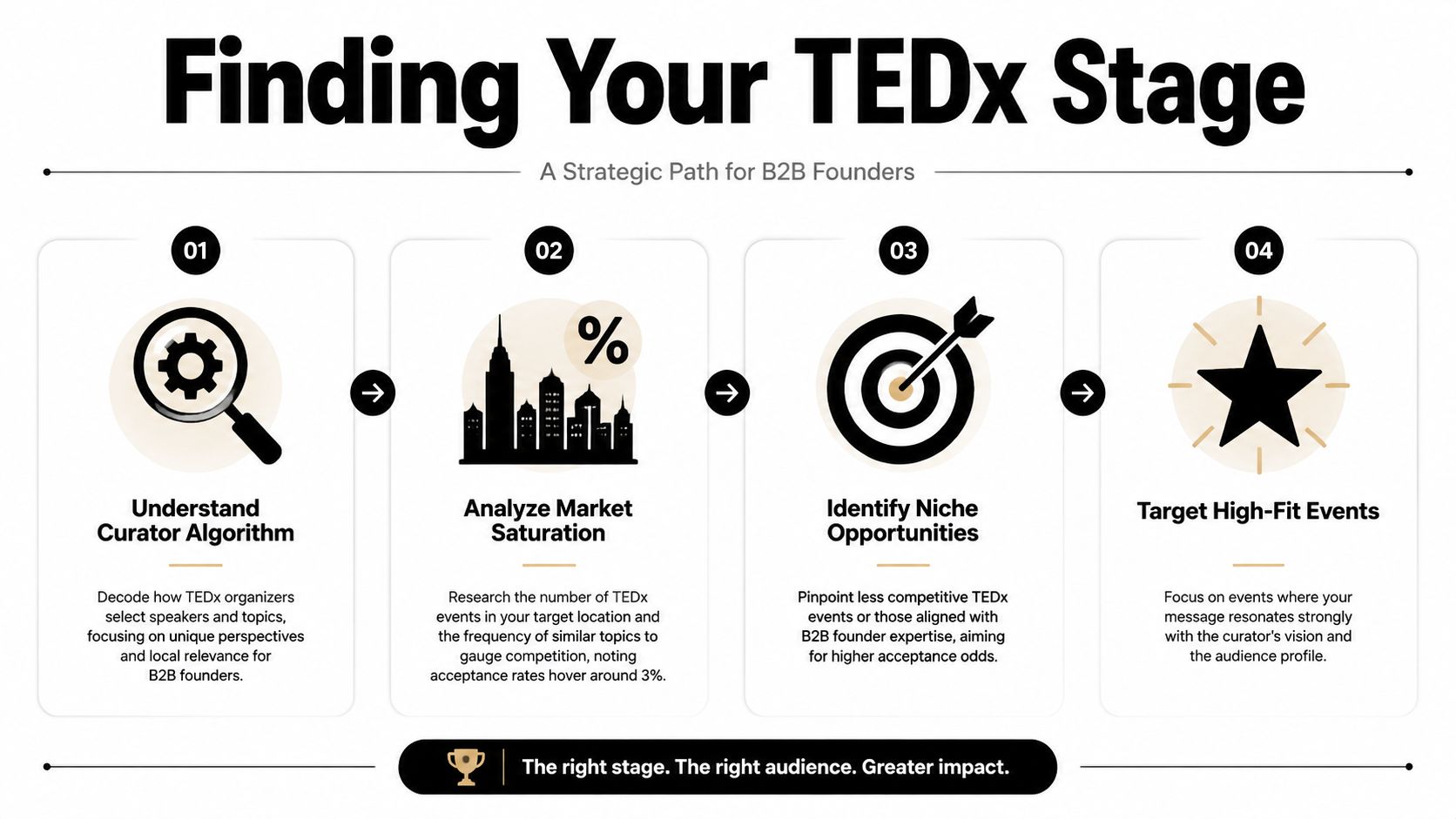
The biggest mistake founders make is applying emotionally. They pick famous cities, obvious events, or local stages they assume are accessible. That's lazy targeting.
TEDx is selective. Most TEDx events reject over 90% of applicants, and applying to 5 to 10 events in a year typically yields 1 to 2 acceptances when your idea aligns tightly with the theme, according to this TEDx application breakdown. Another source in the same dataset frames acceptance at roughly 3%, which tells you what you're up against.
Read the curator logic, not just the event page
Every TEDx event has its own preferences. The public theme is only the surface layer. A deeper filter usually sits underneath:
- the kinds of stories the organizer likes
- whether they prefer local operators or public-facing experts
- how much diversity of thought they're trying to create in the lineup
- whether your industry is already overrepresented in recent editions
A B2B founder often loses because they sound too polished, too commercial, or too similar to the last “future of work” applicant.
Study the previous speaker lineup and ask:
- Did they feature practitioners or mostly academics and activists?
- Did any recent talk cover adjacent territory to yours?
- Does your message complement the event theme, or does it force-fit into it?
- Are you bringing a fresh perspective, or just an industry perspective?
Build a target list like a pipeline
Don't treat TEDx applications like inspiration. Treat them like deal sourcing.
A practical shortlist should include:
- High-fit local events where your background has geographic relevance
- Theme-aligned regional events where your idea naturally supports the curator's concept
- Less saturated niches such as university, innovation, or sector-adjacent communities
- Referral-accessible events where someone in your network knows an organizer, volunteer, or prior speaker
If you want a clean way to evaluate event fit, use the same discipline you'd apply to outbound account selection. This guide to prospect research for targeted outreach is useful because the logic is identical. You're not blasting applications. You're prioritizing the opportunities where your profile can win.
What to track for each event
Use a simple spreadsheet or Airtable base with these columns:
| Field | Why it matters |
|---|---|
| Event name | Basic tracking |
| Theme | Filters idea alignment |
| Deadline | Prevents rushed submissions |
| Prior speaker profiles | Reveals curator taste |
| Organizer names | Enables personalized outreach |
| Fit score | Forces prioritization |
| Referral path | Increases response odds |
Don't apply because an event looks prestigious. Apply because your idea is unusually believable in that room.
That's the hidden edge. Strong applicants don't just have good ideas. They look inevitable for a specific stage.
Crafting a TED-Worthy Application and Pitch
Avoid submitting a generic conference speaker kit. TEDx applications reward one clear idea, broad relevance, and proof that you can explain it to a mixed audience without sounding like you are pitching your company.
Your application has one job. Make the organizer confident that your talk will spread, reflect well on the event, and create downstream value beyond the room. For a SaaS founder, that value is measurable. A strong TEDx topic can drive branded search, warm inbound leads, podcast invitations, investor familiarity, and partnership conversations for months. Build your pitch around that kind of idea, not around your product story.
According to this TEDx application guidance video, applicants are often asked for a credentials form, a separate idea summary, and a short video pitch. Treat those as three separate assets with three separate goals.
Build the credentials document like proof
Curators scan fast. Help them verify you fast.
Include:
- Identity details: Full name, contact details, location, and current role
- Relevant achievements: Only the wins that support the specific idea you want to present
- Verification links: LinkedIn, published articles, interviews, company bio, prior talks
- Topic authority: Research, operating experience, customer pattern recognition, or lived experience tied directly to the idea
Cut anything that does not strengthen the case for this talk.
Awards without relevance are noise. A long bio is noise. A media logo strip is noise unless it proves you are the right person to carry this idea.
Write the idea summary for spread, not self-promotion
A TEDx application rises or falls on idea quality. Can the organizer repeat your idea in one sentence? Can an attendee explain it to a colleague the next day? Can that idea travel on social clips and still make sense?
Use a tight structure:
- One sentence: State the core idea plainly
- Short summary: Explain the problem, the shift in thinking, and why a general audience should care
- Evidence of relevance: Show why this idea matters beyond your company, product category, or founder story
Here's a stronger founder-style example:
Single-sentence idea
B2B growth improves when companies remove invisible friction from buyer follow-up.
Sample pitch summary
B2B teams often blame slow growth on messaging, traffic, or market conditions. A large share of the problem sits elsewhere. Buyers show intent, then fall into slow, inconsistent follow-up systems that make the company harder to trust. My talk argues that operational friction shapes revenue earlier than many leaders realize. Delays, unclear ownership, weak handoffs, and generic outreach change the buying experience before a proposal is ever reviewed. The audience will see growth from a different angle. Trust is not only built through brand and sales skill. It is built through response design. I will draw from real operating patterns inside B2B teams to show how communication systems affect confidence, momentum, and conversion. This idea applies outside SaaS because every organization depends on follow-up, handoffs, and responsiveness. The practical takeaway is simple. Companies that reduce friction in their communication process become easier to buy from, easier to refer, and easier to remember.
That works because it is bigger than the founder. It gives the organizer an idea worth spreading, then ties your experience to that idea.
Your video pitch decides whether you feel credible
You do not need expensive production. You need clarity, pace, and range.
Record a short video in good light, look into the camera, and explain the idea as if you are speaking to an intelligent buyer outside your industry. Organizers are checking whether you can hold attention, simplify complexity, and sound trustworthy without hype.
A practical structure:
- Open with the tension: What problem have smart people misunderstood?
- State the idea: What is the new lens or insight?
- Broaden the relevance: Why should a mixed audience care?
- Close with the result: What change in thinking will the audience leave with?
Use one take if possible. Overedited videos usually lower trust.
Show business relevance without turning it into a sales pitch
Founders miss this point. TEDx organizers do not want a disguised demo, but they do respond to ideas with clear real-world consequences.
Frame your topic around outcomes such as reduced decision friction, stronger trust, better communication, improved adoption, or faster action. Those themes make a talk feel useful to the audience and commercially credible to the organizer. If your idea can later support pipeline growth, category authority, or earned media, good. Keep that business logic in your strategy, not in the application copy.
If your pitch still sounds too internal, review these essential communication skills for founders. Weak founder communication shows up fast in TEDx applications. Jargon, stacked caveats, and product-centric framing make a strong idea feel narrow.
Use AI to improve specificity before you send anything
AI can improve your application quality if you use it for diagnosis, not for ghostwriting.
Feed the event theme, prior speaker topics, and your draft application into your AI tool. Ask it to identify vague claims, jargon, weak transitions, and places where your topic sounds too promotional. Then ask for three tighter versions of your one-sentence idea, each aimed at a general audience.
Use AI for organizer outreach too. Build a short prompt that pulls in the event theme, organizer name, prior speaker patterns, and your topic angle, then drafts a personalized first email. You still need to edit it. The gain is speed and personalization at scale, especially if you are applying to several high-fit events.
For practical guardrails on tone, brevity, and structure, use these cold email best practices before you contact organizers.
Sample email
Subject: TEDx [Event Name] speaker idea for [Theme]
Hi [Organizer Name],
I'm reaching out because TEDx [Event Name] focuses on [Theme], and I have an idea that fits that audience well.
My core idea is: [15-word idea].
I'm a [role] with direct experience in [relevant domain]. The talk is built for a broad audience and focuses on [broader relevance], not on promoting a company or product.
If useful, I can send a short video pitch and a concise summary.
Best,
[Name]
[LinkedIn]
[Website]
Short wins. Specific wins. A curator should understand your idea in seconds and remember it later.
Rehearsal and Delivery Techniques
Getting accepted is the midpoint. Most founders underestimate what happens next and then panic when they realize TEDx delivery standards are stricter than normal event speaking.
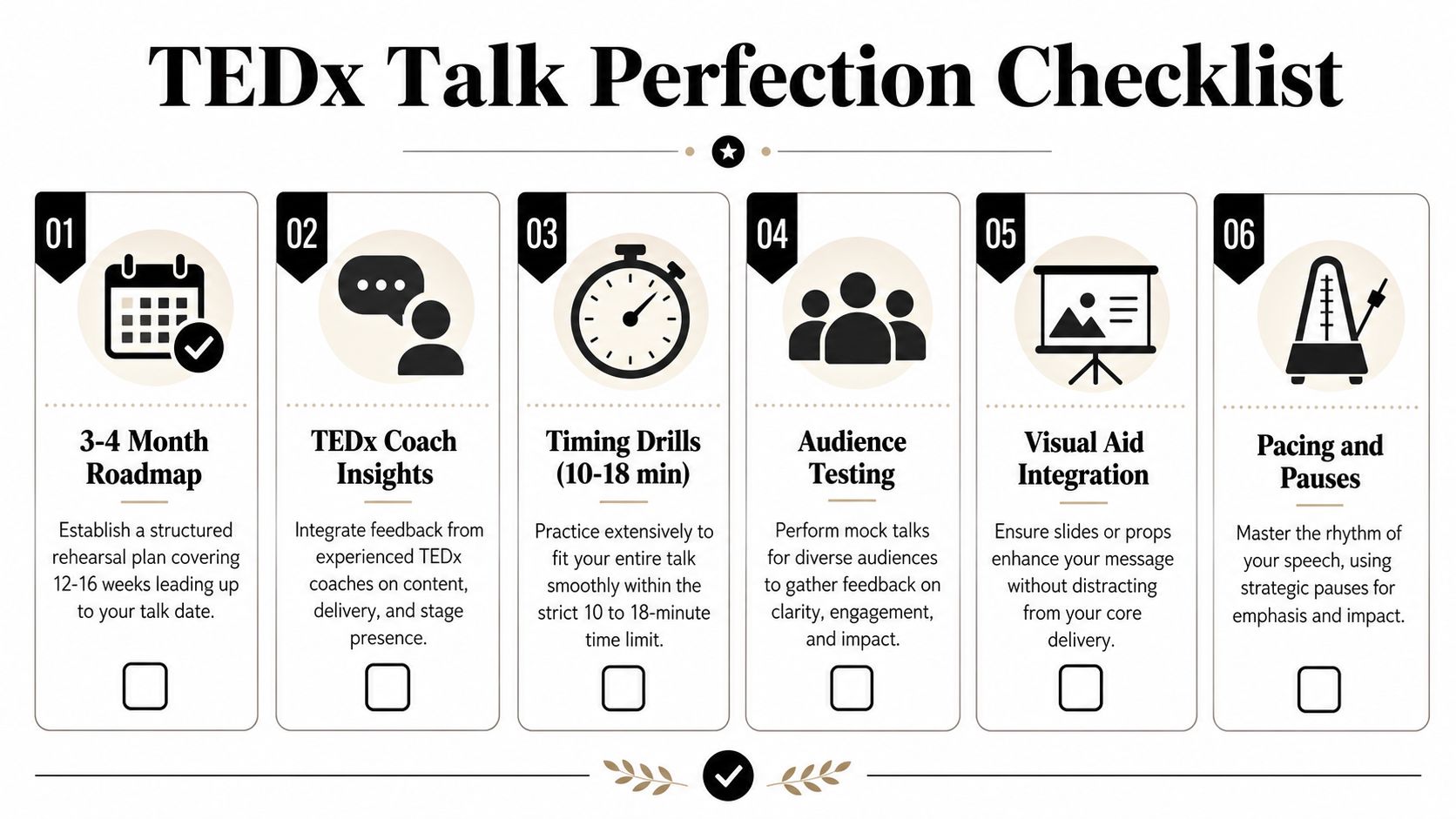
The official TEDx Speaker Guide states that TEDx talks are capped at 18 minutes, with many events enforcing 10 to 15 minutes, and that the rehearsal process often spans 3 to 4 months with practice in front of diverse audiences.
Rehearse for compression, not performance
A founder's default instinct is to add context. TEDx punishes that instinct. You need fewer points, cleaner transitions, and stronger phrasing.
A disciplined rehearsal rhythm looks like this:
- Month one: Lock the idea, shape the structure, and remove extra branches
- Month two: Rehearse out loud repeatedly and test comprehension with non-experts
- Month three and four: Tighten timing, slides, stage movement, pauses, and emotional control
If you're struggling with delivery, founder communication habits usually show up here. Rambling, stacked caveats, jargon, and overexplaining all become obvious on stage. This guide on essential communication skills for founders is a good outside reference because TEDx rewards clarity under pressure.
Use feedback from mixed audiences
Don't practice only with your executive team. They already understand your world.
You need feedback from:
- A peer in your industry who can tell you if the idea is credible
- A smart non-expert who can tell you if the idea is understandable
- A blunt listener who'll tell you where attention drops
If non-experts can't explain your idea back to you, the talk still isn't clear enough.
Keep slides minimal
Your slides should support memory and emphasis. They shouldn't carry the argument.
Use slides only when they do one of three jobs:
- show a concept faster than words can
- create contrast or reveal
- give the audience a visual anchor for a key point
Everything else belongs in your spoken delivery. Learn the clicker. Get used to the confidence monitor. Practice pauses intentionally. TEDx talks feel conversational, but they're engineered with precision.
Automation and Follow-Up Strategies
Manual TEDx outreach wastes founder time. The work is repetitive, the data is scattered, and maintaining consistent follow-ups beyond the first message often proves challenging. That's exactly where automation earns its place.
The goal isn't to spam more organizers. The goal is to build a controlled system that helps you identify relevant contacts, personalize intelligently, and keep every conversation moving.
Build a lightweight outreach stack
A simple founder stack is enough:
| Job | Tool options |
|---|---|
| Event tracking | Airtable, Notion, Google Sheets |
| Contact discovery | LinkedIn, event websites, Apollo |
| Workflow automation | Zapier, Make |
| Email sending | Gmail, Outlook, Instantly, Smartlead |
| CRM logging | HubSpot, Pipedrive, Close |
You don't need all of them. You need a repeatable flow.
A strong workflow looks like this:
- You add target TEDx events to Airtable.
- Zapier or Make pulls organizer data into your table.
- LinkedIn and public event pages supply names, roles, and context.
- Your email platform sends a personalized first-touch message.
- Non-responders get timed follow-ups.
- Responses sync to your CRM so nothing disappears into your inbox.
Where AI actually helps
AI is useful in three places.
First, it can summarize event themes and prior speaker patterns so you don't manually read every page. Second, it can help draft personalized first lines based on the organizer's event history. Third, it can categorize replies so you know who asked for a pitch, who declined, and who needs another follow-up.
Use AI to speed up research and drafting. Don't let it write generic outreach that sounds machine-made.
A practical sequence that doesn't feel robotic
Your follow-up sequence should stay respectful:
- Email one: Short introduction and clear-fit idea
- Email two: Follow up with one sentence about why your idea matches their theme
- Email three: Offer the video pitch or supporting materials
- LinkedIn touch: Connect only if the organizer is active and public-facing
For campaign design ideas, this guide to automated email marketing campaigns is useful because the same rules apply here. Personalization should be built into the system, not bolted on at the end.
Good automation removes admin. It does not remove judgment.
That's the difference between strategic outreach and founder spam. Automation should make you more consistent, not less thoughtful.
Maximizing Publicity and Measuring ROI
The business value of a TEDx talk is realized after the event, through strategic distribution and measurement.
Founders who treat TEDx as a branding trophy waste the asset. Founders who treat it as a demand generation input get compounding returns across pipeline, partnerships, and category authority. Your job after the talk is simple. Turn one stage appearance into repeat exposure, attributed traffic, and sales conversations you can measure.
Turn the talk into a revenue asset fast
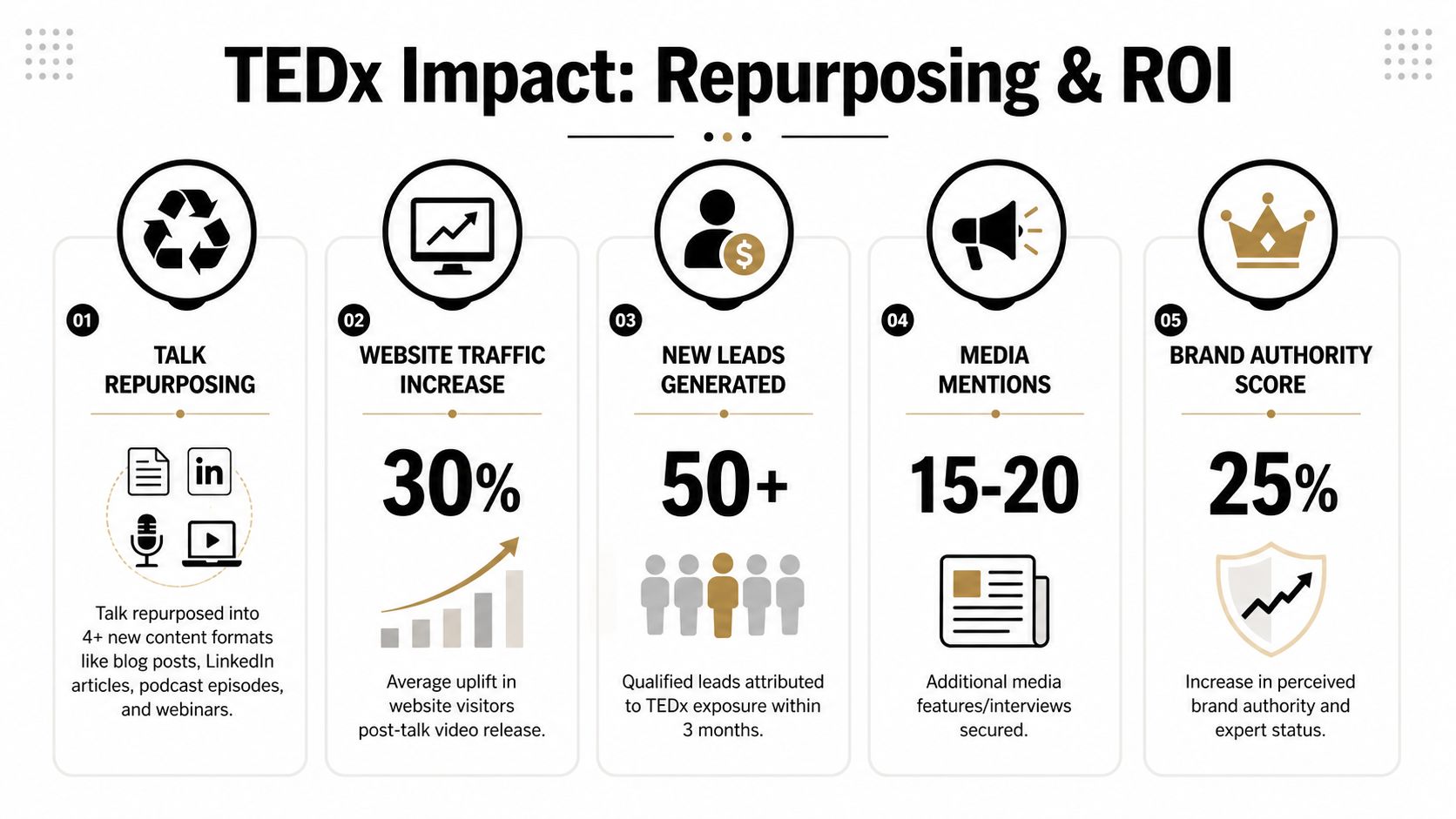
Repurpose the talk within the first 14 days while attention is still fresh. Publish clips, written takes, founder emails, and sales-ready proof points on a schedule, not randomly. One strong talk can feed weeks of content if you plan the edits before you step on stage.
The highest-value outputs are usually:
- a LinkedIn article tied to one sharp business takeaway
- a founder email that links the talk to a market problem your product solves
- a webinar topic built from the strongest audience response
- a podcast pitch angle based on the core idea
- a sales enablement asset for warm prospects evaluating credibility
Repurposing affects lead flow, not just reach. The Speaker Lab's TEDx guide notes that B2B founders can see up to 30% higher inbound leads when talks are repurposed strategically.
Measure business impact, not applause
Views matter less than pipeline influence. Set up tracking before the video goes live so you can tie attention to revenue outcomes instead of guessing later.
| Metric | Why it matters |
|---|---|
| Inbound lead source mentions | Confirms the talk is creating direct awareness |
| Demo quality | Shows whether authority is improving prospect fit |
| Podcast and media invites | Indicates brand lift and earned distribution |
| Partner outreach | Signals stronger market credibility |
| Content-assisted pipeline influence | Connects thought leadership to active deals |
Use UTM links on every post, clip, and newsletter mention. Add a required “How did you hear about us?” field to forms. Instruct sales to tag any deal where the prospect mentions the talk, a clip, or a reposted quote. If you use AI in your GTM stack, use it here too. Have it classify lead source mentions from call transcripts, summarize patterns in CRM notes, and flag opportunities influenced by TEDx content. That gives you faster attribution without adding manual admin for your team.
Distribution works better when you already own attention. If social is a major channel for your post-talk rollout, it helps to build your X audience with SupaBird, because TEDx clips perform better when they hit an existing founder audience instead of an empty feed.
A TEDx talk should sit inside your funnel like any other high-performing asset. If it does not influence leads, meetings, or revenue, you have a distribution problem, not a speaking problem.
Timeline Planner and Pitfalls to Avoid
Avoid compressing the preparation timeline. Treat TEDx as a year-long strategic project tied to pipeline goals, not a side quest you squeeze between product launches and fundraising.
A rushed process costs money. You submit weaker applications, record a flat video, accept poor-fit events, and end up with a talk that generates applause but no measurable business result. If you want TEDx to produce leads, partnerships, hiring lift, or category authority, build the timeline around those outcomes from day one.
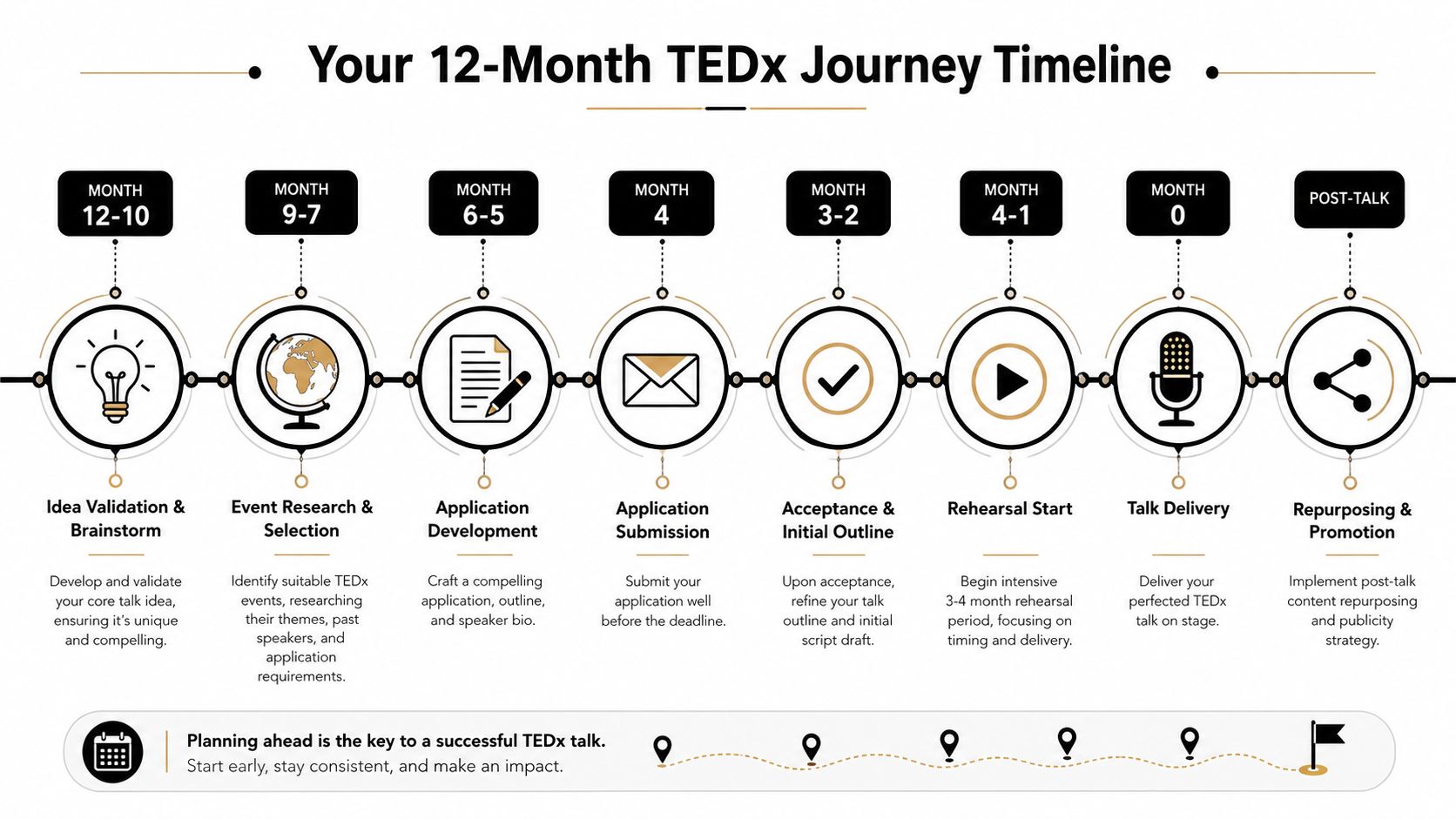
Use this sequence:
- Months 1 to 3: Validate one core idea, stress-test its relevance to your market, and define the business outcome you want from the talk
- Months 4 to 6: Research event fit, build a qualified target list, and use AI to speed up organizer research, personalization, and follow-up tracking
- Months 7 to 9: Record a credible pitch video, refine your application materials, and prepare for curator interviews with clear proof that your idea is distinct
- Months 10 to 11: Rehearse early, cut complexity, and test the talk with mixed audiences until the message is clear in one pass
- Month 12 and after: Repurpose clips fast, push distribution across owned channels, automate lead-source capture, and review whether the talk influenced pipeline
The failure points are predictable:
- applying with a broad topic instead of one sharp argument
- chasing any TEDx event instead of selecting the ones your buyers, peers, or future partners will respect
- sending a lifeless video that explains your credentials but does not prove stage presence
- treating rehearsal as polish instead of message testing
- waiting until the talk is published to set up outreach, CRM tagging, transcript analysis, and follow-up automation
- judging success by views instead of meetings booked, inbound mentions, earned media, and influenced revenue
If you want help building the outreach systems, follow-up workflows, and post-talk automation that turn TEDx visibility into real pipeline, MakeAutomation can help you design and implement the process end to end.