
Theory of Application: A Practical Guide for B2B and SaaS
You're probably looking at a stack of things that each make sense on their own, but don't quite work together in practice. The strategy deck says the CRM should enforce the SOP, the SOP assumes the AI agent will route cleanly, and the team still falls back to old habits because the new workflow hasn't survived contact with real customers. That's the gap the theory of application closes, not by adding more theory, but by turning theory into a testable operating model.
In the modern scientific tradition, that shift began when theory was tied to observation, experiment, and falsifiable prediction instead of speculation alone, and in contemporary scientific usage a theory is a well-substantiated explanation that must generate testable predictions supported or contradicted by evidence (Theory). For B2B teams, the practical lesson is simple. A framework only matters if it can be measured, audited, and improved in the actual workflow.
If you're comparing sales playbooks, it helps to browse the 2026 sales playbooks and ask a harder question than “Does this look good?” Ask whether the model fits your actual constraints, whether it can be reproduced by another rep, and whether it survives across channels, markets, and handoffs.
Why Most B2B Playbooks Stall Between Theory and Execution
A SaaS founder can read three automation playbooks in one week, approve a new CRM workflow on Friday, and still find the sales team logging notes in old fields by Tuesday. The problem usually isn't effort. It's that the framework was treated like a finished answer instead of a model that still had to be translated into a usable system.
The theory of application is the missing layer between the abstract model and the repeatable result. It asks whether the causal claim is true, whether the workflow can be repeated, where the idea stops working, and whether the process can be inspected without heroics. That's the difference between a clever deck and an operational standard.
Why elegant ideas fail in messy systems
In applied work, the model only helps if it gives a concrete X→Y relationship with scope conditions and assumptions that can be checked against real cases (University of Washington guidance on applying sociological theories). If the playbook says, “Use enrichment to improve conversion,” that's not enough. You still need to know which segment, under which sales motion, with which handoff, and what outcome count as improvement.
That's why so many B2B teams stall. They confuse explanation with execution. A theory can be conceptually strong and still be unusable if it doesn't tell operators what to do when the CRM is incomplete, the lead source is noisy, or the AI agent makes the wrong routing decision.
Practical rule: if a framework can't survive a real workflow with noisy data, one human exception, and a handoff between teams, it's not yet an application standard.
The academic history matters here because application became durable only when ideas were judged by whether they produced consistent real-world results across independent tests and could be reproduced in medicine, engineering, and industrial systems (Theory). That's the standard B2B teams need too, especially when vendors promise speed but don't show how the result will hold up after the pilot ends.
A good shortcut is to treat any sales, RevOps, or automation playbook as a hypothesis, not a mandate. If the framework can't be checked against evidence inside your own stack, it's still a draft.
What the Theory of Application Actually Means
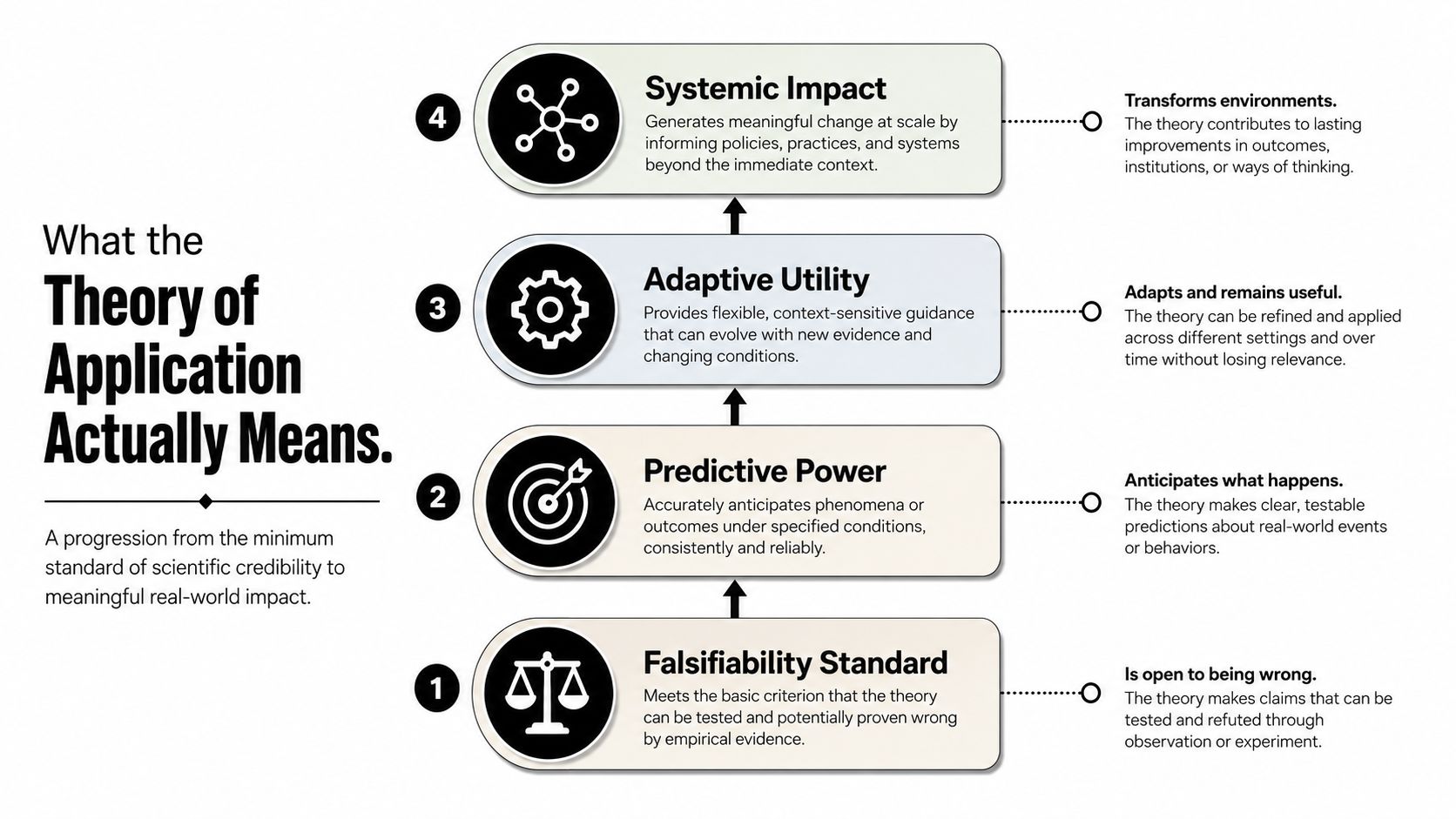
A useful definition starts with the scientific-method turn of the 16th and 17th centuries, when theory became tied to observation and experiment rather than pure speculation (Theory). In that tradition, the point of a theory isn't just to sound coherent. It's to make predictions that can be supported or contradicted by evidence.
Blueprint, build, load test
Think of the theory as the blueprint, and application as the build. A blueprint can look elegant on paper, but the test is whether the building stands under load. In a B2B setting, load means messy records, human judgment, conflicting incentives, and the unglamorous edge cases that appear after rollout.
Application is not the same as deployment. Deployment is pushing a workflow live. Application is the disciplined translation of a model into a measurable process that someone else can run, inspect, and improve. That's why a CRM automation that only works when the founder personally fixes exceptions isn't really applied yet.
The strongest practical definition is this. A theory of application is a standard for deciding when an idea has been translated well enough to operate in the world. That standard includes truth, reproducibility, scope, and auditability.
What makes a theory operationally useful
In quantitative or computational settings, reproducibility depends on documenting model assumptions, parameter values with units, and the basis for each estimate, along with well-annotated code so the result can be reproduced as rigorously as an experiment (MBoC guidance on reproducible modeling). That point matters outside the lab too. If your lead scoring model depends on hidden assumptions, no one can audit why it works or when it stops working.
The clearest mistake teams make is treating application like a one-time launch. Good application is a loop. The workflow gets tested, the assumptions get checked, and the model gets revised when the evidence changes.
A theory becomes useful when operators can tell, quickly and honestly, whether it helped, where it helped, and what it cost to make it work.
That's the standard to use when evaluating an AI agent, a vendor playbook, or a new SOP. If it can't be explained as a measured workflow with a visible cause and effect, it's still abstraction.
How a Theory Travels From Paper to Practice
Attachment theory is a useful case because it shows how an academic framework can become institutionally operational over time. The Association for Child and Adolescent Mental Health says it has been one of the most popular theories of child development for the last 50 years, and that its applications have been significant and varied, including therapeutic interventions plus public health and policy change (ACAMH on attachment theory applications). That kind of reach doesn't happen because the theory is fashionable. It happens because people keep finding ways to translate it into procedures.
Why adoption is a trajectory, not a launch
The important part isn't just the theory's creation. It's the path it took through primary texts, intellectual predecessors, and the era in which it emerged, which are the same historical factors researchers are told to study when evaluating why some theories become widely applicable while others stay abstract (ACAMH). In practice, adoption moved from academic formulation to therapeutic methods, then into public systems that could carry it at scale.
That pattern shows up in B2B software too. A sales methodology usually starts as a founder's belief, gets condensed into a training deck, then becomes a CRM process, and only later becomes a habit. If the workflow breaks at any stage, teams blame execution when the issue may be that the theory never made the trip into a form that frontline users could run.
The biggest operational lesson is to inspect provenance. Which playbook are you running, where did it come from, and has it survived contact with real customers? A method that worked in one market but never got adapted for another may still look respectable while failing.
Map the journey inside your own stack
Look at your current automation or sales motion and ask three questions. Where did this rule originate, who translated it into SOP form, and what evidence shows it still works now? If nobody can answer those questions cleanly, the framework is probably being carried by inertia, not by fit.
That's also why durable theories become institutional. They don't just explain. They travel well enough to survive training, handoffs, and local adaptation.
The Four Decision Lenses for Choosing a Framework
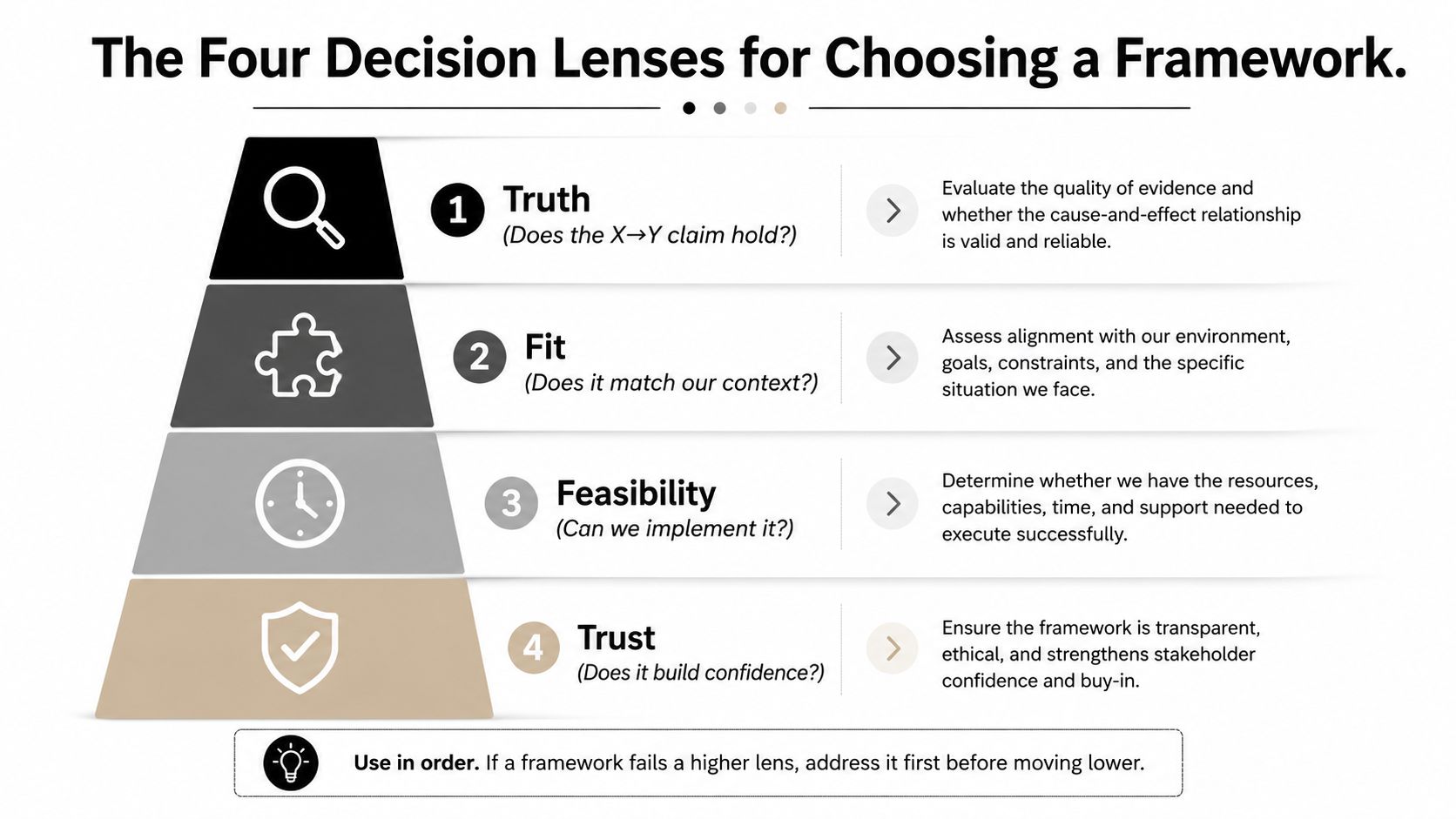
Before adopting a playbook, an AI agent, or a vendor methodology, use four decision lenses. These aren't abstract ideals. They're practical filters for deciding whether a framework deserves to enter your operating system at all.
Truth and reproducibility
Truth asks whether the X→Y claim holds. If the playbook says a new qualification rule improves pipeline quality, can you test that claim in your own environment? Reproducibility asks whether someone else can get the same result with the same inputs and assumptions, which is why documented parameters and code notes matter so much in computational work (MBoC).
A quick afternoon test works well here. Run the workflow on a small segment, write down the inputs, and have another operator repeat it without coaching. If the outcome changes every time a different person runs it, the method is too fragile to trust.
Scope and auditability
Scope is where the claim stops working. Many skip this, and that's why a pilot that performs well in one segment gets rolled out too broadly. A framework isn't wrong just because it fails outside its boundary. It's wrong when nobody defines the boundary.
Auditability asks whether the workflow can be inspected and improved. If a rep, manager, or ops lead can't see why the system made a decision, the team can't debug it later. That's true for AI routing, lead scoring, and SOP enforcement.
Here's a simple internal test. Write the framework in one page, then ask a teammate to identify the assumptions, the decision points, and the exceptions. If they can't, you don't have an operational standard yet.
| Lens | What it tests | Fast practical check |
|---|---|---|
| Truth | Does the claim hold? | Run a small controlled test |
| Reproducibility | Can others repeat it? | Have a second operator run it |
| Scope | Where does it fail? | Define segment and boundary conditions |
| Auditability | Can we inspect it? | Trace one decision end to end |
For teams comparing operating methods, the structure in this project management methodology comparison is a useful reminder that the best framework is the one you can run consistently, not the one that sounds smartest in a meeting.
Applying Theory to AI and SaaS Workflows
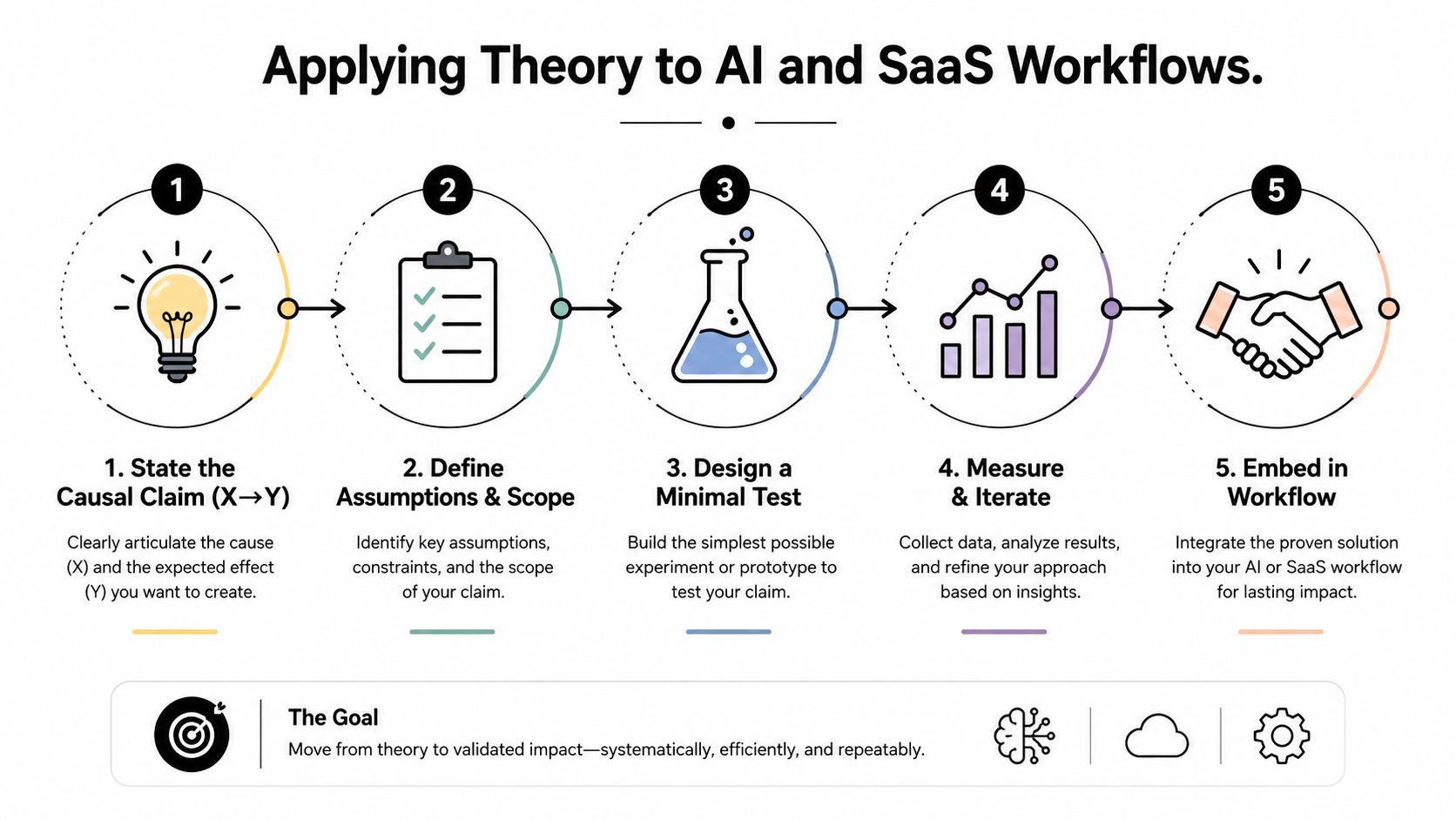
A strong workflow starts with a causal claim, not a vague hope. If you're using AI in sales ops, write the claim in plain language. Example, “If we enrich inbound leads before routing, SDR response time drops because fewer records need manual cleanup.”
Step 1 through 3, make the model testable
First, state the X→Y relationship. Second, define the assumptions and scope conditions. That means naming the segment, the channel, and the cases that don't count. Third, design a minimal test that isolates the change as much as possible.
If you're automating CRM follow-up, don't test ten variables at once. Change one routing rule, one notification path, or one enrichment source. Then compare the result to the baseline you already use.
The fastest way to fake progress is to change too many parts of the workflow at once.
That rule saves teams from false wins. A new sequence might appear better, but if the data source changed, the lead mix changed, and the AE assignment logic changed at the same time, you won't know what worked.
Step 4 and 5, document and embed
Fourth, document the parameters and units. If a model uses response time, define exactly what counts as response time. If it uses lead score, define the fields that feed it. The modeling standard from MBoC is relevant here because it treats transparent parameter documentation as part of scientific rigor, not an afterthought (MBoC).
Fifth, tie each optimization decision back to evidence rather than description. A lead gen SOP should say what happened, what changed, and why the next version is better. That's what turns a one-off fix into institutional knowledge.
For a practical implementation guide, the AI in business workflow playbook is a useful companion if you need to map theory into an actual operational sequence.
The right outcome isn't “we launched the automation.” It's “we can explain the result, reproduce it, and know when to stop trusting it.”
Choosing Between Competing Implementation Pathways
Three pathways usually compete in B2B environments. One is a top-down SOP rollout. One is pilot-led adoption. One is vendor-led integration. The right answer depends on which constraint binds first, because access is never just one variable. In health-services research, access is framed through five linked dimensions, availability, accessibility, accommodation, affordability, and acceptability (Milbank and Georgetown systems-oriented health research).
Compare the constraints, not the slogans
A top-down SOP rollout is strong when you need consistency fast. It tends to win on accommodation because it standardizes the process, but it can struggle with acceptability if the frontline team never bought into the logic. Pilot-led adoption is usually the best fit when the environment is messy and you need evidence before scaling. It often improves acceptability, but it can be slower on availability because the process stays local longer.
Vendor-led integration is attractive when the technical lift is too high for the internal team. It can increase availability because the tool is already there, but it may create accessibility problems if the workflow depends on experts to maintain it. Affordability also matters because a shiny platform can be cheaper to start and more expensive to stabilize.
| Implementation Pathway Compared Across Five Dimensions | Availability | Accessibility | Accommodation | Affordability | Acceptability |
|---|---|---|---|---|---|
| Top-down SOP rollout | Fast to distribute | Can be hard to use if rigid | Strong standardization | Often efficient upfront | Depends on team buy-in |
| Pilot-led adoption | Slower to spread | High local usability | Flexible to context | Lower early risk | Usually easier to earn |
| Vendor-led integration | Quick if tool exists | Depends on setup quality | Mixed, tool-dependent | Can be expensive over time | Varies with trust in vendor |
That's where one-size-fits-all guides break down. The right choice is the one that addresses the first constraint you hit, not the one that looks best in a slide deck.
If you want a practical reference on choosing automation routes, the Dooza process automation guide is helpful because it forces the conversation toward process fit instead of just tool adoption. That's the right frame for a messy environment.
What Most Application Guides Miss About Trust and Adaptation
Application is not purely rational. People don't just follow a workflow because it's logically correct. They follow it when they trust the process, understand the change, and feel that the system respects their reality.
The clearest evidence for that comes from community-based intervention work with African American Medicaid enrollees, where adaptation produced lower per-member-per-month cost by USD $115, higher retention by 3.62%, and preserved or improved quality (community-based intervention study). The lesson isn't just that adaptation matters. It's that adaptation can change both value and utilization patterns without raising cost.
Trust is part of the mechanism
A 2025 qualitative study identified five mechanisms shaping healthcare use among underserved populations, including perceived need, perceived obstacles, trust in a resource person, individual capabilities, and collective capabilities (PMC study on healthcare use among underserved populations). That's a direct warning to B2B teams. If your rollout only addresses individual behavior, it's incomplete.
A CRM SOP that ignores how reps trust the system will fail even if the logic is sound. An AI agent that makes decisions nobody can explain will create workarounds. A workflow that assumes everyone has the same context will erode adoption in the first month.
Practical takeaway: adoption doesn't break only because the process is complex. It breaks when the process asks people to surrender judgment without giving them confidence.
Adaptation has to be social
The best internal adaptation often happens through managers, enablement leaders, and power users who translate the change into local language. That's why the “human in the loop” idea matters in automation. It's not just a safety feature. It's how trust gets built when the system still has edge cases.
For teams designing review layers or escalation paths, the human-in-the-loop automation article is a useful reminder that transparency beats blind automation under such conditions. You want the team to see where judgment still lives.
The operational lesson is blunt. If you don't design for trust, you'll get compliance theater. People will click through the workflow and route real decisions around it.
Your 90-Day Application Roadmap and Next Move
Weeks 1 to 2, inventory every framework, SOP, and agent rule against the four lenses, truth, reproducibility, scope, and auditability. Weeks 3 to 6, pick one pathway and run a pilot in the workflow that wastes the most time today. Weeks 7 to 10, instrument the process and document the parameters. Weeks 11 to 13, audit the result and decide whether to scale, revise, or retire it.
Start with the workflow that loses you the most time this week, not the one with the highest theoretical upside. That choice forces the theory of application to prove itself where the pain is real.
If you want help turning your current playbooks, CRM logic, and AI workflows into something your team can run, audit, and improve, A CTA for MakeAutomation.