B2B Lead Generation LinkedIn: The 2026 Playbook
If your LinkedIn inbox feels busy but your pipeline still looks thin, you're not alone. A lot of SaaS founders and agency operators have a profile, a company page, a few hundred connections, and a steady trickle of DMs, yet very little of it turns into qualified meetings. The fix isn't sending more messages, it's treating b2b lead generation LinkedIn as a measurable pipeline motion, not a vanity-count exercise.
That starts with accepting the market reality. LinkedIn has become the default professional channel for B2B demand, with industry roundups saying 89% of B2B marketers use LinkedIn for lead generation, 62% say it produces leads, and 40% call it their most effective channel for high-quality leads, while roughly 80% of all B2B social media leads come from LinkedIn. Sopro's LinkedIn lead generation statistics also note that it delivers 277% more leads than Facebook and X combined, which explains why so many outbound teams concentrate their effort there instead of spreading it across multiple social platforms.
Why LinkedIn Now Anchors B2B Lead Generation
A founder can spend all week posting on X, refreshing email sequences, and tweaking a landing page, then still get better prospect density from one LinkedIn search. That happens because the platform is large and unusually dense with buying relevance. Research roundups put LinkedIn at over 1.1 billion to 1.2 billion members globally and about 310 million monthly active users, and they also note that four out of five LinkedIn members drive business decisions at their companies. Brenton Way's LinkedIn marketing stats roundup gives useful context for that audience mix, because it helps explain why the platform became a real acquisition channel after its 2003 launch.
For B2B teams, that density changes the math. On LinkedIn, your ICP is visible through titles, company history, mutuals, and activity. Buyers, influencers, and approvers identify themselves in ways that make list-building and qualification far cleaner than on broader social channels. A RevOps lead, a marketing director, or a founder often surfaces with enough context to route them into the right motion fast.
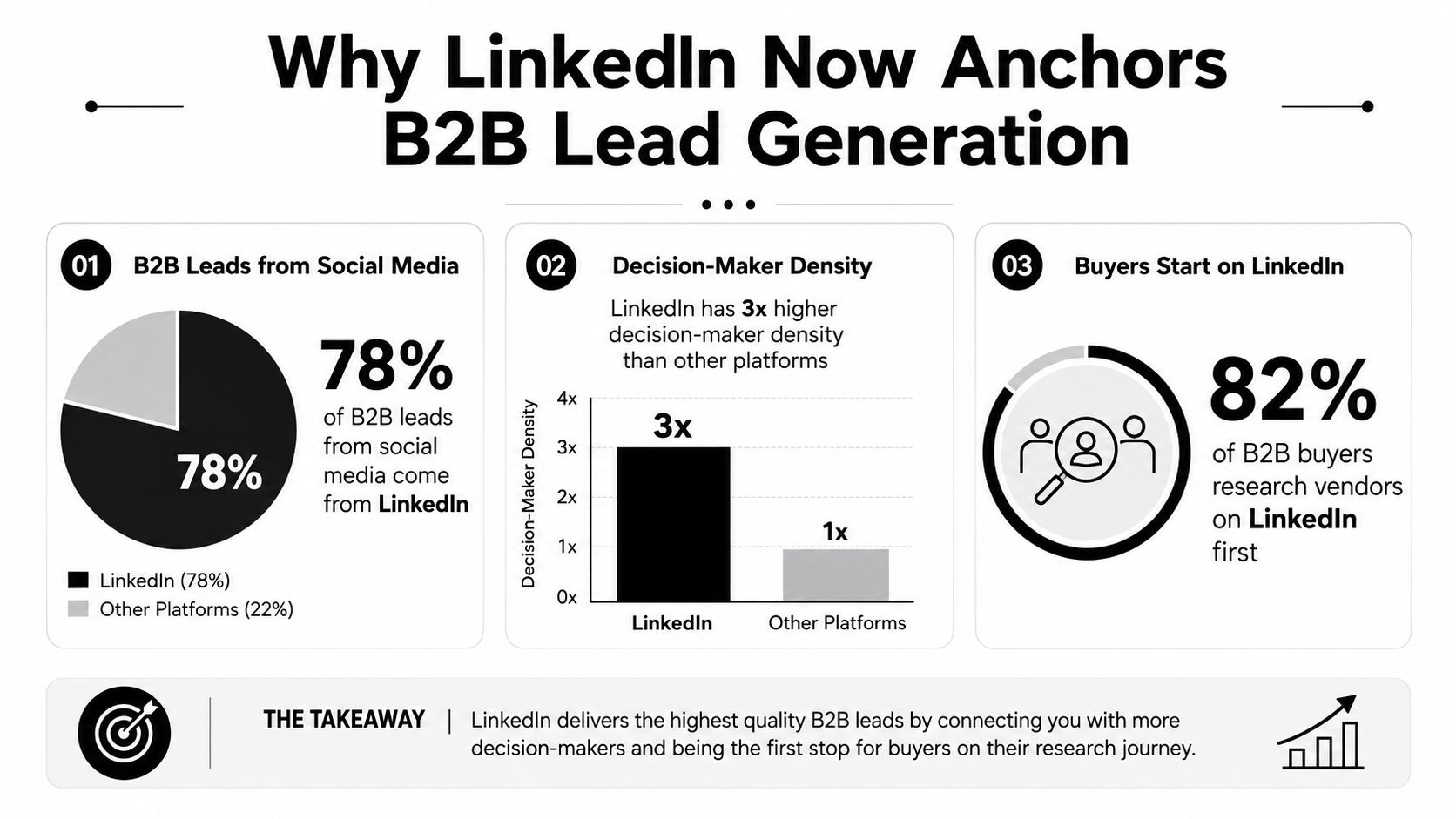
The practical move is straightforward. Stop treating LinkedIn as a place to “stay visible” and use it as the first screen for buyer research, list-building, and warm outbound. If your current motion is stalling, the question usually is whether your profile, target list, and sequence are built to turn attention into a next step.
LinkedIn's own lead-gen guidance lays out the basic campaign structure, define the qualification plan, choose tactics, then run campaigns through a Lead Gen Form paired with Sponsored Content or Message Ads, with immediate routing into CRM or sales workflows after completion. LinkedIn's lead generation guidance keeps that sequence tied to a pipeline system instead of random activity.
For a practical walkthrough on the surrounding workflow, this breakdown of LinkedIn lead generation best practices is worth keeping nearby while you build. If you need to compare tools for connection management or outreach, this resource to compare LinkedIn outreach tools can help you choose a stack without overcomplicating the workflow.
Turning Your Profile and Company Page Into Conversion Assets
A prospect who accepts your connection request usually checks your profile before they reply. If your headline says something broad like “Founder at X” and your About section reads like a résumé, you've lost the moment when attention is highest. The profile should answer three questions fast, what you do, who you help, and what to do next.
Rewrite the profile for buyer clarity
A strong headline doesn't try to impress everyone. It makes a promise to one buyer type. For a SaaS founder, “Helping RevOps teams clean pipeline data and automate follow-up” is stronger than a role title because it names the problem and the audience. For an agency owner, “Growth systems for e-commerce brands that need more qualified demo requests” is tighter than “Performance marketer” because it points to the outcome.
The About section should read like a short sales page, not a biography. Lead with the pain point you solve, mention the type of company you work with, and close with the one action you want people to take. The Featured slot should support that message with a case study, a lead magnet, a booking page, or a clear offer page. If you're comparing tools for connection management or outreach, this resource to compare LinkedIn outreach tools can help you choose a stack without overcomplicating the workflow.
Practical rule: if a prospect can't tell what you sell within 10 seconds of landing on your profile, the profile is doing branding, not conversion.
Make the company page back up the pitch
Your company page should not be a neglected placeholder. The tagline, About section, and team activity all act as proof when a lead checks you after a DM. Keep the wording aligned with the personal profile so the message feels consistent rather than stitched together by marketing and sales in different rooms.
The best company pages also use employee visibility well. When founders and sellers comment, share, and post from the same point of view, the page stops being a static brochure and becomes social proof. That doesn't mean posting constantly. It means making sure the people prospects see after outreach reinforce the same promise.
A quick audit is enough to catch most leaks.
- Headline: name the audience and outcome, not just the role.
- About section: explain the problem you solve in plain English.
- Featured content: show proof, offer, or next step.
- Company page tagline: match the message on the personal profile.
- Employee activity: make sure the visible team reinforces the same positioning.
If those five pieces line up, every connection request has a better chance of turning into a real conversation instead of a polite silence.
Defining Your ICP and Building a Tight Target List
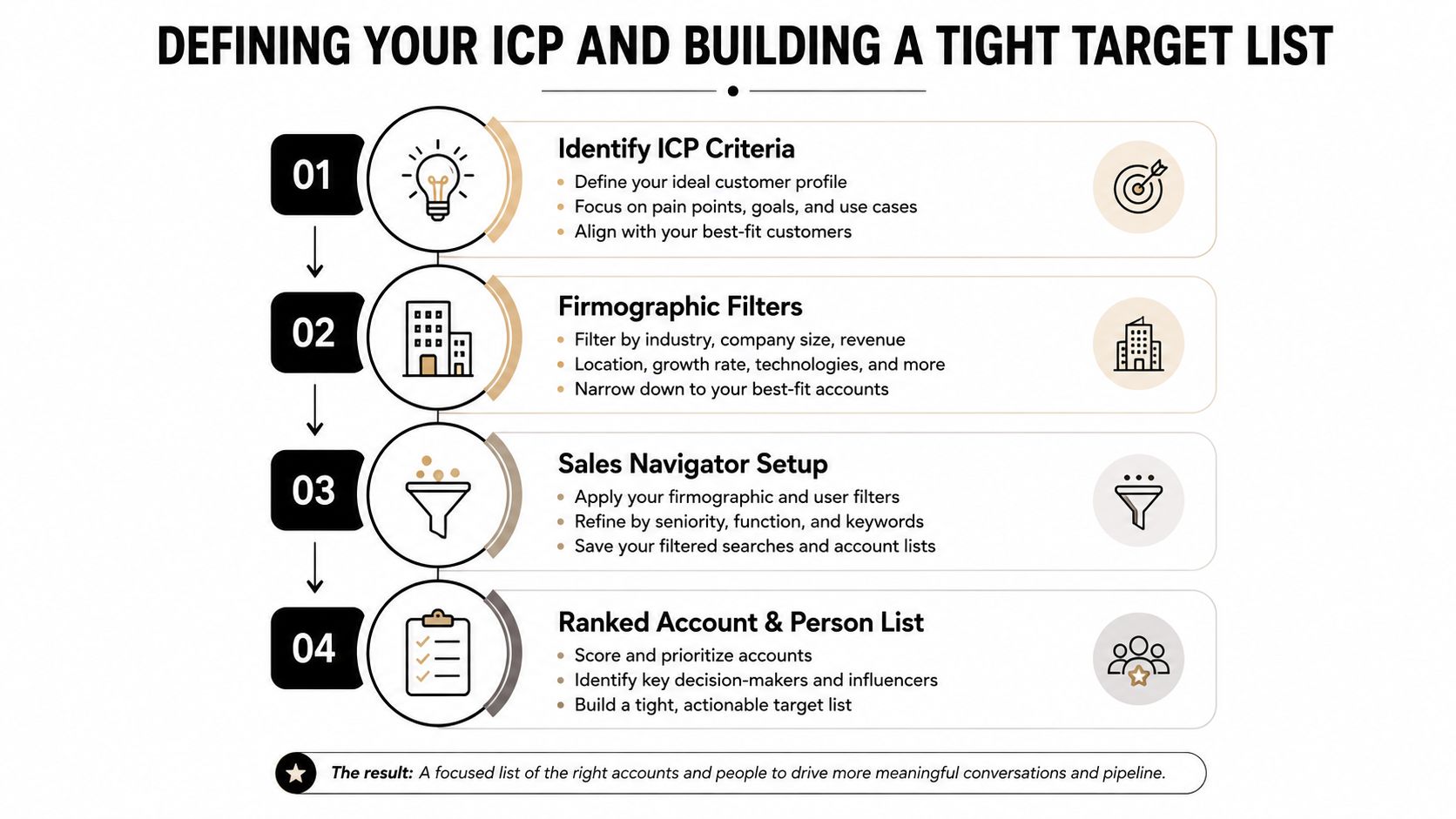
Generic targeting is where most LinkedIn motions break. “We sell to growth-stage SaaS” sounds strategic until you sit down to build the list and realize you're messaging half the market. A usable ICP turns into filters, and filters turn into a short list you can work.
Start with firmographic and role filters
The cleanest way to build a list is to lock the company profile first, then the person. If you sell to B2B SaaS, decide whether you want mid-market, enterprise, or founder-led teams before you search titles. If you're an agency targeting e-commerce, choose the company model and then work backward to the marketing leader who owns the budget.
That sequencing keeps you from mixing buyers with curious bystanders. It also makes it easier to write better copy, because the pain points of a RevOps leader are not the same as those of a marketing director at a fast-moving brand.
For practical ICP definition, this guide on what is an ideal customer profile is a helpful reference point before you start building searches.
Use a narrow list and rank it
The best outbound motions I've seen on LinkedIn use a small, ranked list of accounts, not a giant spreadsheet. A target list of 20 to 50 accounts keeps the work personal enough to stay relevant and small enough to measure. Within those accounts, prioritize decision-makers first, then the people who influence the deal or shape the internal conversation.
Sales Navigator makes that work faster because it lets you stack filters around title, company, and activity. The point isn't to find more leads, it's to find fewer, better ones. Save searches by segment, not by random keyword pileups, so each list has a purpose.
Don't start with “who can I message today.” Start with “which accounts should my pipeline depend on this month.”
A simple weekly workflow works well here.
- Define the company boundary. Pick industry, size, and business model.
- Map the buying roles. Separate decision-maker, influencer, and evaluator.
- Save the search. Keep one search per segment.
- Rank the list. Put the most relevant accounts at the top, then work in order.
For a SaaS founder selling to RevOps leaders, the list might be narrow by company type and role, with the prospect set centered on teams that already manage pipeline health. For an agency founder selling to marketing directors at e-commerce brands, the filter set should shift toward businesses where paid and lifecycle marketing already matter. The list only becomes useful once it reflects the buying motion you want.
The Multi-Touch Outreach Sequence That Books Meetings
Cold connection requests fail when they arrive before trust exists. The easiest way to improve reply quality is to earn context first, then send the request, then follow up with something that feels like a continuation of the conversation rather than a first contact.
Warm the account before you pitch
The simple warm-up rhythm is practical because it's hard to overdo without looking strange. Spend about 15 minutes commenting, 5 minutes viewing profiles, and 5 minutes reacting or sharing content during the early stage, then wait roughly 1 to 2 weeks before switching into outreach, as practitioner guidance on LinkedIn B2B lead generation recommends. That gives you enough surface interaction to make the eventual request feel familiar.
The order matters. Substantive comments create visibility, profile views create intent signals, and reactions keep you in the feed without being intrusive. Once the prospect has seen your name a few times, the message doesn't feel like a cold interruption.
Use a sequence that asks for one next step
Keep the first connection request short and specific. Reference the post, topic, or shared context, then ask to connect without dumping a pitch. A simple structure works better than cleverness.
For SaaS, a request can look like this, “Saw your post on pipeline hygiene, I work with teams on that problem too. Would be good to connect.” For an agency, “Your recent comments on lifecycle marketing stood out, I'd like to stay in touch.” The copy is not trying to sell, it's trying to earn acceptance.
After acceptance, send one message that adds value before asking for a meeting. If you have a relevant teardown, checklist, benchmark, or short idea, drop that instead of a deck. The second follow-up should tie back to the first conversation point and offer a low-friction next step.
Rule of thumb: the first DM should feel like a continuation of attention, not the start of a pitch.
A practical sequence usually looks like this:
- Connection request: one line, tied to a real trigger.
- First DM: one useful observation or asset.
- Follow-up: a short nudge with a specific ask.
- Break-up note: polite exit, with no guilt language.
Format choice matters too. Plain text still works well for many founder and agency motions, especially when the deal is simple and the buyer doesn't need a lot of explanation. Voice notes and video replies can help when nuance matters, or when the lead has already shown clear interest and a more human format will carry more context. Comment-to-DM flows are useful when someone has engaged publicly, because the message can reference the comment thread directly.
For practical copy ideas, I've seen plain text outperform flashy formats when the offer is direct and the audience is busy. I've also seen video work better when the sale is more consultative and the prospect needs to feel that there's a real person behind the outreach.
Automation, Paid Ads, and Staying Within LinkedIn's Rules
Scaling LinkedIn outreach gets messy fast if you treat automation like a shortcut instead of an operations layer. The safe stack removes manual admin and keeps human judgment in the loop, so research, targeting, and message quality still come from the team. If the process depends on fake engagement, aggressive scraping, or broad blasting, it will age badly and usually creates more cleanup than output.
Separate safe scaling from risky shortcuts
CRM sync, sequence scheduling, enrichment, and routing help because they move data after the human targeting decision has already been made. Risk starts when tooling tries to copy human behavior too aggressively or on a pattern that looks mechanical. At that point, outreach starts to look automated, especially when every message follows the same cadence or every action fires on the same schedule.
The better pattern is to let tools move data, not impersonate attention. Keep account research human, keep the list tight, and let the stack handle the repetitive handoffs.
For teams comparing broader workflow options, lead generation automation tools is a useful companion guide for keeping the stack focused instead of bloated. If you need a concrete path for follow-up content, video automation via Zapier shows how teams connect trigger-based workflows without rebuilding the entire process from scratch.
Use paid as an overlay, not a replacement
LinkedIn's campaign structure is straightforward. Define the qualification plan, choose the tactic, then run campaigns with a Lead Gen Form template paired with Sponsored Content or Message Ads, and route responses into CRM or sales workflows as soon as the form is completed, as outlined in LinkedIn's lead generation guidance. That setup works because paid captures demand while organic builds familiarity.
A good paid stack supports organic instead of trying to replace it. Sponsored Content can retarget prospects who already saw your founder posts. Lead Gen Forms can capture interest without sending people to a long landing page. Message Ads can work when the audience is narrow and the offer is clear, but they get expensive quickly if the targeting is broad or the ask is vague.
| Category | Primary Use Case | Risk Level |
|---|---|---|
| CRM sync | Route leads and activity into sales workflows | Low |
| Sequence scheduling | Organize follow-ups without manual drift | Low to moderate |
| Enrichment tools | Fill missing contact or firmographic data | Moderate |
| Lead Gen Forms | Capture interest from high-fit audiences | Low |
| Sponsored Content | Retarget and nurture warm prospects | Low to moderate |
| Message Ads | Direct inbox offers to targeted segments | Moderate |
| Aggressive scraping | Bulk profile collection and list building | High |
| Engagement pods | Artificial likes and comments | High |
One option in this category is MakeAutomation, which builds AI and automation systems for B2B and SaaS workflows, including lead routing, CRM automation, and SOP design. It fits best when the LinkedIn motion needs cleaner handoffs between outreach, qualification, and follow-up, not when the goal is to spray more messages into the market.
The compliance review should stay simple. Check how lists are built, how fast messages are sent, what gets synced to CRM, and whether any part of the workflow depends on behavior that would look spammy if you explained it out loud.
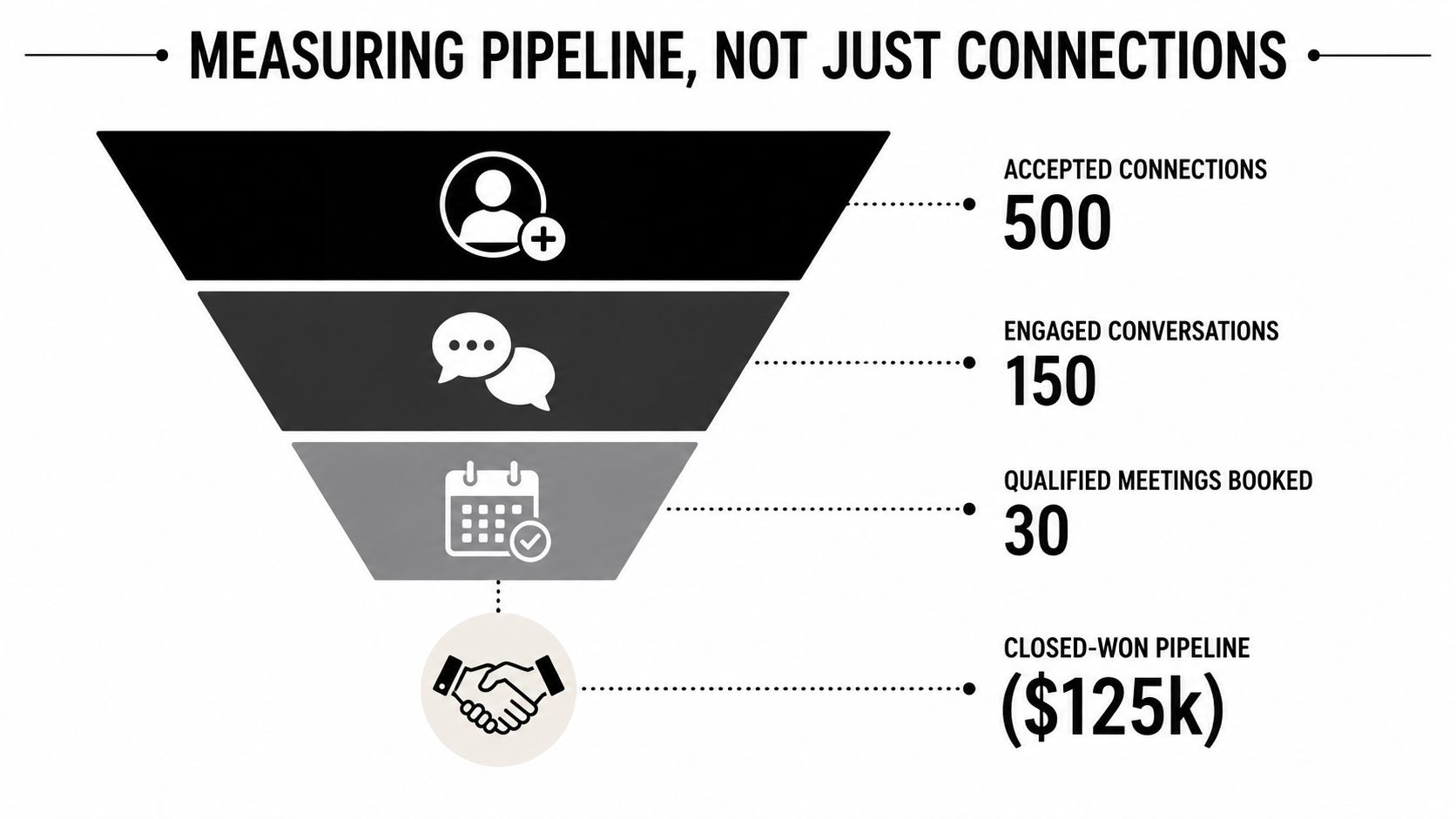
Measuring Pipeline, Not Just Connections
The loudest LinkedIn stories usually brag about connection counts or inbox volume. That's the wrong scoreboard. If the motion doesn't produce qualified conversations, sales-accepted leads, and eventual pipeline, the activity is just expensive socializing.
Score the lead before you celebrate it
A connection is not a lead in the revenue sense. A lead becomes useful when it matches the ICP, shows some buying signal, and enters the sales motion. That's why a lead-quality score is more useful than raw acceptance totals. It forces the team to judge whether a profile fit the target account, whether the reply was substantive, and whether the conversation moved toward a meeting.
The dashboard should track a few things every week. The most important are qualified conversations booked, SAL-to-SQL conversion, pipeline value sourced from LinkedIn, cost per SAL when paid is involved, and reply or engagement rate by message format. Those are the numbers that tell you whether the channel is helping sales, not just keeping the inbox active.
For a broader framework on what pipeline metrics matter, sales pipeline metrics that predict revenue is a useful reference alongside your internal dashboard design. It helps anchor the idea that pipeline health should be visible before revenue closes.
Use attribution that reflects how buyers actually behave
LinkedIn rarely closes deals alone. A lead may first see a post, then accept a connection request, then reply to a DM, then attend a webinar, then convert after an email follow-up. If you only credit the last touch, LinkedIn looks weaker than it is. If you credit every touch equally, you blur the difference between curiosity and intent.
Multi-touch attribution is the cleaner way to think about it. It lets you connect LinkedIn activity to the rest of the motion without pretending the channel worked in isolation. That matters most in longer sales cycles, where the platform's role is often to create trust and keep the account warm before the actual close.
Track the path, not the vanity event. A connected lead that never enters sales is not the same as a lead that becomes a meeting and then a pipeline opportunity.
A weekly review should answer three questions. Which message format produced the best replies, which account segment turned into the most qualified meetings, and which source created real pipeline instead of accepted connections? If those answers are unclear, the motion needs better scoring, not more outreach volume.
Troubleshooting, Format Selection, and Scaling Past Plateaus
Most LinkedIn programs don't die because the platform stopped working. They stall because the team kept widening the target list, kept sending similar copy, or kept assuming that more personalization would solve a weak offer. When reply rates slip, the problem is usually closer to targeting than creativity.
Read the failure mode before changing the format
Low reply rates usually mean the first line is too generic or the lead isn't close enough to the problem. Declining acceptance rates usually point to a list that drifted away from the ICP. If the audience suddenly looks colder, the outreach itself may be fine, but the input list isn't.
Format choice should follow the buyer, not a trend thread. Text DMs are still the cleanest choice when the offer is direct and the buyer is already busy. Video can help when the sale is consultative and trust matters. Newsletters and conversation ads make more sense when the buyer needs repeated exposure before they'll engage, especially in longer SaaS cycles.
Scale without flattening the motion
The mistake at scale is turning a high-context motion into a factory line. A junior BDR can handle list hygiene, engagement tracking, and follow-up routing, but the offer, positioning, and ICP still need senior input. If the target list gets broader, the message has to get sharper, not more polished.
A quarterly refresh keeps the motion from decaying. Revisit the ICP, prune weak segments, and review which formats are getting attention. If organic content is landing, use paid to retarget that audience rather than trying to cold-start everything from scratch.
- Low reply rates: test the first line before rewriting the whole sequence.
- Declining acceptance: tighten the account list and stop chasing easy volume.
- Scaling: layer paid retargeting onto the content that already earns attention.
- Format choice: match the medium to deal complexity, not to platform hype.
For teams that have hit a plateau, the next move is usually operational, not creative. Hire or outsource a BDR only after the list, message, and routing are stable, then give that person a narrow lane so the data stays readable.
If you want this system built without duct-taped spreadsheets and broken handoffs, visit MakeAutomation to see how their automation and workflow design support lead routing, CRM follow-up, and repeatable LinkedIn outreach operations for B2B teams. If your LinkedIn motion needs to produce pipeline instead of just activity, they can help you turn the process into something your sales team can trust.