AI for Customer Retention: A B2B SaaS Implementation Guide
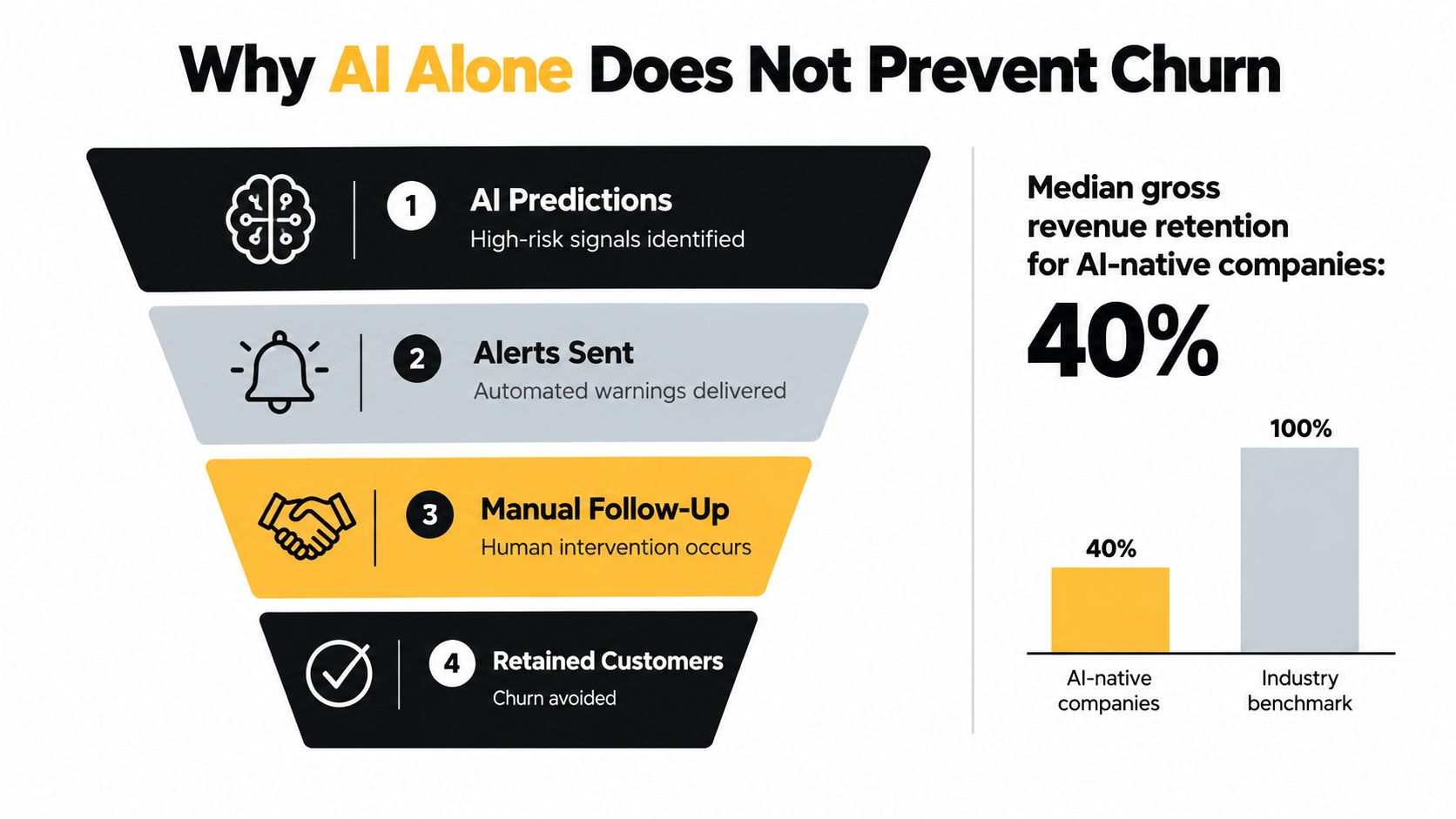
Median gross revenue retention is 40% for AI-native companies, compared with 63% for B2B SaaS, so AI alone doesn't prevent churn. For AI products priced under $50 per month, median GRR falls to 23%, which makes segment fit, pricing, usage intensity, and human support more important than adding another AI feature.
That finding changes how experienced SaaS operators should approach AI for customer retention. The retention system isn't a chatbot bolted onto support or a prediction model sitting in a notebook. It's a connected operating layer that collects behavioral signals, scores risk, routes the right intervention, and measures whether the intervention changed renewal behavior. Personalization can move retention materially, but only when the underlying data and workflow are reliable.
A survey of 150 e-consumers found the strongest relationship with retention came from AI-based product recommendations, with r = 0.74, p < 0.001. Email personalization followed at r = 0.68, website customization at r = 0.61, and targeted advertising at r = 0.49. The study reported that personalization explained up to 64% of the variance in customer retention (academic survey).
Why AI Alone Does Not Prevent Churn
The 40% versus 63% GRR gap should make every SaaS founder question the assumption that more AI automatically means less churn. RevenueCat's 2026 analysis of 3,500 software businesses found median gross revenue retention of 40% for AI-native companies versus 63% for B2B SaaS, while AI products under $50 per month reached just 23% GRR (RevenueCat analysis cited by Userpilot).
That isn't an argument against AI. It's an argument against confusing product novelty with durable value. A low-priced AI tool may attract users who experiment heavily, pay little, and leave once the novelty fades or a competing model offers a similar capability. A high-value B2B workflow can retain better when the AI is embedded in approvals, reporting, compliance, or team processes that customers rely on every day.
A useful distinction is whether AI changes the customer's operating outcome or adds a conversational interface. A chatbot that answers basic questions may reduce ticket volume, but it won't fix poor onboarding, missing integrations, unreliable output, or a pricing model that doesn't match usage. Those are product and value problems, not messaging problems.
Practical rule: Before funding an AI retention program, identify the segment that retains better after AI is introduced. Then find the price floor, usage pattern, and workflow dependency associated with that behavior.
Retention diagnosis starts with a clear definition of churn. Teams that need a shared vocabulary can use this guide to understand what is B2B churn, including the difference between lost logos, contraction, and complete account cancellation.
A practical filter for retention investment
Use three questions before choosing a model or automation:
- Product type: Is the AI embedded in a recurring workflow, or is it an optional feature customers can replace easily?
- Pricing tier: Does the price support human intervention when the account is at risk, or does the unit economics force full automation?
- Churn driver: Are customers leaving because they lack value, usage, trust, support, or budget?
If the dominant issue is low activation, invest in onboarding and product education before predictive outreach. If usage drops after a failed workflow, route the account to support and product operations. If customers receive value but aren't discovering adjacent features, recommendation and personalized lifecycle messaging may help.
The first question should always be: which customer segments retain better after AI is introduced, and where does retention collapse? Without that answer, AI can accelerate acquisition, automate outreach, and still leave the core churn mechanism untouched.
Building the Data Pipeline for AI-Driven Retention
A churn model needs a time-aware account history, not a pile of event logs. Start by defining the prediction unit. For most B2B SaaS teams, that means an account or subscription, with user-level behavior rolled up to the account while preserving important seat-level signals.
The minimum pipeline should combine four signal groups:
- Product usage telemetry: Logins, active seats, feature adoption, workflow completion, failed actions, API activity, and meaningful usage frequency.
- Support language: Ticket topics, reopen events, unresolved issues, escalation history, and customer sentiment extracted from ticket text or call transcripts.
- Billing and plan events: Payment failures, downgrades, cancellations, renewal dates, seat reductions, and expansion or contraction events.
- Engagement behavior: Email replies, in-app interactions, onboarding completion, meeting attendance, and responses to customer success outreach.
Raw events become useful only after identity resolution. Connect anonymous product activity, authenticated users, decision-makers, billing records, CRM accounts, and support contacts to a stable account identifier. Store event time separately from ingestion time, because a late-arriving event shouldn't make the model appear to know something that wasn't available at prediction time.
The prediction table
Each training row should represent an account at a defined observation point. Features must describe the period before that point, while the label should describe a future churn or renewal outcome. This separation prevents target leakage, one of the fastest ways to build a model that performs well offline and fails in production.
Handle missing data deliberately. A missing support ticket doesn't necessarily mean a healthy customer, and an absent feature event may mean the integration failed. Add data-quality indicators, document the meaning of nulls, and monitor feature freshness after deployment.
| Signal Type | Best For | Latency | Privacy Risk |
|---|---|---|---|
| Product usage telemetry | Activation, adoption, declining usage | Near real time | Behavioral profiling |
| Support ticket text | Friction, sentiment, unresolved problems | Minutes to hours | Sensitive customer language |
| Billing and plan events | Commercial risk, contraction, payment issues | Event driven | Financial and account data |
| Email and in-app engagement | Responsiveness, campaign fatigue, re-engagement | Minutes to days | Communications monitoring |
Teams often debate whether to build the pipeline internally or use a CDP and integration layer. Build core pipelines in-house when data ownership, custom feature logic, and long-term governance matter more than speed. Use managed connectors when your systems are fragmented and the first priority is reliable synchronization. A real-time workflow layer such as real-time data processing can help orchestrate events, but it shouldn't replace a durable source of truth.
Before production, assign owners for consent, retention periods, access controls, deletion requests, and model input reviews. Privacy protection isn't a legal appendix. It affects what signals you can collect, what explanations you can provide, and whether customers trust the intervention.
Choosing the Right Churn-Prediction Model
Choose the model based on the intervention it will control. A risk score that triggers a discount, executive escalation, or renewal forecast needs an explanation that operators can act on. A simpler model with stable reasoning can support better commercial decisions than a black box that customer-facing teams do not trust.
One comparative churn-prediction study reported about 96% accuracy for random forest and AdaBoost. Multilayer perceptron and SVM reached 94%, decision tree reached 90%, naïve Bayes reached 88%, while logistic regression and LDA reached 86.7%.
Those figures help compare approaches, but they do not establish a production decision rule. Accuracy can look high when churners are a small minority of the customer base. A model that labels nearly every account as safe may appear accurate while missing the accounts that need help.
Match complexity to operating capacity
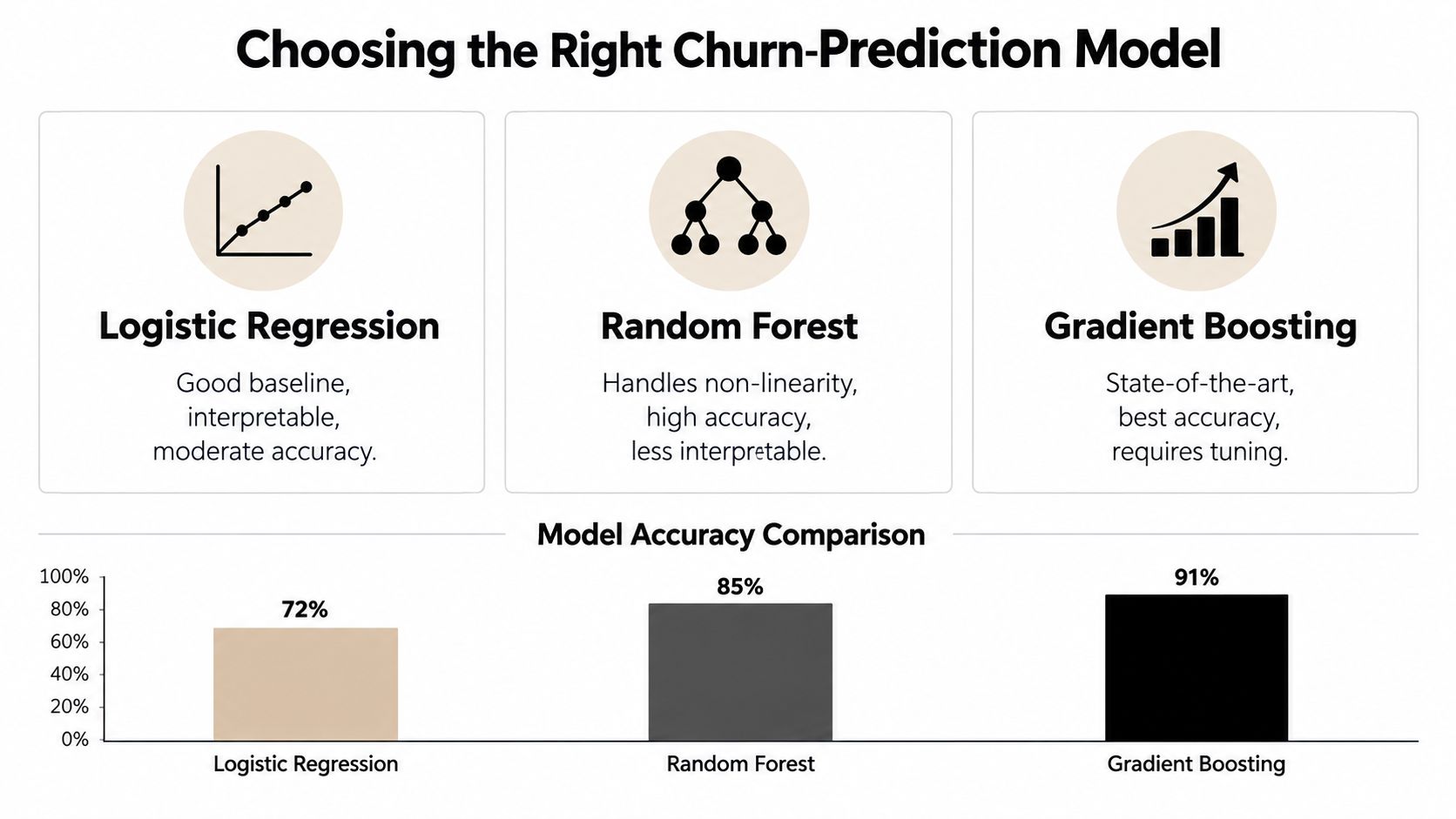
Logistic regression is a strong baseline when the team needs interpretable coefficients, quick iteration, and straightforward deployment. With disciplined feature engineering, recency, frequency, adoption depth, support friction, and billing events can produce a useful risk ranking without a large ML platform.
Random forest captures nonlinear interactions and mixed feature types. It fits cases where churn depends on a combination such as declining usage, unresolved support issues, and an approaching renewal. The trade-off is weaker interpretability, which creates more explanation work for customer-facing teams.
AdaBoost and gradient-boosted approaches can perform well on structured data when the team can tune thresholds, validate drift, and maintain feature pipelines. They require more operational discipline than a baseline model, particularly after product changes alter customer behavior.
Text can add signal when customers describe risk in tickets, surveys, or calls. A separate text-enriched prediction research report measured a neural network with RoBERTa at 96% accuracy, 97% F1, 88% precision, and 95% recall when customer language was included. The practical value comes from connecting that signal to a permitted action, not from adding a large language model by default.
Optimize the decision, not the score
Track precision, the share of flagged accounts that need intervention, and recall, the share of risky accounts the system catches. Tie both measures to treatment cost, account value, response rate, and renewal outcome. A model can improve recall while creating too many low-value tasks, or improve precision while allowing preventable churn to pass through.
Use feature importance or SHAP-style explanations to show which categories influenced a score. Do not expose raw private text to every operator. Give each role controlled reasons such as “usage declined,” “support issue remains unresolved,” or “key seats became inactive.”
Start with logistic regression when data definitions are immature or transparent reasoning matters most. Move to tree-based models after event definitions stabilize and the team can monitor drift. Add text features only when support language is consistently captured, permissioned, and tied to an intervention.
Teams planning a workflow-oriented implementation can review churn prediction automation as a reference, then test the model against their own renewal outcomes instead of copying benchmark settings.
Automating Outreach and Voice AI Agents
A prediction is valuable only when it changes what a customer experiences. The safest sequence is to score the account, identify the likely risk driver, choose the least intrusive useful action, and define the point where a human takes over.
Start with low-risk interventions. A meaningful usage drop can trigger an in-app guide, a training message, or a customer success task. A cluster of inactive seats can trigger an adoption review. A payment failure should follow a billing workflow, not a generic “we miss you” campaign.
Route by risk and emotional context
Voice and chat agents make sense when the customer needs a fast response, the issue is well-defined, and the system can retrieve accurate account context. They become dangerous when the customer is angry, the renewal is commercially significant, the issue involves a service failure, or the account has already asked for a human.
A 2026 customer-service attitudes report cited by Forbes found that 57% of consumers would trust a business less if it predominantly uses AI in customer-service interactions, up from 53% the previous year (Forbes customer-service report). Faster response doesn't compensate for making a customer feel blocked.
Routing rule: Let AI handle triage, retrieval, summaries, and routine follow-up. Give humans ownership of accountability, exceptions, emotion, and commercial judgment.
A mid-market SOP can be implemented as follows:
- Trigger: The risk score crosses a reviewed threshold or a defined behavioral event occurs.
- Enrich: Pull plan, renewal date, active seats, recent tickets, unresolved issues, and prior outreach into the CRM.
- Classify: Assign the likely cause, such as adoption, reliability, billing, missing capability, or service dissatisfaction.
- Treat: Send one relevant message or create a CSM task. Don't launch every available channel at once.
- Escalate: Route high-value, high-severity, or emotionally charged accounts to an account manager.
- Close the loop: Record the intervention, customer response, resolution, and eventual renewal outcome.
An orchestration layer can connect email, in-app messaging, CRM tasks, and calls. Teams evaluating AI voice agents for outbound calls should test disclosure, opt-out handling, transcript access, escalation timing, and failure recovery before broad deployment. For a deeper implementation reference, see how to implement AI voice agents that work without treating automation as a substitute for service ownership.
The sequence below shows how a workflow can move from an account signal to an accountable human response.
Don't measure this system by the number of messages sent. Measure whether the right customer received the right help before the renewal decision was made.
Measuring Impact and Designing Experiments
Retention experiments fail when teams treat model accuracy as the outcome. A model can identify risk correctly and still produce no commercial value if the offer is mistimed, the message is irrelevant, or the customer would've renewed without help.
Use a treatment group and a holdout group within comparable account segments. Keep the intervention policy fixed during the test, record eligibility before contact, and preserve the original risk score so later changes don't rewrite the experiment. For account-based products, randomize at the account level to prevent users in the same organization from receiving conflicting treatments.
The dashboard that matters
Track a compact set of outcome and operating metrics:
- Gross revenue retention: Revenue retained from the existing base, excluding expansion.
- Logo retention: Accounts renewed rather than canceled.
- Expansion contribution: Additional revenue associated with treated accounts, kept separate from prevented churn.
- Cost per retained account: Incentives, labor, model, messaging, and agent costs divided by incremental retained accounts.
- Time to intervention: The interval between a risk signal becoming available and a useful action reaching the account.
- Precision and recall: Whether the model is targeting the right accounts and finding enough of them.
Use uplift thinking when possible. The key question isn't “who is likely to churn?” It's “who is more likely to stay because we intervened?” Sending an expensive offer to a customer who would've renewed creates cost without incremental retention.
A disciplined test cycle
Run the first experiment long enough to observe the relevant customer decision, while avoiding early conclusions based on opens, clicks, or initial replies. Review results by account tier, product maturity, region, and risk driver because an average treatment effect can hide a harmful experience for one segment.
Watch for common errors:
- Early peeking: Teams stop when a few positive responses appear.
- Seasonality: Renewal timing and budget cycles distort short windows.
- Contamination: CSMs manually contact both treatment and holdout accounts.
- Changing thresholds: Operators alter eligibility halfway through the test.
- Privacy shortcuts: Teams export raw transcripts or sensitive fields into unapproved tools.
Scale only when the intervention improves a commercial outcome at an acceptable cost and doesn't damage trust or service load. If the model is accurate but treatment has no lift, change the action. If the treatment helps only one segment, narrow the program. If neither prediction nor intervention works, pause and fix the data or product issue instead of adding automation.
Team Roles, Privacy Rules, and the Implementation Roadmap
An operational retention system needs clear ownership. A data engineer or platform owner maintains identity resolution, feature freshness, and integrations. A retention analyst defines labels, validates model performance, and owns experiment design. A product or growth lead decides which customer problems deserve intervention. An operations lead documents SOPs, escalation rules, and hand-offs.
Privacy work starts before training. Minimize collected data, document consent and purpose, restrict access to sensitive support text, define deletion procedures, and audit model features for inappropriate proxies. Tell customers where AI is used, especially in service interactions, and provide a clear path to a human.
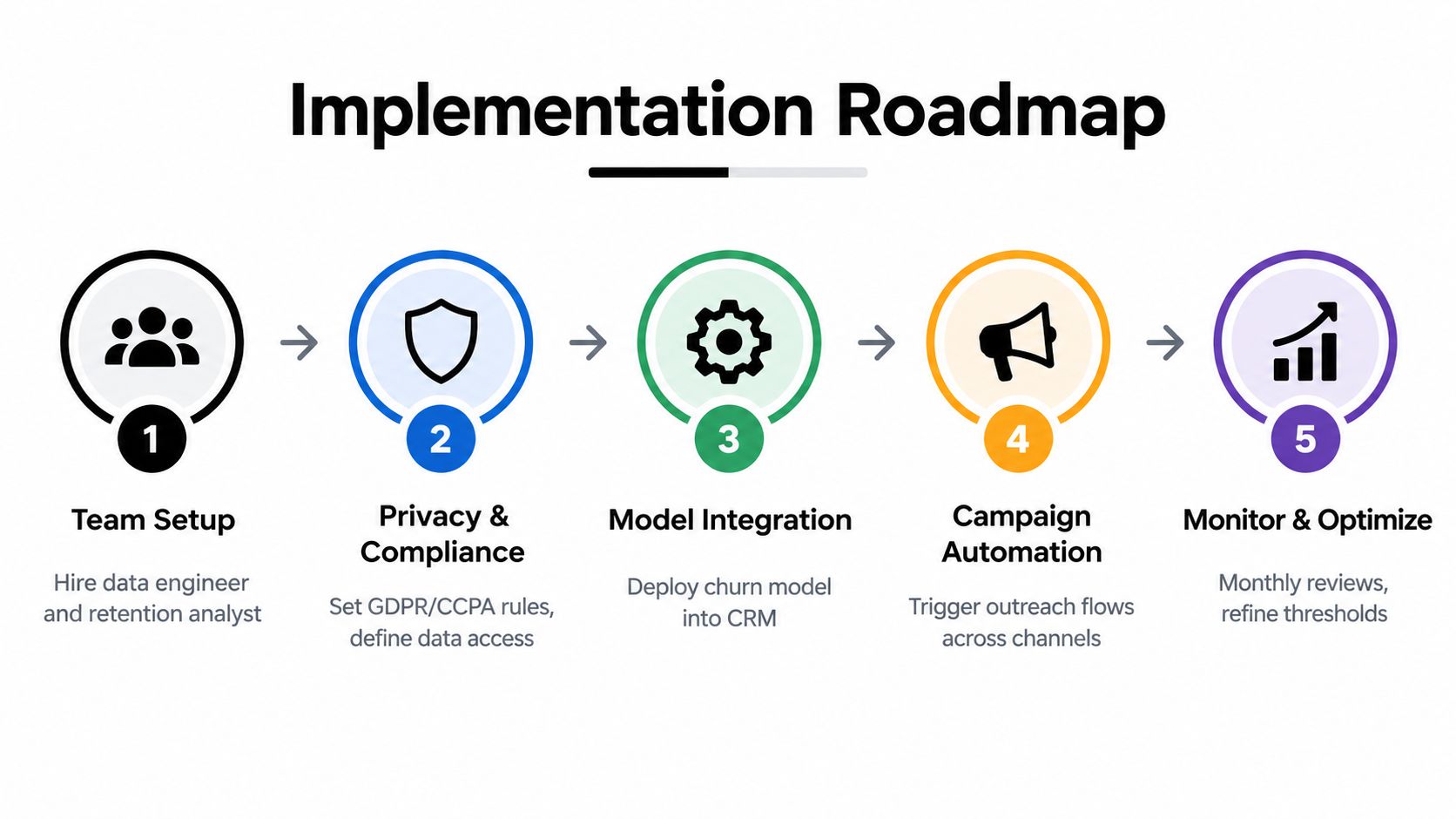
A phased rollout
- Pilot one segment: Choose a customer group with reliable data and a defined churn driver.
- Prove the workflow: Connect the score to one treatment and one escalation path.
- Expand selectively: Add high-value accounts only after the human hand-off works.
- Scale carefully: Introduce more channels, treatments, and segments with separate holdouts.
- Optimize continuously: Review thresholds, false positives, customer feedback, and renewal outcomes.
The RevenueCat benchmark is a useful guardrail. AI-native products can retain poorly when price, usage, and product value don't support durable adoption. The Forbes trust finding adds another constraint: a hybrid model isn't a compromise, it's often the safer operating design.
MakeAutomation helps B2B and SaaS teams connect CRM workflows, triggered outreach, AI-enhanced operations, voice agents, and documented SOPs into a working retention process. Visit MakeAutomation to discuss the data pipeline, routing logic, and automation hand-offs your team needs before putting AI retention into production.