AI Implementation Consulting: The Complete Guide
AI implementation consulting is already a mainstream enterprise priority, with the market projected to grow from US$14 billion in 2024 to US$72.8 billion by 2030, a 31.6% CAGR. The practical challenge isn't deciding whether to run an AI pilot, but making that pilot work inside governed, end-to-end business processes.
That distinction matters. A demo can classify leads, draft proposals, summarize calls, or answer internal questions without confronting the constraints that appear in production. Real operations add permissions, data quality problems, system integrations, approval steps, audit trails, exception handling, and people who need to trust the output.
Nearly 70% of global businesses are already implementing or planning AI integration as part of digital transformation, according to market analysis from Research and Markets. The opportunity is no longer limited to finding an interesting use case. It's building an operating system around useful AI so the system remains reliable after the pilot team moves on.
What AI Implementation Consulting Actually Means
AI implementation consulting turns a promising pilot into an operating workflow. The work connects AI to the systems, decisions, controls, and people that determine whether a business process performs reliably after launch. Companies invest in it because working systems matter more than additional strategy decks.
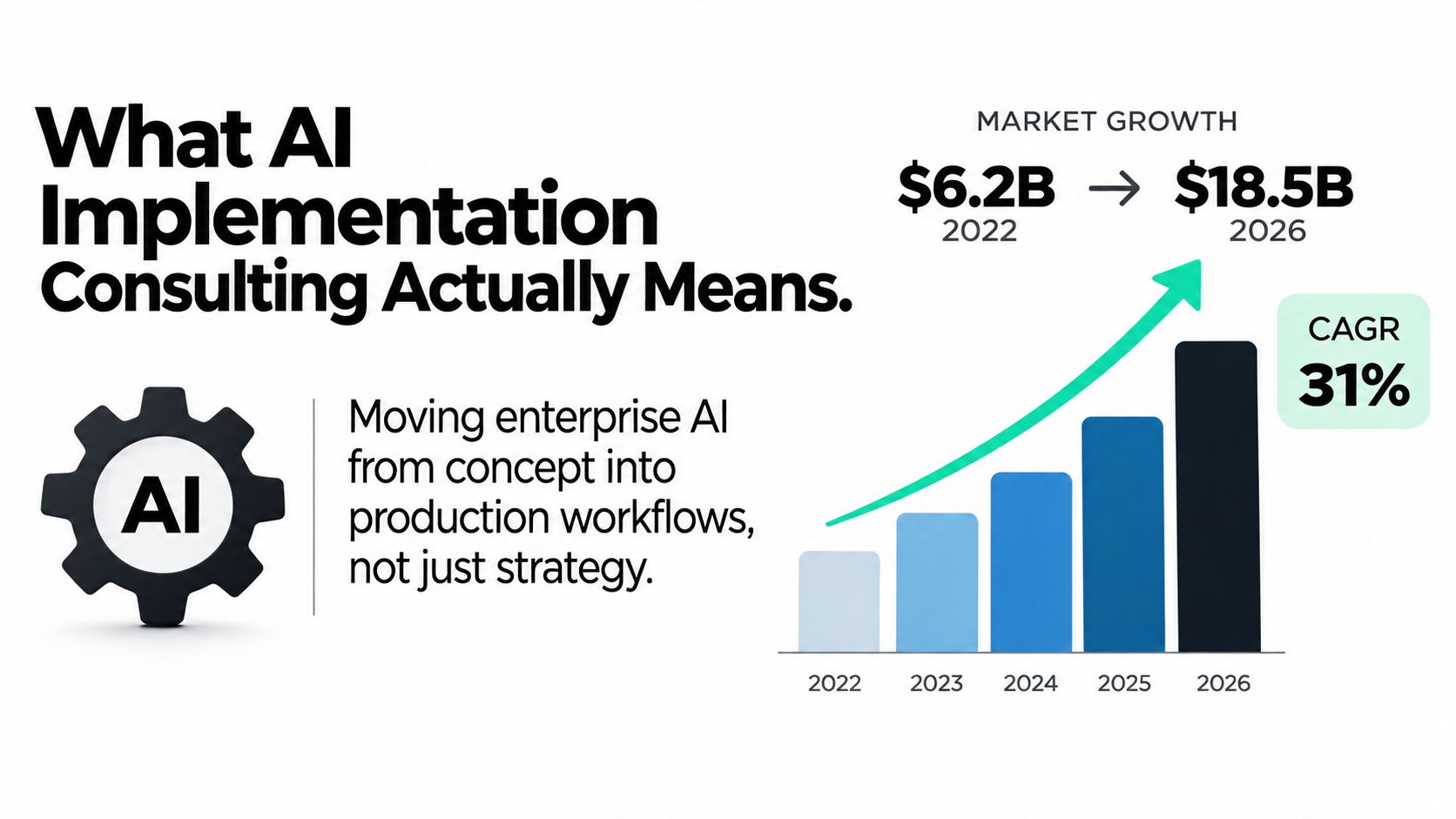
AI implementation consulting translates a business problem into a production workflow that uses AI safely and measurably. The scope can include workflow mapping, data preparation, tool selection, prompt and model design, API integration, human review, security controls, deployment, monitoring, documentation, and team adoption.
Generic AI advisory asks:
- Where could AI create value?
- Which model or platform should we evaluate?
- What might an AI roadmap look like?
Implementation consulting addresses the operating details:
- Which system provides the source of truth?
- What happens when the model is uncertain?
- Which employee can approve or override an output?
- How does the result enter the CRM, ticketing platform, ERP, or project system?
- What gets logged for audit and improvement?
- Who owns the workflow after launch?
Strategy isn't the same as operational ownership
A consultant can recommend a language model without understanding the process it enters. That approach produces expensive prototypes. An implementation partner maps the workflow first, then selects technology that fits the task, data, risk profile, and existing stack.
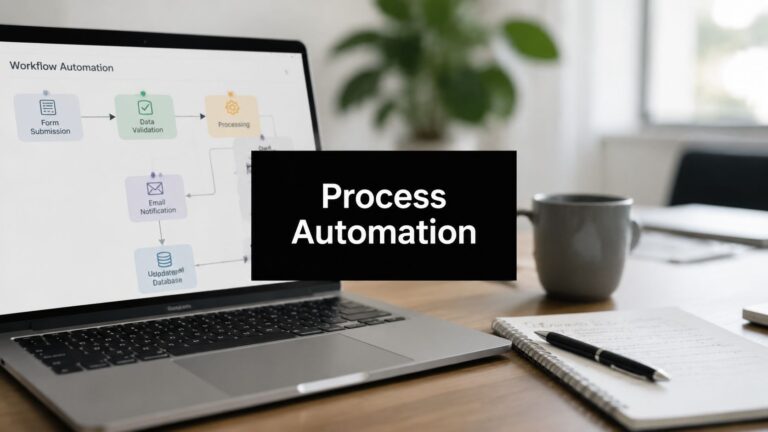
For a B2B company, the workflow might connect inbound lead qualification to a CRM, route qualified opportunities to sales, generate a structured brief, and require human approval before outreach. For an agency, it could turn a project intake form into a scoped delivery plan, assign work, and update status across tools.
Start with an AI readiness assessment covering systems, workflows, data access, ownership, and constraints. The output should be a prioritized implementation backlog, not a collection of fashionable use cases.
Practical rule: Choose the workflow before choosing the model. A technically impressive model that sits outside the production workflow has no operational value.
The Four Phases of a Successful Engagement
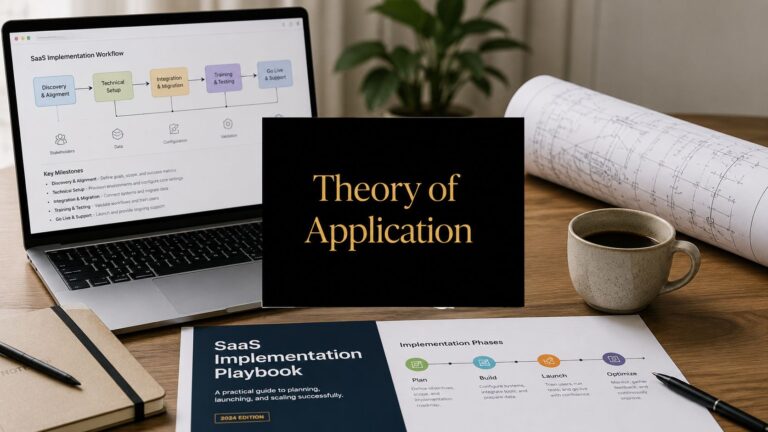
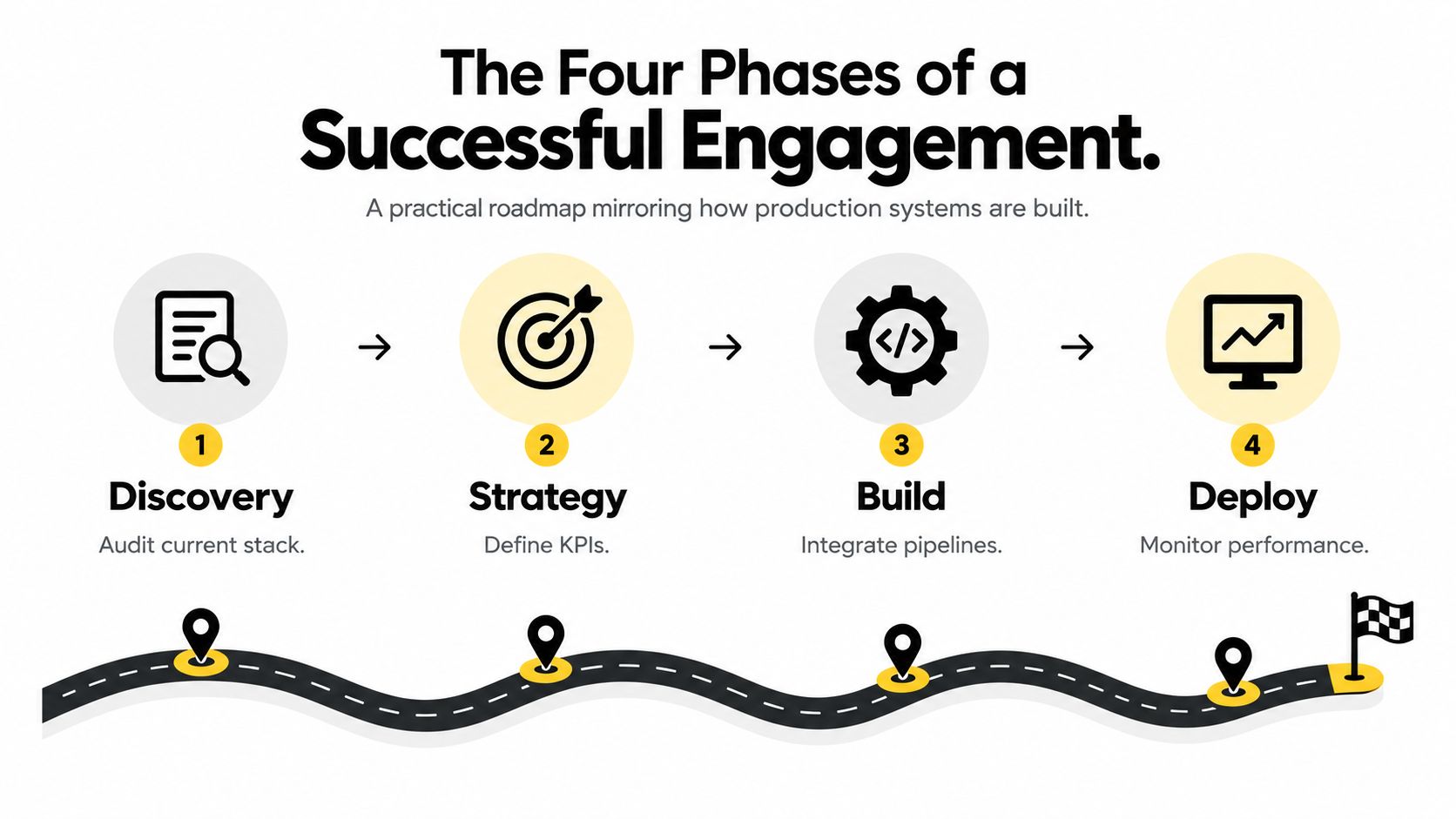
A successful AI pilot proves a workflow can work. Production implementation proves the business can run it repeatedly, safely, and across connected systems. Treat the engagement as four coordinated phases: discovery and readiness, controlled pilot build, production deployment, and scale with governance. Keeping these phases distinct exposes missing work before it becomes a budget problem.
Phase one, discovery and readiness
Start with the current workflow. Map the path from trigger to outcome, identify systems and data sources, interview users, document decision points, and record failure modes.
Require clear answers to these questions:
- Which task consumes the most repetitive human effort?
- Where do delays, rework, or inconsistent decisions occur?
- What data does the process rely on?
- Which steps require human judgment?
- What must never happen automatically?
- Which metric represents business value?
The deliverables should include a workflow map, data and integration assessment, risk register, success criteria, and ranked use-case backlog. A model demonstration is not a substitute for this work. Choosing the model first usually leaves the business with a convincing prototype and no operating plan.
Phase two, controlled pilot build
Build the pilot around one narrow workflow and controlled conditions. Its job is to test output quality, user behavior, data access, and the handoffs required for production.
Define the input, expected output, review process, test set, failure handling, and continuation rule before development starts. A sales-enablement pilot, for example, could generate account briefs from approved CRM and public company information, with a salesperson reviewing every brief before it enters a customer-facing process.
Keep the pilot small enough to diagnose. Adding departments, tools, and autonomous actions too early makes failures hard to trace and encourages teams to mistake activity for validation. The pilot should also document what remains unresolved, because those gaps become the production backlog.
Phase three, production deployment
Production introduces the work that pilots often avoid. The system must connect to live applications, enforce authentication and permissions, protect sensitive information, manage latency and operating costs, and create logs that explain each significant action.
Expect data pipelines, integration engineering, automated testing, security review, monitoring, incident response, documentation, and user training. A strong sandbox answer does not prove that the workflow can handle real volume, changing data, incomplete inputs, or service interruptions. Assign owners for each dependency before launch, not after the first incident.
Phase four, scale and governance
Scaling requires operating standards, not copied prompts. Set rules for model changes, access controls, human review, documentation, quality checks, and ownership across teams.
Create a governance cadence with named owners. Review output quality, exceptions, user feedback, system changes, and business outcomes. For agentic workflows, use scoped permissions and explicit tool boundaries. The system should take only the actions it needs, while every consequential action has an accountable human owner. That discipline closes the gap between a successful pilot and an AI workflow the business can operate at scale.
Understanding Pricing Models and Real Costs
AI budgets become clearer when you separate the pilot from the operating system required to run it. Enterprise GenAI programs can require substantial first-year investment, including managed operations. That benchmark applies to enterprise programs, not every small automation project, but it points to the main cost reality: production deployment usually costs more than the pilot.
Integration engineering, security and compliance hardening, MLOps, monitoring, support, and governance drive the bill. A pilot can stay inexpensive because it avoids live-system constraints. Production must resolve permissions, data handling, failure recovery, ownership, and performance.
What you're paying for
A proposal should show costs across the full lifecycle:
- Discovery: Workflow analysis, technical assessment, data review, prioritization, and implementation planning.
- Pilot: Prototype development, evaluation, user testing, and controlled integration.
- Deployment: Engineering, security review, permissions, testing, documentation, and rollout.
- Operations: Monitoring, incident handling, model or prompt updates, reporting, and ongoing optimization.
The gap between a successful pilot and an operational workflow often drives unexpected spending. Budget for the integrations, controls, documentation, and support needed to move beyond a contained demonstration.
A fixed project fee works when the workflow and deliverables are well defined. It provides budget clarity, but change requests and unlisted integrations can create friction. Require a written definition of scope and a process for approving additions.
A retainer suits businesses that need continuous optimization, support, and governance after launch. It provides continuity only when the agreement defines service levels, response expectations, reporting, and included work.
Time and materials fits a technical environment with unresolved unknowns. It gives the delivery team room to investigate, while the buyer should set a spending cap, require weekly progress reporting, and agree on acceptance criteria.
| Pricing Model | Best For | Typical Scope |
|---|---|---|
| Fixed fee | A defined workflow with stable requirements | Readiness assessment, pilot, or specified deployment |
| Retainer | Ongoing optimization and operational support | Monitoring, improvements, governance, and assistance |
| Time and materials | Complex environments with unresolved technical unknowns | Discovery, integration engineering, testing, and rollout |
Ask for a cost breakdown by phase, assumptions about existing systems, excluded work, third-party software costs, security responsibilities, and post-launch support. Use a cost-benefit analysis framework to connect investment with reduced manual work, faster cycle times, better decision consistency, or increased capacity.
Don't compare proposals by headline price. Compare the production risk each proposal leaves with your team.
How to Choose the Right Implementation Partner
The right partner doesn't merely know how to call an AI API. They understand the workflow that surrounds the API, the people who rely on it, and the controls that keep it from creating operational risk.

Start by asking for a walkthrough of a comparable production system. You don't need confidential customer details. You do need to see how the partner handled integration, authentication, exceptions, monitoring, user permissions, documentation, and ownership after launch.
Compare execution capability, not presentation quality
| Evaluation area | Weak signal | Strong signal |
|---|---|---|
| Business understanding | A list of generic AI use cases | A mapped workflow with measurable acceptance criteria |
| Technical delivery | Model recommendations | Integration, testing, deployment, and monitoring plan |
| Governance | General claims about responsible AI | Specific approval paths, logs, permissions, and escalation rules |
| Adoption | One training session | Role-based rollout, feedback loops, and process ownership |
| Post-launch support | A handoff document | Named owners, service expectations, and improvement cadence |
Ask direct questions during interviews:
- Which workflow would you refuse to automate first, and why?
- How do you test output quality before live deployment?
- What happens when the model is wrong, unavailable, or given incomplete data?
- How do you restrict an agent's access to tools and records?
- What will our internal team own after the engagement?
- What documentation will we receive?
- Which costs sit outside your proposal?
A partner focused mainly on prompts will talk about model capability. A production partner will talk about data contracts, fallback paths, review queues, system boundaries, and operational ownership.
The market is moving toward process engineering and controls design, not just model selection. That aligns with the broader implementation demand described in IBM's analysis of AI adoption challenges, which emphasizes the difficulty of moving from pilots to governed, repeatable workflows.
Use this video as a supplementary reference when assessing how a partner communicates implementation work and business alignment:
Why Most AI Projects Stall After the Pilot
The common diagnosis is wrong. Many leaders assume projects stall because the model isn't capable enough. In practice, teams often misunderstand the problem, optimize for the wrong metric, or place the model outside the workflow where decisions happen.
RAND's research on AI project failure identifies miscommunication about the problem, insufficient data, inadequate infrastructure, and excessive focus on technology instead of user outcomes as major failure factors. Better model quality can't rescue a system that solves the wrong problem.
The pilot removes the hardest constraints
A pilot often uses clean examples, cooperative users, limited permissions, and manual intervention from the project team. Production introduces incomplete records, contradictory instructions, changing business rules, privacy concerns, system outages, and users who don't follow the intended process.
That's why the pilot-to-production gap is primarily organizational and operational. Someone must decide who can approve an output, who handles an exception, who reviews a quality decline, and who is accountable when an automated action causes harm.
The central questions are simple:
- Who changed what? Record model, prompt, workflow, and permission changes.
- When did it change? Keep a reliable history of deployments and configuration updates.
- Why did it change? Connect changes to incidents, feedback, policy, or business requirements.
- Who approved it? Assign an accountable owner for consequential changes.
- What happens next? Define fallback and escalation paths before launch.
Build for workflow resilience
A production workflow needs boundaries. Give an AI system access only to the tools and data required for its task. Require human approval for sensitive actions. Separate drafting from sending, recommendation from execution, and classification from irreversible updates.
Data quality deserves its own workstream. Establish validation rules, source ownership, duplicate handling, freshness expectations, and a process for correcting bad records. A practical data quality assurance approach can prevent the team from mistaking unreliable inputs for model failure.
A pilot proves that AI can perform a task. Operationalization proves that the business can govern, maintain, and trust the task at scale.
How MakeAutomation Accelerates AI Implementations
The hardest AI implementation work starts after the pilot succeeds. A B2B team needs to turn a promising workflow into an owned operating process, with clear handoffs, reliable integrations, and controls that survive real exceptions.
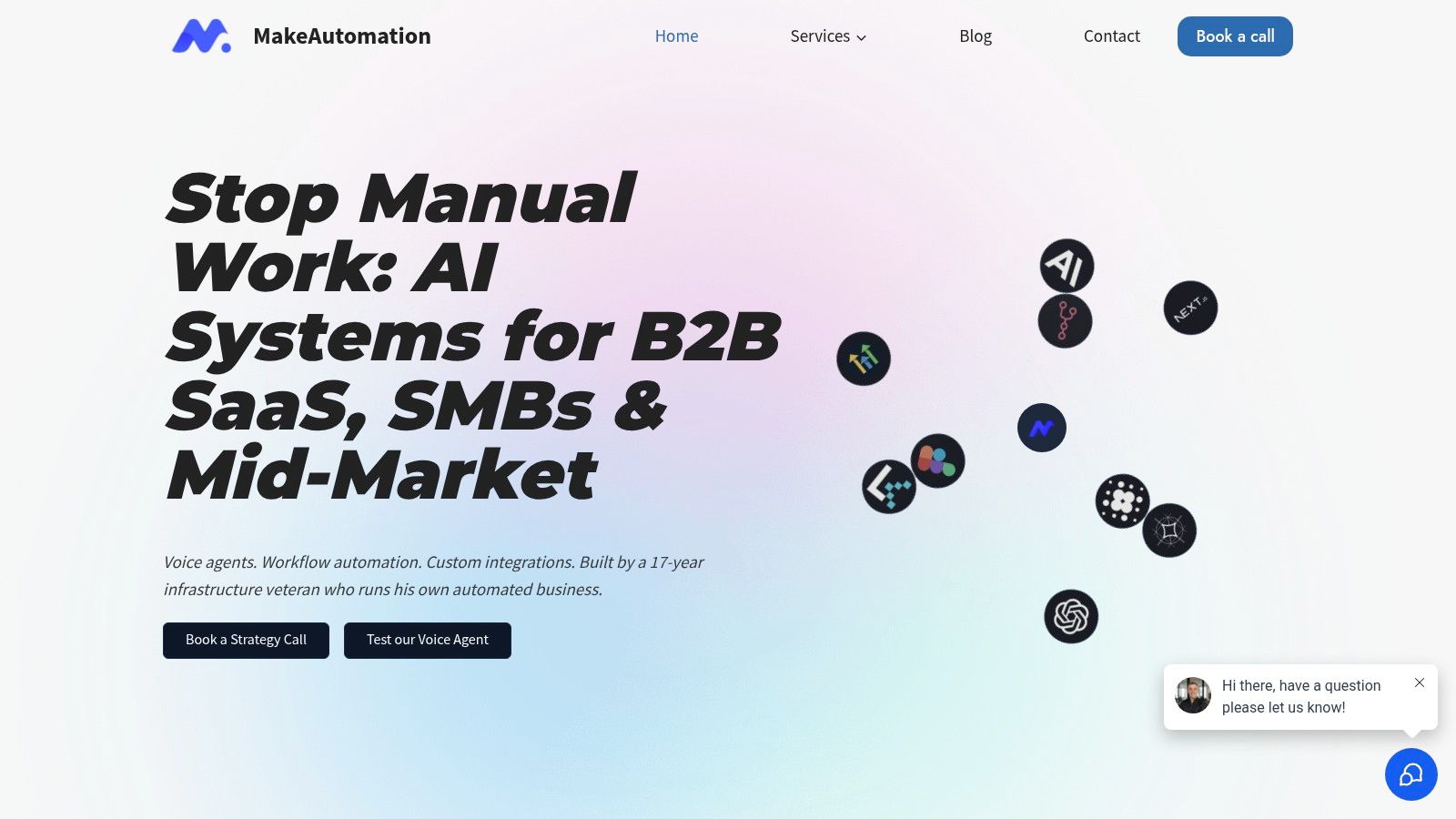
MakeAutomation is an AI and automation optimization specialist serving B2B and SaaS businesses. Its frameworks address lead generation, client outreach, project management, AI-supported operations, recruitment, CRM automation, and SOP development. The stated goal is to reduce manual workflows and support growth toward 7-figures, as described on MakeAutomation's website.
From scattered tools to an owned process
A SaaS company may hold lead information in forms, email, a CRM, meeting notes, and project documents. Adding a chatbot does not solve that fragmentation. The implementation must map each handoff, define the shared data structure, set qualification rules, connect approved actions to the existing stack, and show where staff intervene.
Recruitment requires the same operating discipline. AI can support intake, candidate organization, interview summaries, and communication drafts. Managers still need defined ownership, review rules, consistent records, and documented SOPs. Automation removes repetitive handling while keeping decisions accountable.
MakeAutomation provides hands-on implementation, process documentation, consultations, and workflow optimization. Its work can include AI automation and voice AI agents for inbound and outbound calls. Call routing, qualification, summaries, and follow-up actions must feed the company's operating process, rather than remain isolated experiments.
The practical recommendation is to operationalize one workflow first. Define the handoffs, connect the tools, test exception paths, document ownership, and measure reliability before expanding to another process. That sequence closes the gap between a successful pilot and repeatable business execution.
Turning AI Strategy Into Measurable Results
AI strategy produces business value only when a successful pilot becomes a governed workflow. Define the owner, success measure, failure response, data controls, and rollout path before expanding. That operating layer is the hidden bottleneck: teams can prove a use case, then stall when integration, approvals, adoption, and accountability span the full process.
MakeAutomation supports readiness reviews, process design, implementation, CRM and workflow automation, SOP development, and voice AI agent projects. For B2B and SaaS teams, its practical role is turning a promising pilot into documented execution, with clear next steps for the workflow that matters most.