
Recruitment Process Template: Build and Automate Hiring
Your hiring workflow probably looks finished in a document. There's a requisition form, a job description, an applicant tracker, interview slots, approval steps, and an onboarding handoff. Yet interviewers still ask different questions, hiring managers override scores with “gut feel,” candidates wait without updates, and nobody can explain whether the process identifies people who can do the work.
That's the implementation gap. A useful recruitment process template must standardize decisions, not just record activity. It should show what happens, who owns it, what evidence is required, how candidates are evaluated, when automation is allowed, and how the company checks whether hiring decisions hold up after the person joins.
Why Standardised Hiring Beats Administrative Checklists
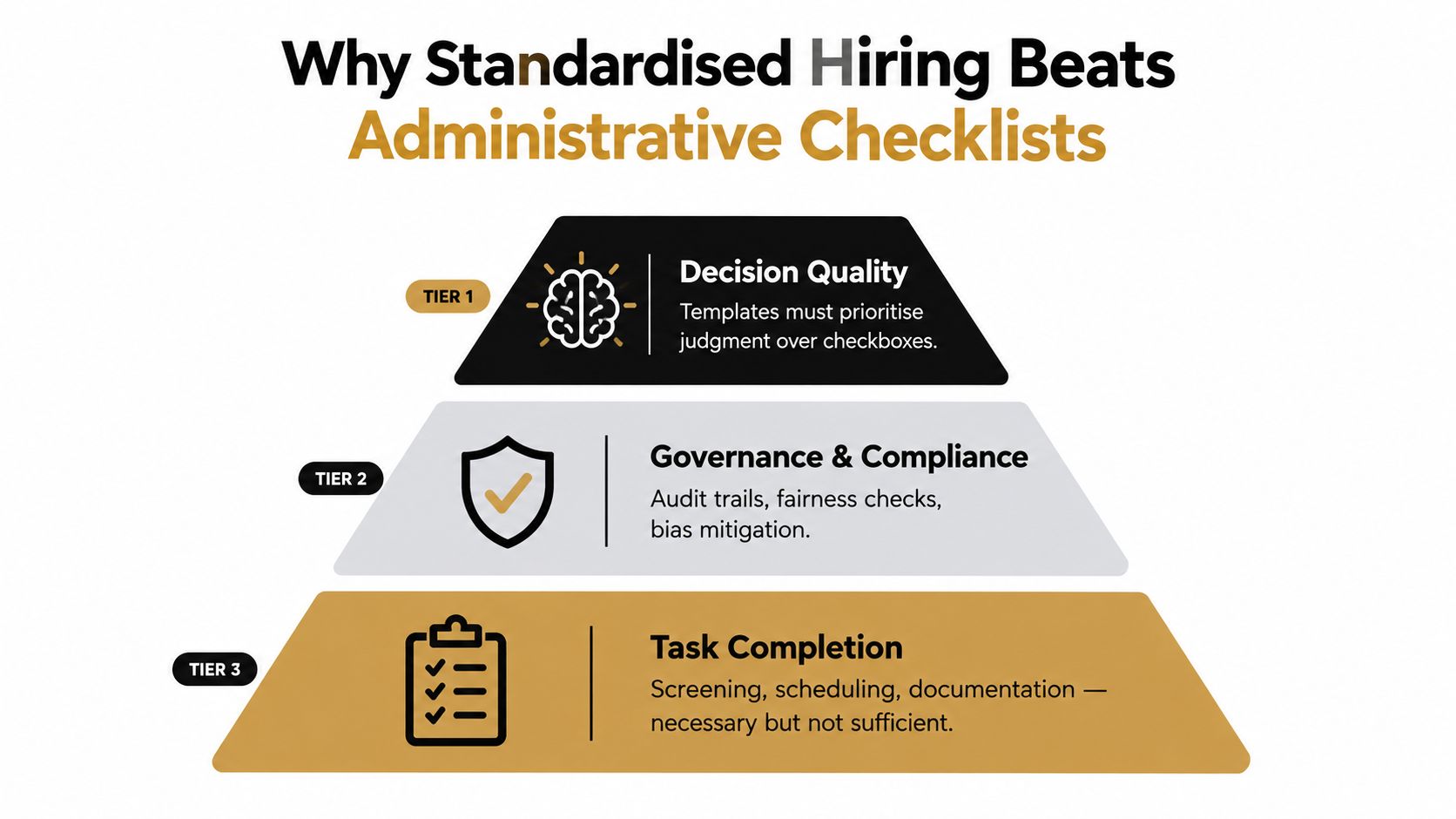
An administrative checklist answers, “Did someone complete the task?” A hiring system answers, “Did the team make a job-related decision using comparable evidence?” Those questions sound similar, but they produce very different workflows.
A checklist might record that a recruiter completed a phone screen and that three managers attended an interview. It won't show whether each candidate received the same questions, whether interviewers scored the same competencies, or whether the final decision rested on evidence rather than confidence and conversational chemistry. For a scaling B2B or SaaS company, that weakness becomes more visible as hiring expands across functions, locations, and interview panels.
Standardise the evaluation layer
The evidence for structured interviews is strong. A landmark 1998 meta-analysis by Frank Schmidt and John Hunter reviewed 85 years of personnel-selection research and compared 19 hiring methods. It reported average predictive validity of 0.51 for structured interviews, compared with 0.38 for unstructured interviews. Combining a structured interview with a general mental-ability measure produced a multiple validity of 0.63, as reported in the Schmidt and Hunter personnel-selection summary.
In practical terms, a structured interview uses the same job-related questions, sequence, rating criteria, and scoring rules for every candidate. That doesn't remove human judgment. It gives judgment a consistent frame, so the panel compares evidence rather than personality, fluency, or familiarity.
Practical rule: If two candidates are assessed against different questions and different standards, the process isn't genuinely comparable.
A strong template should therefore include a competency model, interviewer assignments, anchored scoring rubrics, independent notes, and a final decision matrix. It should also preserve the original scores before group discussion, because consensus can otherwise become a polite way for the most senior or persuasive interviewer to rewrite everyone else's assessment.
Track decisions, not just tasks
The same principle applies to process standardization more broadly. A process standardization framework is useful when it defines the conditions for a reliable decision, not when it just adds more checkboxes.
For each evaluation stage, record:
- Competency: The job-related capability being assessed.
- Evidence: The answer, work sample, or observed behaviour supporting the rating.
- Score: A defined rating with behavioural anchors.
- Owner: The person responsible for the assessment.
- Decision rule: The threshold or combination of scores required to progress.
This design makes the hiring record more defensible and helps new interviewers reach the same operating standard as experienced ones. It also makes automation safer, because software can move candidates, send reminders, and assemble evidence without becoming the decision-maker.
The result isn't a guarantee that every hire will succeed. It's a repeatable method for improving selection quality while preserving a clear record of how the company reached its conclusion.
Designing a Multi-Gate Recruitment Workflow
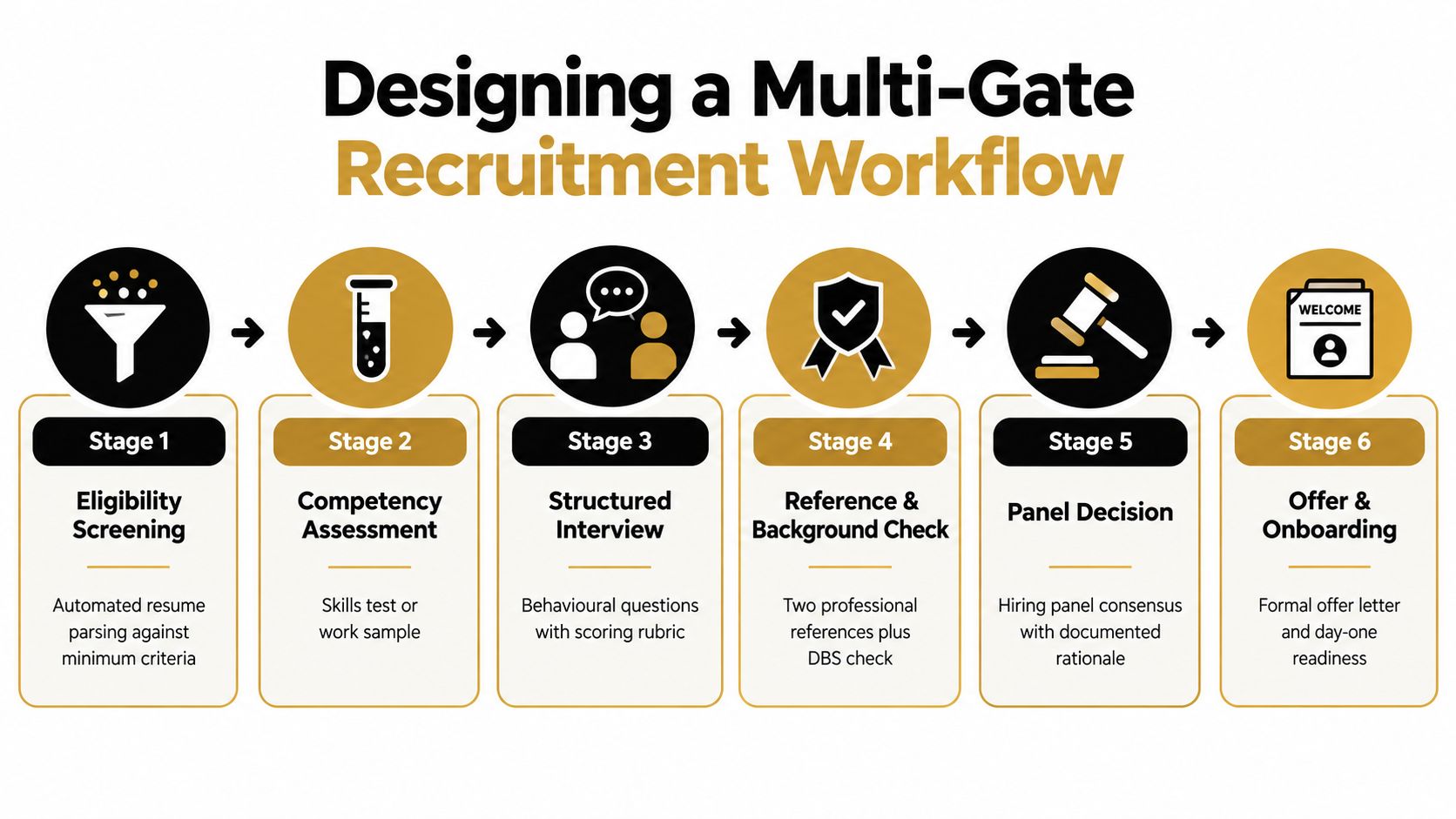
A reliable workflow separates eligibility from qualification, qualification from assessment, and assessment from selection. The U.S. Department of Labor describes a process where human-resources specialists first screen applications for basic eligibility, rate applicants against additional qualifications, and forward the strongest applications to a hiring manager for final selection. Its guidance also explains that interviews measure competencies important to job performance and that applicants may need to provide supporting evidence, as described in the Department of Labor application guidance.
That structure translates well to a growing company because every gate can have a named owner, required evidence, and a service-level target.
Build the gates around evidence
| Gate | Primary owner | Required evidence |
|---|---|---|
| Requisition and role definition | Hiring manager and finance | Approved headcount, role mission, competencies, and job description |
| Eligibility screening | Recruiter or HR | Minimum criteria and documented eligibility decision |
| Qualification assessment | Recruiter and hiring manager | Competency scores, work sample, or technical assessment |
| Structured interview | Assigned interview panel | Independent notes and anchored ratings |
| Verification and selection | HR and hiring manager | Reference or background evidence, decision matrix, approval |
| Offer and onboarding handoff | HR and hiring manager | Approved offer, candidate communication, onboarding owner |
Don't treat these as rigid bureaucracy. They're control points that prevent common failures, such as opening a role before the manager and finance team agree on scope, or moving a candidate into interviews without deciding what capability the interview is meant to test.
Administrative work belongs inside the workflow, but it shouldn't replace judgment. Status updates, interview scheduling, reminders, document collection, and onboarding notifications are good automation candidates. Qualification judgments, accommodations, disputed records, and final selection require accountable human ownership.
Give every stage a service target
A stage without a time expectation becomes a queue. Define how quickly the recruiter reviews an application, how long the hiring manager has to return a score, when the panel meets, and how soon the candidate receives an update. The exact target should vary by role and market, but every target needs an owner and an escalation path.
Candidate communication also forms part of the workflow design. Clear role information and predictable updates support employer branding for small businesses, because candidates experience the process as evidence of how the company operates.
Use an HR automation workflow to send confirmations, assign tasks, notify owners when a gate is overdue, and create the onboarding handoff. A recruitment automation process should never obscure who made the evaluative decision or why the candidate progressed.
Structuring Competency-Based Interviews and Scoring
A structured interview works when the template turns abstract competencies into observable evidence. “Leadership,” “communication,” and “strategic thinking” are too broad to score consistently until the team defines what those capabilities look like in the role.
Start with the work, then build the interview around it. For a sales operations hire, that might mean pipeline analysis and forecast judgment. For an engineer, it could involve incident-response planning. For customer success, it may be a customer-escalation exercise. The assessment should resemble the decisions and constraints the person will face after joining.
A large meta-analytic review covering 245 validity coefficients and 86,311 individuals found corrected validity for job performance of approximately 0.63 for structured interviews versus 0.20 for unstructured interviews. Structured board interviews using consensus ratings reached approximately 0.64, according to the meta-analysis of interview validity.
Use a six-part interview protocol
- Define competencies and indicators. Write the capability in job-related terms and list the behaviours that demonstrate it.
- Create identical questions. Use behaviourally anchored questions tied to the same competency for every candidate.
- Assign domains. Give each interviewer responsibility for specific competencies instead of allowing everyone to assess everything.
- Score independently. Require each interviewer to submit a rating before the panel discussion begins.
- Record evidence. Notes should describe what the candidate did, decided, or produced, not whether the interviewer liked the conversation.
- Apply the decision rule. Predeclare the minimum score, critical competency threshold, or weighted combination required to progress.
Teams that need examples can use a resource on competency-based interview questions as a starting point, then adapt the questions to their own job analysis. Copying generic questions without defining the expected evidence only creates the appearance of structure.
Prevent the panel from diluting the system
The most common failure is a hybrid interview. The team begins with standardized questions, then adds informal prompts, changes the sequence for one candidate, and finishes with a broad discussion about “fit.” That approach preserves the weaknesses of an unstructured interview while adding more administration.
Other failures are predictable:
- Dominant interviewer: One senior person controls the conclusion. Require independent scores and a written rationale for overrides.
- Personality scoring: Interviewers rate confidence or warmth instead of job evidence. Keep each rating tied to an observable indicator.
- Prestige substitution: A famous employer or impressive résumé replaces proof of capability. Use work samples to test the relevant skill.
- Uncalibrated rubrics: Interviewers interpret a score differently. Review sample answers and agree what weak, acceptable, and strong evidence looks like before interviews begin.
Tools for AI resume screening can help organize applications, but they shouldn't decide which competencies matter. The hiring team must define the assessment logic first, then use software to reduce administrative load around it.
Tracking Funnel Velocity and Conversion Metrics
A hiring funnel leaks in two ways. Candidates can leave because the process is slow or confusing, and the company can advance people who don't meet the role requirements. Measuring only total applicants hides both problems.
Track stage counts and elapsed time from approved requisition through offer acceptance. Useful formulas include:
- Screen rate: screened applicants ÷ applicants
- Interview-to-offer rate: offers ÷ final interviews
- Offer-acceptance rate: accepted offers ÷ offers
- Time-to-hire: accepted-offer date minus application or requisition date
- Application abandonment: candidates who begin a form but don't submit it, expressed as a percentage of form starters
These measures answer different operational questions. A low screen rate may indicate weak sourcing or unclear requirements. High abandonment can point to excessive form length, technical friction, unclear instructions, or unnecessary data collection. A low offer-acceptance rate may reflect compensation, process delays, or poor role communication.
Interpret benchmarks carefully
External benchmark reporting cited an average time-to-hire of 41 days in 2024, up from 33 days in 2021, and about 20 interviews per hire in 2026, compared with 14 in 2021, as reported in Workable's candidate experience metrics guidance. Those figures are directional, not universal. Role type, geography, seniority, and labour-market conditions can change the baseline substantially.
The useful comparison is internal. Set targets by job family, then compare actual performance against the agreed service level. A senior engineering search and an entry-level operations role shouldn't share an identical cycle-time target just because they appear in the same dashboard.
Review leakage as an operating rhythm
Review the funnel weekly while a role is active. Look for candidates stuck between recruiter screening and hiring-manager review, interviews waiting for notes, and offers waiting for approval. Every breach should have a named owner and corrective action, such as adding interview capacity, clarifying a rubric, removing a redundant gate, or fixing an application form.
Velocity also affects candidate trust. Fast scheduling won't compensate for unclear evaluation, but a well-designed process loses credibility when candidates receive silence after completing a work sample or panel interview. Treat every delay as both an operational defect and a candidate-experience signal.
Closing the Skills-Based Hiring Implementation Gap
Many companies claim to use skills-based hiring while leaving the résumé as the main gatekeeper. That isn't a minor inconsistency. It means the organization has changed the language of the process without changing the evidence used to make decisions.
The available data shows the gap clearly. Eighty-five percent of surveyed employers said they used skills-based hiring in 2025, yet 67% still used résumés as a screening tool, down from 73% in 2024, according to the 2025 state of skills-based hiring report. In the United States, 19.3% of job postings required a bachelor's degree in November 2025, up from 17.6% in October 2024, according to the same report.
Replace declarations with proof
Removing a degree requirement doesn't automatically remove subjective screening. The team may instead shift its preference toward prestige, familiar employers, polished communication, or an unrecorded sense that someone “looks like a fit.”
A practical proof-of-skill layer contains five components:
- Competency definitions: Explain the capability in terms of work outcomes.
- Job-relevant simulations: Ask candidates to solve a realistic problem.
- Scoring anchors: Describe what weak, adequate, and strong evidence looks like.
- Decision thresholds: Set the minimum required evidence before reviewing background signals.
- Post-hire validation: Compare assessment results with actual performance during a defined review period.
For a SaaS account executive, the work sample might involve pipeline prioritization and a customer scenario. For a technical support candidate, it could test troubleshooting and written explanation. For an operations manager, it might involve designing a response to a process failure. The sample doesn't need to imitate the entire job. It needs to reveal a capability that matters to successful performance.
Audit whether decisions changed
The most useful audit asks what happened to candidates who would previously have been filtered out. Track which evidence caused progression, which criteria caused rejection, and whether résumé or degree signals overruled stronger work-sample results.
Recent research found that fewer than one in 700 new hires at firms publicly dropping degree requirements were workers without bachelor's degrees, as reported in the skills-based hiring research cited above. That finding doesn't prove that every employer failed, but it does show why policy announcements aren't enough.
Teams exploring recruiting with skills assessments should connect assessments to job outcomes rather than add another generic test. Review the assessment design after hires have had time to demonstrate their work, compare scores with early performance evidence, and remove exercises that don't predict anything useful. Skills-based hiring becomes real when the selection record shows that demonstrated capability can outweigh résumé convention.
Adding Governance and Candidate Experience to Automation
Automation can make a hiring process faster, but speed magnifies whatever logic the team already uses. If the screening rule is weak, automation applies it more consistently. If the process is opaque, automation gives candidates fewer opportunities to understand or challenge the outcome.
A trustworthy recruitment process template adds governance beside every automated action. It distinguishes administrative automation, such as scheduling or reminders, from evaluative automation, such as ranking candidates or recommending rejection.

Map the automation before deploying it
Create an inventory with one row for every automated step:
- Action: What the system does.
- Input: Which candidate data it uses.
- Classification: Administrative or evaluative.
- Human owner: Who remains accountable.
- Escalation path: What happens when the result looks wrong.
- Audit record: What the system stores, including overrides.
- Candidate notice: What the applicant is told and when.
A scheduling bot can usually operate with limited risk if candidates can reach a human and request an accommodation. A résumé-ranking model requires much stricter review because it may exclude a person before an accountable reviewer examines the evidence. Consequential recommendations should receive human review, and the original automated result should remain visible when a reviewer overrides it.
Design for errors and different jurisdictions
Global B2B and SaaS employers can't assume one workflow fits every candidate. Privacy, employment, accessibility, and transparency expectations vary across jurisdictions, so the template should identify where local review is required rather than hiding those differences in a single global automation rule.
Candidate experience needs explicit controls:
- Disclosure: Tell candidates when automation materially affects their application.
- Accessibility: Provide a non-automated route or accommodation process.
- Human escalation: Offer a clear way to request review.
- Data retention: Define what is stored, for how long, and who can access it.
- Bias monitoring: Review funnel outcomes by legally appropriate demographic or proxy-risk categories.
- Decision explanation: Give candidates understandable process information without exposing sensitive controls.
Skills-based hiring adoption rose to 70% for entry-level roles in NACE's 2026 employer survey, while résumé use and degree requirements remained widespread, according to the reported skills-based hiring statistics. That combination reinforces the central operating question: does automation test a valid assessment, or does it just accelerate an old filter?
MakeAutomation can help B2B and SaaS teams document recruitment stages, assign owners, automate administrative handoffs, and connect the workflow to repeatable operating procedures. Use it alongside a defined competency model, human review controls, and post-hire checks, not as a substitute for them.
A practical next step is to map your current hiring flow, mark every decision that relies on intuition, and replace each one with defined evidence, ownership, and an escalation rule. If you want support turning that map into an automated recruitment workflow with documented stages, scoring logic, and governance controls, visit MakeAutomation to discuss the process with its automation specialists.