
Lead Generation CRM: A Complete Comparison Guide
A lead generation CRM should respond immediately, but speed alone doesn't guarantee revenue. A 2025 survey reported a 32% close rate for responses within five minutes, compared with 15% when prospects waited up to 24 hours.
That result sounds like a clear argument for the fastest possible response-time SLA. It isn't. A CRM that routes every form fill to the nearest sales representative may create instant activity while flooding sellers with poor-fit contacts, duplicate records, and incomplete context. The operational question is more demanding: can your system acknowledge demand quickly, qualify it accurately, assign it intelligently, and preserve the evidence needed to measure revenue?
The strongest lead generation CRM implementations treat the platform as infrastructure, not an address book. They connect marketing sources, enrichment, sales activity, qualification, follow-up, and attribution in one controlled workflow. This guide compares the major CRM architectures and shows how B2B and SaaS teams can balance response speed with routing quality.
Understanding Lead Generation CRM Priorities
The evidence for fast follow-up is compelling. A Harvard Business Review study published in 2011 found that companies contacting a prospect within one hour were nearly seven times more likely to achieve a meaningful conversation with a decision-maker than companies waiting an additional hour. A related analysis of 939 B2B companies reported a 32% close rate for responses within five minutes, compared with 15% when the response took up to 24 hours. The figures are summarized in this analysis of speed-to-lead performance.
That doesn't mean every lead deserves an instant sales call. It means the organization must remove avoidable delay between a real buying signal and a useful response. A confirmation email, accurate owner assignment, relevant content, and a clear escalation path can all contribute to that outcome. The CRM's job is to coordinate those actions without confusing activity with qualification.

Speed is an input, not the outcome
A useful lead generation CRM should answer five operational questions:
- What happened? Capture the source, campaign, page, form, referral, and consent context.
- Who is this? Match the person to a company, account, territory, language, and existing relationship.
- What do they want? Separate a pricing request or demo inquiry from a low-intent download or general question.
- Who owns the next action? Assign the lead using rules that reflect account ownership, expertise, geography, and availability.
- What happened afterward? Record the response, qualification decision, meeting, opportunity, and outcome.
A system that only stores names and email addresses fails the last four questions. A system that sends immediate messages but loses source attribution creates a different problem. It may appear productive while making it impossible to determine which channels create qualified pipeline.
Practical rule: Set a fast acknowledgment SLA for every valid inquiry, but set a separate qualification SLA for leads that meet your buying criteria.
This distinction matters for global B2B teams. A prospect in one time zone may need a local-language response, an account executive with industry expertise, or an after-hours voice agent. Sending the wrong person quickly can be worse than sending the right person after a short enrichment step.
Your CRM should therefore reduce the delay to meaningful engagement, not merely the delay to any engagement. That principle should shape the lead generation funnel, from capture through qualification and opportunity creation.
Building a CRM Data and Workflow Foundation
Software selection comes after process design. If the underlying records are incomplete or contradictory, automation only moves bad information faster and gives it more authority.
Start with a controlled lead record. Every inbound contact should carry immutable source attribution, campaign and landing-page identifiers, consent status, lifecycle-stage history, and deduplication keys. Activity records should synchronize across forms, email, telephony, advertising, and calendar systems. These requirements are also outlined in this technical guide to speed-to-lead architecture.
Define the record before the workflow
A practical foundation includes:
- Identity fields: Normalize email and phone values, then use company and identity attributes to support secondary matching.
- Acquisition fields: Preserve the original source, campaign, landing page, referral context, and later campaign touches.
- Compliance fields: Store consent status, communication preferences, and the basis for permissible outreach.
- Lifecycle fields: Record every movement from inquiry to qualification, opportunity, customer, or disqualification.
- Ownership fields: Track current owner, previous owner, territory, language, account relationship, and fallback assignment.
- Activity fields: Synchronize calls, emails, meetings, notes, sequences, and status changes.
Use deterministic matching on normalized email and phone values first. Apply probabilistic matching for company and identity fields only when the system can preserve an audit trail for merges and field changes. Never allow an automated merge to erase the original source or ownership history.
The practical test is simple. Every inbound lead should be created once, assigned to the correct owner, enrolled in the appropriate sequence, and excluded from duplicate or conflicting campaigns. If the system can't demonstrate those outcomes, predictive scoring and AI personalization are premature.
Measure the failure point
A global average hides the problem. Segment operational metrics by acquisition channel, geography, company size, and lead score. A useful dashboard should include:
- Duplicate rate
- Enrichment completion rate
- Routing-error rate
- Time-to-first-touch
- Sequence enrollment latency
- Meeting-booked rate
- Marketing-qualified-to-sales-qualified conversion
- Pipeline value per source
These metrics turn CRM troubleshooting into diagnosis. A high routing-error rate points to ownership logic. Slow sequence enrollment points to workflow or integration latency. Weak meeting conversion may indicate poor qualification, weak messaging, or low-quality acquisition sources.
The CRM should make a bad result explainable. If nobody can tell whether the problem began in data capture, scoring, routing, or rep execution, the workflow isn't operationally mature.
Enrichment deserves the same discipline. Use CRM data enrichment to fill relevant gaps, but set confidence thresholds and preserve the original values. Enrichment should improve routing and personalization, not overwrite facts that sales teams rely on.
Designing Intelligent Lead Routing Systems
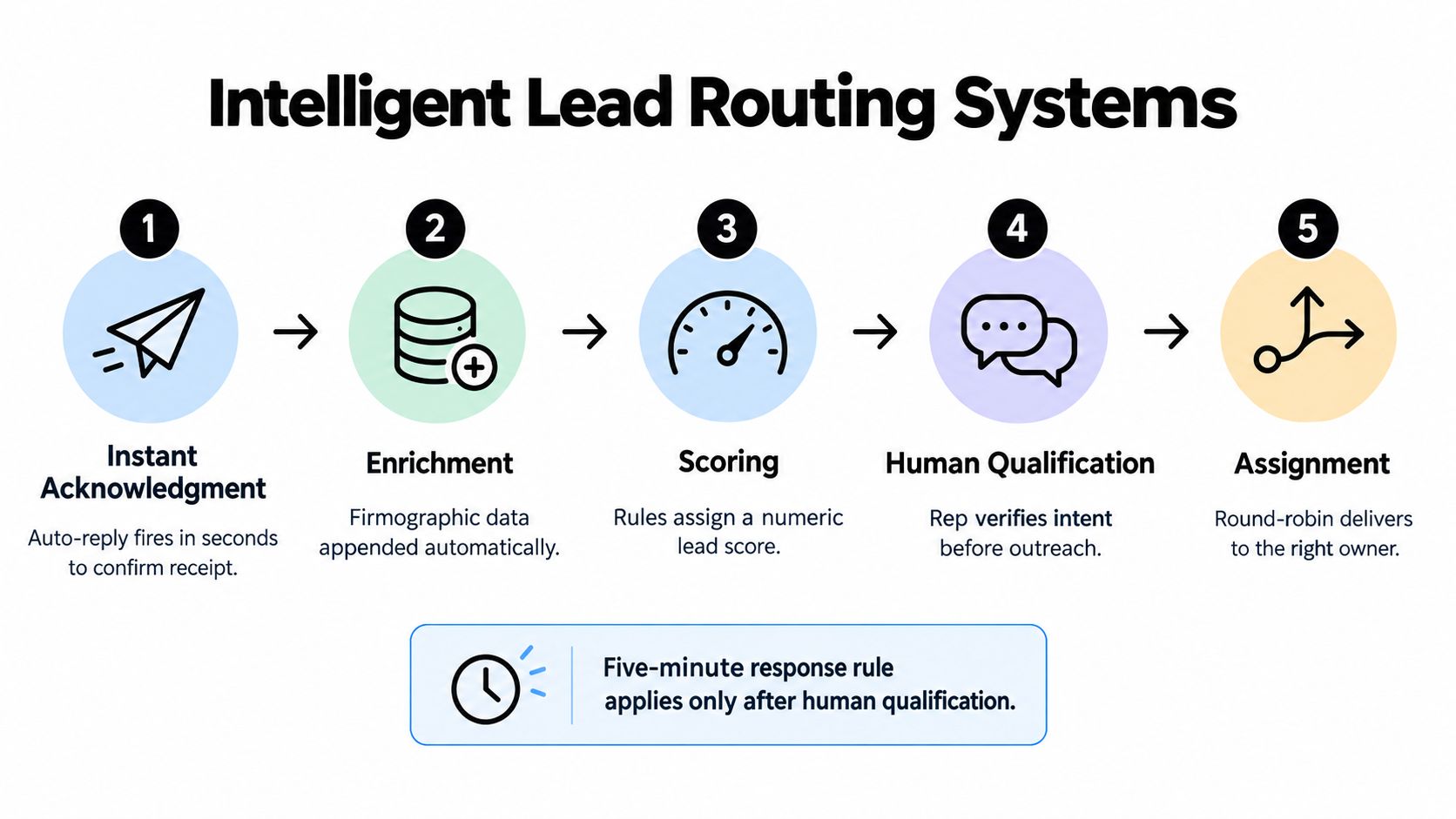
The five-minute rule is useful only after the system understands what it has received. The same form submission can represent a purchase-ready account, a student researching a category, an existing customer asking for support, or a competitor testing a message. Routing all of them directly to sales turns response speed into capacity waste.
A 2025 survey of 939 B2B companies reported a 32% close rate when responses arrived within five minutes, compared with 15% when prospects waited up to 24 hours. Industry summaries also cite an average B2B response time of approximately 42 hours, with 38% of leads receiving no reply. Those figures support urgent process improvement, but they don't prove that every lead should receive the same human response. The underlying comparison is documented in this lead response-time analysis.
Separate acknowledgment from qualification
A routing design has two tracks. The first confirms receipt quickly and gives the prospect a clear next step. The second establishes whether the contact merits human sales capacity and identifies the correct person to handle it.
Use the following sequence:
- Acknowledge immediately. Confirm that the request arrived and provide useful expectations.
- Enrich the record. Append firmographic, account, territory, language, and existing relationship data.
- Score against explicit rules. Combine fit, intent, account status, and engagement instead of relying on a single activity.
- Qualify the buying context. Ask or infer whether the prospect has a relevant need, authority, timing, and use case.
- Assign and escalate. Route to the right owner, with a fallback path for unavailable teams or uncertain AI outcomes.
The visual workflow above correctly treats the five-minute response as a post-qualification standard, not a universal instruction. That matters because a fast, poorly matched handoff can reduce seller trust in the CRM. Once representatives learn that automated alerts contain noise, they stop treating the alerts as urgent.
Design for global coverage
Global routing needs more than a round-robin queue. Build rules for:
- Account ownership: Existing customers and named accounts should bypass generic distribution.
- Territory: Use the prospect's company and operating location, not only the form's country field.
- Language: Route based on requested language and representative capability.
- Business hours: Define who handles inquiries during local working hours and who covers after-hours demand.
- Fallback ownership: Send unresolved or unassigned leads to a named operations queue.
- AI escalation: Transfer to a human when the agent cannot establish intent, fit, or consent.
Track qualified-opportunity rate, meeting-show rate, and revenue per routed lead alongside first-response time. Speed is a leading indicator. Revenue quality is the decision metric. Optimizing the first while ignoring the second can maximize an intermediate result and weaken the pipeline.
Comparing CRM Architectures for Lead Generation
Your CRM architecture decides whether lead routing produces pipeline or just more activity. Teams that obsess over speed-to-lead and ignore routing quality usually end up with noisier queues, lower seller trust, and weaker conversion. Choose the structure that protects ownership, preserves context, and supports the operating model you can reliably run.
Three architectures show up repeatedly in lead generation programs: traditional database-driven systems, automation-first platforms, and AI-integrated ecosystems. The categories matter because each one handles routing logic, exceptions, and cross-system coordination differently.
| CRM architecture | Strongest use case | Main operational advantage | Primary risk | Best fit |
|---|---|---|---|---|
| Traditional database-driven CRM | Structured pipeline and contact management | Reliable records, ownership, and lifecycle visibility | Manual workflows and disconnected tools | Teams standardizing a core sales process |
| Automation-first platform | High-volume capture, routing, and follow-up | Flexible workflows and fast orchestration | Poor logic can multiply duplicates and noise | Growth-stage B2B and SaaS teams |
| AI-integrated ecosystem | Conversational qualification and predictive prioritization | Voice agents, recommendations, and adaptive engagement | Bad data can compound through automated decisions | Teams with mature governance and clear escalation rules |
Traditional systems favor control
A traditional CRM is the right starting point when the actual problem is record disorder. It gives sales and marketing one pipeline, one ownership model, and one set of lifecycle stages. If your team still argues about what counts as a lead, qualified lead, opportunity, or customer, fix that before adding more automation.
Control has a cost. Traditional systems usually struggle when lead generation depends on multiple tools acting in sequence. Forms, advertising platforms, email, telephony, and enrichment can all feed the CRM, but the database alone does not coordinate the next action well. You can have clean records and still miss the right handoff.
Automation-first systems favor execution
Automation-first platforms work best after you have clear rules. They can create records from forms, trigger enrichment, assign owners, start sequences, and sync activity across systems with less manual work. That makes them attractive for growth teams handling larger lead volume and more routing paths.
They also fail fast when the operating model is vague. If duplicate management, consent handling, exclusions, account matching, and ownership rules are still unsettled, the platform will automate the confusion. The result looks productive in dashboards. In practice, it creates duplicate alerts, conflicting outreach, and a queue full of leads that should never have reached sales.
This matters even more for global teams. A blanket response-time SLA sounds disciplined, but it often pushes leads into the wrong hands just to satisfy a clock. Faster acknowledgment is useful. Faster misrouting is expensive. Systems built around real-time data processing help only when event history is preserved and routing decisions use the full account context, not a single form submission.
AI ecosystems favor scale with oversight
AI-integrated CRMs add conversational qualification, next-step recommendations, account prioritization, and voice-agent coverage. They are a strong fit for teams that need broader coverage across time zones or want to reduce repetitive qualification work without expanding headcount.
The governance burden is much higher. An AI agent can apply the wrong rule consistently, misread ambiguous intent, or send an existing customer through a new-lead path. Those errors do not stay isolated. They repeat at system speed. Use confidence thresholds, human review, explicit escalation rules, and complete interaction logging. AI should extend a process that already works under pressure. It should not be the architecture that hides operational confusion.
Real-World Scenarios for CRM Implementation
A lead generation CRM fails in ordinary ways. The breakdown usually starts when a company automates intake before it settles ownership, qualification, and routing rules.
Consider a growth-stage B2B SaaS team that connected website forms, ad platforms, an enrichment tool, email software, and the sales CRM because inquiries were slipping through the cracks. Activity increased as soon as the setup went live. Contacts entered sequences, alerts hit seller queues, and dashboard activity looked healthy. Revenue operations got harder, not easier.
The problems were operational. Existing accounts were recreated as new leads. One person could submit through multiple campaigns and trigger conflicting messages. Some records arrived without enough company context to assign territory correctly. The team had optimized for speed-to-lead, but speed exposed weak routing architecture. For global teams, that matters more than a universal response clock. Fast acknowledgment helps. Fast misrouting hands a qualified buyer to the wrong rep, creates cleanup work, and slows the core sales motion.
Leadership responded the way many teams do. They added more automation. More sequences fired on uncertain records. Reps spent time checking ownership, fixing duplicates, and sorting queue noise instead of working qualified opportunities.
The operating model changed first
The turnaround started only after the company stopped launching new workflows and set hard operating rules:
- Response-time SLA: Every valid inquiry received a quick acknowledgment. Human follow-up happened only after qualification and territory checks.
- Enrichment threshold: A record entered sales routing only when the required account and identity fields met the agreed confidence standard.
- Account matching: Existing customers and named accounts routed to the current owner, not a general queue.
- Fallback ownership: Unresolved records moved into a visible operations queue instead of disappearing inside an integration failure.
- Campaign exclusion: A lead already in an active sales sequence stayed out of conflicting nurture flows.
Then the company reviewed routing-error rate, duplicate rate, time-to-first-touch, qualified-opportunity rate, and pipeline value by source. That made root causes visible. The team could see whether the issue started in the form, enrichment step, routing logic, sequence design, or seller behavior.
Automation improved only after ownership rules and exception handling were clear.
That is the pattern worth paying attention to. CRM implementation problems rarely come from a missing feature. They come from vague definitions, conflicting systems, and teams that reward activity volume instead of qualified pipeline. Scale followed only after data governance became part of revenue operations, not a cleanup task left for later.
Selecting the Right Lead Generation CRM
Choose a CRM by testing its operating behavior, not by counting features. A polished interface, AI assistant, or long integration directory won't compensate for duplicate records, weak account matching, or invisible handoffs.
Begin with the buyer journey. Can the system connect anonymous activity, consented identity, account-level engagement, calls, email, partner referrals, and offline sales activity while preserving a trustworthy audit trail? Current guidance often underexplains this multi-touch attribution problem, as noted in this practical discussion of B2B lead-generation attribution.
Test the workflow before signing
Ask vendors to demonstrate these scenarios with your own fields and routing rules:
- Duplicate submission: The same person submits through different campaigns.
- Existing account: A known contact requests a new demo.
- Global assignment: A prospect's form language differs from the company's registered location.
- After-hours inquiry: A high-intent request arrives outside the assigned team's schedule.
- Uncertain qualification: An AI agent cannot establish buying intent.
- Attribution review: Several channels influence one opportunity before sales engagement.
- Human versus automated sequence: The team needs to compare assisted and automated handling without losing source history.
Require the vendor to show the audit trail, not just the final dashboard. You should be able to see when a field changed, why an owner changed, which sequence ran, and how the opportunity received attribution.
Buy for the next constraint
A traditional CRM may be sufficient if your immediate priority is record standardization. An automation-first platform makes more sense when your team has defined routing and needs coordinated execution. An AI-integrated ecosystem becomes appropriate when you can govern data quality, monitor agent outcomes, and provide reliable human escalation.
MakeAutomation is one implementation option for teams that need CRM workflow automation across lead creation, campaign engagement, lead scoring, routing, personalized follow-up, and activity logging. Compare it with your existing stack against the controls above rather than selecting it for automation volume alone.
Founders evaluating strategic support or capital can also find CRM investors for your startup while mapping the systems required to scale sales operations. Investment readiness doesn't replace workflow discipline, but a clear operating model makes the business easier to evaluate and improve.
The decisive question is simple: does the CRM create qualified revenue opportunities, or does it merely record activity around demand that already existed? Choose the platform that can answer that question with traceable data, controlled experiments, and downstream pipeline outcomes.
MakeAutomation helps B2B and SaaS teams connect lead capture, enrichment, routing, follow-up, CRM activity, and AI or voice-agent handoffs into a measurable operating system. Visit MakeAutomation to discuss a lead-generation workflow that improves response speed without sacrificing qualification quality or attribution.