B2B Lead Generation for SaaS: A Growth Playbook
Your dashboard says lead volume is up. Sales says the leads aren't a fit. The pipeline looks busy until you check how many opportunities came from those campaigns, and nobody can explain what buyers researched before they filled out a form.
That isn't a lead-volume problem. It's a system problem. Effective B2B lead generation for SaaS doesn't start and end with capturing contact details. It shapes buyer decisions before prospects identify themselves, then turns the strongest signals into relevant conversations.
Why Most SaaS Lead Gen Programs Stall Before They Scale
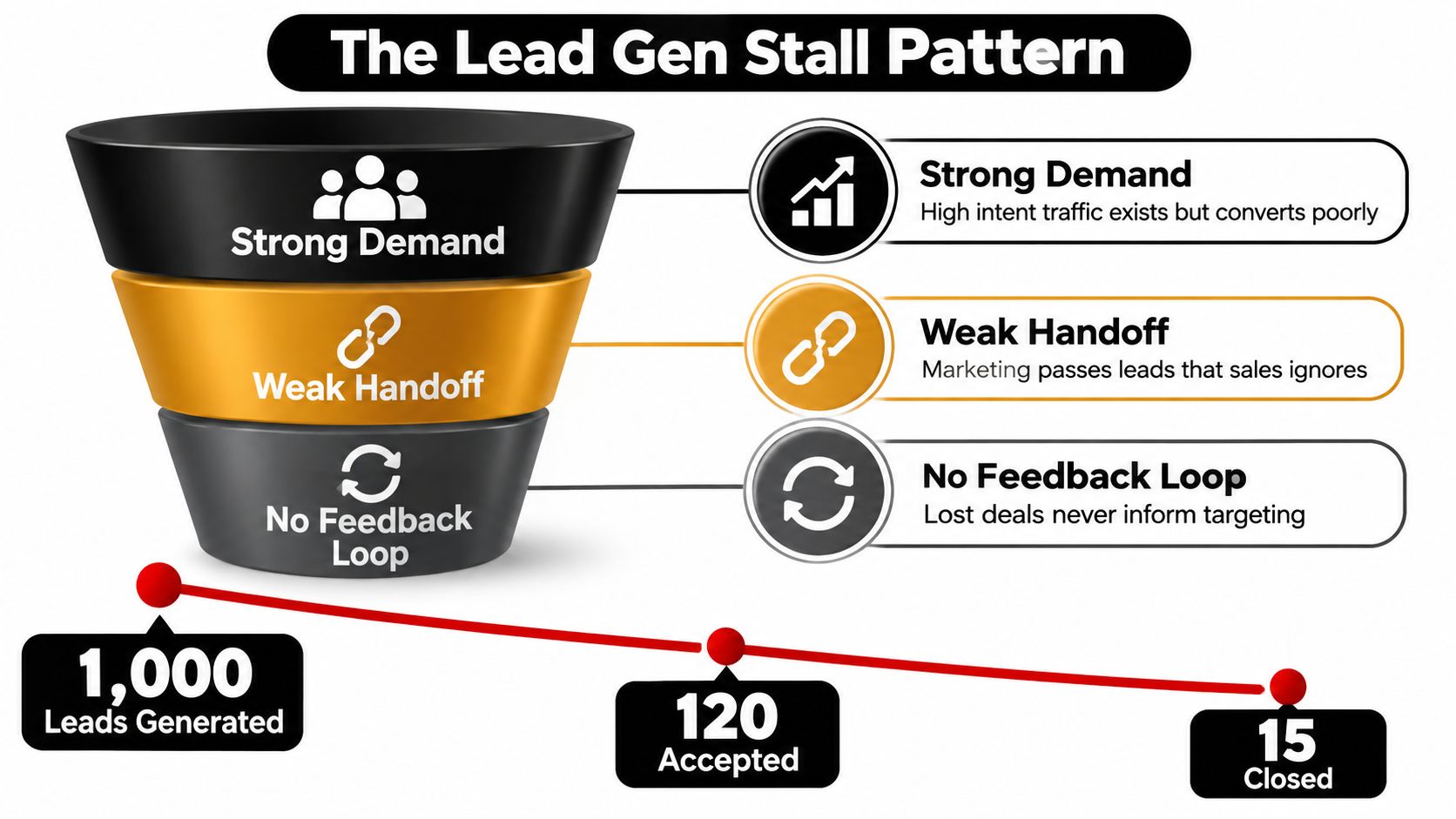
Growth-stage teams often mistake activity for progress. Marketing publishes content, runs ads, and sends leads to sales, but the handoff is weak: the lead doesn't match the ideal customer profile, the sales rep doesn't know why they came in, and the eventual loss never changes the next campaign.
A healthy pipeline works differently. Marketing and sales agree on who qualifies, the CRM records what happened at every stage, and the team uses conversion quality to adjust targeting. That matters in a large but competitive market. The global B2B SaaS market was estimated at roughly USD 390 billion in 2025, up from about USD 154 billion in 2020, with a projected 26.24% compound annual growth rate through 2031 (Mordor Intelligence's B2B SaaS market analysis). Opportunity is expanding, but more companies are competing for the same buyers.
Separate demand creation from lead capture
Lead capture is the identifiable moment: a form submission, a trial signup, or a booked meeting. Demand creation happens earlier, while buyers compare options, ask peers, and decide which vendors deserve attention. If your program measures only captured leads, it misses the part of the journey where preferences take shape.
Treat the funnel as a connected system. Start with target-account fit, make useful expertise easy to find, capture meaningful intent, route the right prospects, and feed sales outcomes back into targeting. A guide to B2B lead generation tactics that work can help your team compare approaches, but tactics won't repair a broken handoff or vague qualification rules.
Operator's rule: Don't scale a channel until sales can explain which accounts it produces and what makes those accounts worth pursuing.
Defining an ICP That Survives Contact With Sales
Sales rejects an account marketing marked as qualified: the company matches the target industry, but its workflow doesn't need your product. That disagreement exposes an ICP built around surface traits. An ideal customer profile must describe the companies that can get value, support implementation, and justify a purchase.
Make sales rejection criteria explicit.
Start with closed-won and closed-lost deals. Compare the workflows, buying conditions, and technical requirements behind each outcome. Interview customers about what prompted the purchase and where implementation became difficult. Translate those findings into account-level rules your team can apply in CRM routing and campaign filters.

Write an ICP sales can challenge
Use one shared definition with enough detail to resolve disagreements:
- Firmographics: Industry, company size, geography, and business model. Prioritize traits shared by successful customers. Broad market eligibility gives sales little guidance.
- Use case: The workflow or business problem your product solves. Specify the current process, its limitations, and the outcome the buyer needs.
- Technology fit: Required platforms, integrations, and data conditions. Identify implementation blockers before an account enters an active sales conversation.
- Buying role: The user, champion, budget owner, and other stakeholders shaping the purchase. Record who experiences the problem and who can authorize change.
- Trigger and urgency: The event or pressure that makes action worthwhile now. Separate a persistent inconvenience from a problem the account has committed to solving.
The ICP should also guide what buyers learn before they identify themselves. Use customer interviews to identify the assumptions that helped good-fit buyers choose you, then address those assumptions in your messaging. A profile that only filters form fills arrives too late to influence those decisions.
Keep fit and intent separate. Fit establishes whether an account can become a viable customer; intent establishes whether a conversation is timely. High activity should never compensate for an implementation blocker. A quieter account with a relevant workflow still deserves attention.
Use lead-quality benchmark ranges as context, but set qualification rules through deal reviews. Ask sales which rejected accounts exposed missing criteria and which lost opportunities revealed weak urgency. Adjust the profile around those patterns.
Document acceptance and rejection rules with sales, then test them against actual accounts. Revisit them as the product and customer base change. For a starting definition, see what an ideal customer profile is. The practical test: can sales explain why an account belongs, what could disqualify it, and what would make it worth pursuing now?
Picking the Right Channel Mix for Growth-Stage SaaS
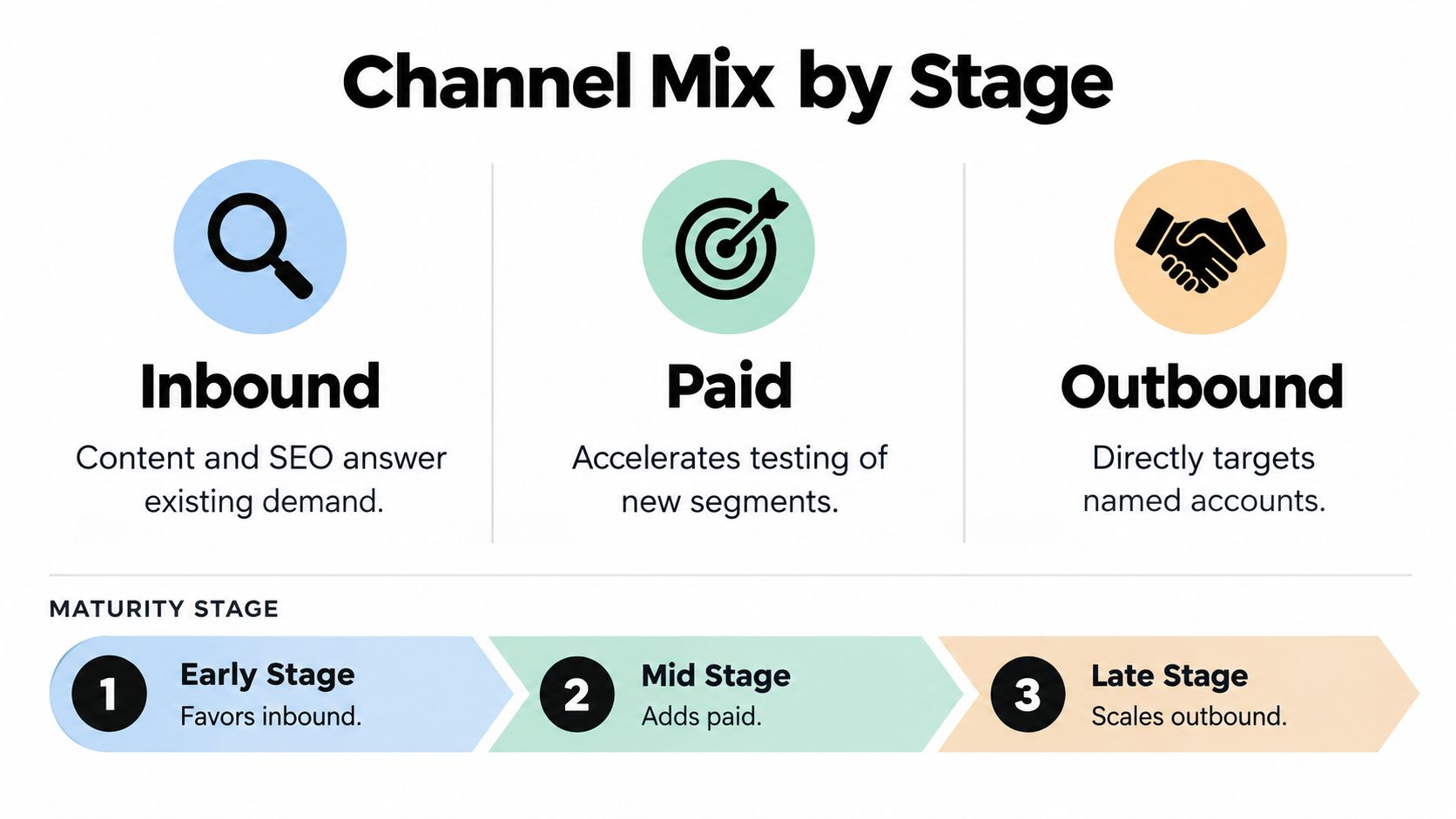
Choose channels based on the job you need done, not the latest trend. Inbound content helps buyers find and evaluate you. Paid campaigns help test messaging and audience fit. Outbound gives you a direct route to selected accounts. A team can use all three, but it should know what each channel is meant to prove.
The buyer's research often happens before sales gets involved. A 2024 Gartner survey of 632 B2B buyers found that 61% preferred a completely rep-free buying experience, and buyers spent only 17% of purchasing time in direct contact with vendors (Gartner buyer research summary). That's why your content needs to answer real evaluation questions: implementation effort, integration requirements, security, cost, ROI, and comparisons with existing workflows.
Assign every channel a job
Inbound and SEO suit problems buyers already search for. Publish practical explanations, use-case pages, comparisons, and product education that help prospects make progress before they're ready to talk. For a deeper search strategy, see how to build a B2B SEO pipeline.
Paid is useful when you need a fast read on whether a message or segment resonates. It can test demand, but don't treat clicks or form fills as proof of a scalable channel. Check whether the resulting accounts match the ICP and progress to meaningful sales stages.
Outbound makes sense when a small set of named accounts could justify focused sales effort. It works best when account selection, role relevance, and a business trigger guide the message. It works poorly when automation sends generic notes to a long list.
Use deal size, sales complexity, and pipeline coverage to decide where to lean. If buyers need to educate themselves and the problem has broad search demand, invest in content. If the account list is narrow and each deal warrants direct attention, prioritize targeted outbound. If you're unsure which segment or message will work, use paid tests to gather a directional signal, then validate it through downstream conversion.
The key isn't to be everywhere. It's to show up where your buyers are learning, then give them a credible next step without forcing a sales conversation too early.
Wiring Campaigns, Sequences, and Automation
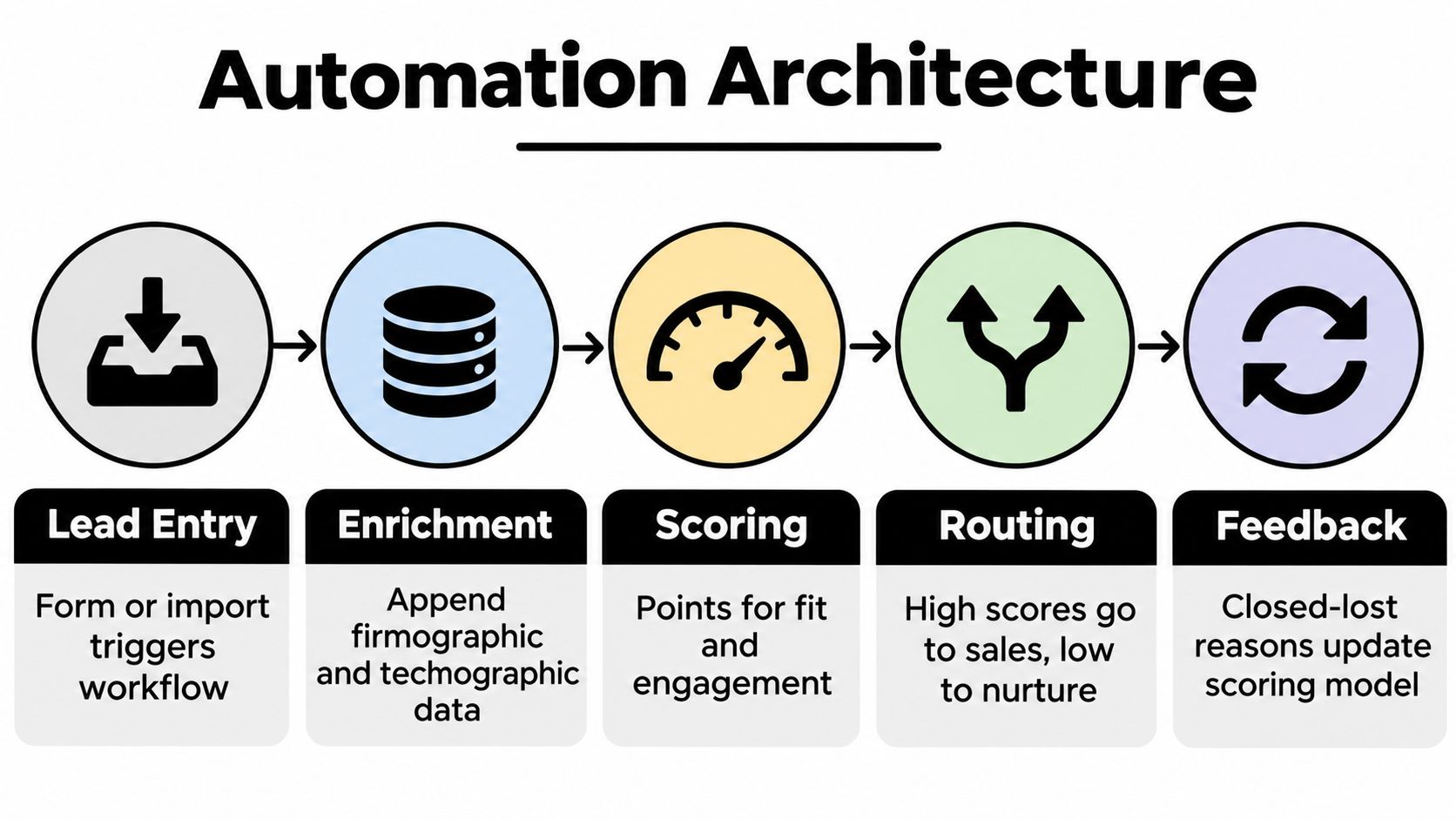
Automation should remove manual handoffs, not remove judgment. Build a clear path from first signal to next action: capture the lead, enrich the record, assess fit and intent, route it appropriately, and record what happens afterward. Whether your CRM is HubSpot or Salesforce, the workflow is only useful if it keeps the underlying data trustworthy.
Build around clean handoffs
Start by defining what starts a workflow and what must be true before it takes action. A form submission can trigger enrichment; the CRM can then check account fit, find duplicates, and assign a lead to sales or nurture. High-value accounts should get human review rather than being pushed through a generic sequence.
For outbound, use a sequence with a purpose at every touch. Segment accounts by fit and buying signal, verify contact data, suppress existing customers and unsubscribed contacts, and tailor the opening to a specific business problem. Then test timing, channel mix, and offer. Don't build a sequence around how many messages the system can send.
A reasonable control list includes:
- Frequency limits: Prevent repeated outreach when contacts appear in multiple campaigns.
- Consent and opt-out handling: Apply the same rules across tools and channels, including voice outreach.
- Deduplication: Keep one dependable record for each person and account.
- Human review: Let a person approve messaging for strategic accounts or sensitive claims.
- Closed-loop feedback: Record sales outcomes and loss reasons so future routing and scoring improve.
Benchmark data places typical B2B SaaS website conversion at roughly 1–3% of visitors, while higher-intent or intent-signal-driven programs may reach 8–10% (SaaS lead-generation benchmarks). Treat that spread as a reason to segment and investigate, not as a promise for your own site.
Document how leads move from entry to follow-up, including ownership and exceptions. If you need to formalize the workflow, use this guide to the sales automation process. A clean system should make it obvious who acts next and what information they need.
Measuring What Actually Drives Pipeline
Your campaign brings in more leads, but sales creates fewer opportunities. A dashboard celebrating form fills, email opens, and MQL volume will miss that deterioration unless it connects acquisition to closed business.
Measure the buying journey before the form fill, too. Track which content and offers appear in accounts that progress, then ask buyers what shaped their shortlist. Treat those observations as evidence to investigate, rather than proof that a touchpoint caused a deal.
Track conversion by source and ICP segment. Use funnel planning ranges as context, with your own stage definitions and historical performance as the operating baseline. Comparing channels with different qualification rules produces misleading conclusions.
Use the funnel to find the leak
Replace a generic benchmark table with a diagnostic view your team can act on:
| Funnel Stage | What to Watch | What to Investigate |
|---|---|---|
| Visitors to leads | ICP fit among captured contacts | Audience, offer, and form friction |
| Leads to MQLs | Share meeting agreed qualification criteria | Targeting and capture criteria |
| MQLs to SQLs | Sales acceptance and viable use cases | Qualification evidence and rejection reasons |
| SQLs to opportunities | Confirmed buying projects | Discovery quality and handoff context |
| Opportunities to customers | Wins, losses, and stalled evaluations | Deal fit, evaluation risks, and follow-up |
Investigate the weakest transition before buying more traffic.
Low lead-to-MQL conversion calls for a targeting and form review. Weak SQL-to-opportunity conversion warrants checking whether sales receives evidence of a buying project. When opportunities stall, sales leadership should inspect evaluation barriers and loss reasons. Keep pre-contact messaging in that review: buyers arriving with mismatched expectations can expose a positioning problem.
Review qualified pipeline and stage conversion by source on a regular operating cadence. Compare cohorts with enough time to progress through your sales cycle before reallocating budget. Use lead generation cost per lead alongside downstream outcomes. Cheap contacts that never reach an opportunity consume budget and sales capacity; fund the channels and segments that consistently produce viable deals.
A 90-Day Scaling Sequence for Growth-Stage Teams
A growth plan needs checkpoints, not a calendar full of campaigns. Sequence the work so each phase produces information the next phase can use. Don't add spend or automation to a funnel whose ICP, attribution, and handoffs are still unclear.
Foundation, then acceleration, then scale
Foundation: Align sales and marketing on the ICP, MQL and SQL definitions, and the fields the CRM must capture. Instrument every funnel stage, audit existing lead sources, and document routing rules. Establish a baseline for stage conversion and pipeline by source before changing several variables at once.
Acceleration: Test a small number of channel and message combinations. Use content to answer buyer questions, paid campaigns to test segment response, and outbound to reach selected accounts with relevant triggers. For each campaign, state what you're testing and what outcome would justify continuing. Keep a control where practical, and wait for the relevant sales cycle to produce useful evidence.
Scale: Shift budget toward segments that create qualified opportunities and customers, not just leads. Expand automation only after the workflow's exceptions are understood. Consider another marketer when a proven channel needs sustained execution, a RevOps lead when data and routing issues prevent reliable decisions, and a sales engineer when technical evaluation repeatedly blocks otherwise suitable deals.
Make deliverables explicit: a shared ICP, a working CRM funnel, channel tests with documented results, and clear owners for each handoff. Each checkpoint should answer whether to continue, adjust, or stop. That discipline prevents a busy team from mistaking a full campaign calendar for growth.
Outbound infrastructure deserves the same care as targeting. Before increasing sending volume, review sender readiness and guidance on domain warmup. A deliverability problem can undermine a carefully chosen audience before sales has a chance to learn from the campaign.
AI, Automation, and the Trust Trade-Off
AI can enrich records, draft a first-pass message, route leads, and summarize account activity. It shouldn't be allowed to invent a prospect's priorities or make high-stakes qualification decisions without review. Prospects complete roughly 60–70% of their evaluation before contacting a vendor, and the eventual winning vendor is often already shortlisted at first contact (research on SaaS attribution and independent evaluation). That means credibility matters before your CRM records a lead.
Start with bounded tasks. Require a human to verify AI-generated product claims and personal details, provide clear escalation to a person, and review scoring rules for patterns that unfairly exclude suitable accounts. For voice agents, set explicit consent and handoff controls. Don't fake familiarity with synthetic personalization; buyers notice when a message pretends to know something it doesn't.
Measure qualified conversations per compliant contact, not raw activity. That keeps the team focused on useful conversations while protecting trust and the ability to keep reaching buyers.
MakeAutomation helps B2B and SaaS teams design and implement lead handling, CRM integration, enrichment, routing, follow-up, and reporting workflows. If you want to replace manual handoffs with a system your sales team can trust, visit MakeAutomation to explore its automation consulting and implementation support.