

Account-Based Marketing Automation: A Practical Guide
Buy the platform first and the strategy will follow. That's the most popular advice in account-based marketing automation, and it's backwards. Software can synchronize lists, trigger ads, and route alerts, but it can't decide which accounts deserve attention, which contacts belong to a buying group, or when a signal is too weak to act on.
Teams that start with tooling usually automate the habits they already had. They send faster lead emails, build prettier dashboards, and still argue with sales about quality. Start with the operating rules instead. Define selection, identity, consent, orchestration, and measurement, then make the stack enforce them.
Why ABM Automation Is an Operating Model, Not a Tool Stack
Account-based marketing wasn't born as a software category. Industry histories place its codification by the Information Technology Services Marketing Association in the early 2000s, as a shift from lead volume toward named organizations, as traced in this history of account based marketing frameworks. Technology arrived later to make that discipline scalable.
That distinction matters when you design automation. If the discipline comes first, tools support account selection, multi-contact orchestration, personalization, sales alignment, and revenue measurement. If the tool comes first, you get generic nurture with an account label pasted on top.
The Loosely Practiced Problem
Calling a campaign ABM doesn't prove it's operating as one. In Forrester's survey of B2B marketing professionals on ABM maturity, 26% of respondents were only loosely practicing ABM or barely practicing it. The common failure modes behind that result are siloed teams, insufficient data access, improper technology use, and an inability to support multiple channels.
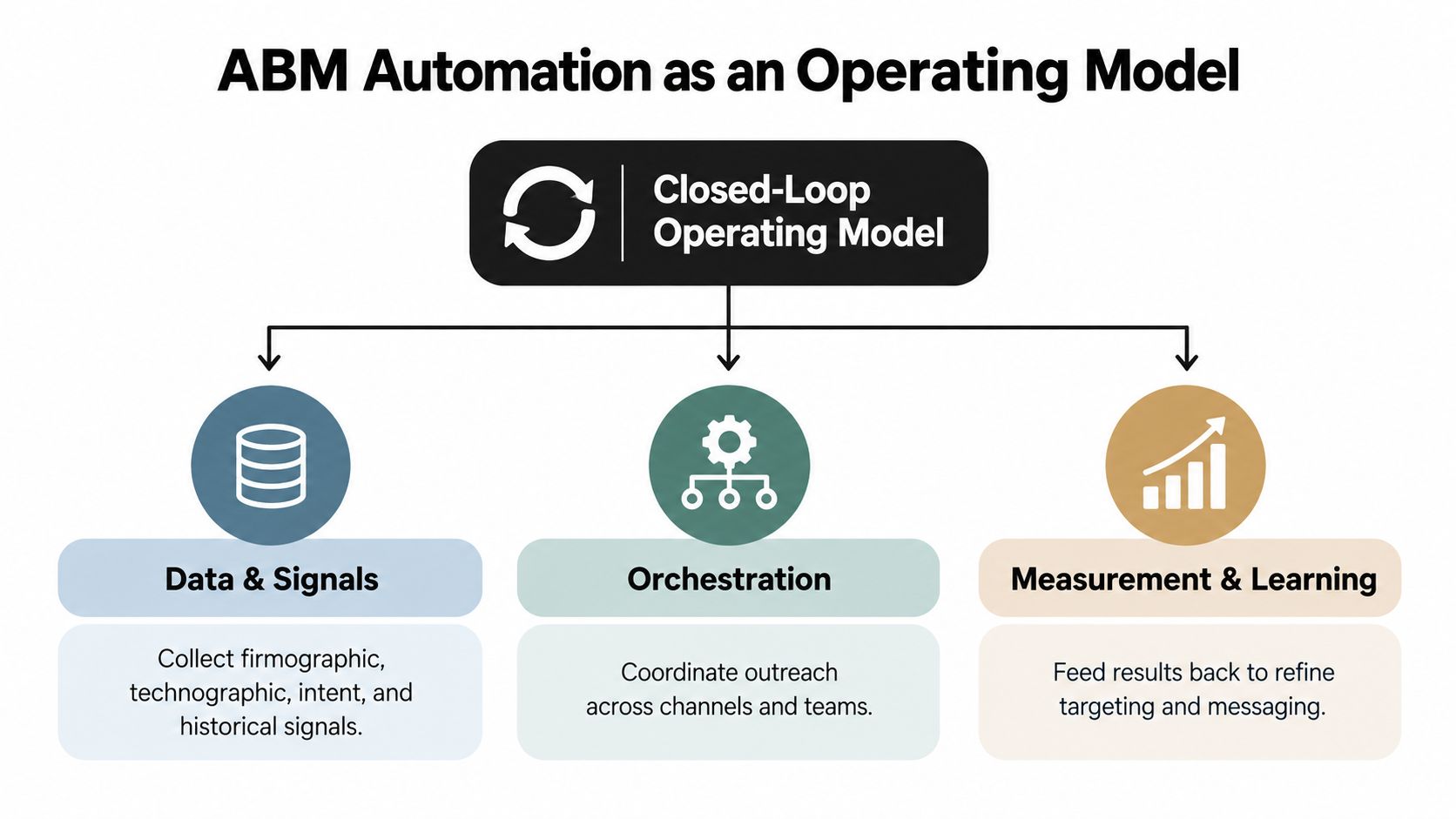
That's why a sound program runs as a closed-loop operating model. You define an ideal customer profile, tier accounts, map buying committees, synchronize systems, gate orchestration on data quality, and measure pipeline progression. Results then feed back into targeting instead of ending in a campaign report.
Practical rule: No automation fires until identity, ownership, and consent checks pass. Speed on bad data just creates rework for sales.
Strategy ownership sits above the stack. If you don't have that leadership layer in place yet, a fractional CMO ABM playbook from Big Moves Marketing is a useful reference for how senior marketing leadership sequences ABM decisions before tooling. Use it to clarify who owns account selection and revenue outcomes.
What The Operating Model Actually Requires
- A documented ICP: Written rules, not a slide someone made last year.
- A canonical account record: One ID every system references.
- Gates before triggers: Duplicate, match, and consent checks run first.
- Revenue measurement: Pipeline and win outcomes, not lead counts.
Build those four pieces and most respectable platforms can execute them. Skip them and even expensive platforms will faithfully automate confusion.
Selecting Target Accounts and Mapping Your ICP
Your ICP is a decision rule, not a persona poster. It should let two different people look at the same company and reach the same include or exclude verdict. If it can't do that, automation will interpret it differently in every system.
Combine four signal families. Firmographic data covers industry, size, geography, and structure. Technographic data shows what they run today, intent signals suggest active research, and historical value reflects what similar customers paid, retained, and expanded to.

Write Inclusion And Exclusion Rules
Vague priority labels don't survive contact with a CRM. Write hard rules instead, for example, must run a compatible core system, must operate in a served region, must not be a current customer in an active renewal, must not be owned by a parent account already in a tier. Exclusions do as much work as inclusions, because they stop wasted ad spend and awkward outreach.
If you need a starting structure for this exercise, this walkthrough of building an ideal customer profile covers the inputs in more depth. Adapt it to your actual sales motion rather than copying generic firmographic cutoffs.
Adoption context helps, but it shouldn't dictate your list. In the 2024 ABM Benchmark Study published by 6sense, 64% of surveyed marketers used an account-based or target-account approach, with adoption ranging from 57% to 67% across professional services, business services, financial services, manufacturing, and technology. ABM is now a majority practice, so your edge won't come from doing it. It'll come from selecting better.
Tier By Effort, Not Enthusiasm
- Tier 1: Named accounts get individualized research, custom content, and coordinated sales plays.
- Tier 2: Clustered accounts share industry or use case messaging with moderate personalization.
- Tier 3: Programmatic accounts receive automated advertising and nurture until signals justify promotion.
Review tiers on a fixed cadence. Accounts cool off, get acquired, change leadership, or buy a competitor, and a stale tier assignment misdirects budget for quarters. Promotion and demotion rules should be as explicit as entry rules.
The trade-off is list size versus depth. A smaller, well-qualified list lets you afford committee mapping and relevant creative. A bloated list forces generic messaging, which is just demand generation wearing an ABM badge.
Mapping Buying Committees and Connecting Identity in the CRM
Automation personalizes to whoever is in the database. Deals, however, move when a group reaches consensus, and that group rarely matches your contact list on day one. Committee mapping closes that gap before any workflow fires.
The benchmark evidence makes the stakes clear. In 6sense research on B2B marketing attribution and contribution, 92% of B2B purchases involve groups of at least three people, while 65% involve five or more. If you're only tracking one enthusiastic contact, you're blind to most of the decision.
Map Roles Before You Map Names
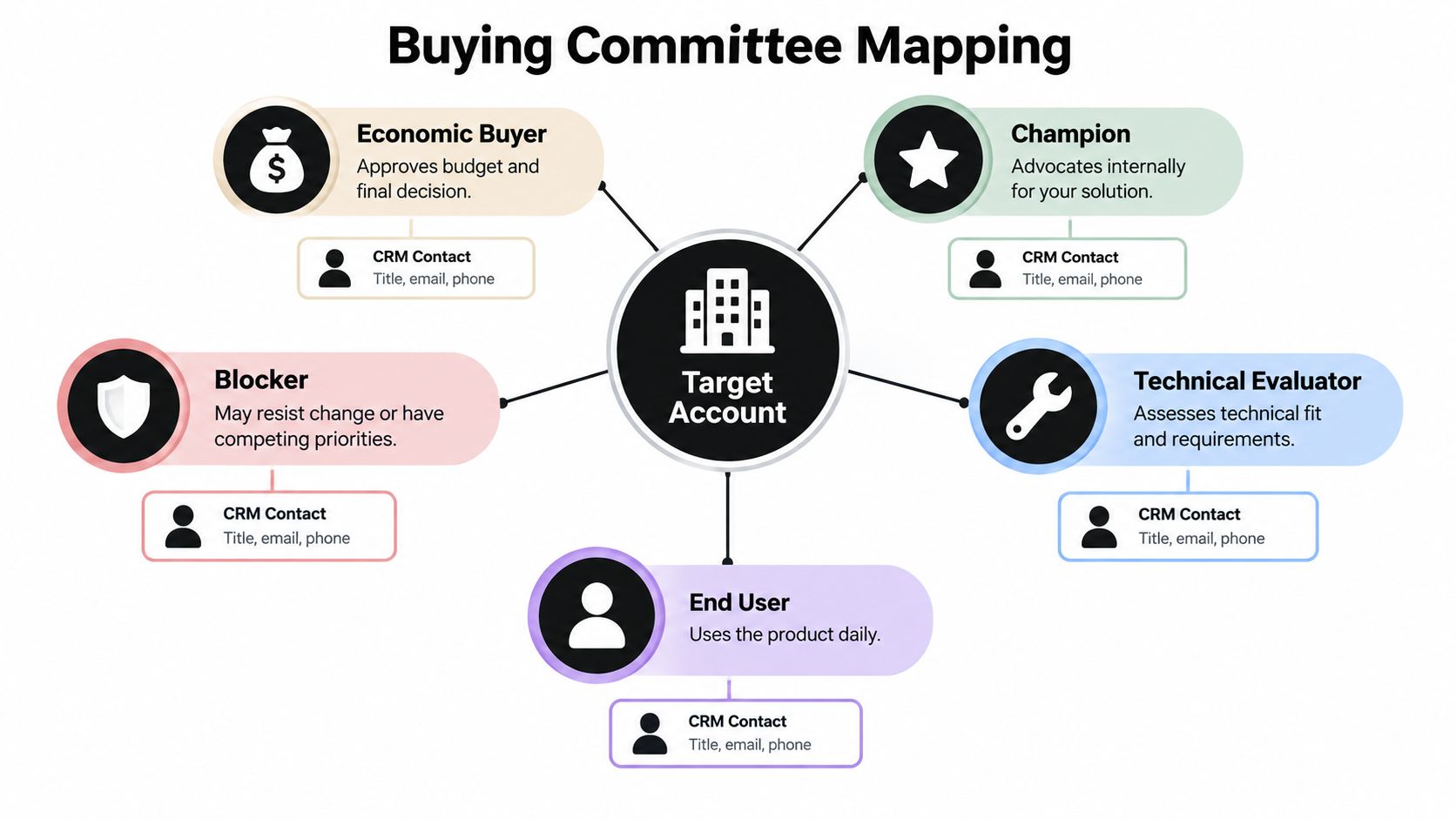
Start with the roles your deal needs, then find the people. An economic buyer approves budget, a champion advocates internally, a technical evaluator judges fit, end users judge daily usability, and a blocker may resist change or defend the status quo. Store the role on the CRM contact record, not in a rep's notebook.
Role gaps become work items. If an account has a champion and users but no economic buyer, the next action isn't another nurture email. It's a multithreading play, perhaps executive content, a peer introduction, or a sales task to identify the budget holder.
Connect Every Contact To One Account ID
Identity hygiene determines whether orchestration works. Each contact should resolve to a canonical account ID, with systems syncing account, contact, opportunity, consent, and engagement events against that key. Free email domains, subsidiary structures, and inconsistent company names are where matching breaks.
Track three health checks continuously:
- Contact-to-account match rate: The share of contacts confidently tied to a canonical account.
- Duplicate account rate: Multiple records representing the same company, splitting engagement history.
- Stale intent handling: Old research signals that should decay instead of permanently marking an account hot.
An unmatched contact is not a lead to route faster. It's a data problem to resolve before routing, because automation will otherwise credit the wrong account and alert the wrong owner.
Set a confidence threshold for matches. Below it, send records to enrichment or manual review, and above it, allow scoring and enrollment. That single gate prevents most of the embarrassing cross-account personalization errors that erode sales trust.
Building Automated Outreach and Nurture Workflows
A good workflow coordinates a team around an account. A bad one blasts individuals in parallel and calls the noise multichannel. The difference is whether triggers pass through checks and whether channels share a sequence logic.
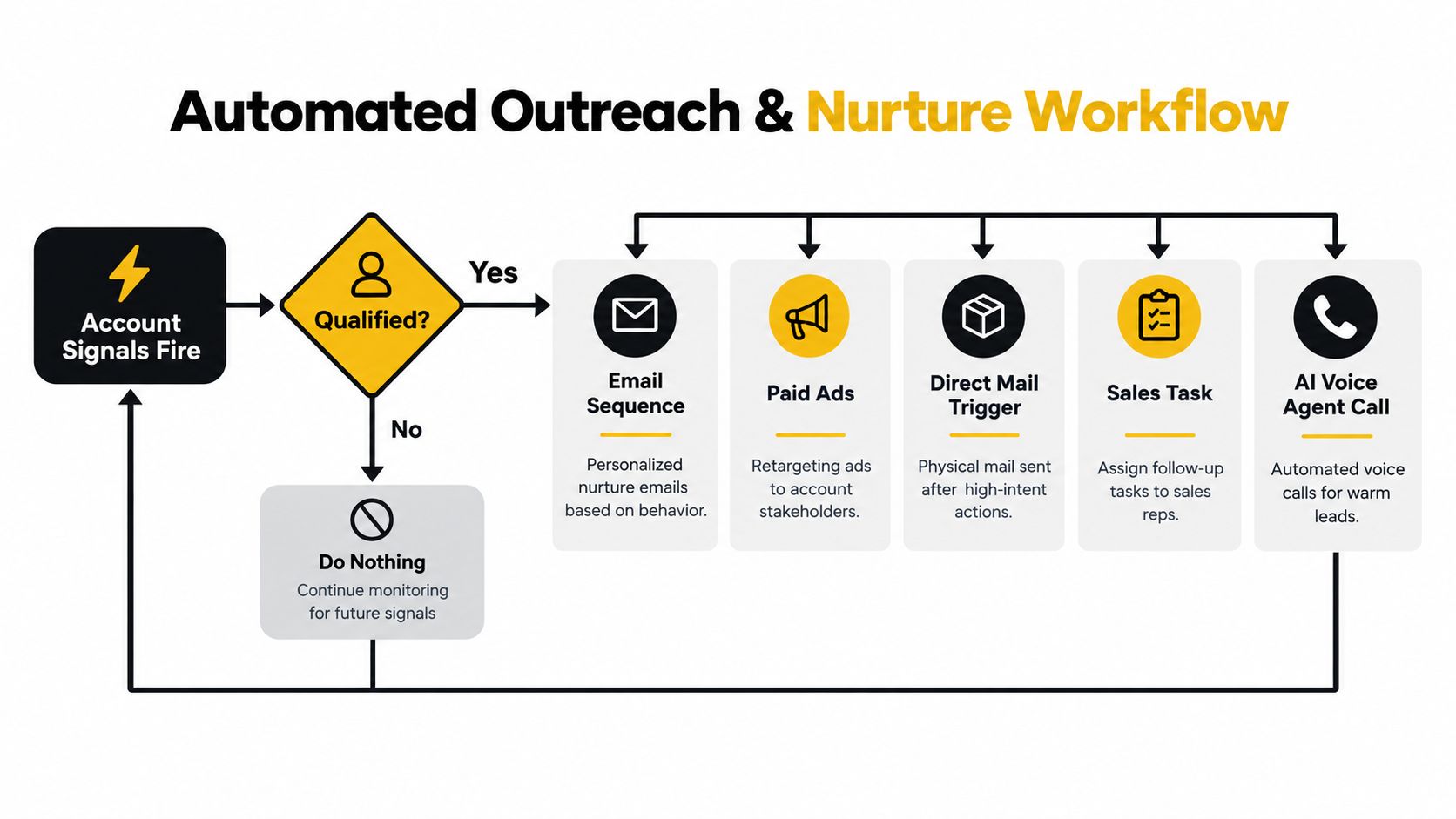
The visual below maps the basic pattern, from qualifying signal to parallel actions with a feedback loop.
A Concrete Trigger Sequence
Suppose a Tier 1 account crosses an engagement threshold. First, the system verifies that the active contacts belong to that account and checks consent status for each channel. Then it enriches missing role data, confirms sales ownership, and only then enrolls the committee.
Enrollment fans out by role. The champion gets a problem-focused email sequence, the economic buyer sees paid placements with outcome-oriented creative, and the account owner receives a task with context. A direct mail trigger or an AI voice agent call prompt can follow higher-intent actions, but only for contacts whose consent and region permit it.
For the email layer specifically, these lead nurturing automation patterns show how to structure sequenced follow-up without overwhelming contacts. Apply them at committee level, so one person's activity doesn't reset everyone else's stream.
Suppression Is A Feature
- Open opportunity suppression: Pause prospecting nurture when a deal is active, and switch to deal-support content.
- Opt-out propagation: A unsubscribe or do-not-call flag must reach every connected system, not just the sender.
- Frequency caps across channels: Email, ads, and calls shouldn't each assume they're the only touch that week.
- Recent sales touch holds: If a rep just had a live conversation, automated touches step back.
The example below demonstrates how an automated voice follow-up sounds in practice, which is worth hearing before you attach one to account triggers.
For regulated and data-heavy industries, it's worth studying how other sectors structure gated workflows. This overview of financial data driven marketing automation from Visbanking illustrates how financial teams sequence data checks before customer-facing automation. The pattern transfers well to ABM, verify first, then act.
Integrating the Tech Stack Around a Canonical Account Record
Most ABM stacks don't fail because a tool lacks features. They fail because five tools hold five versions of the same account, and each automation acts on its local copy. Integration work means deciding what each system owns and what it merely reflects.
The CRM should hold the canonical account record and the relationships to contacts, opportunities, and owners. Marketing automation orchestrates campaigns and stores engagement, intent providers contribute signals with timestamps, and sales engagement tools execute human and assisted outreach. Ad platforms receive audiences, they shouldn't originate account truth.
For practical wiring patterns between these categories, this marketing automation integration guide lays out connection approaches you can adapt to your stack. Whichever pattern you choose, keep one direction of truth for account identity.
System Roles In An ABM Automation Loop
| System Category | Primary Role in the Loop | Example Responsibility |
|---|---|---|
| CRM | Source of truth | Owns canonical account ID, ownership, opportunities |
| Marketing automation | Orchestration | Enrolls committees, runs nurture, enforces suppression |
| Intent and enrichment | Signal | Supplies firmographic, technographic, and research activity data |
| Sales engagement and AI agents | Action | Executes tasks, sequences, and voice follow-up with context |
Decide Sync Direction Per Object
Account tier and owner should flow from CRM outward. Engagement events flow inward from email, web, ads, and calls, then roll up to the account. Consent state needs special care, it must propagate everywhere quickly, because a contact who opted out in one system can't legally or ethically receive automated outreach from another.
AI agents plug in at the action layer, not the truth layer. A voice agent can place a follow-up call, log the outcome against the contact and account, and create a sales task, but it shouldn't invent account attributes or override ownership. MakeAutomation, for example, offers an ABM workflow that maps contacts to the correct company account, updates engagement context, and alerts account owners, which fits this action and coordination layer alongside existing CRM and marketing tools.
Test integrations with failure cases, not demos. Submit a form with a subsidiary name, trigger an opt-out mid-sequence, and merge a duplicate account. If engagement history, suppression, and ownership survive those events, your loop is real.
Measuring Buying-Group Progress Instead of Lead Volume
Lead volume is a comfortable metric because it's easy to count. It's also the wrong unit for ABM, since one form fill from a junior researcher tells you almost nothing about whether an account can buy. Measuring accounts as groups is harder and far more useful.
ABM teams already track more metrics than non-ABM teams on average, but more dashboards don't fix wrong metrics. If MQLs remain the headline number, reps will still chase individuals while deals stall for lack of consensus. Replace the headline, not just the chart count.
Build A Buying-Group Scorecard
- Stakeholder coverage: Which required roles have you identified, and which are still missing?
- Role relevance: Are engaged contacts the people who influence this purchase, or just the most clickable?
- Engagement quality: Depth matters more than touches, think repeated visits to evaluation content over one webinar registration.
- Stage progression: Is the account moving between defined buying stages, and how long does each stage take?
- Commercial outcomes: Opportunity creation, pipeline velocity, win rate, revenue, and post-sale value.
The better question is not which touch gets credit. It's whether this account has enough coverage and consensus to advance, and what action would create the missing piece.
Rules For Messy Realities
Anonymous engagement needs a home. Attribute identified web sessions to the account where confidence allows, hold them as account-level signals, and don't fabricate a person. When a visitor later identifies themselves, you can enrich the picture without rewriting history.
Duplicate contacts should merge before scoring, or one person with two records looks like two engaged stakeholders. Long sales cycles need stage-based reporting with aging views, so an account progressing slowly still reads differently from one that's gone dark. Sales touches belong on the same scorecard as marketing touches, because the buying group doesn't experience your org chart.
Review the scorecard with sales on a regular cadence. When coverage is thin, the agreed action is multithreading. When coverage is strong but progression stalls, the action might be executive alignment or a business case asset. Measurement earns its keep when it changes the next play.
Privacy, Data Quality, and AI-Agent Guardrails
Personalization is usually sold as an unqualified benefit. In practice, automated relevance built on inferred behavior can misfire, especially when identity resolution is wrong or a signal means less than the vendor claims. More personalization isn't automatically better.
Account-level relevance using declared business context is often safer and more credible. Referencing a company's stated initiative or a contact's actual role reads as prepared. Referencing opaque browsing inferences can read as surveillance, and it may be flatly incorrect.
A Guardrail Checklist Before You Scale
- Confidence thresholds: Define how certain identity and intent must be before automated outreach uses them.
- Human review: Route consequential messages, especially AI-generated ones, through a person for high-value accounts.
- Suppression rules: Honor opt-outs, regional restrictions, and customer status in every channel.
- Compliance checks by region: Apply the rules of the contact's location, not your headquarters.
- Source transparency: Log where each data point came from, so a rep can explain or discard it.
- Fallback messaging: When data is uncertain, default to generic but accurate content instead of a guessed personal detail.
AI voice agents raise the stakes because they act in real time. A wrong assumption in an email gets deleted, while a wrong assumption spoken on a call gets remembered. Constrain agents to verified account context, give them clear escalation paths to humans, and audit call logs against the CRM record they claimed to use.
Roll It Out In A 30, 60, 90 Sequence
In days 1 to 30, finalize the ICP, tiers, and identity hygiene, and run a quarterly data-and-routing audit covering duplicate accounts, match rates, stale intent, consent status, ownership, and SLA adherence. Don't build new workflows on unaudited data.
In days 31 to 60, build orchestration for a small pilot set of accounts, including consent gates and any AI agent integrations. In days 61 to 90, expand coverage, formalize SOPs for sales handoff, account recycling, and intent refresh, and make the buying-group scorecard the primary review artifact. Watch for the classic failure modes throughout, siloed teams, weak data access, improper technology use, and single-channel thinking.
If your ABM program needs the wiring to match the strategy, MakeAutomation builds CRM, marketing automation, and AI voice agent workflows that map contacts to accounts, gate outreach on clean data, and alert owners at the right moment. Bring us your target account list and current stack, and we'll map the closed loop before automating anything. Start at MakeAutomation to book a working session.