
Infrastructure Automation Explained: A Practical Guide
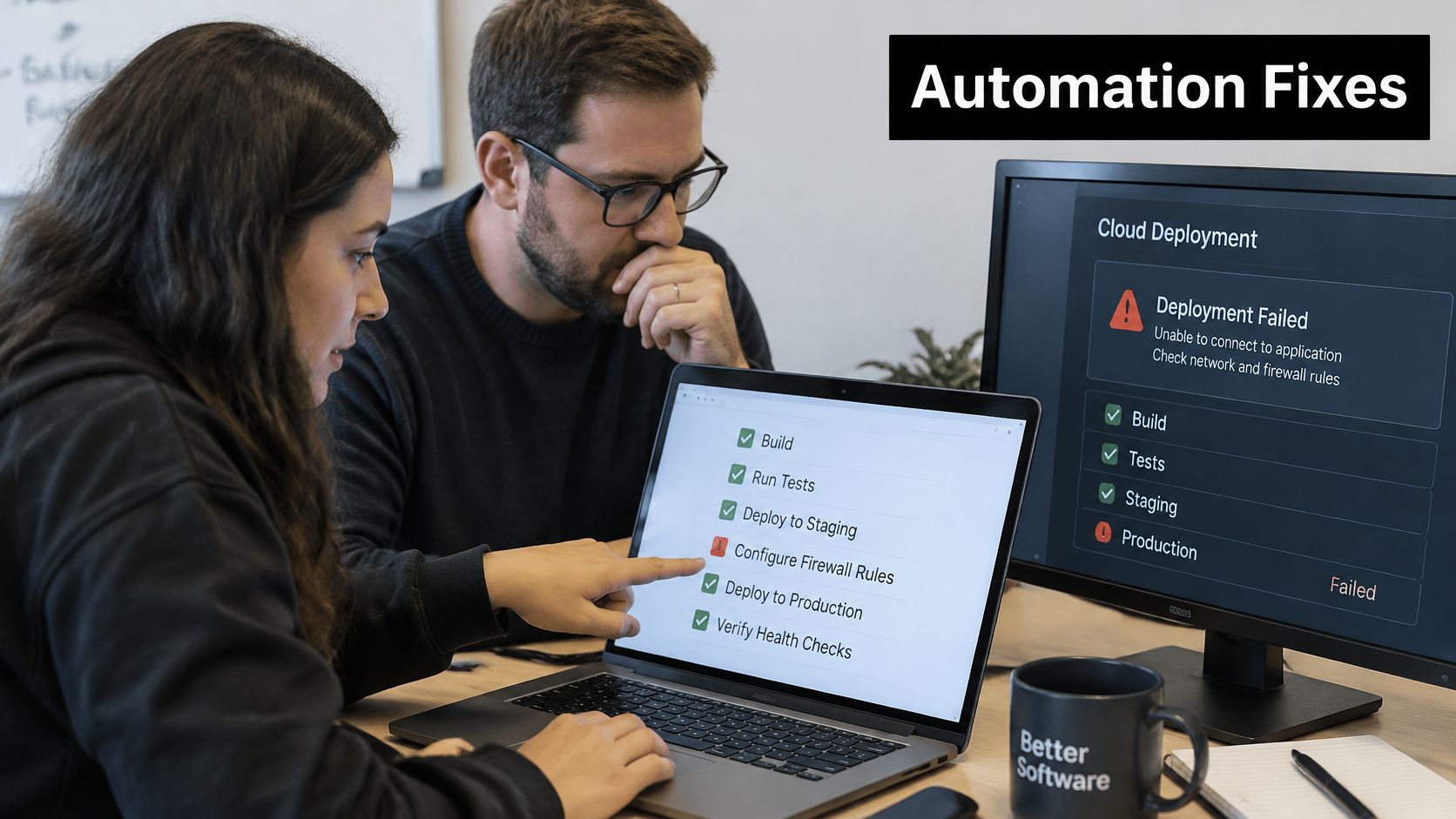
Your SaaS team is launching in a new region. An engineer follows the setup checklist in a shared document, another copies settings from the existing environment, and the application still can't connect to its database. Eventually, someone finds a missed firewall rule. The launch problem wasn't a lack of effort. It was a process that depended on people remembering every detail.
Infrastructure automation replaces that fragile handoff with a repeatable delivery system. But repeatability alone isn't enough. You also need to control how far a mistake can spread, prove that changes work, and recover when they don't.
What Infrastructure Automation Means for Your Team
Infrastructure automation means using executable definitions and workflows to create, configure, change, and verify the systems your software runs on. Those systems include servers, networks, databases, permissions, and the delivery steps connecting them.
Think of a recipe. A cook shouldn't need to phone the person who invented a dish to discover an essential ingredient. Similarly, an engineer shouldn't need the original system administrator to rebuild an environment.
The files describe the intended setup. Version control records who changed the recipe and why. Automation tools apply it, while checks establish whether the result is usable.
If you cannot rebuild an environment from its files, it is not automated yet.
More than faster server creation
Creating a virtual machine is only part of the job. The application also needs appropriate access, service configuration, network connectivity, and a safe route for future updates.
A working approach connects these responsibilities:
- Provisioning creates resources such as networks and databases.
- Configuration installs packages and establishes service settings.
- Delivery workflows move proposed changes through testing and review.
- Verification checks both the proposed configuration and the running environment.
The troubleshooting scene is familiar because a successful resource-creation command doesn't necessarily mean a successful deployment.
Infrastructure as code, often shortened to IaC, is the part that represents infrastructure in versioned files. Infrastructure automation is broader: it includes the workflows and operating controls around those files. Our explanation of cloud automation helps distinguish cloud-specific tasks from this wider operating model.
The category represents substantial commercial investment: DataIntelo's infrastructure-as-code market report estimates that the global market reached USD 2.7 billion in 2024. That's a market-size estimate, not proof that any particular team has implemented it well.
For your team, the useful questions are practical: Which parts need to connect? How should you introduce them? And what stops a repeatable mistake from becoming a widespread outage?
Business Value for B2B and SaaS Teams
Delivery performance provides a stronger business case than counting administrator hours saved. In the 2015 State of DevOps Report, which surveyed 4,976 professionals worldwide, high-performing teams deployed 30 times more frequently and moved changes from commit to production 200 times faster than lower-performing peers; deployment automation and infrastructure as code were among the practices associated with stronger performance.
The 2021 Accelerate State of DevOps Report, drawing on more than 32,000 professionals across seven years, described elite teams deploying on demand, commonly multiple times daily, while low performers deployed fewer than once every six months. These are observed performance patterns, not a promised return from buying an automation tool.
Measure delivery and recovery together
For a founder, release speed matters because customers are waiting for improvements. For an operations lead, recovery matters because customers also expect continuity.
Use the core measures described in DORA's metrics history:
- Deployment frequency shows how often the team delivers changes.
- Lead time for changes shows how long committed work takes to reach production.
- Change-failure rate shows how often deployments require intervention.
- Time to restore service shows how quickly the team recovers from failure.
Version-controlled changes, automated tests, and repeatable pipelines reduce manual variation. Smaller changes also give responders a narrower set of suspects when something breaks.
That can protect revenue-critical workflows such as authentication, checkout, and customer reporting. It doesn't mean every faster release is safer.
Business test: If provisioning gets faster while incidents become harder to recover from, the automation hasn't delivered the outcome you need.
Baseline these measures for a specific service before setting targets. Don't turn survey benchmarks into performance commitments for a team with a different architecture or risk profile.
Core Components and How They Connect
An automated stack needs connected responsibilities, not a growing collection of scripts. The handoff between layers matters as much as the tools within them.
Infrastructure automation layers and their failure modes
| Layer | What It Controls | What Breaks Without It |
|---|---|---|
| Source of truth | Version-controlled definitions of networks, servers, databases and access | Changes happen by hand and no one can reproduce an environment |
| Provisioning | Creating and changing cloud resources from declarations | Environments drift from their documented state |
| Configuration management | Packages, OS settings and service configuration on existing machines | Servers differ in small, hard-to-trace ways |
| Delivery pipeline | Test, plan, review and apply in a fixed order with approvals | Changes ship without review or checks |
| Policy and security checks | Rules for encryption, network exposure and permissions | Risky settings reach production unnoticed |
| Monitoring and drift detection | Comparison of live state with declared state, with alerts | Manual edits accumulate silently |
From definitions to a running service
The source of truth is normally a Git repository. It contains resource definitions, reusable modules, environment settings, and instructions for executing the workflow. Secrets belong in a secret-management system, not committed alongside the code.
The provisioning tool reads these definitions and calculates resource changes. Terraform and OpenTofu, for example, maintain state that maps declared resources to real infrastructure. That state needs restricted access and coordination so competing runs don't modify the same environment simultaneously.
Configuration management handles what happens inside existing machines. Ansible might install a monitoring agent, configure a service, and ensure that it starts after reboot. Provisioning and configuration can overlap, but they answer different questions: what resources exist, and how those resources behave.
The delivery pipeline connects those actions. It should show reviewers the proposed changes before an authorized identity applies them. Avoid letting engineers approve one plan while the pipeline generates and executes a different one.
A valid file isn't a deployment test
Policy checks can reject an exposed storage bucket or an excessively broad permission. Static validation can catch malformed configuration. Neither proves that the application will work.
A 2025 arXiv study evaluating LLM-generated infrastructure templates reported first-attempt deployment success rates of 20.8%–30.2% across the tested models and found that 42.7% of syntactically correct templates still failed during deployment. Those findings concern generated templates in that evaluation, not all infrastructure code.
Runtime failures can involve provider behavior, dependency ordering, identity permissions, quotas, or unreachable services. Create an isolated environment, apply the configuration, test service connectivity and expected outputs, then clean it up.
Monitoring closes the loop after deployment. Say an engineer edits a security group through the cloud console during an incident. A scheduled drift check should identify the difference between the live environment and its declared configuration.
The owner then decides whether to reverse the manual edit or incorporate it into code. Blindly overwriting it could reintroduce the incident.
Mark which layers exist in your stack, who owns them, and where the handoff stops. Prioritize the missing control that currently allows an unreviewed or unverified change into production.
Four Patterns for Automating Infrastructure
Different infrastructure problems need different automation patterns. A provisioning engine, a configuration tool, a delivery pipeline, and an automated responder aren't interchangeable.
Declarative provisioning
Problem solved: You need reproducible cloud resources without writing every API operation by hand. You describe the desired end state, and the tool calculates how to reach it.
For a SaaS reporting service, a Terraform module might define a database replica, its network placement, and the application identity allowed to connect. Reviewers inspect the proposed changes rather than a checklist of console clicks.
The main failure mode is an unexpected replacement. Changing a resource identifier or an immutable setting can cause a tool to propose destroying and recreating a resource.
Read destructive actions separately from routine updates. A database replacement deserves a different review from adding a harmless label, even when both appear in the same plan.
Configuration convergence
Ansible and similar tools repeatedly bring existing machines toward declared settings. This suits virtual-machine fleets and legacy hosts that you cannot replace whenever configuration changes.
Say background-job workers need the same runtime package, service configuration, and log collector. A configuration run makes those settings consistent and reports where execution fails. Our Ansible best practices provide useful guidance for keeping that work maintainable.
The failure to anticipate: an engineer applies a manual hotfix, then the next configuration run overwrites it. Treat emergency edits as temporary changes that need an explicit reconciliation decision.
Convergence isn't the same as understanding intent. The tool knows the declared settings, not why someone departed from them.
Pipeline-driven delivery
Problem solved: Engineers need a consistent path from a proposed change to an authorized deployment.
A SaaS team adding capacity to its application cluster can route the change through commit, tests, plan review, approval, and apply. The pipeline preserves evidence of what was checked and who authorized the release.
A poorly designed pipeline can delay urgent recovery. Provide a documented break-glass path with restricted permissions and audit logging rather than forcing responders to improvise around controls.
Keep routine checks efficient. Run inexpensive validation early, and reserve expensive environment tests for the changes that need them.
Event-driven remediation
Monitoring can trigger a predefined response to a known condition. For example, an unhealthy background worker might be replaced automatically after the system confirms that another worker can safely retry its jobs.
The risk is a bad trigger repeating the wrong action across the fleet. Restarting workers won't fix an unavailable database, and repeated restarts may make diagnosis harder.
- Bound the action: Limit which resources the responder can change.
- Stop repeated failure: Use retry limits, cooldowns, and escalation.
- Preserve evidence: Record the trigger, action, and resulting health state.
Start with declarative provisioning and controlled delivery. Add automatic remediation only when you understand the failure and have tested how to stop or reverse the response.
These patterns usually coexist. Choose each for a specific responsibility rather than expecting a single tool to manage every operational decision.
Choosing Tools Without Locking Into One Provider
Let the job choose the tool. Start with the resource or workflow you need to control, then consider how your team will operate it.
Infrastructure automation approaches compared
| Approach | Best Fit | Main Trade-off |
|---|---|---|
| Declarative infrastructure-as-code (Terraform, OpenTofu, Pulumi) | Cloud resources across one or more providers | State management and provider version upgrades |
| Configuration management (Ansible) | Configuring existing servers and virtual machines | Less suited to rebuilding immutable infrastructure |
| Kubernetes manifests with GitOps (kpt, Argo CD, Flux) | Teams already running Kubernetes clusters | Steeper learning curve outside container platforms |
| Workflow automation platforms (n8n) | Approvals, notifications and ticket routing around infrastructure | Not a substitute for state-managed provisioning |
| Custom code | Complex logic, high volume and specialized integrations | Maintenance burden falls on your own team |
Evaluate the operating cost
Score candidate tools against these criteria:
- Workload portability: Identify what can move and what relies on provider-specific services.
- Team skills: Check whether engineers can debug failed runs without outside help.
- Regulatory exposure: Assess access restrictions, audit evidence, and data handling.
- Switching cost: Include migration of state, modules, credentials, and workflows.
- Outage tolerance: Establish what happens when the automation platform is unavailable.
- Lifecycle maintenance: Assign responsibility for upgrades, integrations, and deprecated APIs.
Tool fragmentation also affects governance. The New Stack's review of infrastructure as code describes multicloud complexity and the associated governance and cost-management challenges. Connecting more tools isn't a useful objective if engineers must maintain duplicate controls.
Where approval workflows connect to service management, include licensing and administration in the evaluation. The HaloITSM licensing insights from DataLunix offer a focused resource for evaluating that part of the surrounding toolchain, rather than the provisioning engine itself.
Standardize controls, not every resource
Say your core application runs on AWS while a smaller workload runs on Azure. Keep provider-specific resources in separate modules, but use consistent review requirements, policy checks, and approval records.
Don't invent a universal storage abstraction unless portability justifies its maintenance cost. A shared interface that conceals important differences can make troubleshooting harder.
Keep definitions in your repository and state in an access-controlled backend you control. Document modules, version integration endpoints where supported, and place an abstraction layer between client code and external APIs.
Our platform-agnostic approach may recommend n8n or custom code for complex logic, higher volume, data control, or specialized integrations. We design systems to avoid proprietary lock-in so the client's team or another qualified specialist can maintain them.
The practical test is whether an engineer can execute your rebuild procedure without depending on undocumented clicks in an automation vendor's dashboard.
Roadmap From First Script to Governed Platform
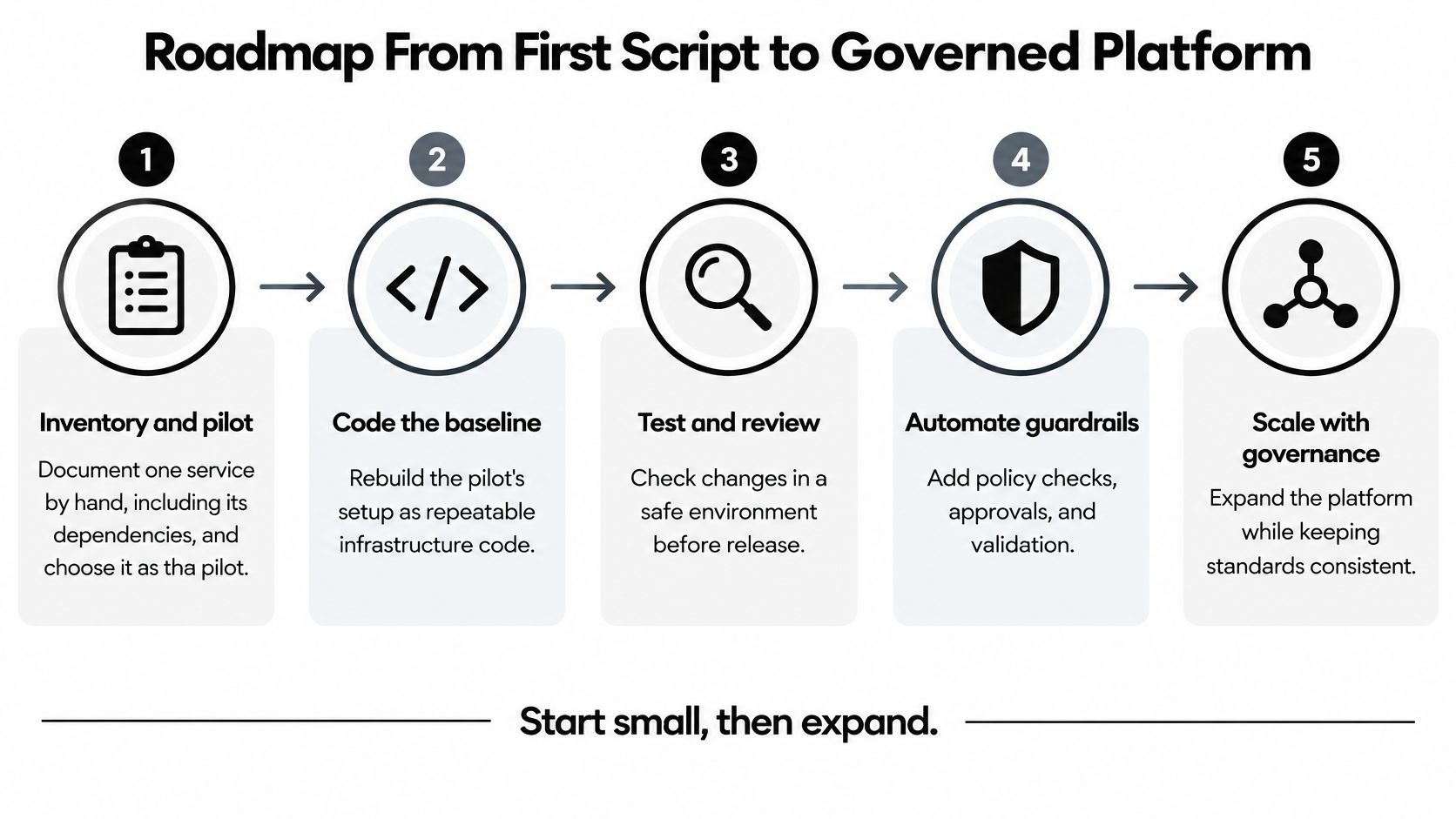
Start with a service you understand well enough to test. Don't begin by replacing the entire infrastructure estate.
In a 2025 Spacelift survey, 45% of infrastructure decision-makers believed their organizations had achieved a high level of infrastructure automation, but only 14% demonstrated behaviors associated with automation excellence. Use observable exit criteria rather than a maturity label.
The rollout should progress through bounded stages.
Build in small, verifiable slices
Inventory and pilot. Document a service, its dependencies, access requirements, and current change procedure by hand. Choose a pilot with meaningful manual work but manageable customer risk.
Code the baseline. Rebuild the pilot's staging environment using an infrastructure-as-code tool and remote state with locking. Locking prevents concurrent runs from attempting conflicting changes; protect and back up the state because it may contain sensitive information.
Add pipeline and review. Require pull requests, publish a plan for each proposed change, and require production approval. Start recording the service's delivery and recovery measures now, so you can compare outcomes as the workflow changes.
Introduce ephemeral tests and policy. Create temporary environments, run deployment and smoke tests, evaluate security rules, and destroy test resources afterward. Include cleanup after failed runs so abandoned environments don't become an operational burden.
Enable self-service and drift control. Publish approved modules with clear inputs and ownership. Give drift alerts named responders rather than sending them to an unattended shared channel.
A practical automated DevOps pipeline connects these steps without requiring every product team to assemble its own release process.
Rollout phases, owners and exit criteria
| Phase | Typical Owner | Tooling Decision | Exit Criterion |
|---|---|---|---|
| 1. Inventory and pilot | DevOps or platform lead | Choose one service and document it by hand | Every change to the pilot is recorded |
| 2. Code the baseline | DevOps engineer with a senior developer | One infrastructure-as-code tool and locked remote state | Staging rebuilds from files with no manual steps |
| 3. Pipeline and review | Engineering lead | Pull requests, a plan on every change, approval for production | Every production change has a reviewed plan and a commit |
| 4. Ephemeral tests and policy | Platform team with security | Temporary environments and policy-as-code checks | A template passes deployment tests before merge |
| 5. Self-service and drift control | Operations director | Approved modules and scheduled drift checks | Product teams provision from approved modules and drift alerts have owners |
Demonstrate operability, not just completion
Use realistic, appropriately protected test data and representative dependencies. A deployment that works only against empty databases and permissive test accounts hasn't answered the operational questions.
In our build process, we work iteratively, test with realistic data, and show the client progress during the build. Apply the same discipline internally: demonstrate a successful change, an intentionally rejected change, and a recovery.
Expand when the team can operate the pilot without its original author supervising every run. Self-service should distribute safe capabilities, not distribute undocumented responsibility.
Guardrails and an Adoption Checklist
In Dimensional Research's 2024 study commissioned by StackGen, 97% of infrastructure-as-code users reported difficulties, based on 315 respondents from organizations with more than 150 developers. That scope matters, but the operational lesson is useful: plan for incorrect changes instead of assuming code removes human error.
Guardrails require shared ownership across engineering and operations.

Limit what a bad change can reach
Blast radius means the customers, services, or resources a failure can affect. Design controls around that boundary:
- Stage rollouts: Release by region or customer segment so health checks can stop expansion.
- Gate sensitive changes: Require human approval for identity, network boundaries, and production data.
- Enforce policy: Test encryption, exposure, and permissions before release. Rite NRG's guidance on how to build security controls into delivery provides useful implementation context.
- Route drift alerts: Give a named owner authority to investigate unexpected changes.
- Prepare recovery: Retain previous module versions and test restoration. Reverting code alone won't undo deleted data.
- Watch integrations: Monitor unexpected external API responses rather than assuming a successful request has the expected meaning.
- Constrain emergency access: Log break-glass activity and define a deadline for reconciling manual edits with code.
For example, a staged firewall update could fail its connectivity check on a limited worker group, stopping expansion and triggering the tested reversal. The important property isn't speed alone. It's that the failure stays contained.
We build with versioned endpoints, abstraction layers between client code and external APIs, and monitoring that alerts when external API responses change unexpectedly.
List your revenue-critical services, recovery objectives, and incident-communication owners alongside the technical controls. Responders should know who can authorize recovery and who updates affected customers.
Use this video as a companion to the operational discussion.
Your adoption checklist
- Choose the pilot: Name the service whose changes create the most manual work.
- Prove reproducibility: Confirm its environment can be rebuilt from files.
- Set the foundation: Pick an infrastructure-as-code tool and a locked remote state location.
- Control production: Require a plan and review for each production change.
- Prepare for failure: Write a recovery test and assign every alert an owner.
- Measure outcomes: Track deployment frequency, lead time, change failures, and restoration time from the start.
- Keep human judgment: Document which change types always require an approver.
MakeAutomation can help turn a manual infrastructure workflow into a tested, governed delivery system, from strategy and architecture through deployment and ongoing optimization. Our process moves through Discovery & Audit, Solution Architecture, Build & Integration, and Deploy & Optimize, without requiring you to hire developers or learn new platforms. Visit MakeAutomation to discuss a pilot service, its failure risks, and the controls needed before expanding automation.