
What Is an AI SDR and How Does It Work in 2026
An AI SDR is software that runs the early, top-of-funnel stages of B2B sales, finding target accounts, researching contacts, sending outreach, qualifying replies, updating the CRM and booking meetings for human reps. It's a category with real money behind it now, with the global AI SDR market valued at approximately $3.8 billion in 2024, even though many organizations are still testing rather than running one as a core motion.
That figure comes from Grand View Research's AI SDR market report, and the adoption picture behind it shows up in Salesforce's 2024 survey of 5,500 sales professionals, where 81% of surveyed sales teams said they were either experimenting with AI or had fully implemented it.
You're probably reading this inside that gap. Your one account executive is writing follow-ups at 9 p.m., half your demo requests wait until the next morning for an answer, and a spreadsheet of trade-show contacts has sat untouched for two years. Someone on the team forwards a vendor page and asks whether this replaces a hire.
So what is an AI SDR? It's a supervised workflow with handoff rules, not a robot that sends email. Judged properly, it's measured by accepted opportunities and revenue per seller hour, not by meetings booked. What follows is where the line sits between software and people, how the loop runs in practice, what it's good for, and how to tell whether it's working before you spend a quarter on it.
What an AI SDR Handles and What Stays Human
Strip away the branding and an AI SDR does a defined job: the work a sales development rep handles in their first quarter, and no further.
On the front end of the funnel, that still covers real ground. The system identifies accounts matching your criteria, researches the companies and the people inside them, sends approved outreach, answers routine questions about pricing and availability, sorts replies by intent, logs every action to the CRM, and books meetings onto a rep's calendar. Discovery, negotiation and closing stay with people. The software is an automation layer for lead development, and every handoff rule in it points at a named human who takes over with context.
It works like a pre-sales researcher who never sleeps. It gathers the facts, opens the conversation with a relevant reason to talk, keeps the thread warm, then walks a qualified prospect over to the closer. Signing the contract is never its job.
Where the confusion starts
Three different tools get sold under the same label:
- A website chatbot answers questions and waits. It has no list, no sequence and no pipeline.
- An AI SDR starts outreach itself, works a book of accounts, follows up on its own schedule and escalates when a reply qualifies.
- An AI-assisted tool drafts copy while a person picks who gets contacted and presses send.
The role being automated is worth understanding first. The human SDR model became a standard go-to-market motion for B2B SaaS companies over the past decade, splitting prospecting from later-stage account executive work, and what an SDR actually does is the job description the software inherits. McKinsey's analysis of generative AI's economic potential frames the sales case along similar lines, citing use cases like synthesizing customer and product information, preparing conversation scripts and supporting lead nurturing, and it estimates a productivity gain of approximately 3% to 5% of current global sales expenditures. Read that as reclaimed capacity rather than eliminated headcount: the hours come back, and where they go next is a management decision.
| Sales task | AI SDR role | Human rep role |
|---|---|---|
| Identify target accounts | Scores and lists accounts against ICP rules | Sets and updates the ideal customer profile |
| Research companies and contacts | Gathers firmographic and public signals | Verifies high-value and strategic accounts |
| Write and send outreach | Drafts and sends approved sequences | Approves messaging and claims for key accounts |
| Answer routine questions | Responds to pricing, availability and product FAQs | Handles objections and complex questions |
| Qualify replies | Classifies responses against defined rules | Judges fit during discovery |
| Update CRM records | Logs activity and outcomes automatically | Reviews data quality and corrects gaps |
| Book meetings | Schedules calls on rep calendars | Runs discovery, negotiation and closing |
A practical way to read that table: anything rule-based and repeatable sits on the left, anything requiring judgment under uncertainty sits on the right. Hand over research, first drafts, follow-up and CRM logging first. Keep discovery, pricing exceptions and negotiation. If you'd rather add judgment than automate the seat, you can hire sales development representative talent who owns the whole conversation.
How an AI SDR Runs Its Closed Loop
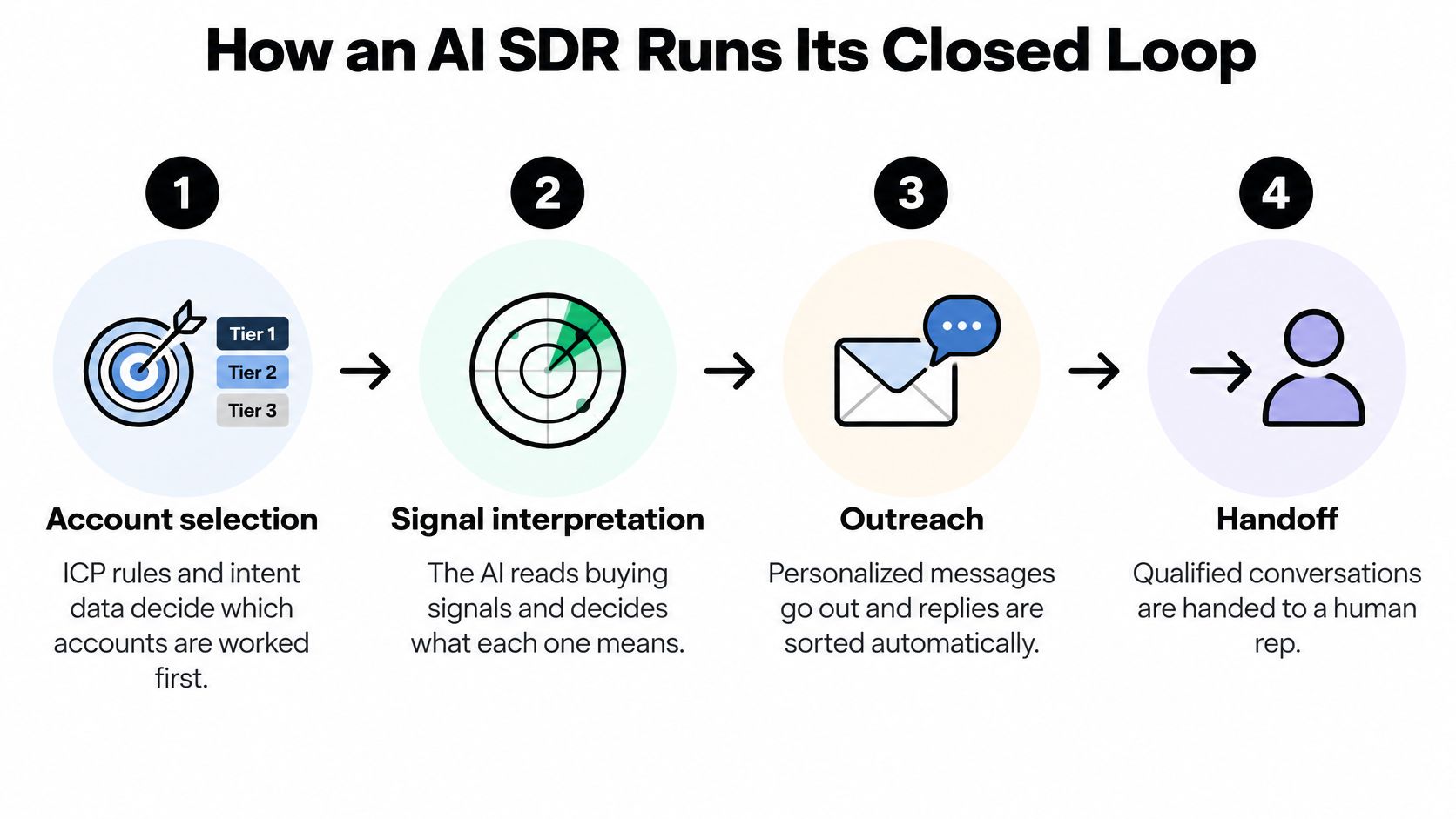
An AI SDR isn't a message generator with a schedule attached. It's a closed loop that runs in a fixed order, and every stage feeds the next one.
- Account selection. ICP rules, tiering and intent data decide which accounts get worked first and which wait. Point a system at a loose definition and it will contact the wrong people quickly and confidently.
- Signal interpretation. Website visits, job changes, hiring posts and past CRM activity tell the system whether the timing is right. One signal rarely justifies a touch. Two or three together do.
- Next-best-action selection. It picks the channel, the message angle and the send window. Personalization either earns a reply or blends into the four other emails that landed that morning.
- Multichannel execution. Email, LinkedIn or a call task runs inside approved frequency limits, with bounce checks before each send. Caps matter more than clever copy at this stage.
- Response classification. Every reply gets sorted as interested, objection, out of office, referral or unsubscribe. A referral filed as a rejection is a lost introduction.
- CRM updating. Each action and outcome lands on the record with the thread attached. Without that, the next stage runs blind.
- Escalation. When a reply meets the handoff criteria, a named person takes over with full context. Nobody should have to ask a prospect what they already told the system.
Why a weak link breaks the next stage
The stages are sequential for a reason. Thin account data produces generic personalization, and generic personalization gets ignored no matter how well the sending infrastructure performs. A misclassified reply does damage in both directions: it can stop a warm lead from ever reaching a rep, or keep pressing a prospect who has plainly said no.
McKinsey's research on automation in B2B selling reports that companies using sales technology and automation consistently report efficiency gains of 10% to 15%. That gain comes from the loop running end to end. Fix one stage in isolation and the number doesn't move.
Read the whole thing as a relay race. The CRM record is the baton, passed from selection to outreach to classification to a human closer, and a dropped baton costs you the lead even when every runner was fast.
Name one owner per stage
Sketch your own loop on a whiteboard this week and write one person's name next to each of the seven stages. You may discover that account selection and escalation are owned by nobody. If you want a walkthrough of the surrounding pieces, the guide to AI-powered sales automation covers where automation fits around the loop you've drawn.
Common Sales Uses for AI SDRs
Deployments that hold up tend to start in the same shape: narrow, supervised and close to the data. A team picks one segment, runs it with a human reviewing output, watches the downstream numbers for a full cycle, and only then widens the scope to a second use case.
The handoff rule deserves as much design attention as the outreach. A rule written as "escalate when interested" means nothing, because classification varies by reader. A rule written as "escalate any reply that mentions a competitor, a deadline or a budget figure, within two hours, to the account executive" is something a system can execute and a manager can audit.
Outbound prospecting is the use everyone thinks of first, and it works best when a recent buying signal, not just an ICP match, triggers the first touch. Inbound lead response is often where the fastest return sits, because the system answers a demo request within minutes, including at 10 p.m. on a Friday when no rep is watching. Re-engagement of dormant contacts from old lists and lapsed opportunities tends to be the safest volume play, since nobody in the pipeline is waiting on it.
| Use case | Typical trigger | Human handoff point | Best fit |
|---|---|---|---|
| Outbound prospecting | Account matches ICP and shows a recent buying signal | Positive reply or meeting request | Teams with a defined ICP and steady outbound volume |
| Inbound lead response | Form fill or demo request | Qualified lead needs a live conversation | Teams that lose speed-to-lead after hours |
| Dormant contact re-engagement | Contact idle for an extended period | Interest reply or reactivated deal | Teams with large, unworked CRM databases |
| Account research | New account enters a target list | Research summary reviewed before outreach | Teams with thin research capacity |
| CRM hygiene | Activity or outcome logged | Conflicting or missing data flagged | Teams with inconsistent records |
| Event and webinar follow-up | Attendance or registration | Interested attendee asks for a meeting | Marketing-led pipeline programs |
How to pick your first use case
Pick the task where rep time is most wasted and the handoff rule is easiest to write. Low-stakes work such as account research and CRM upkeep is usually the right first deployment, because a mistake there is visible and cheap to correct, while a wrong claim sent to a strategic account is neither.
If LinkedIn is your second channel, Linkboost's LinkedIn engagement platform guide is useful for keeping engagement signals and follow-up from colliding with your outbound sequence.
A Worked Example From Inbound Lead to Booked Meeting
Take a 40-person B2B SaaS company with one account executive and an AI SDR handling early outreach. The numbers in this example are illustrative, not benchmarks.
Friday, 9:40 p.m. A visitor submits a demo request describing a reporting problem: six spreadsheets, no single source of truth. Within minutes the AI SDR replies with a note that references that specific problem rather than a generic pitch. It asks three qualifying questions about team size, the current tool and the timeline for replacing it.
While drafting, the system notices the company announced a new revenue operations hire two weeks earlier. It logs that signal on the record and offers two slots on the account executive's calendar for Monday morning. The booking lands in the CRM with all three answers attached, so the rep opens a complete record instead of a blank meeting.
Mid-week. The prospect asks how long customer data is retained after a contract ends. The AI SDR doesn't improvise an answer from memory. It routes the question to the account executive with the full thread copied into the CRM note, and the rep replies with the contractual language.
Later that week. The same system works a dormant list of 1,200 contacts from an old trade-show spreadsheet. In this illustration it produces 38 replies, 9 classified as interested, and 3 accepted by reps as worth pursuing.
The test that matters: three accepted opportunities from a dormant list is a signal. Thirty-eight replies is a vanity number.
The lessons are worth copying. The handoff carried context, so the rep never repeated a question. The factual question went to a human rather than a guess. And the success measure was accepted opportunities, not replies or meetings booked. A deployment judged on reply volume would have called a mediocre week a triumph.
Benefits and the Metrics That Prove Them
Adoption is real but shallow. Only 21% of surveyed commercial leaders had fully enabled enterprise-wide generative AI in B2B buying and selling, while another 22% had piloted specific use cases, according to McKinsey's research on generative AI in B2B sales. The same body of work estimated an incremental $0.8 trillion to $1.2 trillion in potential productivity across global sales and marketing.
For the teams already running it, the payoff is visible. In 2025, 84% of sales professionals using generative AI said it helped increase sales at their organization by enhancing and speeding up customer interactions, according to Salesforce's generative AI research.
The benefits that show up first are consistent: wider prospect coverage without adding headcount in step, follow-up that doesn't slip when a rep has a busy week, first response to inbound interest measured in minutes rather than hours, and human hours returned to discovery and closing.
Why meetings booked flatter the system
A meeting is an activity, not an outcome. A calendar full of calls with people who will never buy looks identical to a healthy pipeline for about six weeks, which is exactly long enough for a budget review to bless the spend before the truth arrives.
Run the test properly and you avoid that. Split a segment into AI-assisted and human-only sequences, holding segment, offer, channel and send window constant, then compare results after a full sales cycle rather than after two weeks. Track accepted opportunities, opportunity-to-close rate, sales-cycle length, revenue per account, revenue per seller hour and escalation quality. Put those in one view instead of three spreadsheets, and build a KPI dashboard for lead generation your reps will open on a Monday.
| Metric | What it shows | Why meetings alone mislead |
|---|---|---|
| Accepted opportunities | Meetings the sales team agrees to pursue | Booked meetings can be low quality or unqualified |
| Opportunity-to-close rate | Share of accepted opportunities that close | Shows whether qualification rules hold up |
| Sales-cycle length | Days from first touch to closed deal | Reveals whether leads were truly ready |
| Revenue per account | Pipeline or revenue attributed to each account | Links activity to money rather than activity to activity |
| Revenue per seller hour | Output of human time once the AI SDR handles early work | Measures the capacity actually gained |
| Escalation quality | Share of handoffs the rep accepts as well prepared | Tests the handoff itself, not just volume |
Limits, Risks and Common Misconceptions
The gap between a working deployment and a stalled one usually comes down to governance, not model quality.

Four beliefs cause most of the damage:
- "It replaces the sales team." It covers the top of the funnel. Discovery, negotiation and closing stay with people.
- "More messages mean more pipeline." Volume without qualification fills a calendar with meetings that never advance.
- "Full autonomy is the goal." The strongest deployments are often narrow and supervised, with a person reviewing anything with consequences.
- "Buyers won't notice." Many will, and the ones who notice ask a rep to verify what the software told them.
That last point has evidence behind it. 69% of B2B buyers prefer to validate AI-generated insights with a sales representative, and nearly one in five buyers who use generative AI said they felt less confident in a purchase because of unreliable information, according to survey reporting on buyer trust in AI-assisted selling. AI outreach is common enough that buyers have learned to spot it: in 2024, 43% of surveyed sales professionals said they used AI in their sales process, up from 24% in 2023, according to HubSpot's AI Trends for Sales research.
The safeguards that answer the limits
Stale or purchased contact data is the most common failure, followed by claims the system was never authorized to make. Opt-out preferences must sync across channels within minutes, regional privacy rules have to be encoded rather than remembered, and frequency caps need to be enforced by the tool, not by good intentions. Security review is rarely a formality either. It's often the reason a rollout slips a quarter, so involve whoever owns it before you choose a vendor.
What a responsible setup looks like:
- Auditable prompts and actions, so you can reconstruct why a message went out.
- Permission-limited CRM access, so the system reads context without touching deal records it shouldn't.
- Approval rules for outbound messages, with a stricter path for strategic accounts.
- Automatic pausing when bounce, complaint or negative-sentiment rates cross a threshold you set in advance.
- Dashboards that track complaints, unsubscribes and inaccurate claims next to qualified pipeline, not instead of it.
Here's a walkthrough of how teams put these controls around AI-assisted selling:
The rule that settles most arguments: the more consequential the decision, the more human review it needs.
Decide Whether to Start With an AI SDR
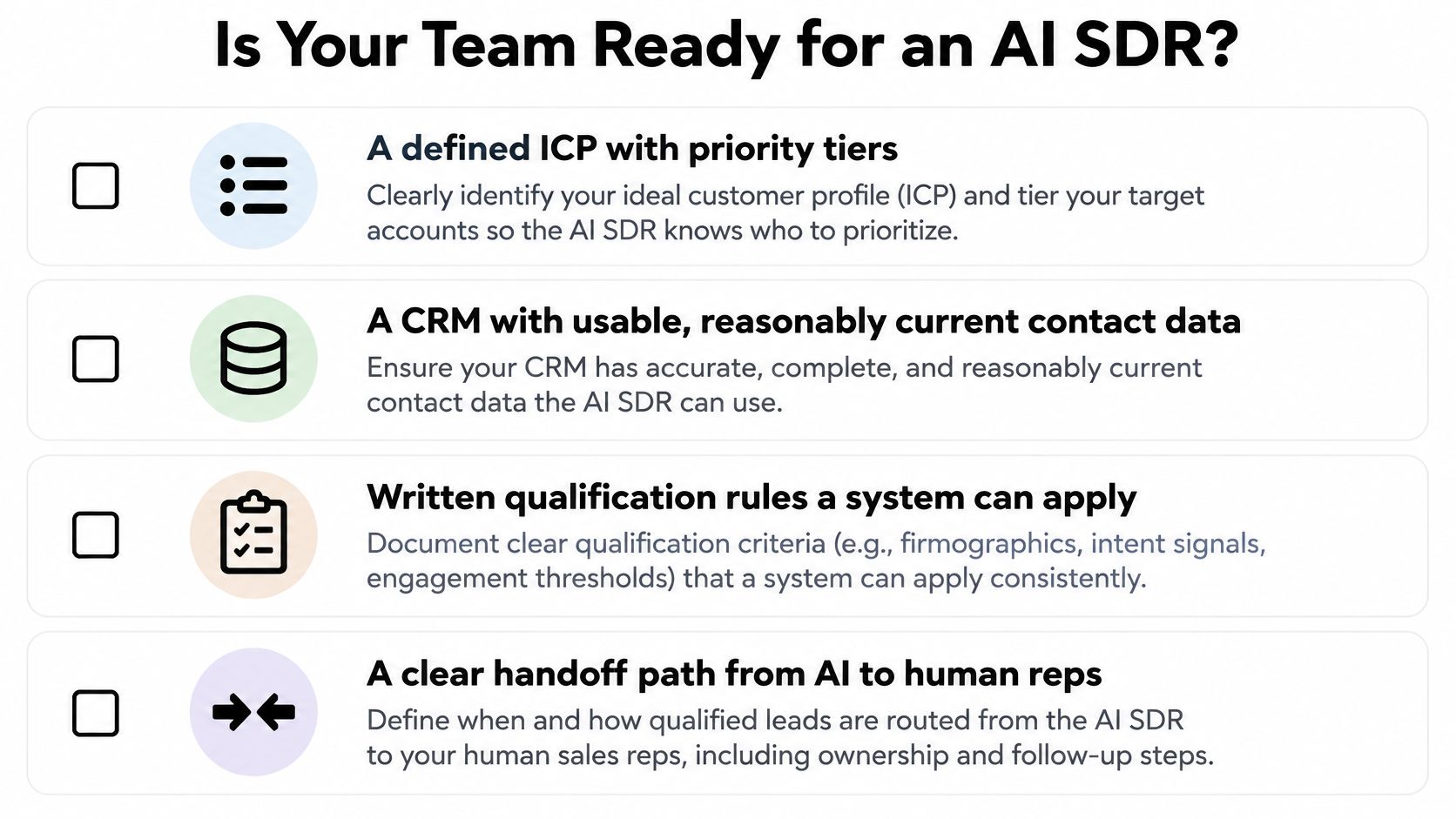
Run this checklist this week, before you take another vendor call:
- A defined ICP with priority tiers, including the accounts you never want contacted.
- A CRM with usable, reasonably current contact data, not a list you bought two years ago.
- Written qualification rules a system can apply, with examples of good and bad fits.
- Approval rules for outbound claims, especially for strategic and enterprise accounts.
- Opt-out and frequency controls that sync across every channel you use.
- A named human owner for each handoff, with a response-time expectation attached.
- Success metrics that go beyond meetings booked, agreed before launch rather than after.
If most boxes are unchecked, fix the data and the rules first. Adoption is early enough that a narrow start costs you nothing: only 1% of 351 surveyed B2B companies reported AI SDRs as a distinct staffing model in the Bridge Group's 2025 benchmark, cited in HubSpot's guide to AI SDRs. You aren't behind a curve that hasn't formed yet.
For a first deployment, choose a narrow, supervised workflow such as account research, CRM hygiene or outreach to low-priority accounts, then expand only once the downstream metrics hold for a full cycle. If you'd rather not map the workflow yourself, a discovery audit is the right first step: it documents current processes, finds the bottlenecks and shows where automation pays off before a tool is chosen, and that phase typically takes 1-2 weeks.
Name the single task that costs your reps the most time this month. That task is your first deployment, and everything else can wait.
MakeAutomation builds the system between your tools, your data and your team, including the AI agents, workflows and handoff rules that keep a person in the loop on decisions that carry consequences. If you're weighing an AI SDR for outbound, we start with a discovery audit that maps your current workflow and shows where automation pays off first, before anyone buys software. Visit MakeAutomation to talk through what a supervised, pipeline-measured deployment would look like for your team.