
Candidate Screening Process for SaaS
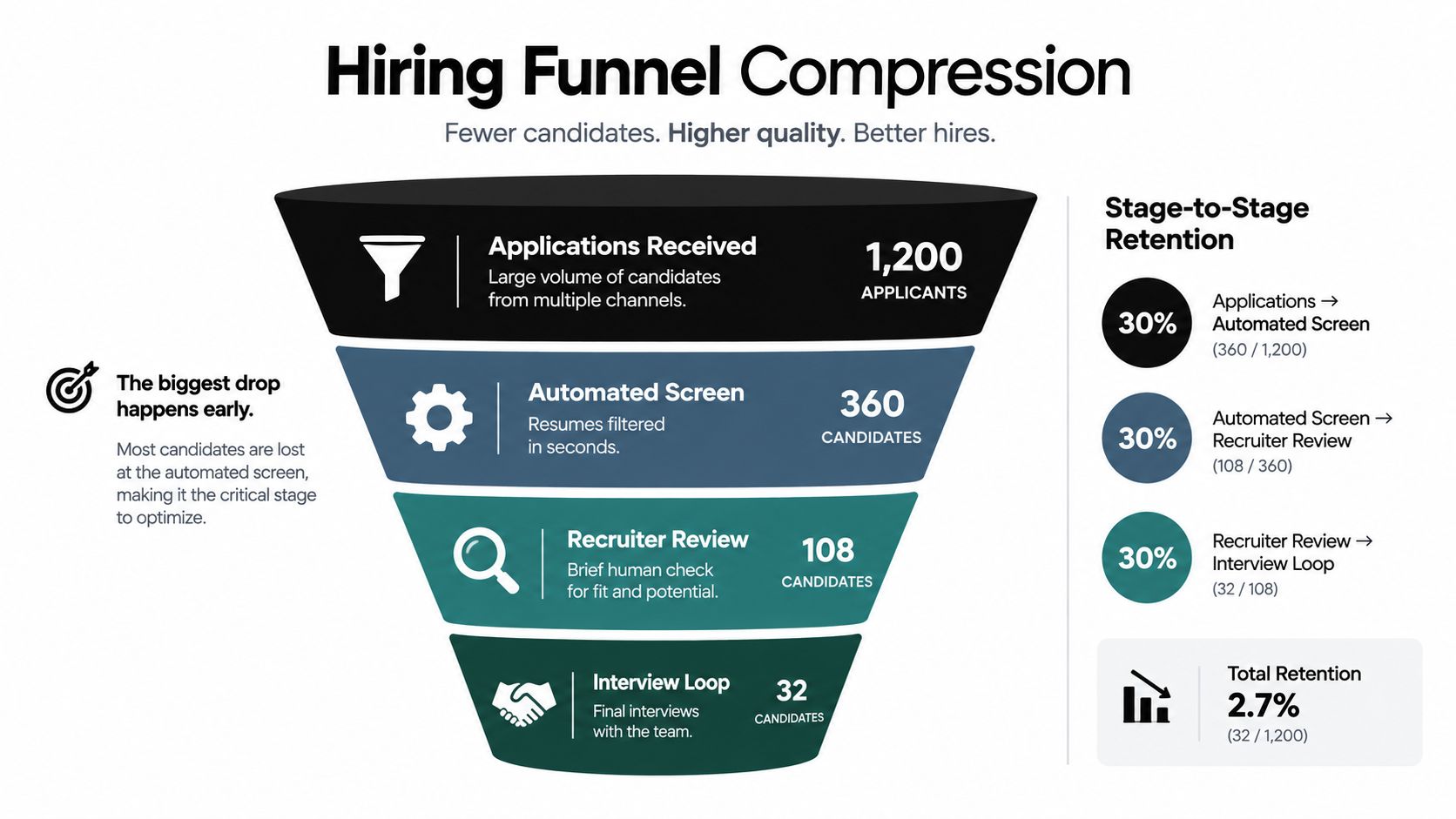
For every 180 people who apply, only one gets hired, an applicant-to-hire ratio of about 0.56%. Roughly 92% of inbound applicants can be filtered out before a recruiter ever speaks to them, according to recruitment funnel benchmarks. That makes the candidate screening process more than an administrative checkpoint. It's the point where your hiring engine compresses the broadest pool into the narrowest set of opportunities.
For SaaS companies, the operational risk runs in both directions. Weak screening floods recruiters with low-signal interviews. Overconfident automation rejects qualified people without a defensible explanation. The process that scales well is structured, evidence-based, auditable, and clear enough that candidates understand what happens next.
The Reality of Modern Hiring Funnel Compression
A high-volume hiring funnel doesn't lose candidates evenly. The greatest reduction happens before a recruiter has a meaningful conversation with an applicant. The benchmark above shows why screening deserves executive attention: the funnel can begin with hundreds of applications, yet only a tiny share reaches interviews and offers.
Screening is the compression point
Many B2B and SaaS teams still describe screening as “reviewing resumes.” That description misses the operational reality. Screening determines which qualifications count, which signals receive priority, which applicants get human attention, and which rejection reasons the company can later explain.
The move from manual review to ATS-assisted filtering has made the first pass faster, but speed introduces a different failure mode. A keyword rule may overlook transferable experience. A knockout question may treat a preference as a requirement. A model trained on historical hiring decisions may reproduce the exclusions embedded in those decisions.
Use funnel benchmarks as diagnostic prompts, not universal targets. If your pass-through rate is unusually low, inspect the criteria and automation rules before assuming the applicant pool lacks quality. If it's unusually high, review whether the role definition is too broad or whether recruiters are spending time on candidates who lack essential capabilities.
Engineer the first decision
A defensible screening system separates three decisions that teams often mix together:
- Eligibility: Does the applicant meet genuine constraints such as required authorization, location, or certification?
- Capability evidence: Has the person demonstrated the skills needed for the role?
- Priority: Among qualified applicants, who should receive attention first?
That separation makes rejection logic easier to audit. It also prevents a recruiter from treating an attractive resume as proof of performance or a missing keyword as proof of incapability.
Practical rule: Every early rejection should map to a documented, job-related criterion that another trained reviewer could understand and apply consistently.
The candidate screening process should therefore be designed like an operating system, not a pile of filters. Define the job evidence first, automate repetitive classification second, and reserve human judgment for context, ambiguity, and exceptions.
Architecting High-Signal Screening Stages
A strong workflow increases candidate effort gradually. Applicants answer essential questions first, demonstrate relevant capability next, and invest in live interviews only after they've produced enough evidence to justify the time.
Start with a role-specific intake
Before publishing a SaaS vacancy, the recruiter and hiring manager should agree on the competencies that matter. For an account executive, that might include discovery, qualification, commercial judgment, and forecast discipline. For a solutions engineer, it could include technical translation, workshop facilitation, and customer problem diagnosis.
Write each competency as observable behavior. “Strategic thinker” is difficult to score. “Can identify the customer's operational constraint, connect it to a proposed solution, and explain the trade-off” gives reviewers something they can evaluate.
Keep true requirements separate from preferences. A preferred industry background shouldn't become an invisible exclusion rule if the person can demonstrate the underlying skill.
Use consistent application questions
Application questions should collect evidence rather than invite generic self-presentation. Ask candidates to describe a relevant decision, explain their contribution, or respond to a realistic role constraint. Use the same questions and evaluation fields for everyone applying to the same role.
Knockout questions belong only at this stage when the requirement is nonnegotiable. If the team can assess it through a work sample or conversation, delaying the filter can preserve more qualified candidates.
Test the work before extending the interview loop
Work samples and job simulations reveal how a candidate approaches the actual job. A content marketer might edit a short product explanation. A customer success candidate might prioritize a set of account risks. A developer might review a small code change or reason through a debugging scenario.
The task must be proportionate, accessible, and clearly connected to the role. Avoid unpaid speculative work that resembles production output. Explain what will be assessed, how long the exercise should take, and who will review it.
A meta-analytic synthesis reports corrected validity estimates of about .42 for structured interviews, .33 for work samples, and .31 for general cognitive ability, while unstructured interviews were weaker at about .19, as summarized in this candidate screening process research overview. The practical implication is straightforward: standardized, job-relevant evidence should carry more weight than conversational chemistry.
Sequence human review around evidence
Blind resume review can reduce the influence of identifying details, but it doesn't replace a good rubric. Recruiters should assess documented experience against role criteria, then examine context where the evidence is incomplete. Hiring panels should receive the same scorecard and defined interview questions rather than improvising separate standards.
For roles involving community work, youth programs, or other trust-sensitive environments, background checks should also be role-specific and appropriately timed. A resource on a criminal background check for volunteers can help teams understand why screening requirements should match the responsibilities and setting.
A well-sequenced workflow reduces wasted effort because the most demanding evaluations happen after baseline evidence exists. Teams looking to connect these stages with operational handoffs can review recruitment process optimization for workflow design considerations.
Integrating ATS and AI Without Amplifying Bias
Automation doesn't create a defensible candidate screening process by itself. It creates a repeatable decision path, which can either preserve sound criteria or scale flawed ones.
Research covering 2025–2026 found significant racial and intersectional discrimination in AI screening simulations. A separate 2026 analysis reported that 26% of Black applicants and 15% of Asian applicants applied to roles where the AI system discriminated against their group, according to the Brookings analysis of bias in AI resume screening. These findings make governance a production requirement, not a policy decoration.
Automate classification, not accountability
An ATS can parse resumes, organize applications, identify missing information, and route candidates to the right queue. AI can summarize evidence or flag profiles for review. Neither should make an unexplained final rejection in a process where the recruiting team can't reconstruct the reasoning.
Configure every automated outcome with a reason code tied to the job specification. “Doesn't match” isn't sufficient. “Required certification not provided” or “work authorization requirement not met” is more useful, provided the criterion is lawful, necessary, and consistently applied.
Keep a human review path for borderline cases. Recruiters should be able to override an automated recommendation, record why they did so, and escalate patterns that suggest the model is misclassifying a group or type of experience.
Build an audit trail
A practical audit log should capture:
- Input criteria: The job version, screening questions, model configuration, and rule set active at the time of review.
- Decision evidence: The candidate information used to support progression or rejection.
- Reviewer action: Whether the outcome came from automation, a recruiter, or a panel.
- Exception handling: Overrides, appeals, accessibility accommodations, and unresolved ambiguity.
- Change history: Who changed a rule, why they changed it, and which requisitions were affected.
Historical hiring data requires special caution. A model can learn that previous hires shared certain schools, employers, career patterns, or language choices, then treat those proxies as quality signals. Audit the inputs for job relevance and remove features that merely reproduce past preferences.
For additional practical ideas, teams can review hiring bias strategies for startups, then adapt them to their jurisdiction, role types, and systems. SaaS teams evaluating tooling can also compare approaches to AI resume screening tools, with explainability and reviewer controls treated as evaluation criteria alongside speed.
Make rejection explainable
A candidate doesn't need access to your entire internal model, but your team should be able to explain the decision in plain language. That requires clear criteria, traceable evidence, and a documented human responsibility for consequential outcomes.
Automation should shorten administrative work. It shouldn't shorten the reasoning required to defend a rejection.
Standardizing Decision Criteria and Scoring Rubrics
A scorecard turns a hiring preference into a shared decision instrument. Without one, each reviewer applies a different definition of "strong," and the hiring manager often resolves disagreement through seniority or intuition rather than evidence.
Start with a small set of competencies tied directly to outcomes in the role. For each one, define what weak, acceptable, and strong evidence looks like. A solutions consultant scorecard might assess discovery quality, technical reasoning, communication, and customer judgment. A demand generation role might assess experimentation, channel diagnosis, measurement discipline, and collaboration with sales.
Weight evidence deliberately
Don't give every signal equal influence. A work sample should usually matter more for demonstrated task execution than a polished resume summary. A structured interview can test reasoning and communication, but it shouldn't override clear evidence from a job-relevant exercise without a documented reason.
“Culture fit” needs careful translation. Score behaviors that support the company's working principles, such as direct communication or reliable follow-through. Don't score similarity to the interviewer, shared interests, accent, or an undefined sense that someone would “fit in.”
A simple rubric can use a common scale, provided the organization defines each level with examples. The scale itself matters less than consistent interpretation.
| Screening Method | Corrected Validity Estimate | Best Use Case in SaaS |
|---|---|---|
| Structured interview | About .42 | Testing defined competencies through consistent questions |
| Work sample | About .33 | Observing role-relevant execution |
| General cognitive ability | About .31 | Evaluating reasoning where the role genuinely requires it |
| Unstructured interview | About .19 | Limited exploratory context, never the sole screen |
The estimates in the table come from the meta-analytic screening method synthesis. They aren't a substitute for local validation, but they reinforce a useful design principle: the closer an assessment is to the work and the more consistently it is scored, the more useful its signal tends to be.
Calibrate before the process goes live
Have reviewers score the same sample responses and discuss disagreements before opening the requisition. This reveals ambiguous criteria early. After interviews begin, review score distributions and written evidence, not just final selections.
Require comments that describe what the candidate did or said. “Great communicator” is an impression. “Explained the implementation risk, asked a clarifying question, and proposed a realistic mitigation” is evidence another reviewer can inspect.
The hiring manager can make the final decision, but the record should show which evidence supported it and where reasonable disagreement remained.
Preserving Candidate Experience at Scale
A fast screening process can still feel broken. Candidates judge the system through the gaps between actions, especially after submitting an application or completing an assessment.
A 2026 candidate-experience study reported that post-application engagement fell from 24/100 in 2023 to 9/100 in 2026, suggesting that automation hasn't automatically improved the applicant journey, as reported by candidate experience survey findings. The lesson isn't to abandon automation. It's to replace silence with precise, timely information.
Treat communication as part of screening
Every automated message should answer three questions: what happened, what happens next, and when the candidate should expect an update. Candidates should know whether their application is under review, whether an assessment is required, how long it should take, and who to contact if they need an accommodation.
A rejection message doesn't need to expose proprietary scoring logic. It should avoid misleading personalization and shouldn't imply human review if no human reviewed the application. Where appropriate, provide a broad, accurate reason tied to the published requirements.
For interviews and assessments, set expectations before the candidate commits effort. Include the evaluation areas, format, estimated time, and deadline. A clear brief reduces anxiety and produces more useful evidence because candidates spend less energy guessing what the company wants.
Monitor dropout as a quality signal
If applicants begin assessments but fail to complete them, don't automatically label the candidates uncommitted. Check whether the task is too long, the instructions are unclear, the platform is difficult to access, or the company has delayed communication.
Use a simple service standard for each stage. Assign an owner for candidate updates, create automatic reminders for internal reviewers, and send closure messages when a requisition changes status. These controls matter particularly in competitive SaaS hiring, where strong candidates may be evaluating several companies simultaneously.
A practical guide to improving candidate experience can help teams map these touchpoints and identify where automation should support, rather than replace, human communication.
Candidates can accept a demanding assessment more readily than an unexplained delay. Effort feels reasonable when the process is transparent.
Candidate feedback should reach the process owner, not disappear into a survey database. Group comments by stage and failure mode, then change the workflow when the same confusion appears repeatedly.
Measuring Success and Auditing Your Funnel
A screening dashboard should show two different stories. Operational metrics tell you whether the process moves candidates efficiently. Governance metrics tell you whether it moves them fairly, consistently, and with enough evidence to defend the decision.
Don't optimize only for speed. A shorter review time can reflect better automation, or it can reflect premature rejection. A higher interview conversion rate can indicate stronger screening, or it can mean the initial bar has become too loose.
Pair efficiency metrics with control metrics
Track time in each stage, screening completion, progression by source, reviewer workload, and the reasons candidates leave the funnel. These measures help identify queues, unnecessary steps, and automation that isn't reducing meaningful work.
Then add a separate governance view:
- Decision consistency: Compare how different reviewers apply the same rubric and investigate material divergence.
- Reason-code quality: Check whether each rejection has a specific, job-related explanation rather than a generic label.
- Override patterns: Review when recruiters overturn automated recommendations and whether overrides cluster around particular candidate backgrounds or experience types.
- Adverse-impact signals: Examine progression outcomes across relevant demographic groups where lawful and appropriately governed, then escalate unexplained disparities for review.
- Change control: Record modifications to screening questions, thresholds, models, and scorecards so the team can connect process changes to later outcomes.
The benchmark of one hire for every 180 applicants is a useful reminder that small errors at the screening gate can affect a large population of candidates, as documented in the recruitment funnel benchmark. Don't treat that ratio as a target. Use it to ask where your funnel compresses and whether the compression reflects genuine job requirements.
Audit the funnel by decision point
Run reviews around specific transitions rather than staring at a single end-to-end metric. Compare applications to automated screens, automated screens to recruiter review, recruiter review to interviews, and interviews to offers. For each transition, inspect the criteria, elapsed time, rejection reasons, reviewer behavior, and candidate feedback.
The review should produce actions, not just charts. Retire a filter that lacks a clear job relationship. Rewrite a question that creates ambiguity. Retrain reviewers whose scoring differs from the panel standard. Require a human checkpoint where the system can't provide adequate evidence.
Balance speed, quality, and defensibility
Speed is valuable when it removes waiting and repetitive administration. Quality is valuable when later-stage evidence supports a sound hiring decision. Defensibility is valuable when the organization can explain how it reached that decision and demonstrate that its process is governed.
A mature candidate screening process reports all three. It also assigns owners, keeps versioned records, and reviews candidate experience alongside funnel conversion. That combination lets talent leaders improve throughput without turning automation into an unaccountable gatekeeper.
MakeAutomation helps B2B and SaaS teams automate recruitment workflows, including application processing, candidate routing, notifications, and AI-supported pre-screening against customized criteria. Visit MakeAutomation to connect screening automation with clearer handoffs, documented decisions, and a more measurable hiring operation.