Recruitment Process Optimization: A SaaS Playbook for 2026
The average recruitment process takes 36 days, while 60% of candidates expect it to take less than 30. That gap isn't an HR inconvenience. It's a growth constraint, especially in SaaS where open roles delay product delivery, pipeline coverage, customer support capacity, and manager focus. A single failed recruitment can cost around $70,000 in lost productivity and expenses, according to these recruiting statistics.
For a growth-stage SaaS company, recruitment process optimization is really about one question. Can your team repeatedly identify, attract, assess, and close strong talent before a competitor does?
The companies that build that capability stop treating hiring like a sequence of admin tasks. They run it like an operating system. The workflow is documented. SLAs are clear. Automation handles the repetitive work. Recruiters and hiring managers spend their time where human judgment matters.
Why Your SaaS Hiring Process Is Leaking Revenue
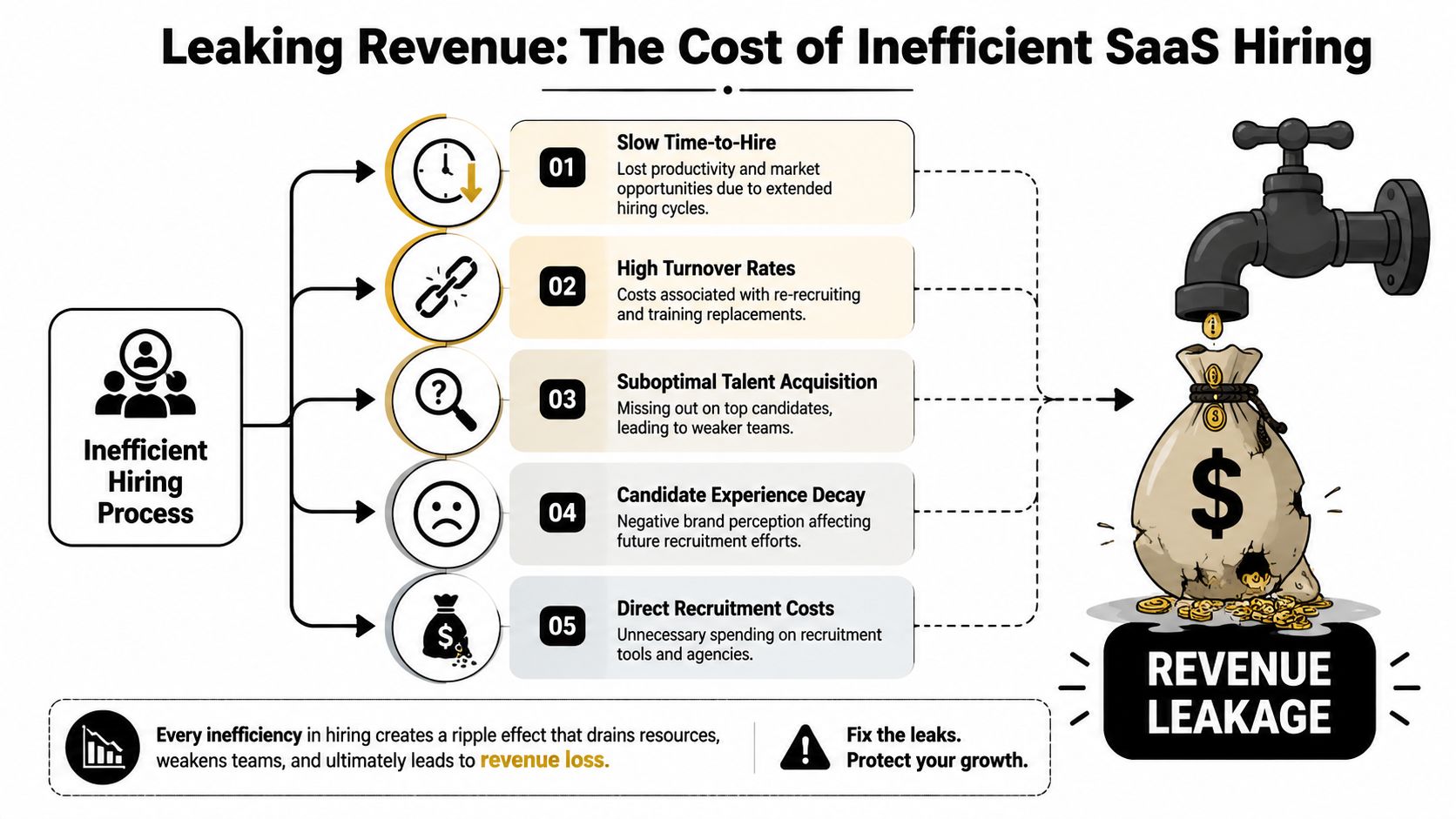
A role that stays open for 36 days is not just a recruiting delay. In a 7-figure SaaS company, it can slow pipeline creation, push product deadlines, stretch support capacity, and pull senior operators into coordination work that should have been automated weeks earlier.
That is the true cost of a weak hiring process. Revenue slips through small operational failures that stack up fast. A recruiter waits on feedback. A hiring manager reschedules a panel. An offer sits in approval for three days because compensation was never aligned upfront. None of those issues look dramatic on their own. Together, they create a slow, expensive funnel that stronger competitors can beat.
Map your team's real workflow
Start with the process your team runs in practice, not the polished version documented in HR.
Map the path from approved headcount to accepted offer. Include every handoff, system, approval, and delay: sourcing, application review, recruiter screen, hiring manager interview, panel, assessment, reference check, offer draft, and sign-off. Then document three operating details for each stage:
- Owner: Who is responsible for moving the candidate forward
- Time in stage: How long candidates sit before the next action
- Exit reason: Why candidates are rejected, withdraw, or go silent
This is an operational efficiency problem as much as a talent problem. Teams that already track operational efficiency metrics that expose handoff delays and bottlenecks usually find the same patterns in hiring. Work queues build in hidden places. Accountability gets fuzzy. Cycle time expands because nobody owns the gap between steps.
Find the leaks that cost you top candidates first
The longest stage is not always the most expensive one. The expensive stage is the one that breaks candidate momentum or forces your team into manual work at scale.
In SaaS hiring, the common leaks are predictable:
- Resume review lag: Strong applicants lose interest while the team catches up
- Scheduling drag: Manual coordination adds days and creates avoidable drop-off
- Repeated interviews: Candidates hear the same questions from different people and conclude the company lacks alignment
- Slow feedback loops: Recruiters cannot close talent if interviewers treat scorecards like optional admin
- Late-stage approvals: Offers stall because finance, leadership, or compensation partners were never brought in early
A useful rule is simple. If a stage does not improve hiring accuracy or candidate experience, remove it, combine it, or automate it.
I have seen this most often in growth-stage SaaS teams that add steps as a safety measure. One extra interview becomes two. A founder review gets added for reassurance. Reference checks happen after verbal close instead of before. The team believes it is reducing risk. In practice, it is increasing delay, inconsistency, and candidate loss.
Poor hiring process creates downstream churn
Revenue leakage does not stop at acceptance rate.
A messy process often produces weak role matching, unclear expectations, and rushed decisions at the end of the funnel. That shows up later as missed ramp targets, manager frustration, and avoidable attrition. Teams working on strategies to reduce employee turnover often find that retention problems started much earlier, inside the interview design, scorecard quality, and approval discipline.
This is why recruitment process optimization matters beyond speed. The goal is to build a hiring engine that can scale with SaaS growth, use AI and automation to remove low-value manual work, and give human time back to evaluation, selling, and closing. Companies that get this right do not just fill roles faster. They create a repeatable advantage in competitive talent markets.
Audit the process before you add more software
Do a blunt review of the current funnel first.
Ask five questions:
- Where do qualified candidates wait without progress?
- Which stage causes the highest withdrawal rate?
- Which interview produces the weakest signal for hiring decisions?
- Which approvals exist for control, and which exist from habit?
- Which steps can AI or automation handle without lowering quality?
Clear answers tell you where process design is failing. Vague answers usually mean the team is about to automate confusion instead of fixing it.
Define Success with Data-Driven Recruitment KPIs
A hiring process doesn't improve because the team says it feels better. It improves when the funnel gets faster, cleaner, more predictable, and more likely to produce strong hires. That requires a KPI set that covers speed, quality, cost, and candidate experience at the same time.
Too many SaaS teams track one headline number and call it a strategy. Time-to-fill matters, but it doesn't tell you whether the process is attracting the right talent, converting strong candidates, or producing hires who stay and perform.
Build a balanced scorecard
A useful hiring scorecard has four categories. Each one should connect to an operational decision.
| Metric Category | KPI | What It Measures | SaaS Benchmark Goal |
|---|---|---|---|
| Speed | Time-to-hire | How quickly candidates move from application to decision | Maintain a fast, stage-controlled process |
| Funnel efficiency | Interview-to-offer conversion rate | Whether interview stages are filtering well or creating noise | Improve through calibrated scorecards |
| Quality | Quality-of-hire | New hire success through early performance and retention signals | Track first-90-day performance and 12-month retention |
| Candidate experience | Candidate drop-off rate | Where strong applicants abandon the process | Reduce abandonment with fast communication SLAs |
| Sourcing | Source effectiveness | Which channels produce top hires, not just applicants | Shift spend toward channels producing stronger hires |
| Cost | Cost-per-hire | Process efficiency across internal and external recruiting effort | Lower manual work with automation |
Those categories align with how operations teams already think about performance. If you need a stronger measurement framework, this guide to operational efficiency metrics is useful because it forces you to separate activity from output.
Put candidate behavior into the KPI model
Many SaaS teams misread the market. They optimize for active applicants and ignore the candidates who need speed and clarity before they engage.
According to Viva IT's hiring funnel analysis, passive talent represents 70% of the global workforce, and 50% of candidates abandon applications because the process is too lengthy. That makes communication SLAs a core KPI, not a courtesy.
Track these operational commitments like you would customer support targets:
- Application-to-first-response SLA: How fast someone hears back after applying.
- Interview scheduling SLA: How quickly the next step gets booked after a pass decision.
- Feedback SLA: Whether candidates receive a decision update within the agreed window.
- Stage aging: The median amount of time candidates spend in each stage.
Hiring teams lose strong candidates long before the final interview. Most of the damage happens during silence.
Set KPIs by role family, not one universal benchmark
An enterprise AE process and a backend engineer process shouldn't look identical. The scorecard categories stay the same, but the emphasis changes.
For example:
- Sales roles: Watch source effectiveness, speed to first interview, and interview-to-offer conversion closely. Delay hurts more because good candidates get pulled into parallel processes fast.
- Engineering roles: Focus harder on assessment relevance, panel consistency, and quality-of-hire signals after onboarding.
- Customer success roles: Candidate communication quality matters because the role itself requires communication strength. The interview process should reflect that.
Keep the scoreboard visible and boring
The best recruiting KPI systems aren't complicated. They're visible, reviewed regularly, and tied to decisions.
Use your ATS dashboard to surface:
- Stage-level aging
- Drop-off by stage
- Offer acceptance patterns
- Source quality
- Hiring manager response times
- Early quality-of-hire indicators
Don't let these metrics live in quarterly slides. Review them in operating rhythm. If a metric changes, someone should know what to test next.
Blueprinting Your Optimized B2B Hiring Workflow
The strongest hiring workflows are compact, documented, and hard to misinterpret. They don't depend on a heroic recruiter or an unusually responsive hiring manager. They run the same way every time, with enough structure to protect speed and enough flexibility to handle role-specific nuance.
A lot of teams get this backward. They buy an ATS, layer on scheduling software, and then automate a process that was messy to begin with. The sequence should be the opposite. Simplify first. Tool second.
According to eLearning Industry's recruiting process optimization guide, 75% of companies report a meaningful reduction in time-to-hire when they streamline the hiring funnel before investing in new tools. The same source points to two changes that matter most: replacing long interviews with focused assessments and using standardized scorecards.

Start with the role mission, not the job description
Before you map stages, define what success looks like in the seat.
For each role, write down:
- Core mission: Why this role exists in the business.
- Top outcomes: What the person needs to achieve in the first 90 days.
- Critical competencies: The skills and behaviors tied to those outcomes.
- Disqualifiers: The gaps that make the hire too risky.
This changes the whole process. Instead of asking broad interview questions and hoping a pattern emerges, you evaluate candidates against known outcomes. SaaS companies that hire well don't screen for “impressive.” They screen for fit with the work that needs to get done.
Use fewer stages with tighter intent
Most bloated hiring funnels are a sign of low confidence. The team doesn't trust its evaluation method, so it adds another round.
A cleaner workflow usually looks like this:
- Application or sourced entry
- Initial screen
- Focused assessment
- Structured panel or manager interview
- Decision and offer
That doesn't mean every role gets the exact same sequence. It means every stage must have a job. If two interviews assess the same thing, one should go.
A focused assessment works better than a long, open-ended conversation because it creates comparable evidence. For a sales role, that might be a discovery call simulation. For an operations role, a prioritization exercise. For customer success, a scenario on renewal risk or stakeholder communication.
Standardize scorecards before panel interviews
Structured scorecards do two things. They improve decision quality, and they reduce the political noise that creeps into hiring debriefs.
Build scorecards with pre-defined competencies and weightings. Every interviewer should score only the areas they were assigned to assess. If one person is testing technical depth, don't let them dominate the decision on communication, motivation, and culture contribution too.
Use practical scoring prompts such as:
- Evidence of handling ambiguity
- Ability to prioritize under pressure
- Clarity of communication
- Problem-solving quality
- Role-specific functional skill
A scorecard should force evidence into the room. It shouldn't give opinion a nicer format.
Enforce a feedback rule with consequences
A structured process collapses if feedback arrives whenever people feel like sending it.
Set a 48-hour feedback rule after every interview stage. The candidate should never sit in limbo because an interviewer forgot to submit notes. If feedback misses the SLA, the recruiting lead should escalate. This isn't about being strict for its own sake. It protects process momentum and keeps candidate communication honest.
For especially high-priority SaaS roles, I also recommend stage owners. One person owns application review. Another owns scheduling. Another owns final approvals. Shared accountability usually becomes no accountability.
A practical blueprint you can document today
Use this workflow as a baseline:
| Stage | Owner | Purpose | Output |
|---|---|---|---|
| Intake | Hiring manager and recruiter | Align on role mission, outcomes, and scorecard | Approved hiring brief |
| Sourcing and application review | Recruiter | Build initial pipeline and screen for baseline fit | Shortlist |
| Screen | Recruiter | Confirm motivation, logistics, and top-level fit | Pass or reject |
| Assessment | Hiring team | Evaluate role-specific capability against outcomes | Scored evidence |
| Final interview | Hiring manager or panel | Validate decision-critical areas only | Final recommendation |
| Offer | Recruiter and approver | Close candidate quickly and clearly | Accepted or declined offer |
That blueprint is simple enough to enforce and detailed enough to optimize. Once it runs consistently, automation has something stable to amplify.
Integrating AI and Automation into Your Funnel
Automation is the optimization layer. It doesn't fix a broken workflow, but it makes a good one scale.
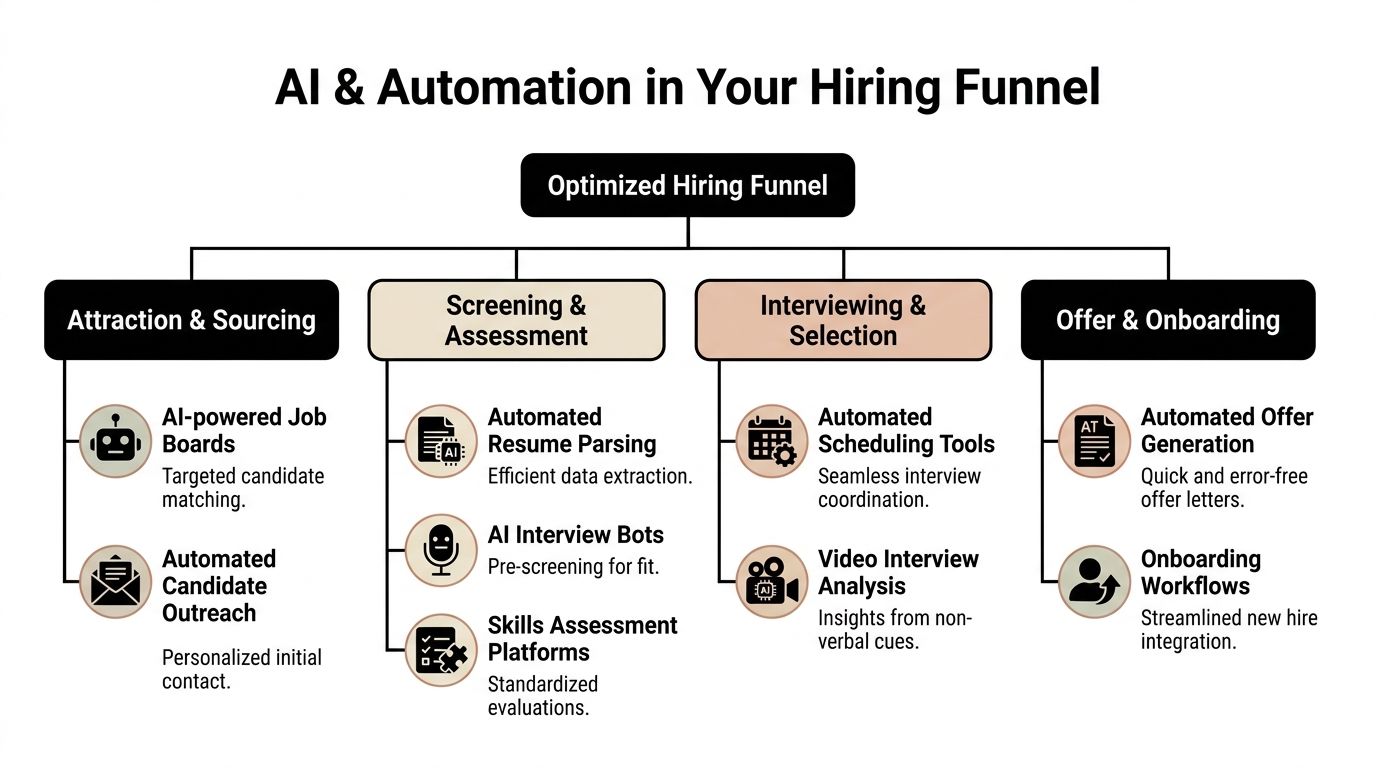
That distinction matters because SaaS founders often hear “AI recruiting” and think of magic sorting, instant fit scoring, or full-cycle hiring on autopilot. In practice, the best use of AI and automation is narrower and more valuable. It removes repetitive tasks, cuts response time, improves consistency, and gives recruiters more room for relationship-building and judgment.
The business case is strong. Companies that are most skilled at recruiting achieve 3.5 times more revenue growth and 2.0 times higher profitability, and one key driver is automation and data-led optimization that can reduce cost-per-hire by several thousand dollars per role while improving quality-of-hire, according to Cadient Talent's analysis of recruitment optimization strategies.
Where automation creates real advantage
The best recruiting automations sit in the gaps where humans are slow, inconsistent, or overloaded.
Use your ATS and connected tools to automate:
- Stage transitions: Move candidates forward when scorecards are submitted or knockout criteria are met.
- Candidate communication: Trigger acknowledgment emails, interview prep notes, reminders, and status updates.
- Scheduling workflows: Let candidates self-select from approved time slots instead of waiting for calendar back-and-forth.
- Pre-screening questions: Filter for essential criteria before recruiter review.
- Task assignment: Automatically create follow-ups for recruiters and hiring managers at each step.
For scheduling specifically, this matters more than generally expected. Good candidates read process friction as organizational friction. Tools built for automated interview scheduling software can remove one of the most common dead zones in the funnel.
Add AI where pattern recognition beats manual effort
AI has a clear role in sourcing and early screening when the input is structured and the output is reviewed.
Useful applications include:
- AI-assisted sourcing: Build candidate lists from platforms like LinkedIn based on role-specific criteria.
- Resume parsing and tagging: Extract structured profile data into the ATS so recruiters don't manually re-enter information.
- Blind review support: Remove identifying details in early screening to keep the focus on relevant qualifications.
- Chatbots for first-touch interaction: Handle common questions, logistics, and qualification prompts.
- Assessment routing: Send the right exercise automatically based on role or hiring track.
These uses are practical because they reduce manual load without pretending that hiring is fully objective. AI should surface options and speed up process execution. It shouldn't replace calibrated human judgment on final fit.
A short walkthrough can help your team visualize where these automations fit into the stack:
What not to automate
At this point, teams get themselves into trouble.
Don't automate:
- Final decision-making: Score aggregation can help, but hiring still needs accountable human judgment.
- Sensitive rejection messages for late-stage finalists: Those deserve context and tact.
- Every candidate interaction: Over-automation can make the process feel transactional.
- Broken workflows: If managers don't submit feedback now, automating reminders alone won't solve the underlying issue.
Automation should remove admin, not empathy.
A simple build order for SaaS teams
If you're implementing this from scratch, sequence matters:
- Automate application acknowledgments and stage-based updates.
- Add self-scheduling for screens and interviews.
- Deploy knockout questions and workflow rules inside the ATS.
- Introduce AI sourcing for the hardest-to-fill roles.
- Add blind screening, chatbot support, and reporting dashboards once the process is stable.
That order keeps the team focused on throughput and consistency first. More advanced AI features work better after you've already defined stage ownership, scorecards, and SLAs.
From Process to Engine with SOPs and Continuous Improvement
A better hiring process is useful. A repeatable hiring engine is what scales.
The difference is documentation and feedback loops. If the workflow only works when your best recruiter is online and your most organized hiring manager is involved, it isn't an operating system yet. It's tribal knowledge. That breaks the moment hiring volume rises, a recruiter leaves, or the company opens roles across multiple teams at once.
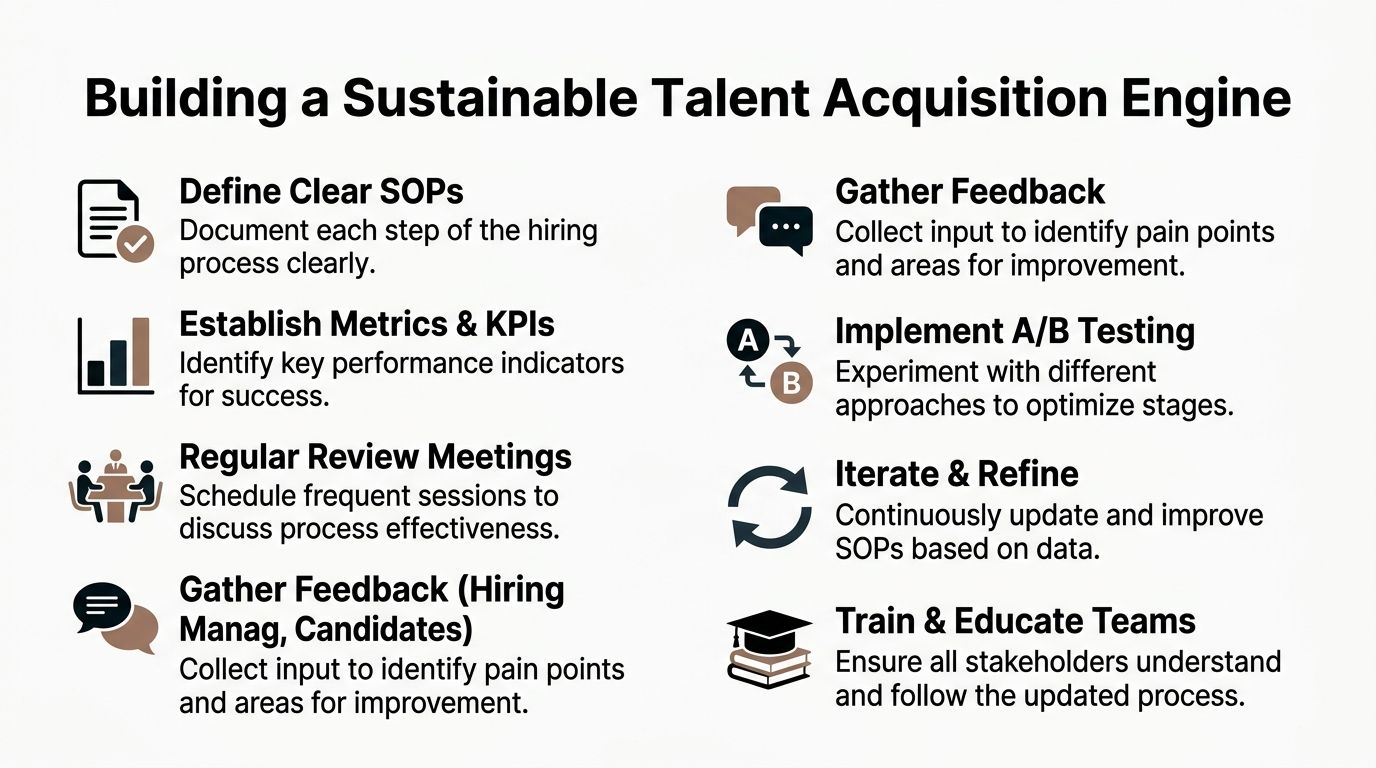
The strongest SaaS hiring teams document the process in enough detail that a new recruiter, coordinator, or hiring manager can execute it without guesswork. Then they review outcomes regularly and test small changes instead of redesigning the whole funnel every quarter.
Write SOPs that people will actually use
Most SOPs fail because they're either too abstract or too long.
A workable hiring SOP should answer five things for each stage:
- Trigger: What starts the step
- Owner: Who is responsible
- Action: What they must do
- SLA: How fast it must happen
- Output: What must exist before the candidate moves on
If you need a clean framework for documenting this, this guide on how to write standard operating procedures is a solid reference for turning repeated work into something scalable.
Use separate SOPs for:
- Intake and role briefing
- Sourcing and outreach
- Application review
- Interview scheduling
- Interviewer prep and scorecard completion
- Offer approval and delivery
- Candidate communication standards
- Data review and reporting cadence
Keep them in one accessible place. Link templates, scorecards, approved email sequences, and escalation rules inside each SOP so nobody has to hunt across folders or Slack threads.
Create a biweekly hiring review rhythm
At this stage, recruitment process optimization becomes an engine instead of a project.
Hold a recurring review with recruiting, hiring managers, and whoever owns recruiting operations. Keep the agenda focused on performance, not anecdotes. Review stage aging, conversion points, response times, and candidate drop-off. Then pick one issue to test.
According to Noxx's breakdown of recruitment process optimization, optimized processes can improve interview-to-offer conversion from 20% to 35% with calibrated scorecards. The same source says that using A/B testing and data-driven reviews can reduce time-to-hire by 20% in six months, while inconsistent interviewer effectiveness can lower retention by 25%.
That's why one-hypothesis reviews work. They force teams to stop arguing in generalities.
Examples of useful hypotheses:
- A shorter application form will reduce early abandonment
- A revised outreach message will improve response quality
- Replacing one panel round with a focused assessment will improve decision speed
- Mandatory interviewer calibration will reduce weak signal in debriefs
- A stricter feedback SLA will cut late-stage withdrawals
Test small changes, not heroic redesigns
Most process improvement fails because teams bundle too many changes together. Then nobody knows what worked.
Use controlled experiments instead:
| Test area | Version A | Version B | What to watch |
|---|---|---|---|
| Job ad copy | Feature-heavy description | Outcome-focused description | Qualified applicant quality |
| Outreach messaging | Generic company pitch | Personalized role mission | Response quality |
| Screening format | Long recruiter screen | Short structured screen plus assessment | Pass-through quality |
| Interview design | Multiple broad interviews | Fewer focused interviews | Interview-to-offer conversion |
| Candidate updates | Manual updates | SLA-based automated updates | Drop-off and response time |
Better recruiting teams don't guess less because they're smarter. They guess less because they measure more.
Train interviewers like operators, not volunteers
One of the least appreciated bottlenecks in hiring is interviewer inconsistency. A process can be beautifully designed and still underperform if interviewers improvise.
Train every interviewer on:
- The role outcomes they're evaluating
- The competencies assigned to their stage
- How to use the scorecard
- What acceptable evidence looks like
- When feedback is due
- What they should never assess outside scope
Calibration matters. If one manager scores harshly and another passes everyone they like personally, your data becomes noise. Then the team adds more interviews to compensate, and the funnel slows down again.
A practical rollout sequence
If you're rebuilding from a messy baseline, execute in phases.
Week 1 to 2
- Audit current workflow and stage aging
- Define role mission and hiring scorecards for priority roles
- Remove duplicate or low-value interview steps
Week 3 to 4
- Document SOPs for intake, review, scheduling, and feedback
- Set SLAs for response time and interviewer turnaround
- Configure ATS workflow rules and communication templates
Week 5 to 6
- Train hiring managers and interviewers on structured evaluation
- Launch focused assessments for selected roles
- Start biweekly hiring review meetings
Week 7 to 8
- Run one A/B test on job ads, messaging, or interview design
- Review conversion rates and drop-off points
- Update SOPs based on actual usage, not theory
This is the shift that matters most. Recruitment process optimization stops being a one-time cleanup effort and becomes a capability the business can rely on during hiring surges, product launches, market expansion, and team restructuring.
If your SaaS company needs help turning a messy hiring workflow into a scalable automation-driven system, MakeAutomation can help design the SOPs, workflows, ATS automations, and AI-powered operating layer that make recruiting faster, cleaner, and easier to scale.