
Webhook Automation: A Practical SaaS Guide
A billing provider emits a subscription update, but your integration doesn't notice until the next polling cycle. By then, the customer's access state is stale, the finance team is looking at different information, and an enterprise client is asking why a cancellation hasn't taken effect. The endpoint itself may be only a few lines of code. The operational failure behind it can involve retries, duplicate events, queue pressure, and state drift across several systems.
That's the shape of webhook automation in production. A webhook is not merely an HTTP route that receives JSON and calls a function. It's an entry point into a distributed system, where delivery can be delayed, duplicated, reordered, or abandoned after repeated failure. Reliable implementations separate ingestion from processing, persist evidence before acknowledging delivery, and provide a way to inspect and repair events that don't complete normally.
Why Event-Driven Architecture Replaced Polling
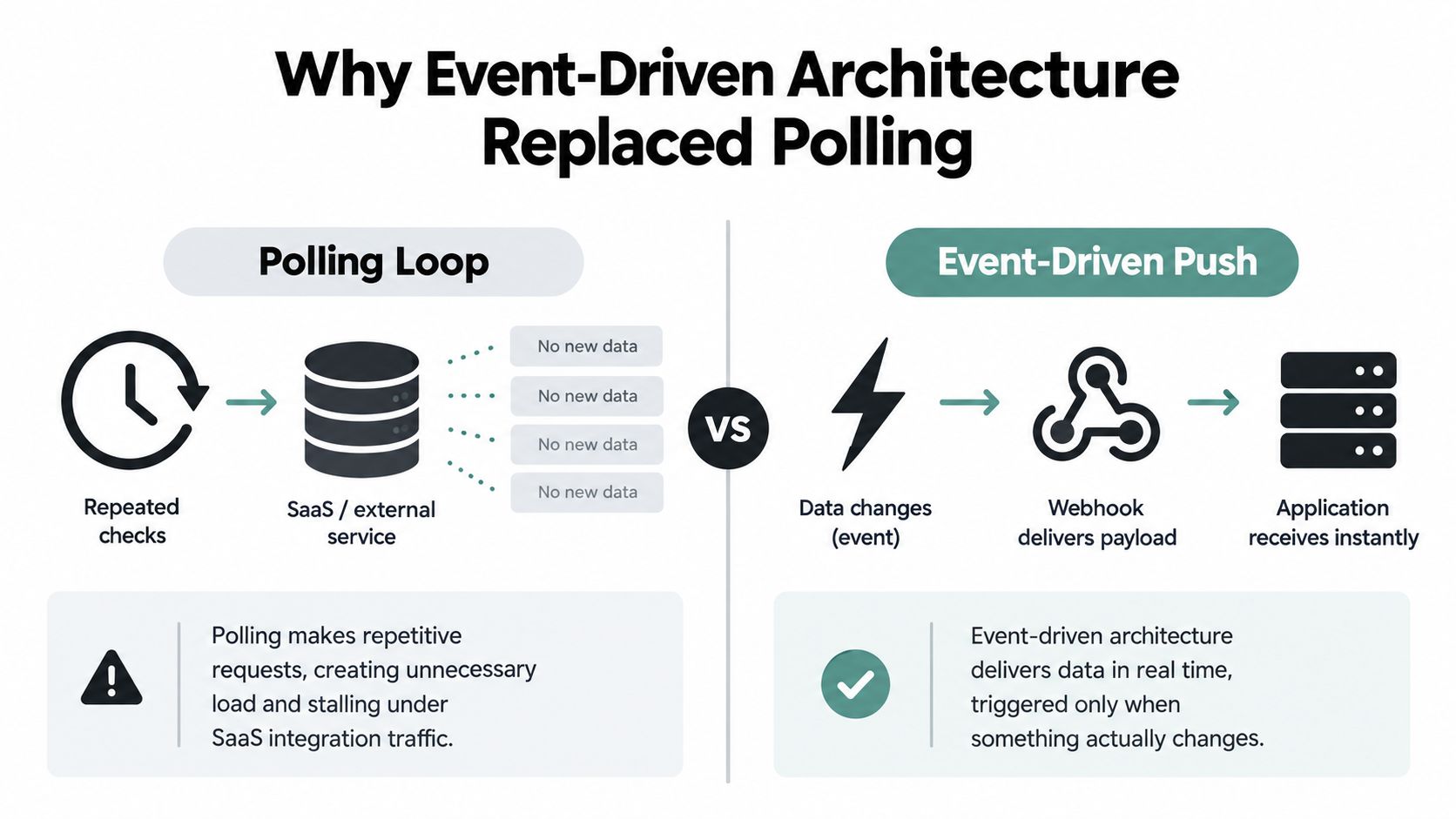
A polling job can report success while the customer's subscription remains outdated. A cursor may skip a narrow boundary, a temporary API error may affect one page, or the source may change between requests. No single failure necessarily produces an alert. The billing update, CRM change, or onboarding task remains stale.
Polling also forces an operational compromise. A frequent schedule increases requests, database work, and provider load. A slower schedule leaves users waiting for changes that have already occurred. The pattern is understandable and can suit low-value data or providers without event support, but it becomes expensive when several B2B systems must remain synchronized.
Webhooks reverse the direction of work. The source sends an event when a relevant change occurs, allowing the receiving system to spend capacity processing known work rather than repeatedly checking whether work exists. This suits real-time data processing across billing, access control, fulfillment, and customer communication workflows.
Adoption changes the architectural default
Webhook support is common among major APIs. The 2023 State of Webhooks research reported support in 83% of the APIs studied, while its 2024 update reported 85%. The more practical implication is architectural: when an integration partner exposes event callbacks, frequent polling chooses an indirect interface and adds another place for missed state changes.
The Postman 2025 State of the API Report analysis found that webhooks were used by 50% of API developer teams, compared with 35% for WebSockets. WebSockets remain appropriate for long-lived, bidirectional communication. Webhooks usually fit service-to-service notifications better because the sender can deliver an event without maintaining a continuous connection.
The migration moves responsibility rather than removing it. A production webhook system needs authenticated requests, durable event records, idempotent processing, retries, and a dead-letter path for messages that cannot complete. Without those controls, an endpoint can return success while downstream work disappears, leaving silent data loss across customer and finance systems.
That trade is worthwhile when an event controls access, billing, fulfillment, or communication. Event-driven delivery reduces unnecessary requests, but reliability depends on treating each webhook as part of a distributed system, not as a lightweight HTTP handler. The useful design question is whether the team can prove that every important event was accepted, processed, or deliberately quarantined.
Designing the Ingestion and Acknowledgment Flow
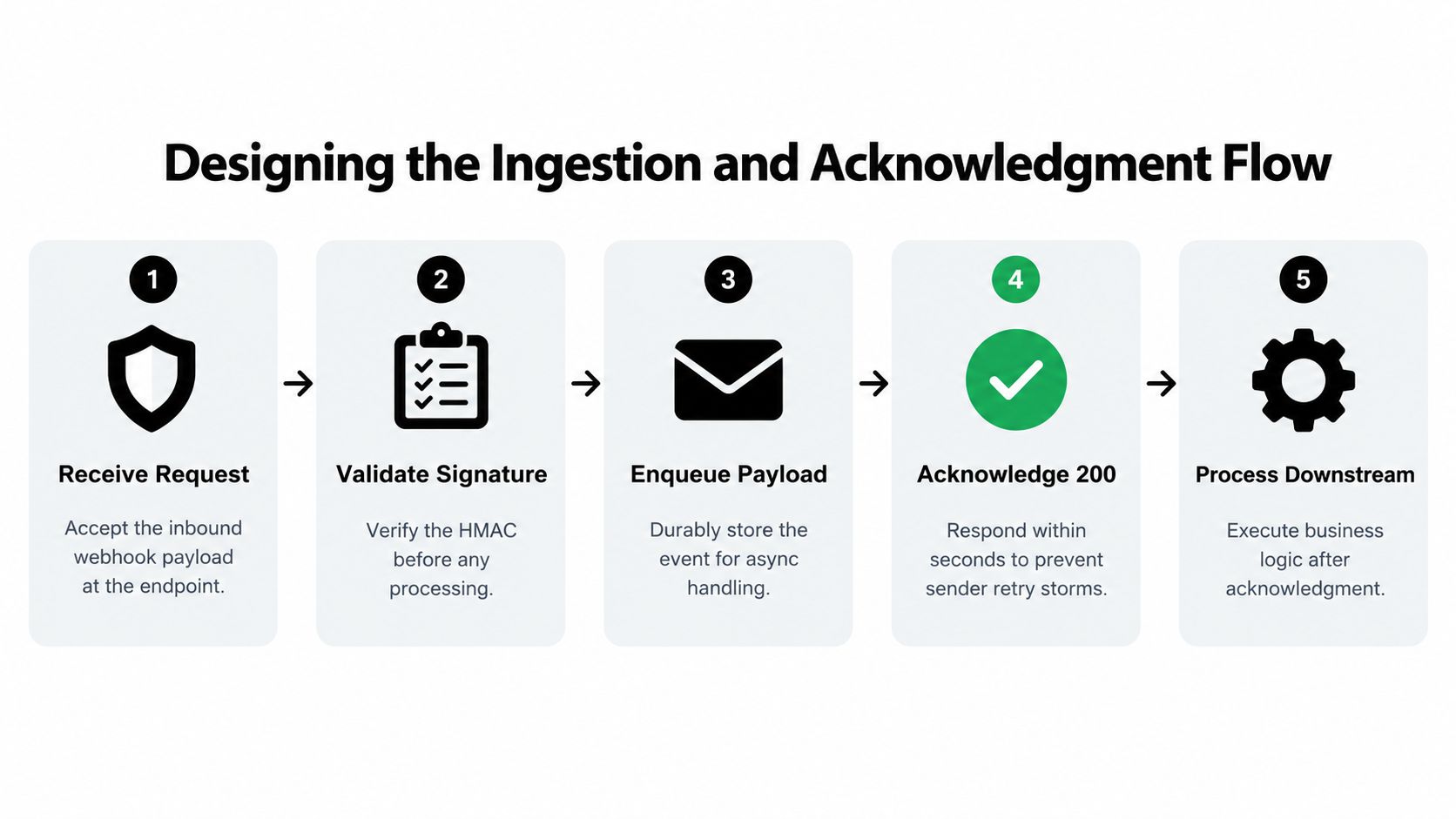
A webhook receiver should behave like a controlled ingestion valve. Its first responsibility is to accept and durably record the event. Its second is to tell the sender that delivery succeeded. Business processing comes later.
Use this sequence:
- Receive the request. Accept the raw body, headers, delivery identifier, and provider metadata. Keep the raw payload available because signature verification often depends on the unparsed body, and later debugging may require the original message.
- Perform lightweight validation. Check that the request uses the expected method, content type, event format, and basic size limits. Reject malformed input without invoking application services.
- Verify authenticity. Calculate the provider's expected signature from the raw body and shared secret, then compare it using a constant-time method. Don't enqueue unauthenticated content.
- Persist and enqueue. Store the event and its processing status in durable infrastructure, such as a transactional database record or a durable message broker. The queue must survive a worker restart and provide enough metadata for replay.
- Acknowledge immediately. Return a successful 2xx response once the event is safely accepted. A worker can then perform database changes, enrichment calls, notifications, and downstream synchronization.
Why the request thread must stay small
Provider timeouts turn slow handlers into duplicate-delivery generators. GitHub's webhook best practices document a 10-second acknowledgment window. If the endpoint takes longer, GitHub terminates the connection and marks the delivery as failed.
A handler that performs several writes and waits for third-party APIs before responding creates a fragile dependency chain. One slow database lock can hold the request open. A payment provider outage can block the worker pool. The sender sees failure and retries, while the original request may still finish later. Your system then processes the same business event more than once.
Practical rule: Acknowledge acceptance, not completion. The 2xx response should mean “the event is durably under our control,” not “every downstream action has finished.”
The queue also gives you a place to apply concurrency limits. If a CRM slows down, workers can pause or reduce throughput without making the public receiver unavailable. If the database is degraded, the ingestion path can preserve events for later processing rather than discarding them in memory.
A workflow engine can help coordinate long-running steps, timeouts, and compensation logic. Teams comparing orchestration options may find Temporal open source useful when a webhook triggers durable work that spans multiple services. For narrower integrations, a broker and a small worker service may be easier to operate.
Here's a short visual walkthrough of the flow:
For integrations involving order or trading events, the same separation applies. A resource such as webhook order routing for Robinhood is useful as a reference point for thinking about event intake separately from the logic that routes and executes the resulting workflow.
Securing Payloads and Ensuring Idempotency
A webhook endpoint exposed to the public internet accepts traffic from anyone who finds its URL. Before the request can change customer, billing, or entitlement state, the receiver must verify that the provider sent it and that the message has not been altered.
HMAC signatures provide the usual first check. The provider signs the raw request body with a shared secret, and your service computes the same signature before comparing the values. Preserve the original bytes for verification. Parsing JSON and serializing it again can change whitespace, escaping, or field order, producing a different signature even when the data appears equivalent.
Use HTTPS, rotate secrets through a controlled process, restrict accepted content types, and keep secrets and complete sensitive payloads out of logs. Authentication choices should be documented in the integration contract. A clear reference covering tokens, signatures, and request verification is available in these API authentication methods.
Signature verification establishes authenticity. It does not prevent duplicate processing.
A provider may retry after a failed acknowledgment, a network break following transmission, or an application error that occurs after part of the workflow has run. The receiver needs a durable idempotency policy based on the provider's event ID or a carefully defined idempotency key.
Persist that identifier with a uniqueness constraint before dispatching side effects. A repeated delivery should become a harmless duplicate, then receive an acknowledgment without repeating billing, provisioning, email, or entitlement changes. An in-memory cache cannot provide that guarantee. A restart or a second application instance can bypass it.
Choosing storage for the reliability boundary
| Strategy | Implementation Complexity | Best Use Case |
|---|---|---|
| Database event table with a unique event ID | Moderate | Systems that need durable audit history, transactional state changes, and straightforward replay |
| Durable queue with broker-managed delivery | Moderate | High-volume ingestion where workers, visibility timeouts, and independent scaling matter |
| Database plus queue transaction pattern | High | Business workflows where persistence and dispatch must remain tightly coordinated |
| In-memory deduplication cache | Low | Temporary protection against bursts, never as the only correctness mechanism |
The table represents a design decision, not a shortcut. A queue absorbs pressure and separates intake from processing, but it does not make a business operation idempotent automatically. A database enforces uniqueness, though a transaction that performs too much work can turn ingestion into a bottleneck.
Keep event identity separate from resource version. Two events for one customer may both be valid, even when they concern the same subscription. The event ID stops one delivery from running twice. A version, sequence, or updated-at value helps determine whether a late event may overwrite newer state.
That distinction prevents a quiet reliability failure: a duplicate is suppressed correctly, while a legitimate out-of-order update is mistakenly discarded. Durable records, explicit uniqueness rules, and version checks give operators a way to replay events and diagnose state drift instead of guessing what happened.
Engineering Resilient Retry Mechanisms
Retries are necessary, but retries without coordination can amplify an outage. Suppose many deliveries fail during a short provider or network disruption. If every sender or internal worker tries again after the same fixed interval, they converge on the recovering endpoint at the same moment. The endpoint receives another burst, fails again, and the recovery window closes.
Fixed intervals are easy to configure and easy to reason about, which is why they appear in early implementations. They're a poor default for systems with shared dependencies. A recovering database, queue, or API needs demand to spread over time, not arrive in synchronized waves.
Use backoff with randomness
An effective retry schedule increases the delay after each failure and adds jitter, meaning a random adjustment to the delay. Exponential backoff reduces pressure from repeatedly failing work. Jitter prevents independent workers from forming a predictable retry cohort.
The webhook retry strategy guidance from Hook0 reports that exponential backoff with jitter recovers roughly 95% of failed deliveries, compared with about 85% for fixed intervals. Treat those figures as guidance from that source, not as a guarantee for your own provider or workload. Delivery behavior depends on timeout settings, failure duration, queue capacity, and whether the destination can recover.
A practical worker policy should include:
- Bounded attempts: Stop automatic retries after a defined policy limit. Endless retries hide poison messages and consume capacity needed by healthy work.
- Jittered delays: Randomize the wait so workers don't retry in lockstep.
- Classified errors: Retry timeouts, connection failures, and temporary server responses. Quarantine malformed payloads and authorization failures until someone fixes the underlying issue.
- Visibility control: Make a message invisible while a worker processes it, then return it to the queue if the worker crashes.
- Attempt metadata: Record the attempt count, last error, next retry time, and worker version.
Provider retries and internal retries should have separate responsibilities. The provider protects delivery from the sender to your ingress endpoint. Your queue and workers protect the work after acknowledgment. If the provider eventually gives up, your system can still retry processing because it already persisted the event.
Retry only when the failure has a plausible recovery path. A malformed payload won't become valid because you sent it again.
Use exponential backoff as a pressure-management tool, not as a substitute for diagnosis. Monitor the errors that trigger retries and separate dependency failures from application defects. A spike in downstream rate-limit responses requires throttling or capacity planning. A spike in schema-validation errors requires contract review, not a larger retry budget.
The safest retry implementation is also observable. Operators should see whether events are waiting, actively processing, repeatedly failing, or ready for review. Without that state model, an apparently healthy 2xx rate can conceal a growing backlog behind the receiver.
Handling Permanent Failures and State Drift
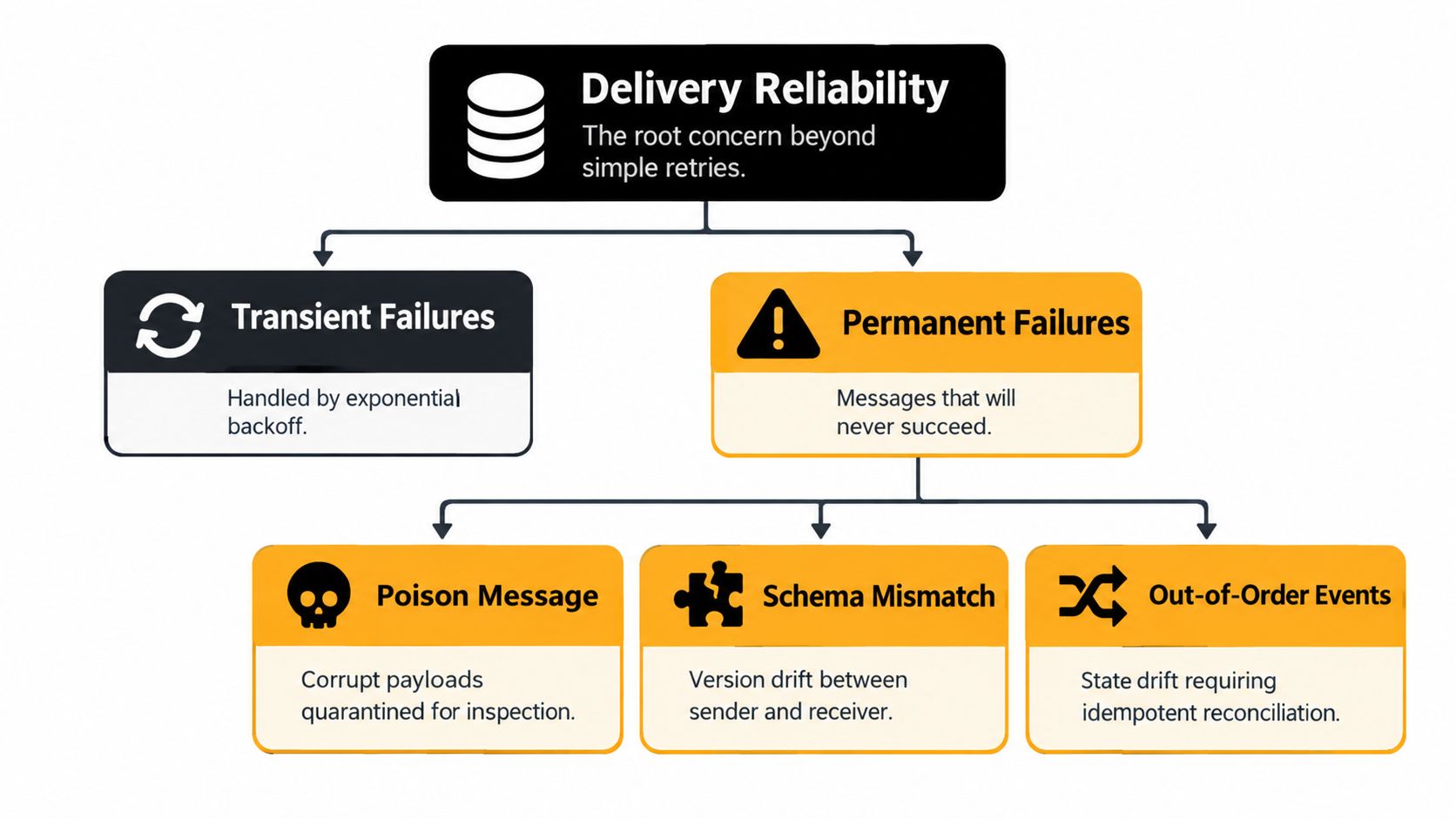
Basic retry advice assumes that every failure is temporary. Production systems disprove that assumption. A payload can remain invalid, a schema can change without a coordinated deployment, credentials can be revoked, or a business rule can reject an event permanently. Retrying those messages only delays the moment when someone must inspect them.
Webhook delivery is also at-least-once by design in many integrations. Events can arrive more than once and not necessarily in the order they were created. A “subscription canceled” event that arrives after a “subscription renewed” event can corrupt access or billing state if the consumer applies messages blindly.
Give failed events a destination
A dead-letter queue is not a trash can. It's a controlled holding area for messages that exhausted automatic recovery or failed validation. Store the raw event, provider ID, headers needed for diagnosis, error classification, attempt history, and the relevant application version. Provide operators with a replay action that sends the event through the normal pipeline after the defect is fixed.
Production guidance recommends atomic persistence before returning a 2xx response, along with reconciliation and dead-letter queues for permanent failures, to reduce inconsistent state. The reliability patterns described in this production guide reflect an important boundary: you can't repair an event you failed to preserve.
Treat poison messages differently from dependency failures. A malformed payload should move quickly to quarantine. A temporarily unavailable CRM may remain eligible for controlled retry. A revoked credential may require an operator to repair configuration before replaying anything.
Reconcile instead of trusting the stream
A reconciliation job periodically compares your local state with the provider's authoritative state. It can identify subscriptions without matching updates, records stuck in an intermediate status, or events that never reached your queue. Reconciliation isn't an admission that webhooks failed. It's a deliberate safety net for distributed delivery.
Design reconciliation to be narrow and repairable. Fetch records changed within a suitable business window, compare versions or timestamps where the provider makes them available, and emit corrective work through the same idempotent processing path. Don't write a separate bypass that applies changes without audit history.
For out-of-order events, prefer one of these approaches:
- Resource version checks: Apply an event only if its version is newer than the stored version.
- Provider refetch: Use the event as a trigger, then retrieve current resource state before applying it.
- State-machine validation: Reject transitions that aren't valid from the current state and send them for review.
- Compensating reconciliation: Allow temporary inconsistency, then repair it through a later authoritative comparison.
The right choice depends on whether the provider exposes ordering metadata and whether your business state can tolerate temporary drift. The wrong choice is assuming arrival order equals business order.
Scaling B2B Workflows and Monitoring Health
Reliable webhook automation becomes valuable when the event starts a chain of work that people previously coordinated manually. A new enterprise account can trigger workspace provisioning, contract checks, CRM updates, and an internal notification. A usage event can enter a billing pipeline without waiting for a scheduled data pull. A shipment update can synchronize customer-facing status while leaving fulfillment logic in its own worker process.
Each workflow should have an explicit reliability boundary. For onboarding, persist the account event before creating resources. For billing, make the charge or usage operation idempotent and retain the source event for audit. For CRM synchronization, record the remote identifier and retry only the failed side effect rather than replaying unrelated steps.
Monitoring should expose the path from delivery to business completion. Track:
- Acknowledgment latency: Shows whether ingress can respond before the provider's timeout.
- Queue depth and age: Reveals whether workers are keeping pace and whether customers are waiting behind old events.
- Retry rate and error classes: Separates transient dependency problems from malformed messages or authentication failures.
- Dead-letter volume: Indicates work that requires human or engineering intervention.
- Reconciliation findings: Shows whether local state is drifting from the provider.
- Processing completion: Measures whether accepted events reach their intended business outcome.
Create alerts around trends and thresholds that reflect your provider contract and service objectives. GitHub's documented acknowledgment window is a useful example of why latency needs a clear operational boundary, but your own integration may have different limits. Dashboards should let an operator trace one event ID across ingress logs, the event store, queue attempts, downstream calls, and final state.
MakeAutomation offers custom API development and integrations that can connect payment notifications, form submissions, CRM updates, and shipping status changes through webhook receivers. Its automation guidance uses the same practical sequence described here, receiving the event, verifying authenticity, persisting the raw message, checking idempotency, queueing enrichment, and synchronizing the result with a CRM.
The key operational test is simple: when a provider reports a failed delivery, can your team explain what happened and recover it without asking the customer to trigger the event again? If the answer is no, the endpoint may be functional, but the workflow isn't reliable yet.
If your SaaS workflows depend on billing, onboarding, CRM, or fulfillment events, visit MakeAutomation to discuss a webhook architecture built around durable ingestion, idempotent processing, and recoverable failures. MakeAutomation can help document the workflow, implement the integrations, and connect downstream automation without leaving critical events in an opaque request handler.