Compliance Documentation: A Complete Guide for B2B Teams
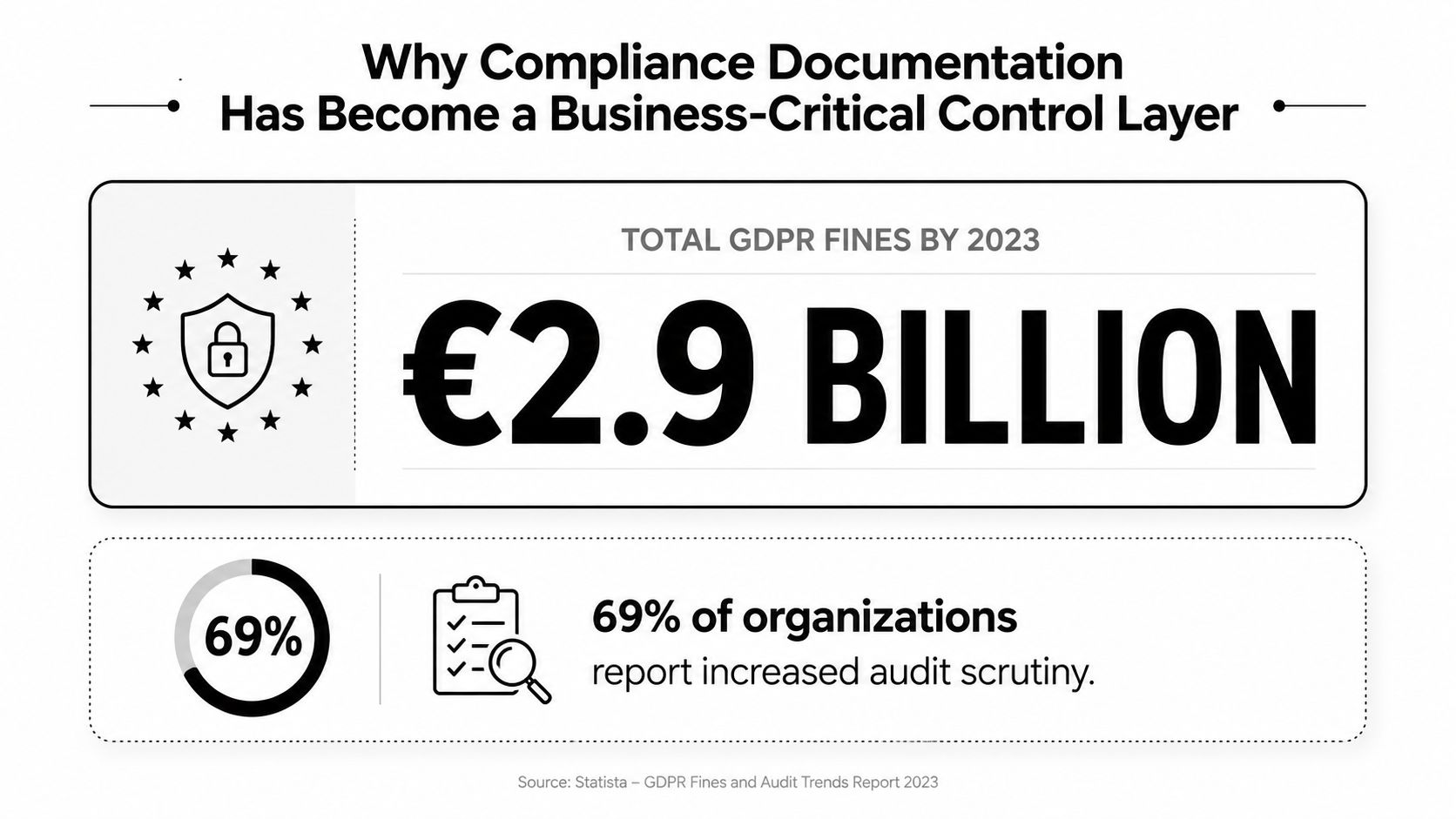
€2.9 billion in GDPR fines by 2023 is not a paperwork story, it's a control failure story. Once compliance documentation stops being traceable, versioned, and easy to defend, the cost moves fast from admin inconvenience to real financial exposure, especially when 69% of companies face fines for non-compliance with data privacy laws and 42% of compliance failures are tied to human error compliance statistics.
That's why the best teams stopped treating compliance documentation like a folder full of policies. They treat it as the evidence layer that supports legal defense, incident response, and customer trust, which is exactly where auditors, buyers, and regulators are looking first.
Why Compliance Documentation Has Become a Business-Critical Control Layer
The old view of compliance documentation was simple. Write the policy, store it somewhere, and show it if someone asks. That model falls apart the moment a regulator, customer, or auditor wants evidence that your control operated the way you said it did.
The financial consequences are already visible. By 2023, GDPR fines had reached €2.9 billion, and the average GDPR fine was estimated at €1.7 million compliance statistics. Those numbers matter because they show that documentation failures are no longer just housekeeping issues. They can become material liabilities.
What compliance documentation actually is
In practice, compliance documentation is the full evidence chain that proves your organization meets a requirement. That usually includes policies, procedures, records, test results, and other artifacts that show what you promised, what you did, and what happened afterward.
A useful way to think about it is this, if a control cannot be traced from intent to execution to proof, it's fragile. Auditors and regulators don't just want a statement of intent. They want a trail they can follow without reconstructing your process from scratch.
Practical rule: if a policy can't be tied to a record, a test, or a log, it's not strong enough to stand on its own.
The operational side is just as stark. In a compliance benchmark, more than 50% of respondents reported rejected audit reports because of incomplete documentation or insufficient testing, and 83% of organizations said they conduct multiple audits separately each year audit benchmark. That tells you something most policy-template guides miss. Documentation isn't just for proving compliance, it's for avoiding duplicated effort, audit friction, and rework.
For teams building foundational process controls, a practical starting point is a strong process documentation layer, because it forces clarity before evidence collection gets messy. A useful reference is this process documentation guide, which pairs well with compliance work when teams need to map daily execution to formal controls.
The conclusion is straightforward. Compliance documentation is infrastructure, not paperwork. It supports customer diligence, certification readiness, incident response, and the ability to defend your controls when the questions get uncomfortable.
Common Compliance Document Types by Framework and Industry
Many B2B compliance teams do not have a document-count problem. They have a classification problem. The team has files, folders, and screenshots, but no clean map showing which artifact satisfies which framework requirement, or which item will hold up during an audit. The practical fix is to group documents by function first, then map them to the frameworks that require them.
The four document families that show up everywhere
Across SOC 2, ISO 27001, GDPR, and HIPAA, the same core categories keep appearing. Policies define what the organization commits to. Procedures explain how the work gets done. Records show that the work happened. Evidence artifacts prove a control ran, a test completed, or an exception was handled.
That overlap matters because many B2B companies live under several regimes at once. They need a documentation set that can satisfy each one without creating duplicate files that drift out of sync. I have seen teams lose more time reconciling versions than preparing the original control set.
| Framework | Policies | Procedures | Records | Evidence Artifacts |
|---|---|---|---|---|
| SOC 2 | Security, access, vendor, incident, change management | Approval workflows, access review steps, incident handling steps | Access reviews, incident logs, training acknowledgements | Scan outputs, ticket histories, test results |
| ISO 27001 | Information security policy set, risk policy | Risk treatment workflows, control operation steps | Risk register, internal audit records, management review records | Control tests, monitoring logs, remediation proof |
| GDPR | Privacy policy, retention policy, data handling policy | Subject request handling, breach response, deletion workflows | Request logs, breach records, consent records | Timestamped actions, audit trails, deletion confirmations |
| HIPAA | Privacy and security policies | Safeguard procedures, incident response, access control steps | Sanctions records, training logs, risk analysis records | Access logs, system reports, review outputs |
EU technical files are more explicit
EU conformity assessment is stricter about traceability. technical documentation guidance makes that clear, because technical documentation has to include the manufacturer's identity, product identification, intended use, applicable regulations and harmonised standards, plus test reports and design-calculation results. When a product only partially applies a harmonised standard, the documentation has to show which sections are affected and what alternative technical solution was used.
That is a useful reminder for SaaS and hardware-adjacent teams alike. Good documentation does not just say “we comply.” It shows how the requirement was satisfied, and it leaves a path an auditor can follow without guessing.
Medical-device style traceability raises the bar further
For regulated products, the strongest files connect design inputs to verification outputs through controlled artifacts such as drawings, BOMs, risk assessments, labeling, and instructions. In medical-device-style technical files, that also expands into design and manufacturing records, ISO 14971 risk management, validation data, clinical or performance evaluation, and post-market surveillance artifacts technical file contents. The lesson is simple, weak traceability at one layer can break the whole argument.
If you are sorting documents by priority, start with the artifacts that prove execution, not the ones that look polished in a shared drive. For teams that also need to document internal workflows, this business process documentation guide is a useful companion, especially when ownership spans product, security, and operations. A practical compliance guide for wealth management can also help teams compare how evidence expectations differ by operating model.
Good enough for day one: policy, procedure, record, and one concrete evidence artifact per control.
The Compliance Documentation Lifecycle from Creation to Audit Readiness
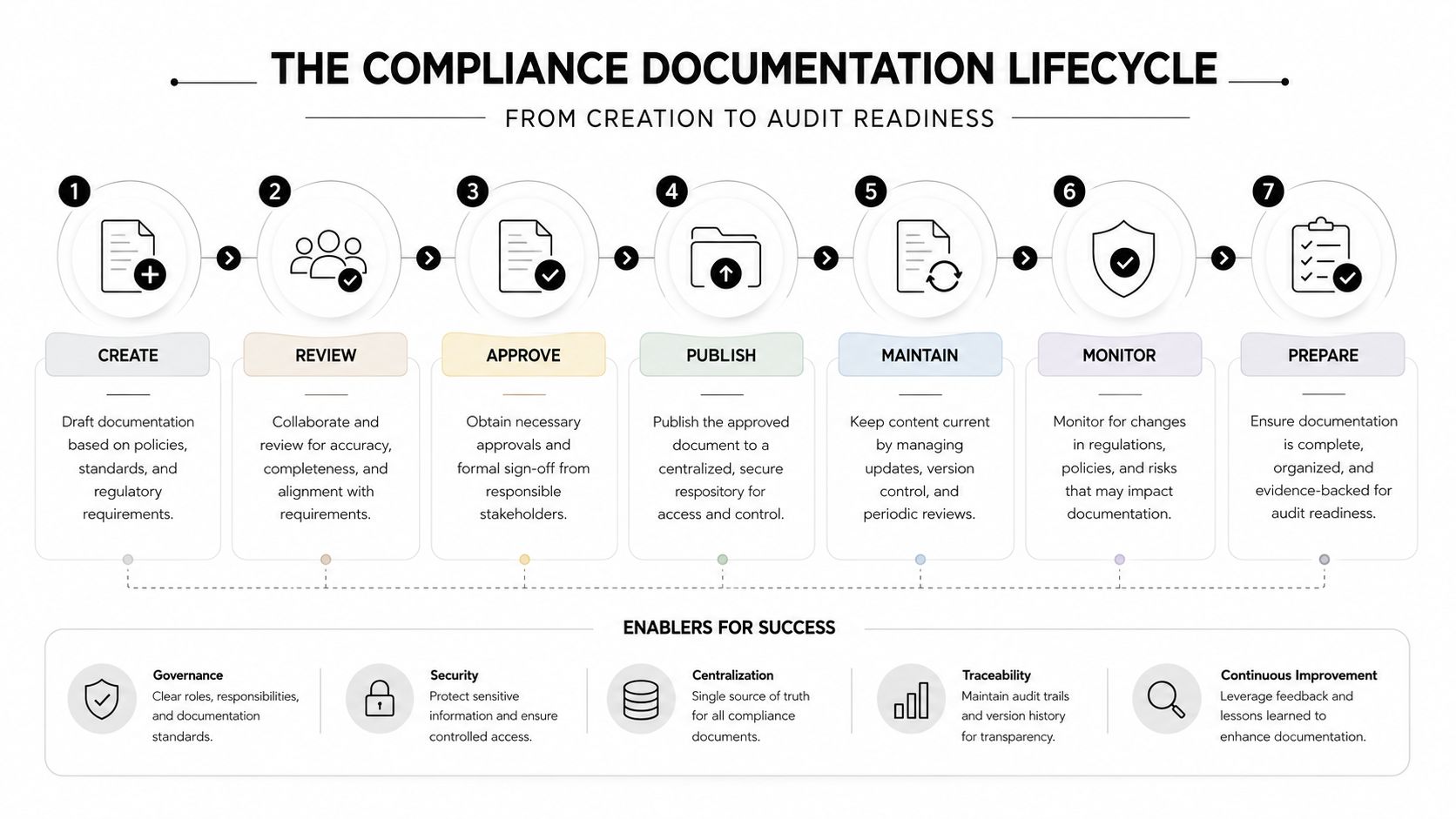
Good documentation behaves like a living control system. Bad documentation becomes a pile of files nobody trusts after the first change request. The gap usually appears in versioning, retrieval, and evidence packaging, not in the first draft.
Start with controlled creation
Creation should begin with controlled artifacts, not free-form notes. In practice, that means tying design inputs to verification outputs through documents like drawings, BOMs, risk assessments, labeling, and instructions. The tighter the link between those artifacts, the easier it is to defend the control later.
That pattern shows up in audit work constantly. If a control was meant to prevent a failure, the documentation should show both the design and the verification. Otherwise the file reads like a claim, not evidence.
Versioning is where many teams struggle
Simple file names are not version control. “Final,” “final-v2,” and “final-for-real” tell an auditor almost nothing. What matters is a change log that shows who changed what, why it changed, and who approved the change.
Drift usually starts here. A team updates a process after a tool rollout, but the document still reflects the old workflow. By audit time, everyone agrees the old version is wrong, yet it is still the one in circulation.
For teams that also need to document internal workflows, this business process documentation guide is a useful reference, especially when ownership spans product, security, and operations. A practical compliance guide for wealth management also helps teams compare how evidence expectations differ by operating model.
Storage and retrieval need different design choices
Centralized storage helps with consistency, but distributed ownership keeps documents closer to the people who execute the controls. The trade-off is real. If you centralize everything without ownership, updates stall. If you distribute everything without governance, drift grows.
The best compromise is a controlled repository with assigned owners by control area, plus a retrieval path that lets an auditor or reviewer build an evidence package quickly. In audits I have supported, the team usually moved faster when they could answer two questions without hunting, where is the current version, and where is the proof it was used?
Audit readiness is a packaging problem
Audit-ready documentation is not just a folder of files. It is a curated evidence set that lets reviewers verify conformity without re-performing every step from scratch. The package should include the control statement, the procedure, the relevant records, and the evidence artifacts that show the control operated during the period.
Auditors usually do not reward volume. They reward coherence.
Teams that rely on scattered files, unmanaged comments, and ad hoc screenshots usually spend the most time cleaning up during the final stretch. Teams that keep a clear lifecycle often move faster because the evidence is already organized for the question being asked.
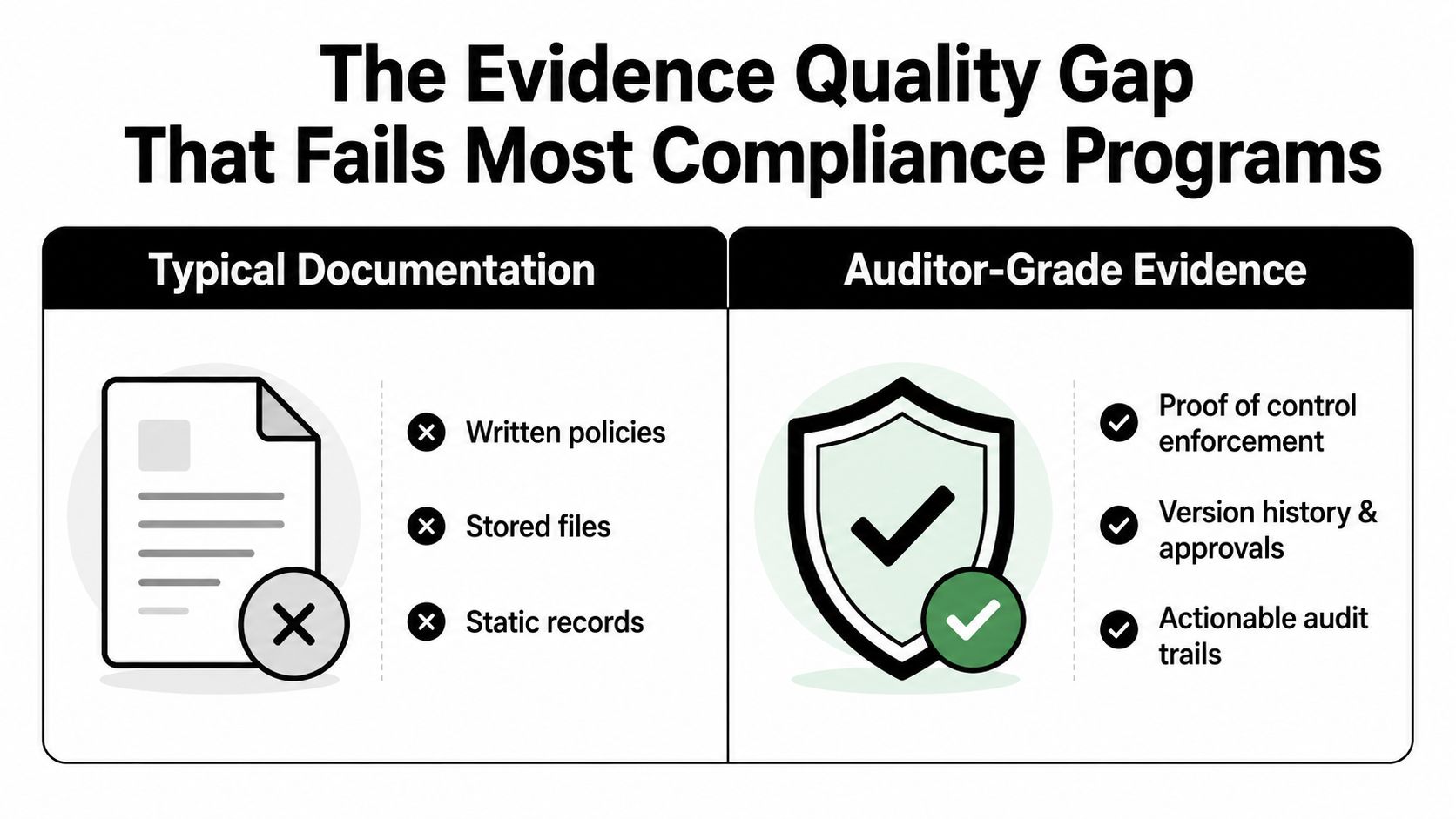
The Evidence Quality Gap That Fails Most Compliance Programs
Having documents is not the same thing as having evidence. That's the gap most compliance guides step around, and it's the gap that gets programs into trouble during reviews. Auditors don't just ask whether a control exists. They ask whether it worked under a specific rule, test, or event.
Minimum viable evidence beats static policy libraries
The strongest regulated programs define minimum viable evidence for each control. That means deciding in advance what proof is acceptable, then collecting that proof every time the control runs. Static policies help, but they don't prove enforcement.
A policy that says access is reviewed monthly is weaker than an access review record showing who reviewed access, what changed, and when the review happened. A generic incident response plan is weaker than a restoration log from an actual drill or a post-incident review that records outcomes.
Map artifacts to testable assertions
The easiest way to improve evidence quality is to anchor every artifact to a testable assertion. If the assertion is that a system was scanned, then the evidence should be the scan result. If the assertion is that restoration was tested, then the evidence should be a timestamped restoration log. If the assertion is that a control owner approved a change, then the evidence should show the approval trail.
That's the kind of proof regulated buyers want to see in modern programs. It's also what turns documentation into defensible evidence instead of administrative background noise.
Why continuous evidence beats point-in-time files
Recent guidance for regulated industries pushes teams toward evidence refresh cycles and “minimum viable evidence” collections, rather than static archives alone evidence-first approach. That shift matters because controls now get reviewed more often, and the evidence needs to stay current.
The practical trade-off is clear. Point-in-time files are easier to store, but they age badly. Continuous evidence takes more discipline, but it reduces the scramble when an auditor asks for proof tied to a real event.
Teams often waste time here. They maintain immaculate policies, but their proof is thin, stale, or disconnected from the control being tested. The fix isn't more documentation. It's better evidence selection.
For teams working across security, engineering, and compliance, a document workflow layer can help standardize evidence collection. A useful operational reference is this document automation software guide, because it frames automation around repeatable evidence capture rather than just file generation.
Managing Documentation Drift Across Teams and Regulatory Changes
Most compliance documentation failures don't start with a legal problem. They start with operational decay. A process changes, but the document doesn't. A manager leaves, but the control owner isn't reassigned. A team copies an older template, and the copied text becomes the official version.
That's documentation drift, the slow mismatch between what the files say and what the organization does. It's easy to miss because the documents still exist, which creates false confidence right up until an audit asks for proof.
The usual drift patterns are predictable
Ownership changes are one of the biggest triggers. When a control owner leaves, the work often survives, but the documentation trail gets fuzzy. Decentralization causes a different problem, because teams start maintaining their own local versions of the same control, and small differences turn into control variance.
Regulatory change adds another layer. If teams don't maintain a regulatory calendar, updates arrive late and get patched in after the fact. That's how inconsistent notes, missing signatures, copy-paste reuse, and failure to document changes keep showing up in regulated environments documentation mistakes and drift.
Governance has to live inside operations
The fix isn't just a review cadence. It's a governance model that assigns accountable owners by control area and periodically re-baselines scope and ownership. Without that, documentation slowly detaches from reality, especially when multiple frameworks apply to the same workflow.
A lightweight rule works better than a heroic cleanup project. Every time a process changes, the owner updates the control statement, the procedure, and the evidence expectation together. If one changes and the others don't, drift has already started.
Build around a regulatory calendar and ownership map
A regulatory calendar keeps teams from being surprised by changes that affect retention, evidence, or control operation. An ownership map makes it obvious who is responsible for each documentation set. Together, they reduce the chance that updates get lost between security, legal, operations, and engineering.
The most reliable teams don't treat documentation as a separate project. They attach it to change management, control reviews, and recurring operational check-ins. That keeps the file set aligned with the business instead of turning it into a stale archive.
If the owner of a control can't name the current evidence location, the program is already behind.
The goal isn't perfect documentation. The goal is documentation that still matches reality when someone outside the team asks for proof.
Automating Compliance Documentation with AI and Workflow Integration
Manual documentation doesn't scale once controls start crossing systems. The useful automation question isn't whether software can write more text. It's whether it can reduce repetitive work without stripping out judgment where judgment matters.
Automate the parts that repeat
The highest-value opportunities are usually the boring ones. Policy drafts can be generated from framework requirements and then reviewed by a human. Evidence artifacts can be auto-populated from CI/CD pipelines, ticketing systems, and monitoring tools. Version histories can be tracked without someone updating a separate log by hand.
That's especially useful when documentation needs to stay current across many controls. If a change request lands in Jira or a pipeline scan flags a new issue, the documentation workflow should react without waiting for someone to remember a monthly checklist.
Use AI where comparison work is slow and repetitive
AI is most helpful when it compares what exists against what should exist. It can flag gaps between policy language and actual procedures, generate audit-ready summaries from raw logs, and surface likely documentation drift before a reviewer finds it. It can also help teams turn long control outputs into readable summaries without losing the source evidence.
The caution is simple. AI can assist with drafting and pattern detection, but it can't replace risk judgment. A model can tell you a policy looks inconsistent. It can't decide whether the control design is acceptable under your specific framework, business model, or risk posture.
Keep the human review where it counts
The best automation setups define hard boundaries. Humans approve control design, risk treatment, and exception handling. Systems handle file generation, reminders, evidence capture, and routing. That split preserves accountability while removing the tedious work that slows teams down.
For teams building that stack, workflow design matters more than shiny features. If automation lives outside daily operations, people ignore it. If it sits inside the same systems where work already happens, it starts to stick.
A practical resource for teams standardizing this kind of setup is MakeAutomation's approach to document automation, especially if your goal is to tie evidence capture to actual workflows instead of adding another repository no one checks.
Automation should reduce the gap between work done and proof recorded. If it only makes prettier files, it's not enough.
Your Compliance Documentation Implementation Roadmap
Start with the minimum viable set. Identify the controls that matter most, then map each one to a policy, a procedure, a record, and an evidence artifact. Get version control in place before you polish templates, because polished files with no traceability still fail under scrutiny.
Phase two is structural. Assign control owners, define review cadences, and build a simple evidence inventory so nobody has to hunt across inboxes and shared drives during audit season. That's also the stage where teams usually discover which files are stale and which processes were never documented.
Phase three is optimization. Add automation where evidence naturally flows from systems, then use continuous monitoring to keep the documentation aligned with reality. If you want a reference point for building a more mature framework set, it's worth reviewing how teams master CEF compliance documents at CEFCore, because the stronger programs treat documentation as an ongoing operating system, not a one-time deliverable.
The roadmap is simple, but it isn't easy. First make the evidence trustworthy, then make the drift visible, then make the workflow sustainable. That sequence protects time, reduces audit friction, and keeps the control set usable as the business grows.
If you want compliance documentation that survives audits, MakeAutomation can help you design the workflows, evidence capture, and SOP structure that make it manageable. Visit MakeAutomation to turn messy manual compliance work into a system your team can run with confidence.