
Cycle Time Reduction: A B2B & SaaS Playbook for 2026
Sales deals are sitting in “legal review” for days. New clients sign, then wait for kickoff because the implementation brief is incomplete. A feature is coded, but it stalls in review, QA, or release prep. Everyone looks busy, yet work keeps arriving late.
That's usually a cycle time problem.
In B2B and SaaS companies, cycle time reduction isn't about making people move faster. It's about removing the waiting, rework, approvals, and handoffs that make work feel heavier than it should. Manufacturing teams have studied this for years. Service businesses often haven't, even though the same logic applies to onboarding, sales, support escalations, and software delivery.
The difference is where the delay hides. In a factory, you can often see the queue. In a SaaS company, the biggest delays are often invisible. A customer success manager waits on sales notes. An account executive waits on pricing approval. An engineer waits on product clarification. A project manager waits because three departments all assume someone else owns the next step.
That hidden waiting time is what drags growth. It slows revenue recognition, clogs delivery capacity, and makes headcount feel less productive than it should.
Why Your Processes Feel Slower Than Ever
Teams often don't describe the issue as cycle time. They say things like “onboarding takes forever,” “sales is stuck in follow-up,” or “engineering has too much in flight.” Those are all different versions of the same problem. Value enters your system, then spends too much time waiting to move forward.
Cycle time is the elapsed time it takes work to move from active start to completion within a defined process. In software, that might mean from first commit to production. In client onboarding, it might mean from signed contract to completed kickoff. In sales, it might mean from qualified opportunity to closed deal.
Digital workflows look fast but move slowly
B2B and SaaS leaders often assume digital work should move quickly because there's no physical production line. But digital work creates its own drag:
- Approval loops that bounce between sales, finance, and legal
- Unclear ownership when a handoff lands in a shared inbox or board column
- Context switching when one person is juggling proposals, meetings, renewals, and escalations
- Rework caused by missing information upstream
A CRM might show the stage changes. A project tool might show tasks assigned. Neither tells you how long work sat untouched between steps.
Practical rule: If work spends more time waiting than being actively processed, the problem isn't effort. It's flow.
Speed matters, but flow matters more
I've seen teams try to solve slow delivery by pushing harder. They add Slack reminders, more standups, more check-ins, and tighter deadlines. That usually creates noise, not flow. People stay busy. The queue stays full.
A better approach is to treat your business like a system. Start with one workflow that matters commercially. Lead-to-close. Signed-to-live. Ticket-opened-to-resolved. Then ask a simple question: where does work stop moving, and why?
That's where cycle time reduction starts paying off in B2B and SaaS. Not on the obvious task itself, but in the spaces between tasks where human latency builds up.
Pinpointing Your Hidden Workflow Bottlenecks
The fastest way to find delays is to map one real workflow and follow the waiting time, not just the work time. Pick a process with direct business impact. Good candidates are lead-to-close, new-client onboarding, or scope approval to project kickoff.

Map the process the way it actually runs
Don't start with the SOP. Start with the messy version people really follow.
For a client onboarding workflow, the map might look like this:
- Contract signed
- Sales hands off account notes
- CSM reviews scope
- Kickoff meeting scheduled
- Client submits access or assets
- Internal setup starts
- First deliverable shipped
Write every step in sequence. Then add three things beside each one:
- Owner who moves it forward
- Trigger that starts the step
- Typical waiting point before the next step begins
A frequent point of surprise arises. The actual task often isn't slow. The wait before someone picks it up is.
Look for invisible human latency
Recent data from the Umbrex Industry Analysis indicates that while 85% of manufacturing cycle time improvements are achieved via automation, 70% of cycle time delays in SaaS and project management still stem from human handoffs and task-switching (industry analysis on cycle time bottlenecks).
That matches what shows up in most service workflows. The delay isn't usually “doing the work.” It's work getting parked because:
- A handoff lacked context so the next person had to chase details
- The task had no deadline owner so it sat in a queue
- One specialist became the gatekeeper for review, approval, or setup
- People switched priorities midstream and left half-finished work behind
A visual map helps expose this. If you need a cleaner way to build one, a practical workflow visualization approach makes these hidden pauses easier to spot across teams.
Work rarely breaks at the busiest step. It breaks at the step nobody clearly owns after the handoff.
Mark the queues, not just the steps
On your map, circle the points where work tends to wait. In sales, this is often proposal approval, security review, or legal markup. In onboarding, it's usually intake completeness, client asset collection, or internal setup assignment. In software, it's commonly review pickup, environment access, or QA clarification.
After you've mapped it, ask the team a blunt question: “Where does this item usually sit untouched?” Not “where is it difficult?” Untouched is the better signal.
Later in the review, this short walkthrough is worth watching because it reinforces how bottlenecks surface when you inspect the flow end to end.
Narrow it down to two or three suspects
You don't need a perfect map. You need a useful one. By the end of this exercise, you should be able to point to two or three places where delay is clustering.
That's enough to move from opinion to diagnosis. And once a bottleneck is visible, you can stop arguing about workload in general and start fixing the exact point where work stalls.
Measuring What Matters for Cycle Time Reduction
Once the bottleneck is visible, don't jump straight to solutions. Measure the flow around it first. Teams that skip this step usually improve the wrong thing and then wonder why customers still feel delay.
A practical starting point is simple. Track a small group of metrics that tell you how work moves, where it queues, and whether the process is becoming more predictable.
The four metrics that matter most
Use a dashboard that includes these measures:
Cycle time
The elapsed time from active start to completion for a defined piece of work. In a sales proposal process, that might be from proposal request to proposal sent.Lead time
The customer-facing wait. This is broader than cycle time. For onboarding, it reflects how long the client experiences between signing and going live.Throughput
How many items your team completes in a given period. For example, completed onboardings, shipped features, or approved proposals.Work in progress
The number of items currently in motion. High WIP often creates hidden delay because people start too much and finish too little.
A useful operational efficiency metrics guide can help standardize these definitions across departments so sales, operations, and delivery aren't all measuring flow differently.
Start with data you already have
Most B2B and SaaS teams don't need a new analytics platform to begin. They already have enough system data inside tools like HubSpot, Salesforce, Jira, ClickUp, Asana, Monday.com, or Linear.
Pull timestamps for stage changes. Look at how long items stay in each status. Compare “time in progress” with “time waiting.” If your CRM says an opportunity entered procurement review on Monday and left on Friday, that delay belongs on the board even if no one logged active work.
A prerequisite for meaningful gains is making data accessible and identifying regular bottlenecks. Companies that tackle high variability first before standardizing quality and maximizing uptime see the most dramatic improvements in throughput (guidance on bottlenecks and variability).
Choosing Your Root-Cause Analysis Method
Once you know where delay is accumulating, use a method that matches the problem.
| Method | Best For | Example Question |
|---|---|---|
| 5 Whys | Straightforward operational issues with a clear symptom | Why did onboarding sit for three days before kickoff scheduling started? |
| Fishbone Diagram | Multi-factor problems involving people, process, tools, and policy | Why do proposals keep stalling before final approval? |
| Pareto Analysis | Finding the small number of causes creating most of the delay | Which delay reasons appear most often across the last set of deals or projects? |
| Constraint Review | Cases where one stage or role repeatedly limits flow | Which team or step holds the longest queue relative to the rest of the process? |
Make the bottleneck measurable
For each suspect step, define one question you can answer weekly:
- Sales example: How long do deals wait for pricing or legal review?
- Onboarding example: How many projects are blocked by incomplete intake?
- Software example: How long do pull requests wait before review starts?
Measurement rule: If a team can't see waiting time by stage, it will confuse activity with progress.
Keep the dashboard lean. Four metrics are enough. The point isn't to build a reporting system. The point is to create enough visibility that the team stops guessing where the drag is coming from.
How to Prioritize High-Impact Improvements
The biggest mistake teams make after mapping and measuring is trying to fix everything. They rewrite SOPs, buy software, add automations, create new approval paths, and launch five initiatives at once. The result is usually more complexity around the same bottleneck.
Focus beats enthusiasm here. The process only moves as fast as its tightest constraint.
One bottleneck deserves most of your attention
A step-by-step method for minimizing time losses starts with Pareto analysis, which helps identify that most cycle time reduction opportunities come from a small number of causes. The Theory of Constraints then gives the operating logic: identify the constraint, exploit it, subordinate everything else to its pace, and increase capacity if needed (practical method for reducing cycle time).
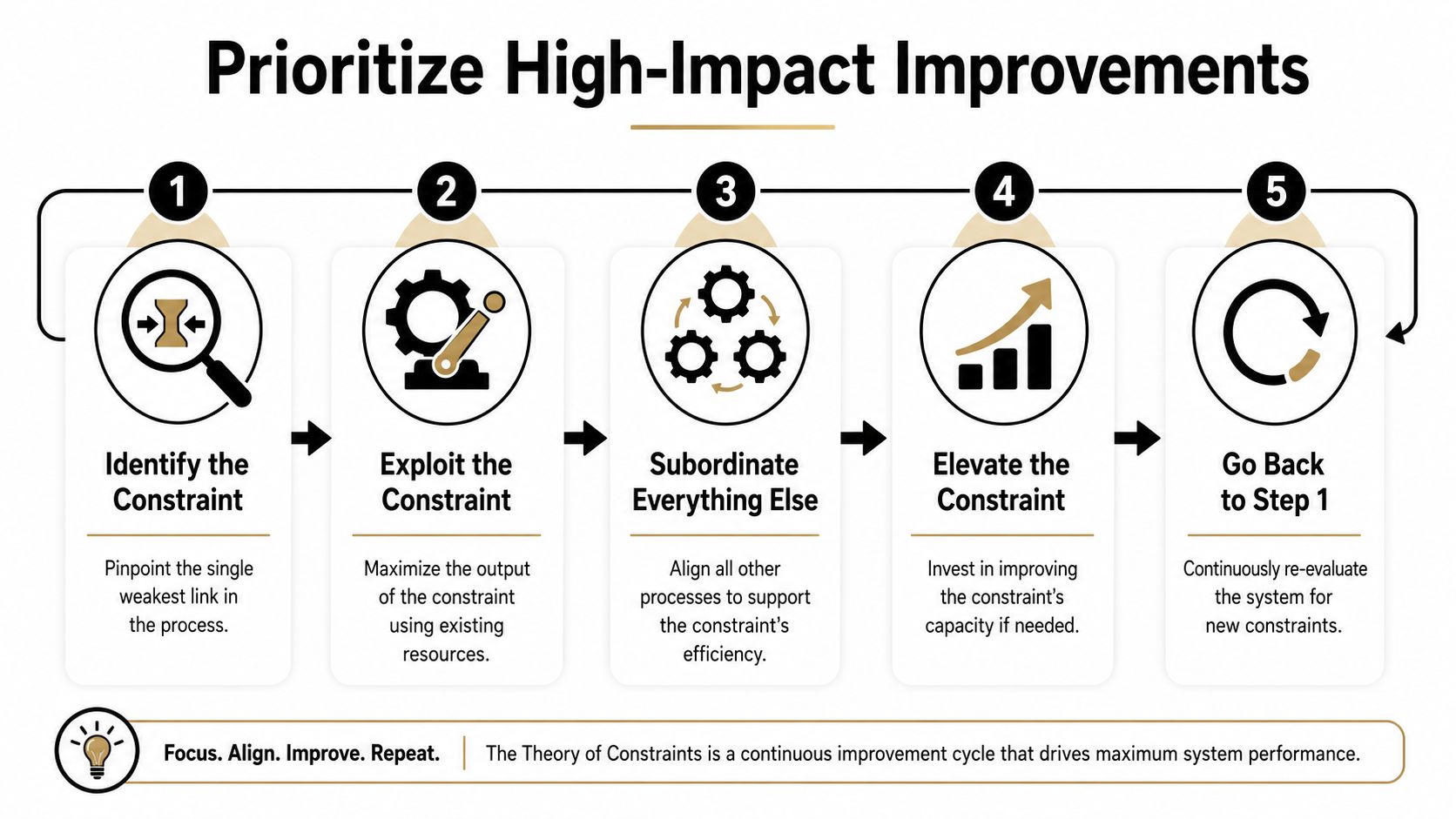
In plain language, this means:
- If legal review is slowing deal flow, speeding up prospecting won't help much.
- If implementation kickoff is delayed by missing intake data, adding more project managers won't solve the queue.
- If engineering review pickup is the hold-up, coding faster just creates a larger pile waiting for review.
Stability comes before speed
Many software and SaaS teams fall into a common trap. They see long cycle times and push for faster output without stabilizing the process first. That usually increases rework.
A 2024 Waydev study found that teams rushing to reduce cycle time without addressing task-switching and unclear priorities saw a 15% increase in defect rates, and 60% of reported cycle time reductions were temporary spikes followed by a rework cascade that extended total delivery time (Waydev findings on speed versus stability).
That lesson applies well beyond software. In onboarding, if the intake form is inconsistent, pushing the setup team to move faster just means they'll restart work later. In sales, if discount approvals lack criteria, forcing quicker turnaround only shifts confusion downstream.
Predictable flow beats occasional bursts of speed. A process that moves steadily is easier to scale than one that alternates between rush and rework.
Choose the first target with discipline
When deciding what to fix first, apply three filters:
Commercial impact
Does this step delay revenue, client activation, or delivery capacity?Queue size
Does work consistently pile up here?Fixability
Can the team improve it with policy, ownership, SOPs, or automation, rather than a full org redesign?
The best first target is usually not the loudest issue. It's the narrow point where work repeatedly waits and where a change in ownership, sequencing, or standardization can enable movement across the rest of the system.
A Tactical Playbook for Faster Workflows
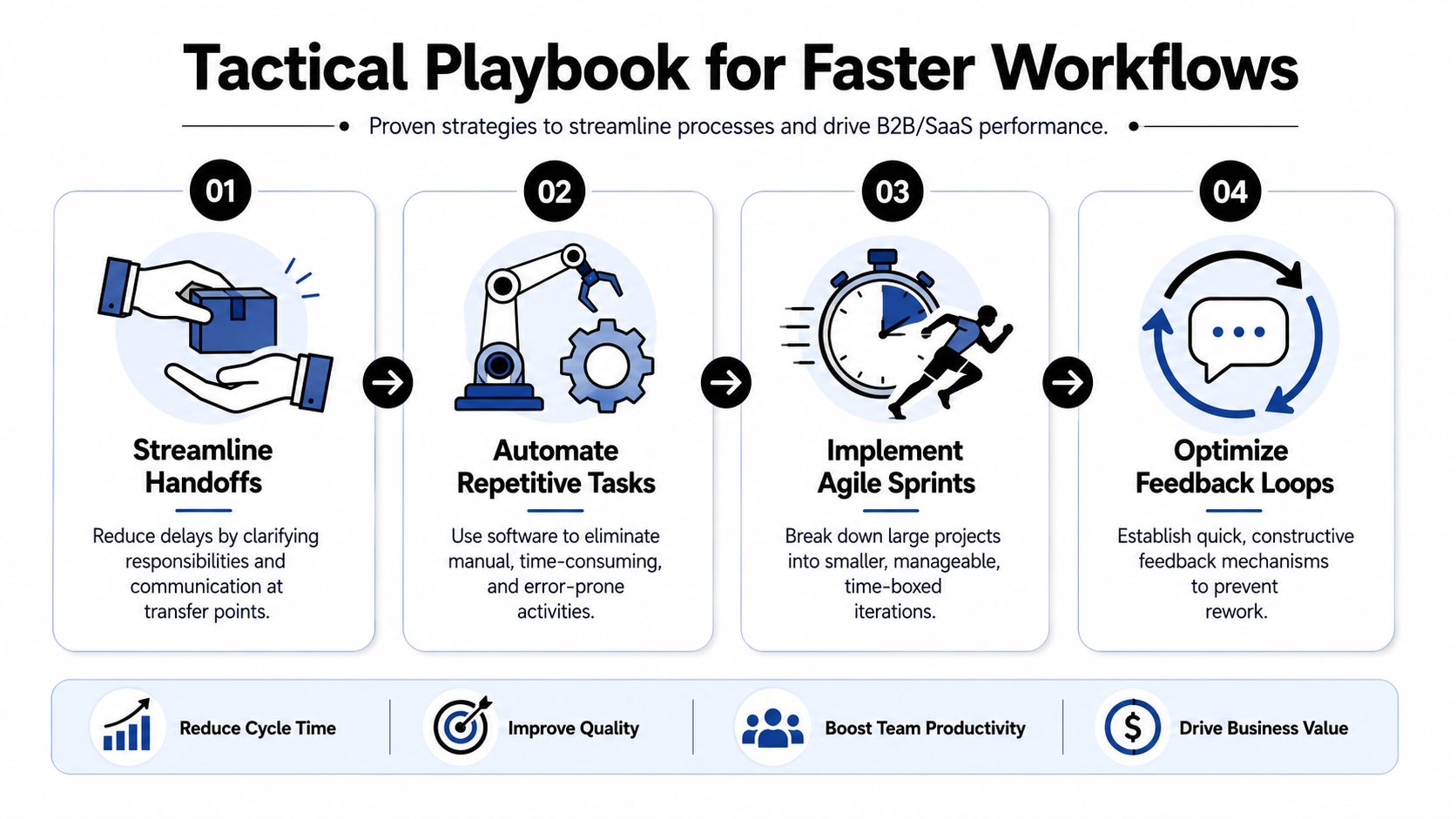
Once you've chosen the constraint, use tactics that reduce waiting, cut ambiguity, and prevent avoidable rework. This makes cycle time reduction operational, not conceptual.
Tighten the handoff
Handoffs are where many B2B workflows lose hours or days. The fix is rarely “communicate better.” It's creating a handoff that can survive without extra explanation.
For a sales-to-onboarding transition, the receiving team shouldn't need to chase Slack threads, call recordings, and side notes to understand the deal. The handoff should include scope, timeline, stakeholders, technical dependencies, and promised deliverables in one standard location.
Use a handoff checklist with mandatory fields. Make incomplete submissions bounce back automatically. That sounds rigid, but it removes the polite chaos that slows everyone down.
Limit work in progress
In project teams, too much WIP destroys flow. People start ten things, finish three, and spend the rest of the week switching context.
A better operating rule is simple:
- Cap active proposals per approver
- Cap active onboarding setups per implementation manager
- Cap engineering tickets per developer or squad
- Pause new starts when blocked work exceeds the limit
This creates tension in the right place. Instead of absorbing more work, the team clears the queue.
Standardize the repeatable path
SOPs matter most where judgment is low and variation is expensive. Proposal creation, onboarding intake review, contract routing, QA prep, and release checklists all benefit from standardization.
Good SOPs are short, specific, and tied to one trigger. They answer three things:
- what starts the task
- what “done” looks like
- what information must be present before work begins
If a process still relies on tribal knowledge, it will keep generating delay through clarification and rework.
Automate the boring middle
Automation is strongest when it removes repetitive coordination work. It's weak when teams use it to mask a broken process.
For a sales proposal workflow, useful automations include:
- Routing requests to the right approver based on deal type
- Auto-generating documents from CRM fields
- Flagging missing inputs before the request is submitted
- Sending reminders when approvals exceed an agreed window
- Updating pipeline stages when a document is approved or sent
In logistics and operations-heavy environments, this kind of system support can be part of a broader solution for reducing operational delays, especially when scheduling, handoffs, and status visibility are spread across multiple teams.
Protect quality while you speed up
Many teams sabotage themselves when they reduce cycle time by skipping checks, compressing review, or pushing messy work downstream. The rework then comes back.
Waydev's 2024 study found that teams pushing speed without fixing task-switching and priority clarity saw a 15% increase in defect rates and that 60% of reported cycle time reductions were temporary spikes followed by rework. That's a strong warning against fake speed.
In software, the practical answer is automated testing, clear review ownership, and smaller work items. In onboarding, it means validating client inputs before setup starts. In sales, it means requiring clean qualification and approval criteria before proposals are built.
Field note: Faster workflows come from reducing interruptions and ambiguity. They don't come from asking people to recover bad process design with effort.
One concrete example is a sales proposal pipeline. A rep requests a custom proposal. Finance needs pricing context. Legal needs clause selection. Leadership wants margin approval. If each person gets involved at a different time and with different information, the proposal drifts. If the workflow starts with a complete intake form, routes to the right approvers in sequence, applies pre-approved clauses where possible, and blocks submission until the record is complete, turnaround improves without anyone rushing.
That's the standard to aim for. Less chasing. Less switching. Less restarting.
Making It Stick Change Management and Continuous Improvement
A process fix that only works for two weeks isn't a fix. It's a burst of compliance.
For cycle time reduction to stick, the team has to understand why the change exists, what behavior is expected, and how the new process will be reviewed. Otherwise people revert to side channels, exceptions, and manual workarounds the first time pressure rises.

Make the new workflow easier than the old one
If the improved process adds friction for frontline staff, adoption will be weak. The handoff form has to be simple. The automation has to save clicks. The board has to show status clearly. Managers need to remove obstacles, not just announce standards.
A practical change management implementation approach helps when a new workflow affects multiple teams and ownership lines.
Review flow on a short rhythm
Use a weekly or bi-weekly review. Keep it tight. Look at the chosen bottleneck, the wait time around it, blocked items, and the reason for exceptions. Don't turn this into a broad status meeting.
Ask only a few questions:
- Where did work wait this period?
- What caused the delay?
- Did the fix reduce variance?
- What should change before the next review?
This creates the feedback loop that keeps the process alive.
Tie improvement to capacity
The point of this work isn't prettier process maps. It's capacity. A 25% reduction in cycle time directly increases production capacity without expanding infrastructure or labor, and that comes from systematically removing waste such as waiting time and unnecessary handoffs (cycle time reduction and capacity impact).
That idea matters in SaaS too. If you cut waiting time inside onboarding or approvals, you free the same team to complete more valuable work without immediate headcount expansion. That's why disciplined flow improvement compounds.
Start Shrinking Your Cycle Time Today
Start with one workflow. Map it accurately. Measure where work waits. Pick the biggest bottleneck, not the most annoying symptom. Then apply targeted fixes that reduce handoff friction, tighten ownership, limit work in progress, and protect quality.
That's what cycle time reduction looks like in a B2B or SaaS company. Not pressure. Not hustle. Better flow.
The companies that improve fastest usually stop treating delay as a people problem. They treat it as a system problem with human consequences. Once you see the hidden latency between teams, you can remove it, standardize what matters, and create a workflow that scales without constant firefighting.
If you want help turning these ideas into working systems, MakeAutomation helps B2B and SaaS teams document SOPs, redesign workflows, implement AI and automation, and remove the manual bottlenecks that keep sales, onboarding, and delivery slow.