
B2B Lead Generation for Technology Companies Guide
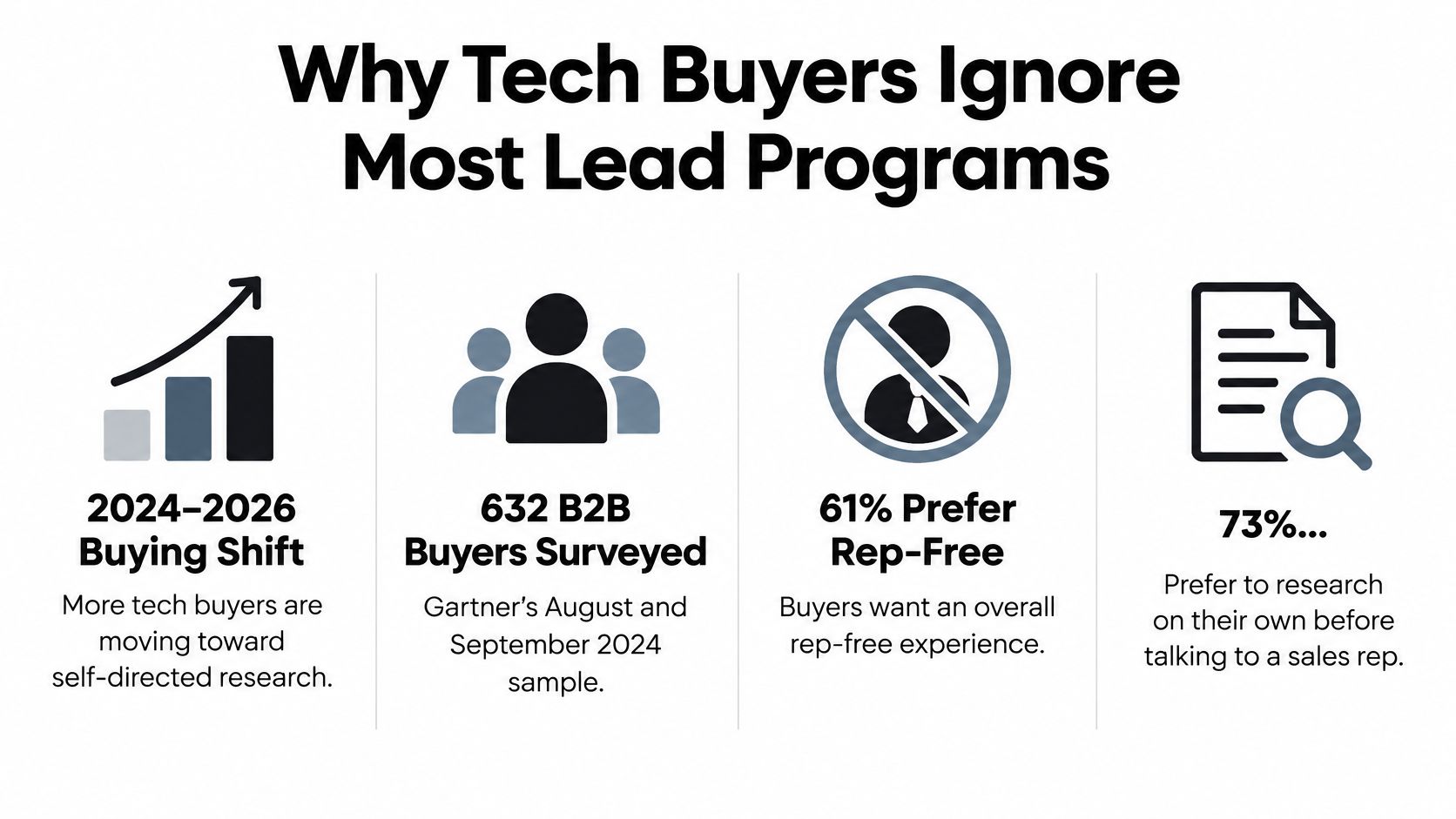
Many B2B buyers prefer to research and purchase without speaking to a sales representative, according to Gartner's survey findings on rep-free buying. For technology companies, lead generation means earning a place on the shortlist, making evaluation straightforward, and following up consistently when buyers ask for help.
SaaS, cybersecurity, and IT services teams need acquisition, qualification, and sales handoff to work as one system. A strong channel cannot compensate for conflicting product claims, unclear qualification criteria, or an inquiry left unassigned in the CRM.
Why Tech Buyers Ignore Most Lead Programs
Tech buyers often build a shortlist before they speak with sales. They research deployment requirements, integrations, security controls, and commercial terms, and may gather answers for colleagues who never visit your website. Irrelevant outreach adds work without helping them evaluate the product.
Fix the promise-to-handoff gap
A cybersecurity landing page may promise straightforward deployment while an SDR describes a substantial implementation project. The technical evaluator now has to find out which statement is accurate. Even when both claims have valid qualifications, the mismatch creates doubt.
Call this the promise-to-handoff gap: marketing attracts interest with one explanation, and sales follows up with another. Close it with an approved claims register covering capabilities, limitations, integrations, security, pricing structure, and implementation responsibilities.
Assign an owner to each claim. Product should approve capability statements, technical teams should confirm integration details, and sales should flag questions that public materials do not answer.
Practical rule: A fast response is useful only when it continues the conversation the buyer expected.
An ideal customer profile helps define which accounts merit follow-up. Include operational fit, not just company size or ability to pay.
Count commercial progress, not captured identities
A content download shows interest in the material. It does not establish an approved project, buying authority, or a reason for immediate outreach.
Keep the stages distinct:
- Engaged contact: Someone interacted with useful material.
- Qualified account: The organization fits your operational and commercial requirements.
- Sales-accepted opportunity: Sales confirmed a credible problem and agreed to pursue it.
Automation should not turn an engaged contact into an opportunity without qualification. Require sales to record an acceptance reason, and use rejection reason codes that marketing can act on.
For website evaluation, FOMOchat's B2B conversion rate optimization tactics can help assess whether page messaging and conversion paths match buyer intent. Apply that review to evaluation pages as well as the homepage.
Channel Blueprint and the Metric That Matters
Tech lead channels and the first metric to fund
| Channel | Job in the journey | Use it when | First metric |
|---|---|---|---|
| Product education and SEO | Teach the category before a project is approved | Complex SaaS or IT with security or integration review | Assisted pipeline, not form fills |
| High-intent paid and retargeting | Capture accounts already comparing tools | Clear category terms and a demo or trial | Cost per sales-accepted opportunity |
| LinkedIn and named-account outbound | Reach buying-committee titles | Mid-market or enterprise with identifiable roles | Positive replies from ICP accounts |
| Review sites and comparison pages | Earn the peer shortlist | Buyers compare features and vendors | Review-assisted opportunities |
| Partner and integration ecosystems | Borrow trust from adjacent tools | Product sits inside a known stack | Partner-sourced pipeline |
| AI answer engines and owned proof | Be recommended in chatbot research | Category where buyers research with generative AI | Mentions that become tracked meetings |
Pick two capture channels and one shortlist channel. That's a recommended operating constraint, not a universal benchmark. A small team needs enough concentration to distinguish a weak channel from poor execution.
For a SaaS product with established category demand, paid search and named-account outbound could capture interest while integration partners build consideration. For a less familiar category, education may deserve priority before paid acquisition.
In 2025, nearly one-third of B2B marketers reported using LinkedIn automation, according to Dux-Soup's B2B Lead Generation Report 2025. Automation multiplies the targeting and offer you already have, including their weaknesses. Keep additional channels paused until sales accepts the accounts your current motions produce.
How to Build the Lead System
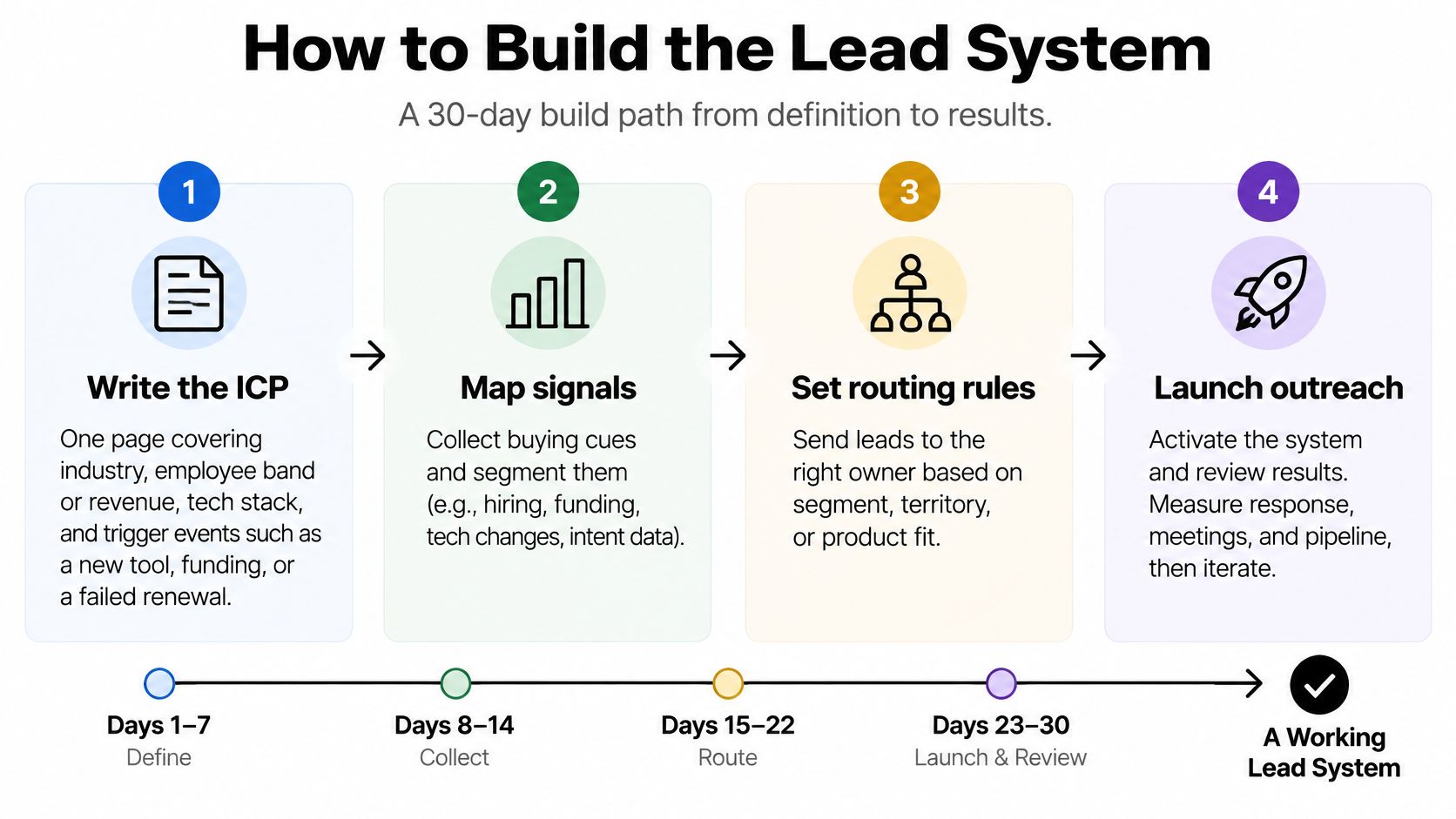
Build the minimum operational version before buying more acquisition tools. Use the following sequence as a proposed month-long implementation plan, with the CRM as the system of record.
The build path should keep targeting, routing, and outreach connected.
Establish the commercial rules
Write the ICP on a single page. Include industry, employee band or revenue, required technology, supported regions, and buying triggers. Explicitly exclude competitors, students, spam, and existing customers from new-business sequences. For an integration product, using the supported CRM may matter more than company size.
Name the buying group and its questions. The economic buyer asks about business impact. The technical evaluator asks whether the product works in the existing stack. Security or IT asks about access and data handling, while procurement asks about terms and vendor requirements. Assign a public page or approved sales asset to each question so an SDR doesn't improvise technical answers.
Lock the offer and next step. Choose a fit conversation, sandbox, or technical assessment according to what the buyer needs to establish next. A developer tool may benefit from a sandbox; an implementation-heavy service may need scoping first. Make the landing page, confirmation email, deck, and outreach script describe the same offer.
Select the channel mix. Give each selected motion an owner, audience, offer, and acceptance criterion. For example, a comparison-search campaign should land on a relevant comparison page, not a broad corporate homepage. Pause other motions so the team can diagnose results without constantly changing the inputs.
Implement the workflow before expanding it
- Create explicit pipeline stages. A workable design is new, qualified, meeting set, and opportunity. Define required fields for advancement: a calendar event can establish a meeting, but an email open can't establish an opportunity. Include a separate disposition field so disqualified records don't linger in an active queue.
For a B2B SaaS client, MakeAutomation designed a 4-stage sales pipeline with automated stage advancement and built 12 automated nurture sequences. The important design choice is to tie advancement to recorded evidence and give nurture a specific purpose, rather than building a long sequence because the platform supports it.
- Connect every inbound entry point. Forms, chat, and inbound calls should create or update CRM records through a shared deduplication process. Route with the fields already available, then enrich asynchronously. If a company lookup fails, the buyer shouldn't wait for a vendor API to recover.
Say a company matching your target profile requests a demo and already uses the required stack. Route it toward qualification immediately; don't make it complete the educational nurture intended for an early-stage researcher. A student asking for learning material should receive an appropriate resource without entering the sales queue.
For tool selection, OGTool's AI lead generation roundup can help you assemble a shortlist. Evaluate candidates against your actual workflow: CRM write access, duplicate handling, enrichment failure behavior, and activity logging matter more than an impressive feature list.
A workflow walkthrough can help your team discuss the implementation before configuring live triggers.
Activate response and routing rules. Give every queue a named owner and a fallback owner. Test what happens when a rep is unavailable, a record already exists, or a phone number is missing. Don't launch a workflow that works only when all fields are perfect.
Review commercial outcomes weekly. Examine contact rate, marketing-qualified-to-sales-qualified conversion, pipeline created, and revenue per account. Inspect rejected records with sales so you can separate poor fit from bad timing or incomplete information.
Before any sequence sends, require this field checklist:
- Identity: Contact details and a resolved account association.
- Eligibility: Customer, competitor, suppression, and permission status.
- Context: Source, requested offer, relevant behavior, and known role.
- Ownership: Assigned owner, lifecycle stage, and fallback route.
- Auditability: Capture timestamp, scoring reason, and next action.
Response SLAs and Score Bands That Route Work
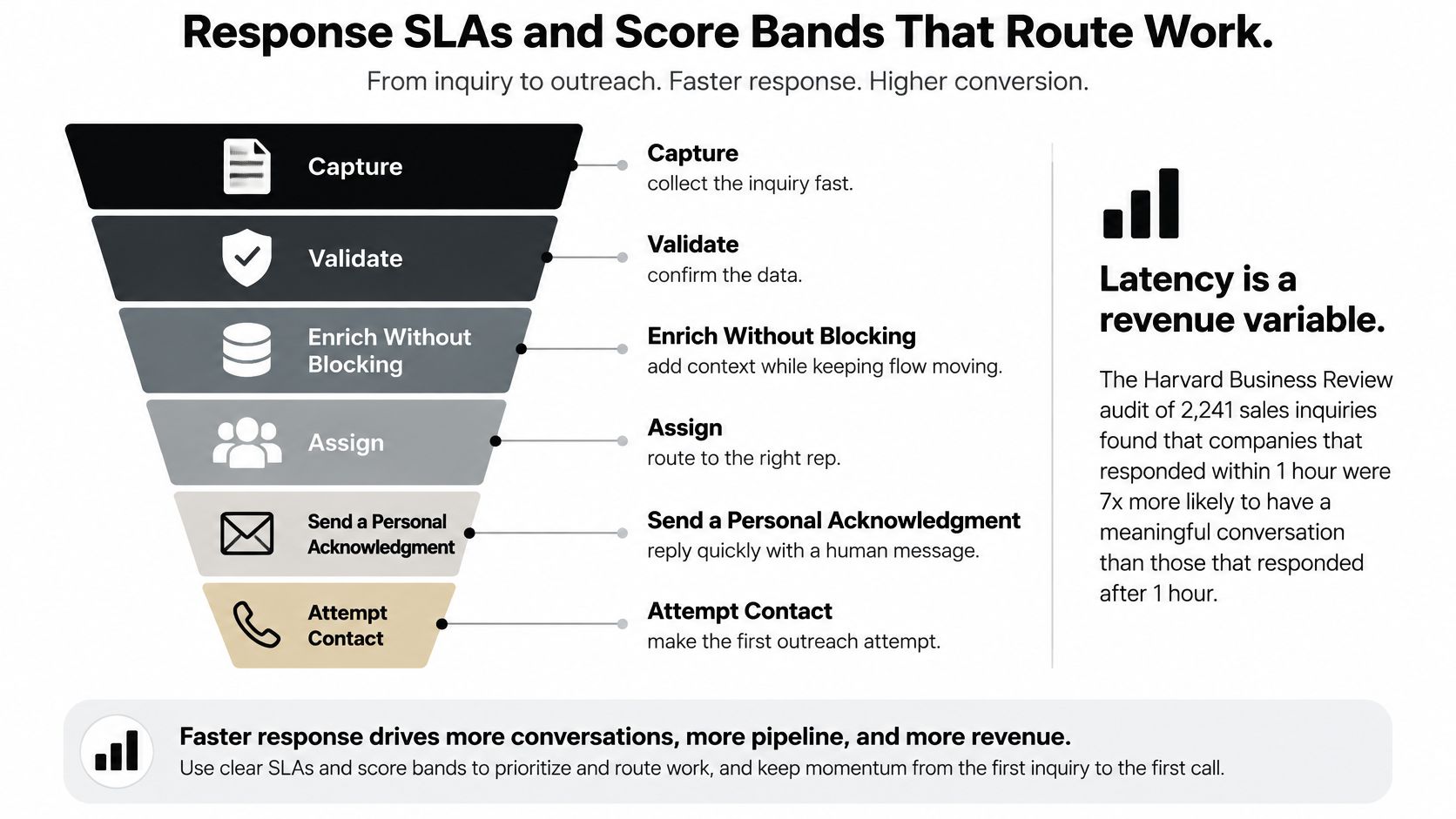
Treat five minutes as the working contact-attempt target for high-intent, qualified inquiries. An InsideSales analysis covering approximately 30 million contact attempts, summarized by Vida's speed-to-lead review, reported conversion rates eight times higher when the first attempt occurred within five minutes rather than after five minutes. That association isn't a promise of your results, but it justifies treating response latency as a revenue variable.
The workflow is straightforward: capture, validate, enrich without blocking, assign, acknowledge, attempt contact. The failure points sit between those steps, especially when a record exists in the CRM but no person or process owns the next action.
Use the funnel as an operational checklist, not merely a reporting diagram.
Make the score a routing policy
The bands below are a proposed starting policy, not an empirically validated scoring model. Calibrate them against accepted opportunities by segment.
Score bands and what happens next
| Band | Signals | Route | Response rule |
|---|---|---|---|
| 0–30 | Fit only, competitor, customer, or spam | Suppress or do not enroll | No sales touch |
| 31–60 | Fit plus light content engagement | Education nurture, where permitted | Deliver requested material without a sales chase |
| 61–80 | Pricing, comparison, repeat sessions, or known evaluator | SDR queue same day | Acknowledge immediately, human attempt that day |
| 81–100 | Demo, trial, or high-intent role on an ICP account | Auto-book or priority queue | Acknowledge within 60 seconds, attempt within 5 minutes |
Hard exclusions override scores. An existing customer asking for help belongs with the account or support team, even if their behavior generates a high intent score. A competitor doesn't become eligible because they repeatedly visit pricing.
Fit alone should establish eligibility, not urgency. Likewise, a job title shouldn't trigger the priority queue without credible evidence of an active inquiry. These lead scoring best practices help turn that distinction into maintainable rules.
Separate acknowledgment from meaningful contact
Our lead response automation responds to inquiries within 60 seconds, 24/7, qualifies leads automatically, and books meetings without human intervention. That capability handles acknowledgment and qualification, but your operational policy still needs to distinguish automated activity from a human attempt.
For high-intent accounts, send a confirmation that references the requested product or use case and provides the promised next step. Then attempt human or appropriately disclosed automated voice contact within the proposed priority window, respecting the buyer's preferences and local calling hours.
Don't count an automated receipt as a completed sales conversation.
Create exception queues for missing phone numbers, duplicates, suspicious submissions, and unmatched accounts. Missing enrichment should trigger a fallback route, not prevent routing altogether. A missed inbound call also needs a visible recovery task; teams evaluating that handoff can review how to recover missed opportunities with SnapDial when designing notification and callback ownership.
Predictive scoring can help identify the hottest prospects automatically, but the model needs supervision. A 2026 study covering more than 150 global B2B organizations reported that AI-scored leads converted about twice as fast as manually scored leads. Treat that as a benchmark indication, not an expected lift.
Avoid training only on closed-won deals, allowing company size to overwhelm intent, or leaving old engagement permanently active. Include rejected and lost records, document why scores changed, and review performance by segment.
Log separate timestamps for capture, assignment, automated acknowledgment, first human attempt, qualification, and opportunity creation. Report the median alongside overdue exceptions so a healthy-looking average doesn't hide abandoned inquiries.
Tips for Earning the Shortlist Early
Only 2% of B2B buyers begin the purchase process with no vendors already in mind, according to Gartner's April 2025 finding. Waiting for a demo request means waiting until buyers may already favor someone else.
The answer isn't to call every person who reads an educational page. It's to make your product easy to understand, substantiate, and remember before a project becomes active.
Publish evidence buyers can carry forward
In a 2025 global survey, 80% of technology-sector buyers used generative AI at least as much as traditional search for vendor research, and 56% identified chatbots as a top vendor-discovery source, according to Responsive's Buyer Intelligence report. Your content therefore needs to answer comparison and implementation questions clearly, not just attract a click.
Publish accessible integration pages that specify supported functionality, prerequisites, and limitations. Build comparison pages around actual evaluation criteria, including situations where your product isn't the right choice. Clear headings, crawlable text, and precise product entities make the material easier for both people and automated systems to interpret, without guaranteeing a recommendation.
Keep security language exact. Don't imply that an integration inherits every certification or control associated with a connected platform.
An outreach plan should connect those public facts to a useful next step.

Ask customers for reviews that describe the original problem, implementation conditions, and observable outcome. A star rating doesn't tell a technical evaluator whether the product supports their operating constraints.
Monitor representative buyer prompts and record which vendors appear, which pages support the answer, and whether your product facts are accurate. Treat these checks as directional observations because recommendations can change with wording and context. Correct your owned material when an answer exposes ambiguity, rather than publishing repetitive pages to chase every prompt.
Convert early interest into readiness
Store permitted anonymous engagement at account level where identification is sufficiently reliable. Don't pretend that an account match identifies a specific employee, and don't use it to justify intrusive outreach.
Keep low-intent accounts in useful education while interest remains relevant. Retention and nurture duration should follow permission, engagement, and your buying cycle, not an indefinite default.
Earlier consideration is valuable. It isn't pipeline until there's a credible buying conversation.
Use a compact message pattern for inbound and shortlist follow-up:
- Problem: Describe the specific operating gap relevant to the buyer's stack.
- Proof: Add a customer outcome only when you can substantiate the metric, baseline, and timeframe.
- Technical fact: State the relevant integration, security control, or deployment condition.
- Next step: Offer the agreed fit conversation or sandbox, not competing requests.
Every factual claim should also appear in the approved sales material. If you don't have numerical proof, use a verifiable qualitative outcome instead of filling the gap with an invented number.
Our B2B SaaS lead workflow enrolls leads in nurture if they don't book within 24 hours. Apply that behavior to eligible fit accounts, not as permission for another generic blast. Stop treating low-intent downloads as urgent sales tasks, and stop counting brand traffic with no identifiable commercial progression as pipeline.
Run the 90-Day Pipeline Test
Use this proposed operating schedule to test the system before expanding acquisition.
- Week 1: Freeze the ICP and disqualifiers. Reconcile the highest-impact product, integration, security, implementation, and commercial claims across the website and sales material.
- Weeks 2–4: Launch the selected capture motions and routing policy. Test acknowledgment, ownership fallback, and contact attempts with real submissions. Stop sequences without a clear next step.
- Weeks 5–8: Add the shortlist motion, choosing reviews or answer-engine proof. Review contact rate, qualification conversion, sales-cycle length, and revenue per account.
- Weeks 9–12: Compare existing routing with intent-enriched routing in matched territories or account segments. Keep channel mix stable enough to interpret the result.
Set pass conditions before spending more
Recommended pass conditions are a first-touch median below five minutes for high-intent inquiries, sales accepting most routed accounts, and pipeline coming from more than a single channel. Require those conditions to hold across consecutive weekly reviews before adding spend.
Track acquisition economics alongside those outcomes. Use lead generation cost per lead as an input, not the final verdict on channel quality.
In our B2B SaaS case study, six months after implementation, qualified lead volume rose 340%, sales admin time fell 68%, lead-to-customer conversion improved 2.4x, and $1.2M in additional attributed revenue was recorded. These are client-reported results, not independently verified outcomes or a forecast for another company.
Book the internal review against the score table before adding another channel. Bring rejected accounts and overdue inquiries, not just campaign dashboards.
MakeAutomation offers lead capture, CRM automation, qualification, routing, and personalized follow-up for B2B and SaaS teams. Visit MakeAutomation to arrange a free discovery call that audits your workflows, identifies high-ROI automation opportunities, and provides a custom implementation plan with a clear timeline and pricing.