
Lead Generation Process: 6 Stages from Target to Handoff
The odds of qualifying a web-generated lead were 21 times higher when first contact happened within five minutes rather than after 30 minutes in a study across six companies, according to Vendasta's account of the Lead Response Management study. That reframes the lead generation process: attracting interest is only part of the job. Your team also needs to preserve that interest until a useful sales conversation begins.
For a growth-stage B2B or SaaS company, the right goal isn't a bigger contact database. It's more qualified pipeline, with clear ownership from the first signal of interest to the sales handoff.
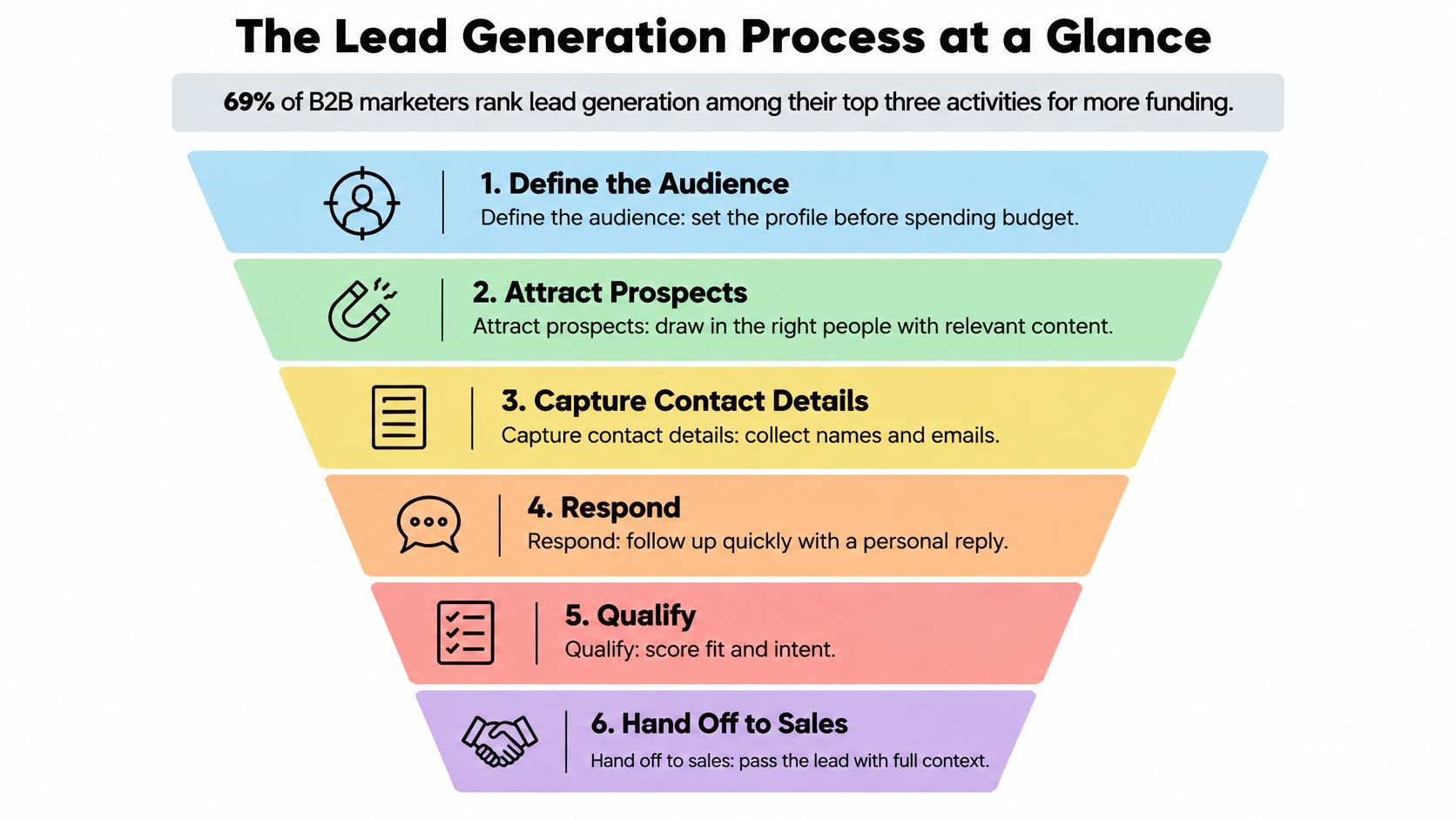
The Lead Generation Process at a Glance
A lead generation process is the sequence that turns buyer interest into qualified pipeline. It runs from defining whom to reach through to passing a qualified lead to sales, with consent and a clear next action at each step.
Lead generation process stages and outputs
| Stage | Goal | Output |
|---|---|---|
| Define audience | Name the ideal customer profile and buying triggers | Written ICP and persona list; record fit among incoming accounts |
| Attract prospects | Bring relevant visitors in through content, search, ads and outbound | Visits and form starts by source; qualified contacts by channel |
| Capture contact | Turn interest into a form fill, call or chat with consent | Lead record with source and opt-in status; complete contact records |
| Respond | Contact the lead through a human or automated touch | First-touch timestamp in the CRM; response time |
| Qualify | Confirm fit, timing and buying authority | Qualified or nurture status; sales acceptance |
| Hand off | Assign an owner and pass full context to sales | Accepted opportunity with owner; qualified-to-opportunity rate |
The stages work like a relay: each handoff depends on the previous one delivering usable information. Strong targeting cannot compensate for a broken form, and a persuasive landing page cannot make up for an unanswered demo request.
Email adoption alone does not show whether a process works. 88% of surveyed businesses reported using email for lead generation in 2025, according to the B2B Marketing Expo survey reported by Dux-Soup. The more useful measure is whether activity in each channel produces suitable buyers who advance toward sales.
Audit rule: Give every stage a named owner, an observable output, and a timestamp. A lead should never sit in a shared inbox without a next action.
Treat the process as a feedback loop. Nurture responses and closed-lost reasons can help refine whom you target and what you offer. Record the time between stages, then look for where qualified leads stall. The UK golf club membership growth guide offers a sector-specific example of membership growth, while the stages above provide a framework for B2B teams.
Defining Your Audience Before You Generate Demand
In 2024, 69% of surveyed B2B marketers identified lead generation as one of the top three marketing activities likely to receive additional funding, according to Grant Marketing's 2024 B2B Marketing Benchmark Report. Before increasing spend, decide exactly whose attention deserves it.
An ideal customer profile, or ICP, describes the organisation you're best equipped to serve. A buyer persona describes the person involved in choosing or using your solution. Mixing them produces vague targeting.
Turn those distinctions into a visible planning exercise.

Build a profile your team can apply
Write the firmographic boundaries. Specify industry, company size, revenue range and supported regions. Targeting small businesses isn't precise enough to guide list building or ad exclusions.
Identify the buying roles. Separate the end user, internal champion, technical reviewer and budget approver. A job title alone doesn't tell you whether someone can authorise a purchase.
List demand triggers. A new operations hire, funding announcement, tool migration or failed campaign can create a reason to act. Distinguish a relevant event from a convenient excuse to send an email.
Set disqualifiers. Document unsupported regions, incompatible systems and commercial requirements you can't meet. Otherwise, salespeople will spend discovery calls finding exclusions marketing could have applied earlier.
Match the offer to the person. A revenue operations leader may want a workflow assessment; a security reviewer may need architecture documentation. Don't send both the same generic download.
Translate the profile into CRM fields. Use controlled values for industry, role, trigger and fit status in HubSpot, Salesforce or Pipedrive. Free-text notes alone make consistent routing difficult.
Say a SaaS company targets every business with a sales team. Its message will be broad, and its qualification calls will cover unrelated problems.
A sharper hypothetical audience would be software firms with an established revenue operations function that are replacing disconnected sales tools. That description gives marketing a problem to address and sales a reason to investigate.
Check whether the ICP is usable
- Boundaries: Can someone include or exclude an account without guessing?
- Buying context: Are the problem, trigger and decision roles clear?
- Operational labels: Can the CRM store and route those attributes?
Use our guide to defining an ideal customer profile when turning those answers into a working document.
Attracting Prospects Through Channels That Convert
A landing page gives interested prospects a focused next step. In 2024, 44% of marketers most commonly used landing pages to generate leads, according to HubSpot's B2B marketing data summary. Build yours around a clear offer, such as a process audit, rather than a list of everything your company does.
A landing page isn't a traffic source, though. Its results depend on who arrives and what they expected before clicking.
Match the channel to the buying situation
Search content attracts people investigating a problem. Publish answers to questions buyers ask before they know your product category, then connect those answers to relevant next steps. Search takes sustained publishing and maintenance, so don't judge a new content programme by immediate demo volume alone.
Comparison guides attract buyers evaluating alternatives. Explain trade-offs, integration requirements and implementation constraints rather than declaring your product the winner everywhere. Free tools and calculators can also attract practical interest, but they require maintenance and a useful result before you ask for contact details.
Email attracts attention from people who already know you. Segment existing, eligible contacts by their problem and buying stage. Distribution is quick once the content exists, but a reliable programme requires list hygiene, relevant messages and suppression rules.
Paid search attracts active demand; retargeting re-engages eligible visitors. Campaigns can begin producing traffic after launch, but someone must review search terms, exclusions, creative and landing-page performance. Don't confuse fast traffic with fast qualification.
Outbound reaches selected accounts rather than waiting for discovery. It requires account research, lawful contact practices and a reason for the recipient to care. Webinars suit buyers who need deeper explanation, but preparation and follow-up can outweigh the live session itself.
For a professional-services comparison, the Advisor Momentum lead generation guide offers a sector-specific resource. Evaluate any channel advice against your own buyer's trust requirements and decision process.
Build a connected test
Say you offer a process audit. A comparison guide can explain competing approaches, while a retargeted ad brings eligible visitors back to the audit landing page. Keep the promise consistent across all assets.
Long sales cycles often need educational content and email to support internal evaluation. Shorter buying journeys can favour paid search connected to a tightly matched landing page. Our B2B demand generation tactics guide can help you develop the supporting activities.
Choose a small channel mix you can operate well. Compare cost per qualified lead, not just cost per form submission.
Set a review window before launching. Pause channels that attract the wrong accounts, but give qualified opportunities enough time to progress before judging revenue.
Getting Found When Buyers Start Their Research in AI Search
Your website isn't always the buyer's starting point. In G2's April 2025 survey of 1,169 B2B decision-makers, 29% started software research with AI search more often than Google, while generative-AI chatbots were the leading influence on vendor shortlists at 17.1%, as reported in Responsive's buyer intelligence coverage.
A buyer can learn about your category, compare vendors and form an opinion without visiting your landing page. Your lead generation process therefore needs an AI-discoverability stage within attraction, with its own owner and measurement.
Make your company easier to represent accurately
Monitor realistic buyer prompts. Use questions from discovery calls, sales objections and customer interviews. Log which vendors appear and which sources the tools reference; don't test only prompts containing your brand.
Audit descriptions of your company. Check product capabilities, supported customers and implementation claims. Correct missing or outdated public information rather than trying to manipulate answers.
Publish evidence-rich comparison and implementation pages. Explain limitations, prerequisites and practical steps in customer language. Thin pages filled with category keywords give buyers little reason to trust you.
Maintain third-party profiles and reviews. Keep business descriptions consistent and encourage authentic customer feedback. Don't assume you control which external sources an AI system selects.
Make proof easy to interpret. Use clear headings, attributable examples and appropriate structured data. Markup should describe what's on the page, not introduce unsupported claims.
Capture self-reported discovery. Add a CRM field that lets prospects name an AI tool or describe their path in their own words. Preserve that answer separately from tracked campaign attribution.
Separate visibility from pipeline
Track relevant prompt coverage and accuracy as awareness measures. An AI mention isn't a lead, and a favourable answer doesn't prove purchase intent.
Record self-reported or attributable opportunities separately, then review branded search activity as supporting context. Buyers may receive enough information without clicking through, so accurate representation matters alongside conversion-page performance.
Capturing and Responding to Leads Within Minutes
The Harvard Business Review study published in 2011 audited 2,241 U.S. companies by submitting online inquiries and timing their replies, according to Vida's account of the study. The response distribution exposes a process problem, not a traffic problem.
Lead response outcomes by time to first reply
| Response time | Share of audited companies | What it means for the lead |
|---|---|---|
| Within one hour | 37% | The company begins a conversation while the inquiry is relatively fresh |
| One to 24 hours | 16% | The buyer waits while the request remains unresolved |
| More than 24 hours | 24% | The buyer has more time to investigate other vendors |
| Never replied | 23% | The inquiry receives no response from the company |
These categories don't establish that every delayed prospect chose a competitor. They show how often companies left an inquiry waiting, despite already having attracted the buyer's attention.
A B2B SaaS company we worked with was losing deals because its sales team couldn't respond to demo requests fast enough. Buying more demand wouldn't have addressed that bottleneck. The team needed a dependable path from submission to useful contact.
Design capture around immediate routing
Keep the initial form limited to what you need to deliver the request and choose the next action. For a demo, that might mean contact details, company information and the problem the buyer wants to discuss. Ask optional discovery questions later.
Configure the workflow so submission triggers operational work:
- Validate and deduplicate: Check required fields and match existing contacts or accounts before creating another record.
- Assign ownership: Apply territory or account rules automatically, with a fallback owner when no rule matches.
- Acknowledge the request: Confirm receipt and explain what happens next.
- Start the conversation: Trigger a relevant human or automated response, not just a generic confirmation.
- Log the event: Store submission, assignment and first-contact timestamps in the CRM.
Don't make enrichment a prerequisite for responding. If an external lookup fails, the lead should still reach an owner with the available information.
Measure the delay buyers experience
An automatic receipt and a useful first response aren't the same thing. Track them separately so a confirmation email doesn't disguise an unanswered question.
Report median response time alongside the 90th-percentile response time, which shows the slower end of the experience. Segment by business hours, source and routing path so an acceptable overall result doesn't hide an after-hours queue.
Define which event starts the clock and which logged action stops it. Trigger an escalation when a request exceeds your service-level threshold, and send that alert to someone who can take ownership.
Test the workflow yourself. Submit through the live form, reply to the acknowledgement, and confirm that the CRM records the interaction without manual repair.
Qualifying Leads Before Sales Gets Involved
90% of B2B buyers research before speaking with a vendor, according to EMARKETER's coverage of AI and B2B buying. A form submission can therefore mean anything from early curiosity to a request for help completing a decision.
Qualification should identify the appropriate next action, not manufacture a reason to call everyone.
Separate fit, readiness and permission
Fit asks whether you can serve the account. Readiness asks whether the buyer is actively evaluating a purchase. Permission determines which follow-up actions are appropriate and lawful.
Anonymous activity, such as repeat visits to comparison content, isn't equivalent to an identified person requesting contact. Keep aggregate intent signals separate from permission-based lead records.
Qualification signals and the action each one triggers
| Signal | Example | Action |
|---|---|---|
| Active evaluation | Requests pricing, security documents or a technical workshop | Route to sales now after checking fit and contact permissions |
| Fit without timing | Matches the ICP but has only read a blog post | Offer stage-specific nurture where permitted |
| Timing without fit | Active buyer outside the target region or size | Qualify further or decline |
| Consent missing | Form lacks a marketing opt-in | Hold marketing nurture until the required permission is recorded |
| Anonymous research | Repeated visits to comparison pages without a form fill | Use as an intent signal only, not as an identified lead |
Missing a marketing opt-in doesn't automatically prevent you from answering a buyer's direct request. Keep request fulfilment separate from promotional sequences, and configure outreach rules for the applicable jurisdiction and channel.
Ask questions that change the next action
A buyer who has completed independent evaluation may need security documentation, pricing boundaries or a technical workshop. Sending another introductory email creates friction instead of helping.
Use progressive profiling to request only the missing details needed for the current interaction. A webinar registration doesn't need the same qualification depth as an implementation discussion.
Record the contact source, permission status and lawful basis for outreach. Apply suppression checks before activating a sequence, including when records arrive through integrations or imported lists. Our guide to qualifying sales leads can help turn those decisions into shared criteria.
Judge the result by revenue per qualified account, calculated using a consistent qualification cohort and revenue window. Pair it with opportunity creation so long sales cycles don't obscure current progress. A growing MQL count is useful only if those accounts become worthwhile sales conversations.
Handing Off Leads to Sales Without Losing Them
A handoff is complete when a salesperson accepts responsibility, not when marketing changes a CRM status. The buyer shouldn't have to repeat information or discover that nobody owns the next step.
Use this timeline to make ownership visible.
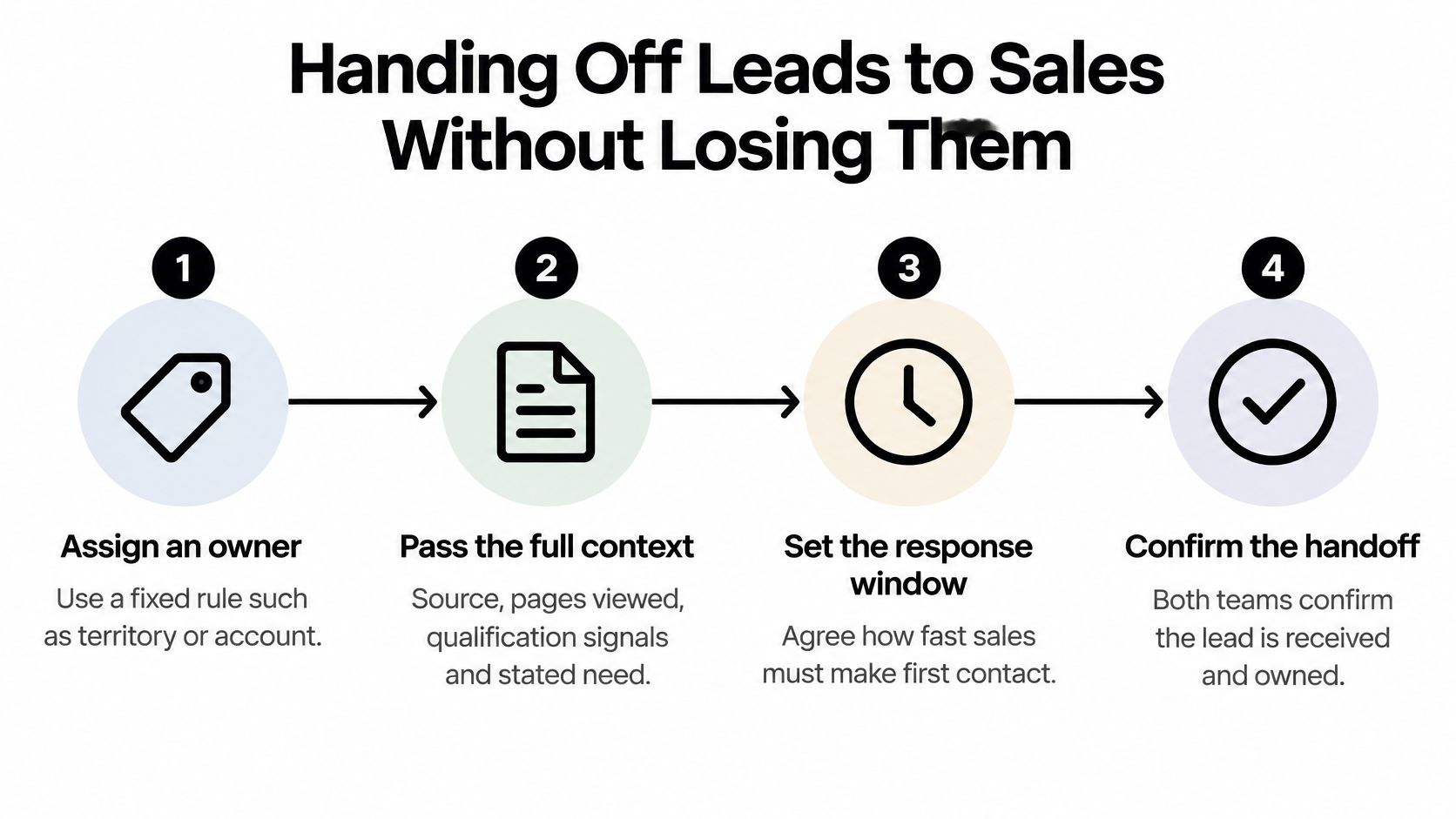
Assign the owner by a fixed rule. Use account ownership, territory or another documented rule. Give unmatched records a monitored fallback queue.
Pass decision-useful context. Include the source, stated need, qualification evidence and permitted interaction history. Distinguish what the buyer said from what an automated score inferred.
Preserve the response deadline. Don't restart the service-level clock when the lead changes teams. The buyer has been waiting since the original inquiry.
Require acceptance or rejection. Create a task with a due time and record the salesperson's decision. An alert alone doesn't confirm that anyone took responsibility.
Provide a booking fallback. Our B2B SaaS lead workflow enrolls leads in nurture sequences if they don't book within 24 hours. Apply permission and suppression checks so the fallback supports the buyer rather than pressuring them.
Make rejection useful
Every rejected lead needs a reason code, such as unsupported region, no budget or no current need. Separate permanent exclusions from temporary timing problems so you don't discard a suitable future account.
Review the codes with marketing. Frequent regional mismatches suggest a targeting issue; repeated missing-context rejections suggest a handoff issue.
For a visual walkthrough of the workflow, use the video below.
At the monthly review, compare qualified-to-opportunity rate by source with rejection trends and response-time performance. Use the results to decide whether to change targeting, qualification criteria or team ownership. Don't let sales acceptance become a checkbox that conceals weak opportunities.
Start Your Lead Generation Process This Week
You don't need to replace your CRM to begin. Start with a narrow workflow you can inspect from first touch to accepted opportunity, then fix the point where suitable buyers wait or disappear.
Build a working baseline
Write the ICP and disqualifiers. Keep them concise enough for marketing and sales to apply during routine work. Resolve disagreements before adding automation.
Audit the stage transitions. Take a recent set of leads and identify the owner, entry event and exit event for each stage. Mark missing timestamps as an instrumentation problem.
Inspect first-response performance. Separate acknowledgements from substantive responses. Look for unassigned records, after-hours delays and failed notifications.
Choose a focused acquisition test. Pair a channel with a landing page and a clear offer. Define qualification criteria before you start comparing campaign results.
Configure escalation and rejection rules. Decide who receives overdue-lead alerts, who provides backup coverage and which rejection reasons sales must record. Test the exception paths as carefully as the normal route.
Get help with the workflow, not just the tools
If you want outside help, every MakeAutomation engagement starts with a free 15-minute discovery call, with no obligation to proceed. We discuss your goals, current tools, bottlenecks and desired outcome, then map the critical workflows. The discussion also helps establish a preliminary scope and timeline.
Bring a sample lead journey, including the form, CRM record, notifications and follow-up. That makes it easier to distinguish a configuration problem from a missing process decision.
Keep the habit: Review response time and qualified pipeline every month. Lead volume belongs on the dashboard, but it shouldn't decide whether the process is working.
MakeAutomation builds lead-handling and CRM workflows that connect capture, qualification, routing, follow-up and sales handoff. Visit MakeAutomation to discuss where your lead generation process stalls and what a practical automation plan could address.