Lead Nurturing Automation That Converts B2B Leads
A prospect downloads your pricing guide, visits a product page, and then disappears. Your team sends a few follow-ups, waits for a reply, and eventually moves the contact into a generic newsletter. Months later, the buyer returns with a different question, but nobody knows what happened between the first download and the new visit.
That gap is where lead nurturing automation either creates pipeline or loses it. A useful system doesn't merely send scheduled emails. It watches for changes in intent, updates the CRM, adjusts the next message, and routes the lead to the right human or channel when email is no longer enough.
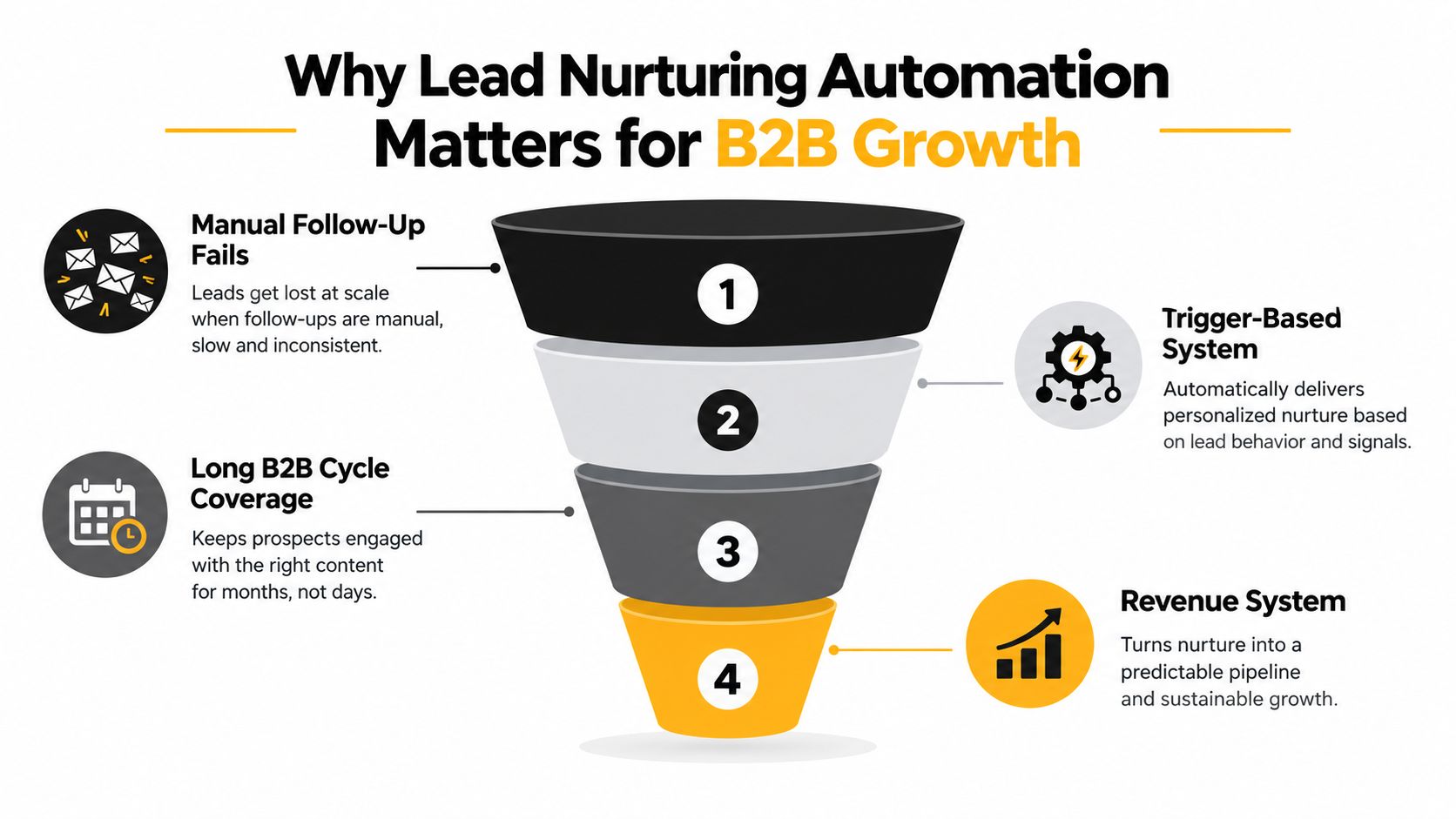
Why Lead Nurturing Automation Matters for B2B Growth
B2B buyers rarely move from first interaction to purchase in one clean motion. A finance leader may download an educational guide, involve an operations manager, compare vendors, pause the project, and return when the budget is approved. Manual follow-up struggles with that pattern because sales and marketing teams usually work from incomplete memories, disconnected spreadsheets, and fixed reminders.
Marketing automation platforms began rising in the early 2000s, shifting nurture from manual list management toward always-on, trigger-based sequencing. That change allowed teams to respond to downloads, page visits, email actions, and sales-stage progression instead of treating every contact as a static record. HubSpot's summary of lead nurturing benchmarks reports that automated lead management has been associated with at least a 10% revenue increase within 6–9 months, while companies using marketing automation to nurture prospects have been reported to see a 451% increase in qualified leads compared with manual approaches.
The problem with timed follow-up
A timed sequence says, “Send message two after three days.” A behavior-driven system asks, “What did the buyer do, and what does that action tell us about the next useful conversation?”
Those are different operating models. If a lead downloads an introductory guide but never returns, the next touch might answer a common implementation question. If the same lead visits a comparison page repeatedly, the workflow should prioritize proof, security information, or a sales-assisted conversation. The delay still matters, but behavior decides the path.
This is especially important for subscription businesses and SaaS companies, where prospects can remain active without being ready to buy. Industry summaries report that 63% of leads won't convert immediately, and that effective nurture programs have been associated with 50% more sales-ready leads at 33% lower cost in comparison with less effective approaches. The lead nurturing statistics summary from 99Firms places those figures in the context of extended buying cycles and cross-channel lifecycle management.
Practical rule: Automation should preserve context between interactions, not simply increase the number of interactions.
What a revenue system looks like
A mature nurture program has a clear relationship with sales. Marketing owns the experience before a lead is ready, sales receives a meaningful signal rather than a vague “engaged” label, and the CRM records what happened next. The system can pause marketing when an opportunity opens, suppress irrelevant messages after a sales call, and restart education when an opportunity closes without a purchase.
The business case isn't speed alone. It's continuity, qualification, and better timing. Nurture automation keeps valuable contacts from disappearing into an unowned queue while giving sales a more complete view of buying behavior.
Setting Goals and Segmenting Your Audience for Smarter Nurture
Start with the outcome, not the workflow builder. A nurture campaign without a defined job tends to become a collection of emails that produces activity without improving sales progression.
Write one objective for each audience group. A new inbound lead might need education and a second meaningful interaction. A product-qualified trial user might need activation support. A stalled opportunity might need proof that addresses procurement, integration, or risk. These objectives require different content, triggers, handoffs, and success measures.
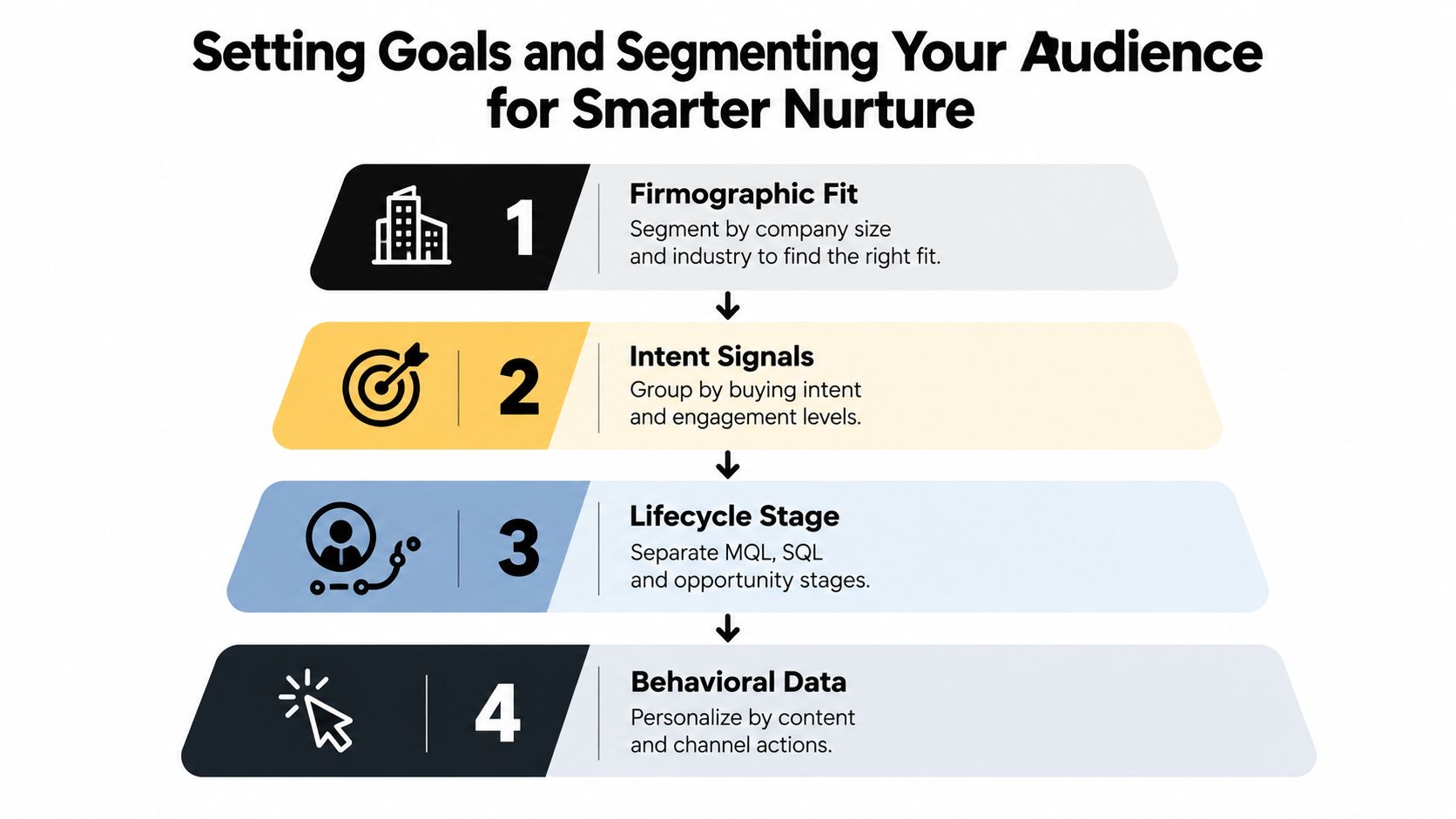
Build segments from four types of evidence
Firmographic fit tells you whether the account resembles the customers your product can serve. Use company size, industry, geography, operating model, and technology environment where those fields are reliable. Don't create a highly detailed segment that your forms and CRM can't maintain.
Intent describes what the account appears to be trying to accomplish. A general content download signals curiosity. A visit to an integration page, pricing page, or security resource suggests a more specific evaluation. Intent isn't a verdict, so combine it with fit before escalating.
Lifecycle stage prevents marketing from treating a sales-qualified lead like a new subscriber. Keep MQL, SQL, opportunity, customer, and closed-lost states synchronized across marketing automation and CRM. Each stage should define what communications are allowed, what communications are suppressed, and who owns the next action.
Behavioral data adds immediacy. Track content consumed, pages visited, replies, form submissions, trial activity, and channel preferences. Recency matters because an old interaction shouldn't carry the same weight as a current evaluation signal.
Use a simple worksheet for every segment:
- Audience definition: Who belongs here, and who must be excluded?
- Primary problem: What question or risk is most likely blocking progress?
- Nurture objective: Education, activation, qualification, re-engagement, or sales acceleration?
- Exit condition: What action moves the lead into another path?
- Owner: Which team responds when the exit condition occurs?
- Evidence: Which CRM fields and behaviors support the decision?
Lead scoring should reflect both fit and intent, rather than rewarding every click equally. For a deeper framework on scoring inputs, decay, thresholds, and governance, use these lead scoring best practices.
Avoid the one-sequence trap
One sequence for every lead usually fails in predictable ways. A small company gets enterprise procurement content, a technical evaluator receives executive messaging, and an inactive contact keeps receiving calls to book a demo. Segmentation doesn't require dozens of micro-campaigns. It requires enough distinction to keep the message aligned with the buyer's current problem.
Review the segment definitions with sales before launch. Ask whether a representative could recognize the segment from the CRM record and know what action to take. If they can't, the segment is probably based on marketing convenience rather than buying reality.
Mapping the Buyer Journey and Matching Content to Intent
A segment tells you who a lead is. A journey map tells you what the lead needs next.
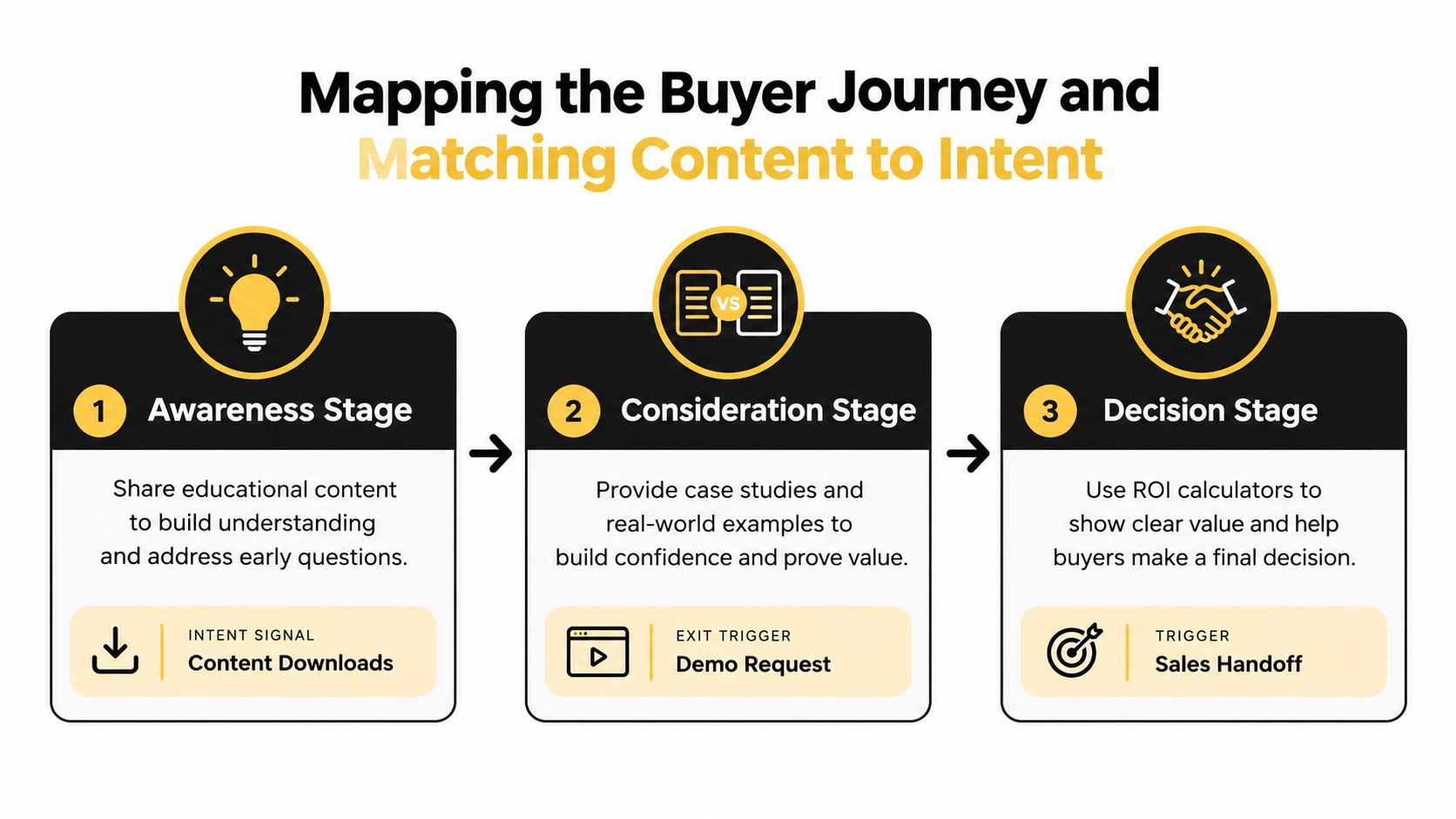
The practical unit of design is a combination of four elements: the buyer's current question, the signal that reveals movement, the content that answers the question, and the condition that changes the path. Without all four, teams often build content libraries instead of useful journeys.
Awareness requires clarity
At awareness, the buyer is defining the problem. Educational articles, benchmark explanations, checklists, and introductory guides work because they help the prospect understand the situation before they evaluate vendors.
The trigger might be a content download or a return visit to a related topic. The next touch should expand understanding, not jump straight to a demo. If the buyer ignores several educational messages, reduce pressure or change the topic instead of continuing the same sequence indefinitely.
Consideration requires proof
During consideration, the prospect is comparing approaches and looking for evidence. Case studies, implementation guides, comparison pages, architecture explanations, and customer FAQs can answer questions that broad educational content cannot.
A repeat visit to a product page should not automatically produce the same reminder email. It should move the contact into a branch that reflects the page viewed, the account's fit, and any known role. A technical evaluator may need integration detail. An executive sponsor may need business justification. A procurement participant may need security and implementation documentation.
The XBurst practical mapping process is useful when the team needs a concrete way to document stages, touchpoints, questions, and ownership before building workflows.
Decision requires reduced friction
At the decision stage, buyers want confidence that the purchase will work in their environment. ROI tools, implementation plans, security materials, stakeholder-ready summaries, and direct consultation can help remove the final barriers.
An explicit demo request or pricing interaction should normally become a CRM event, not just another email trigger. The workflow should notify the assigned owner, pause competing nurture, and provide sales with the context behind the action. If the lead doesn't respond after the handoff, the system can return them to a relevant education path rather than leaving them in limbo.
A journey map becomes operational only when every meaningful signal changes the next action.
Use branching logic deliberately:
- Content signal: Recommend a related asset that answers the next likely question.
- Product signal: Increase qualification only when behavior supports genuine evaluation.
- Sales signal: Suppress marketing touches that conflict with active outreach.
- Negative signal: Lower priority, change frequency, or move the lead into re-engagement.
- Account signal: Coordinate contacts from the same company so sales sees collective activity.
For implementation details, document the conditions, delays, suppression rules, and CRM events in a marketing automation workflow. The map should be understandable to a lifecycle marketer, an SDR, and the person responsible for CRM operations.
A strong map also identifies gaps. If the buyer has a clear awareness asset and a strong demo CTA but nothing that addresses implementation risk, the problem isn't email frequency. It's missing decision-stage content.
Building Sequences and Automation Rules That Hand Off to Sales
Build the workflow around events your systems can observe and your teams can act on. A form submission, trial milestone, CRM stage change, meeting outcome, or high-intent page visit can start a path. A fixed delay can control pacing, but it shouldn't determine the entire experience.
Before writing copy, define the entry and exit conditions. Decide what happens when a lead is already in another campaign, what happens when an opportunity opens, and which team owns the record after a handoff. These rules prevent the common failure where a lead receives conflicting messages from separate automations.
Use conditions instead of a single queue
A useful workflow might begin with an inbound guide download. The first message delivers the asset and sets expectations. The next decision checks whether the contact replied, visited a relevant product page, or engaged with a technical resource. Each outcome should lead to a different action.
A trial workflow needs different logic. Product activity can trigger onboarding guidance, while inactivity can create a customer success task or a troubleshooting message. A demo no-show path should acknowledge the missed meeting, offer a simple rescheduling route, and alert the owner if the account continues to show intent.
Keep CRM handoffs explicit
A sales handoff needs more than a score threshold. Pass the reason for the handoff, the behavior that caused it, the content consumed, the account context, and the recommended next action. Create an SDR task only when the representative can understand why the task exists.
Recalibrate scoring when sales outcomes show that the model is wrong. A click may indicate curiosity rather than buying intent. A reply with a specific operational question may be more valuable than several passive engagements. Review the relationship between scores, accepted leads, opportunities, and closed outcomes on a regular operating rhythm.
| Playbook | Entry Trigger | Sequence Logic | CRM Handoff |
|---|---|---|---|
| Inbound education | Guide or report download | Deliver the asset, recommend a related topic, branch on product and pricing behavior | Assign a follow-up task when fit and intent meet the agreed threshold |
| Trial activation | Trial signup or product event | Send role-specific onboarding, react to activation or inactivity, suppress irrelevant promotion | Notify sales or customer success when usage indicates evaluation or risk |
| Demo no-show | Meeting marked as missed | Send a concise reschedule path, provide useful context, stop repeated reminders | Reopen the owner task if the lead returns to high-intent pages |
| Re-engagement | Extended inactivity | Reduce frequency, test a new problem angle, offer a preference update | Remove from active sales motion unless new intent appears |
If your team lacks the capacity to write, QA, and maintain every message internally, outsourcing email for better ROI can be one resourcing option. The strategic requirement remains internal: your company must own the audience rules, positioning, compliance decisions, and sales definition of readiness.
Test the integrations before launch
Run test records through every path. Confirm that the marketing platform receives CRM stage changes, that sales activity suppresses inappropriate nurture, that ownership fields populate correctly, and that failed syncs create an alert. Check duplicate records, missing consent, unsubscribes, and contacts who belong to multiple audiences.
A workflow isn't finished when the emails are written. It's finished when the system handles exceptions without losing the buyer's context.
Measuring What Matters and Optimizing for Pipeline Impact
Open rates can tell you whether a message reached an inbox and attracted an initial signal. They can't prove that a buyer progressed, that sales accepted the lead, or that the program influenced revenue.
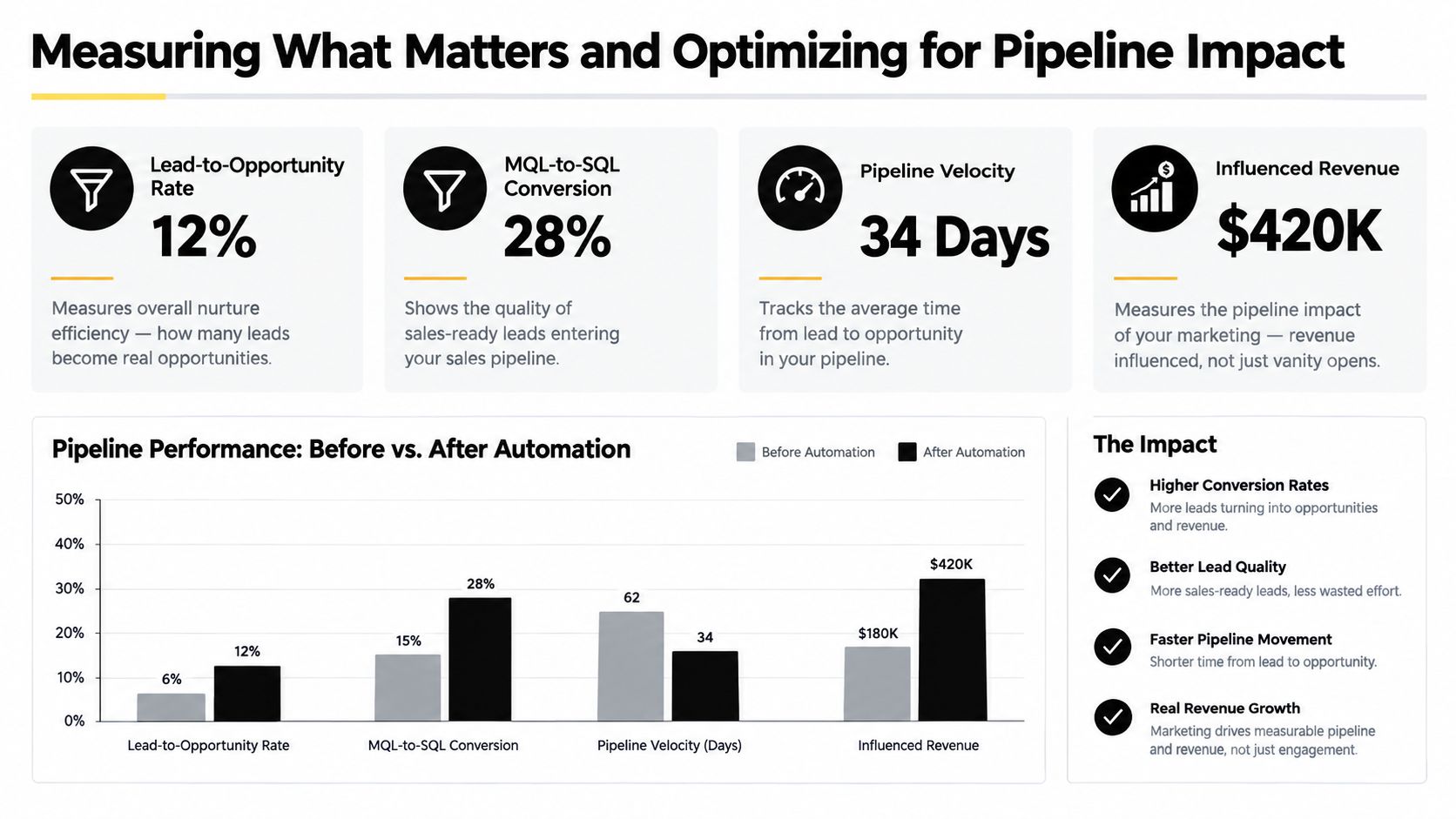
Measure the full path from entry to commercial outcome. SalesGenie's guidance on nurture measurement recommends tracking lead-to-opportunity conversion, MQL-to-SQL rate, click-through rate, and influenced pipeline. It also cites a reported 15–35% benchmark for MQL-to-SQL conversion in B2B nurture workflows and recommends keeping unsubscribe rates ideally under 1%, with quarterly lead-scoring recalibration.
Build a funnel-stage measurement model
Track each metric against a defined stage and owner:
- Lead-to-opportunity rate: Shows whether nurtured contacts become genuine pipeline.
- MQL-to-SQL conversion: Tests whether marketing's qualification signal matches sales' definition of readiness.
- Click-through rate and reply rate: Reveal whether the message creates an active response, although neither proves revenue alone.
- Influenced pipeline: Connects nurture participation with opportunities and revenue, while recognizing that influence isn't the same as sole attribution.
- Unsubscribe rate: Indicates whether relevance, frequency, or audience selection is damaging permission and trust.
Instrument the workflow end to end. Store campaign entry, branch decisions, sales acceptance, opportunity creation, and outcome fields in a reportable structure. Without those events, teams end up optimizing the easiest metric to access, usually opens.
Independent coverage of Brevo's benchmark reports automation emails averaging a 30.63% open rate and 7.39% click-through rate, compared with 20.73% open and 2.27% click-through rate for standard marketing campaigns. The American Marketing Association's coverage of the automated nurturing study also cautions against using open rate alone, since click-to-open rate and pipeline outcomes provide stronger evidence of engagement quality.
Measurement discipline: An engaged inbox is useful only when the engagement leads to a better next decision.
Optimize the system, not isolated emails
Use quarterly recalibration to inspect where leads stall. If many MQLs fail sales acceptance, review fit criteria and scoring. If opportunities are created but move slowly, examine decision-stage content and handoff quality. If unsubscribes rise, reduce repetition and give contacts more control over topics or frequency.
List hygiene supports the model. Invalid or risky addresses distort delivery and engagement data, so an Email Validation API can fit into the acquisition and CRM hygiene process before contacts enter high-value workflows.
For broader governance on testing, segmentation, consent, and lifecycle operations, use these marketing automation best practices. The strongest optimization loop connects a message change to a stage conversion change, not just to a more attractive dashboard.
Avoiding Common Pitfalls and Scaling to Cross Channel Nurture
The most expensive mistake is treating automation volume as maturity. A large sequence can still be static, irrelevant, and disconnected from sales outcomes. One 2026 industry analysis reports that 88% of B2B organizations operate at level 1 or 2 nurture maturity, meaning they rely largely on static sequences that treat leads similarly, while 12% have implemented true account-level personalization. Breakout's analysis of B2B lead nurturing automation frames the gap as a workflow and feedback-loop problem, not a shortage of email templates.
Avoid four failure patterns:
- Over-automation: Stop sending when a human conversation begins, when the account opts out, or when the content no longer matches the buyer's situation.
- Static sequencing: Let behavior, CRM events, and intent signals change the next touch instead of advancing every contact through the same calendar.
- Channel blindness: Treat email as the default forever. A lead may respond better to a call, WhatsApp message, or SDR-assisted interaction depending on market, role, urgency, and permission.
- Noisy reporting: Apple Mail Privacy Protection and Gmail tabbing make opens less dependable, while a cited B2B cold-outreach reply benchmark is around 0.7%. Dialnexa's commentary on cross-channel lead nurturing argues for stronger use of replies, intent, conversational signals, and sales-triggered tasks.
Use a simple routing decision. Continue email when the lead is consuming educational material but shows limited urgency. Offer WhatsApp or messaging when the market and consent support it and the buyer has demonstrated a preference for fast, short exchanges. Route to voice or an SDR when the account shows high intent, the question is complex, or timing makes a live conversation more valuable than another asset.
MakeAutomation can help B2B and SaaS teams design automated nurture sequences, lead scoring models, behavioral triggers, CRM workflows, and AI or voice-assisted processes. Audit your current program by tracing one lead from first touch to sales outcome, then visit MakeAutomation to discuss an implementation that connects the next-best channel to real buyer behavior.