The B2B Lead Generation Funnel, Stage by Stage
Most advice about a lead generation funnel starts with traffic. Publish more content, increase ad spend, attract a wider audience, and hope the pipeline catches up.
That advice misses the expensive part. In many B2B and SaaS funnels, the failure occurs after someone has already raised their hand. A form submission sits in an inbox, a sales alert lacks context, or a marketing-qualified lead reaches sales before anyone agrees what “qualified” means. The dashboard shows activity, but revenue remains thin.
A 2026 benchmark analysis puts the problem in clear terms. The median website visitor-to-lead rate was 1.8%, while the full lead-to-customer rate was 0.94%, meaning roughly one in 106 captured leads became closed-won revenue in that dataset (2026 lead generation benchmark analysis). More traffic can help, but only after the system handles captured demand properly.
Why Most Funnels Fail After the Capture, Not Before It
A captured contact is not pipeline. Pipeline appears when the team can recognize intent, respond with context, qualify the opportunity, and route it to the right sales owner. Traffic gets attention because it is visible in acquisition reports. The leaks after capture are harder to see, buried in inboxes, CRM queues, and inconsistent handoffs.
A founder may see hundreds of new records and only a few opportunities. That pattern often points to execution rather than reach. Someone downloads a guide, requests a demo, or responds to an ad, then receives a generic message days later. The prospect may already be evaluating another vendor by the time a representative follows up.
The stage transitions show where the pressure builds. One 2026 benchmark reports a median lead-to-MQL rate of 28.0%, followed by 47.1% from MQL to SAL and 31.7% from SAL to SQL (stage-level lead generation benchmarks). These figures point to filtering, qualification, and sales acceptance as the core operating problems, rather than mere traffic gaps.
Practical rule: Before increasing acquisition spend, inspect what happens to every lead during the first few minutes, the first day, and the first qualification decision.
Audit the handoff with four questions:
- Capture: Which action creates a lead, and does the CRM preserve its source, company details, and stated intent?
- Response: Who receives the alert, how quickly do they act, and what happens when that owner is unavailable?
- Qualification: Which firmographic, behavioral, and conversational signals move a record toward sales?
- Handoff: Does the sales representative receive useful context, or only a name and email address?
A repair plan should assign an owner to each decision, define the next action, and automate reminders, routing, enrichment, and follow-up where people routinely miss them. The funnel then becomes an operating system for demand, with measurable stage transitions and fewer high-intent prospects lost between marketing capture and sales conversation.
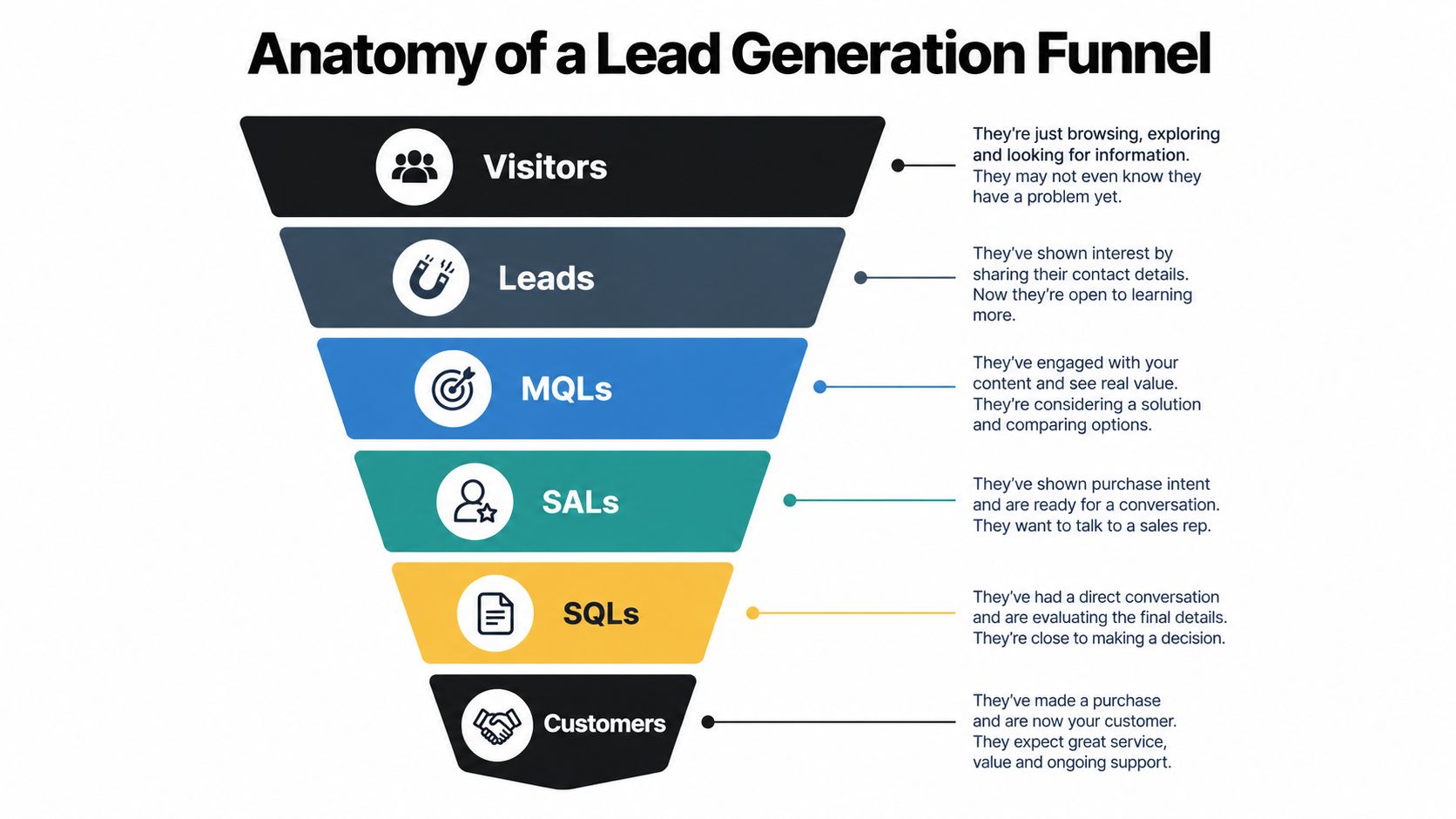
Anatomy of a Lead Generation Funnel
A B2B lead generation funnel is an operating model for sorting attention into sales action. Each stage answers a different question: who arrived, who identified themselves, who fits the target market, who has been accepted by sales, and who has a credible path to purchase. Clear definitions matter because vague stages hide leakage between capture, qualification, and the MQL-to-SQL handoff.
Visitors
A visitor has interacted with a website, article, advertisement, or social profile. The company can see that an anonymous browser reached a page, but it cannot yet connect that activity to a person, account, or confirmed business problem.
A finance operations manager reading about manual invoice work demonstrates topical interest. That visit does not establish buying intent. Search content, paid campaigns, and social distribution belong at the top of the funnel, but acquisition volume is only useful when the traffic has a realistic route to a relevant offer and a trackable next action.
Leads
A lead has provided contact information or started a conversation that the company can record. Examples include downloading a workflow checklist, requesting pricing information, or submitting a form for a product demonstration.
Lead status means identity capture, not sales readiness. A broad educational download may show interest while leaving urgency, authority, budget, and fit unknown. B2B marketing teams building prospect lists can review specialist resources such as best lead scraping tools, while checking data quality, relevance, consent, and applicable privacy requirements.
The capture mechanism also affects the quality of the next stage. A focused offer and a page built around one visitor intent usually produce clearer qualification signals. The practical mechanics are covered in this guide to B2B lead generation landing pages.
Marketing-qualified leads
A marketing-qualified lead, or MQL, meets criteria set by marketing. Those criteria may combine company size or sector, job role, content engagement, product-page activity, and a request that indicates stronger intent.
An MQL should represent a meaningful change in expected sales relevance. A form submission alone rarely proves that change. If every captured contact receives the MQL label, sales cannot use it to prioritize work, and later conversion reporting becomes difficult to interpret. Qualification rules should state which fit and behavior signals are required, rather than relying on a single score with no documented meaning.
Sales-accepted leads
A sales-accepted lead, or SAL, is a record that sales has agreed to review or work. This stage measures whether the marketing definition produced a lead that a representative can reasonably pursue.
Acceptance is easier when the record includes the company, role, stated use case, source campaign, and relevant page activity. A representative should not have to reconstruct the prospect's history across disconnected systems before deciding what to do. A rejection should also carry a reason, such as poor fit, duplicate record, unclear intent, or insufficient information. Those reasons help marketing refine its MQL criteria.
Sales-qualified leads
An SQL has passed a sales qualification process. The representative has usually confirmed a meaningful problem, a plausible use case, and enough fit or buying context to justify continued sales attention.
Contact alone does not create an SQL. The stage records a judgment that the account has a credible opportunity to progress. Teams should document the evidence required, including the problem discussed, relevant stakeholders, and agreed next action. Without that evidence, representatives apply different standards and pipeline reports confuse activity with qualification.
Opportunities and closed-won customers
An opportunity enters a defined sales process when the buying conversation has enough substance to support a commercial next step. The account may have a recognized need, a potential project, identified participants, and a follow-up agreed by both sides.
A closed-won customer has completed the commercial decision and become a paying client. The funnel narrows because each stage tests a distinct condition: identity, fit, marketing qualification, sales acceptance, sales qualification, commercial potential, and purchase. Keep those definitions separate. Otherwise, a CRM can show an attractive volume of leads while concealing stalled handoffs and weak evidence behind later-stage records.
The Metrics That Matter at Every Funnel Stage
A funnel can generate more leads while producing fewer sales conversations. Audit the transitions, especially after capture, because qualification and handoff failures often hide behind healthy top-line volume.
The table below provides median stage benchmarks from a 2026 analysis:
| Funnel Stage Transition | Median Conversion Rate |
|---|---|
| Visitor to lead | 1.8% |
| Lead to MQL | 28.0% |
| MQL to SAL | 47.1% |
| SAL to SQL | 31.7% |
| SQL to opportunity | 59.3% |
| Opportunity to closed-won | 21.7% |
Source: 2026 median B2B funnel conversion benchmarks.
These figures are reference points, not quotas. Segment, offer, sales motion, traffic source, and deal complexity change the expected rate. Use the pattern to locate leakage. A weak visitor-to-lead rate points toward the offer or landing page. Strong lead-to-MQL performance followed by weak MQL-to-SAL performance points toward qualification rules, acceptance criteria, or the marketing-to-sales handoff.
Run a short transition audit
Export one CRM cohort and calculate every transition with the same stage definitions and date logic. Do not compare newly created leads with mature opportunities, or count records without a reliable stage history. A short audit should answer where progression slows and which decision causes the delay.
Check four details before interpreting the results:
- Stage definitions: Confirm that marketing and sales apply the same meaning to MQL, SAL, SQL, and opportunity.
- Cohort window: Group leads created during the same period, allowing later-stage records time to progress.
- Source segmentation: Separate organic search, paid campaigns, referrals, outbound, and partner sources when the sample supports it.
- Lost reasons: Review rejection, disqualification, and no-decision reasons instead of blaming every loss on messaging.
Historical benchmarks provide useful context. Summaries place average visitor-to-lead conversion broadly around 1% to 3%, while lead-to-customer conversion often sits near 2% to 5% across industries. The same benchmark summaries report a 2.9% median B2B website conversion rate across more than 100 million data points in 14 industries, with high-performing websites reaching 4.5% to 4.7% visitor-to-lead conversion (B2B lead generation benchmark summaries).
Treat the weakest transition as an operational problem. Identify whether the cause is routing, qualification, sales acceptance, or follow-up. Change that decision or workflow, then recalculate the same cohort. Small gains across several post-capture stages can produce more pipeline than another increase in traffic.
Where Funnels Leak and Why Follow-Up Speed Decides Deals
The most measurable post-capture leak is response time. A study of 939 B2B companies reported an average first response time of 47 hours. Leads contacted within five minutes closed at 32%, compared with 12% when contact happened after a day (B2B response-time research).
The gap isn't mysterious. A form submission may enter a shared inbox, wait for manual assignment, or reach a representative who doesn't know which campaign produced it. Some teams route every lead to sales, including low-fit contacts, so representatives learn to ignore alerts. Others use a CRM but haven't configured ownership, escalation, or after-hours coverage.
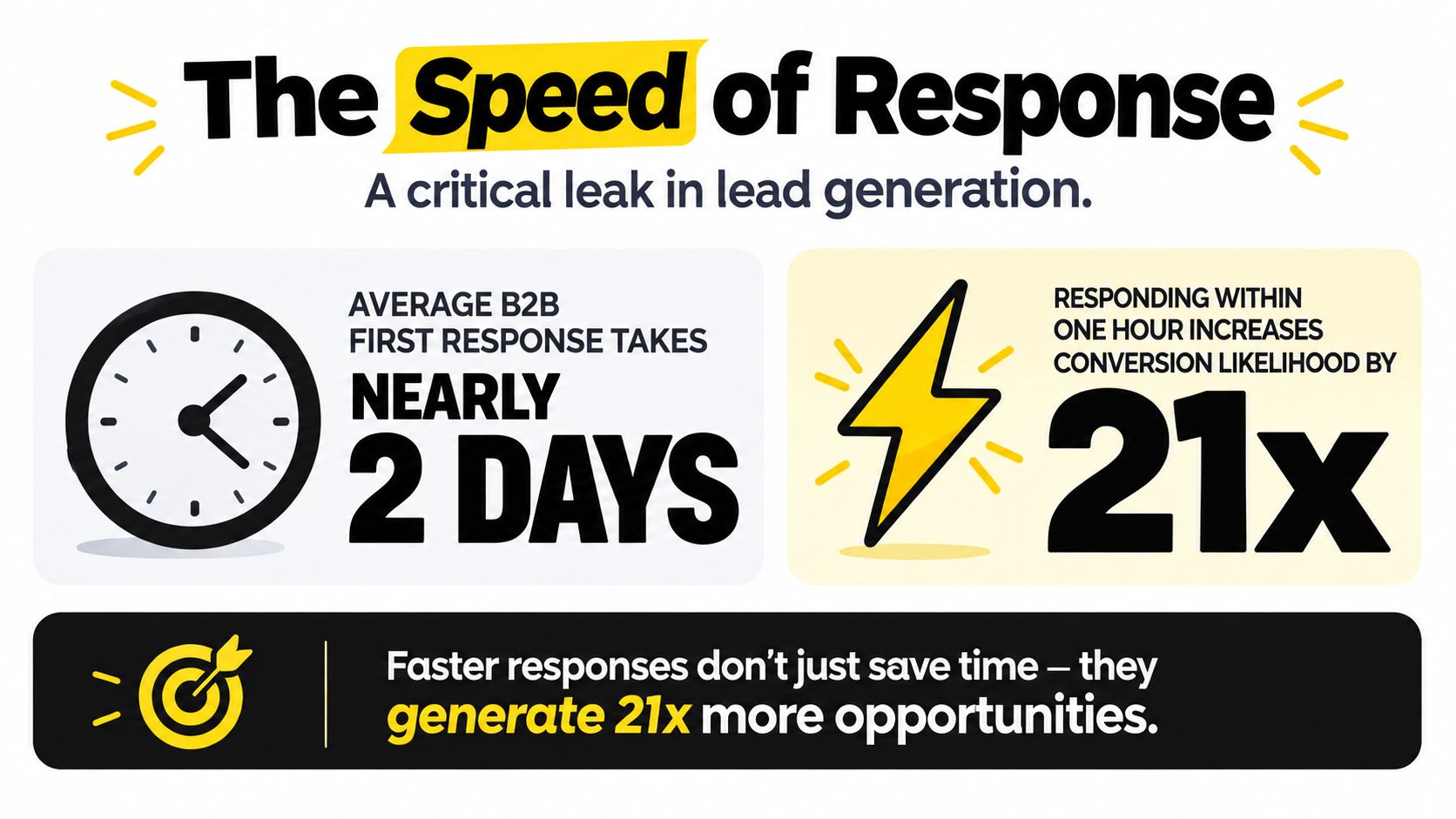
The visual reinforces the operational point, but its displayed comparison should not replace the verified study figures above. Build your service-level agreement around the evidence you trust, then instrument the workflow so you can see whether the team meets it.
The three common causes
Unrouted ownership leaves the lead in a queue. A CRM should assign an owner using territory, account segment, product interest, or another explicit rule.
Unqualified urgency sends low-intent contacts to sales while high-intent requests receive the same treatment. A demo request, a pricing inquiry, and a general content download shouldn't trigger identical paths.
Context-free handoffs force the representative to ask questions the prospect has already answered. Pass the form fields, campaign, page path, stated problem, and relevant engagement history into the sales task.
After the first response, nurture keeps the conversation useful when the prospect isn't ready to speak. A structured lead nurturing automation workflow can deliver the requested asset, offer relevant education, pause when a meeting is booked, and notify sales when behavior changes.
The right automation doesn't replace judgment. It removes waiting, gives representatives context, and reserves human attention for conversations that meet the agreed criteria.
Rethinking the Funnel for Buying Groups and Dark Funnel Behavior
A B2B funnel often looks healthy because one contact fills out a form. That view can hide the actual buying process. A champion may research vendors, a technical evaluator may test feasibility, an economic buyer may assess risk, and procurement may impose requirements. Each participant can interact with your company differently, or remain invisible in your tracked channels.
This hidden research is commonly called the dark funnel. A 2026 industry analysis estimates that 70% or more of buyer research can happen outside tracked brand interactions, recommends segmenting by buying-group role, and reports a 9.8% median MQL-to-SQL conversion rate plus a 0.94% lead-to-closed-won rate (guidance on dark-funnel behavior and buying groups). Those figures illustrate how much leakage can sit between captured demand and revenue, although differing stage definitions make direct comparisons unreliable.
One lead is not one buying group
A single contact's activity can understate account interest. A technical evaluator might download documentation while a champion shares a comparison page internally. If scoring only follows the person who completed the form, marketing and sales may miss coordinated movement across the account.
Replace a single persona field with role-aware context:
- Champion: Needs an internal business case, practical outcomes, and material that can be shared with colleagues.
- Economic buyer: Needs commercial clarity, risk framing, and evidence that the project deserves budget.
- Technical evaluator: Needs implementation detail, integration information, security answers, and proof that the solution can work.
- Procurement or legal: Needs requirements, terms, documentation, and a predictable route to completion.
The operating change is straightforward. Store the person's likely role, account, topics researched, assets consumed, and open questions in the CRM. Use those fields to determine the next content recommendation and the information sales receives. A contact's score should reflect account activity when several relevant people engage, not only the first conversion.
Replace linear movement with account orchestration
The linear model treats one lead as the unit of progress: MQL, then SQL, then opportunity. An account-based model asks whether several relevant people show coordinated intent and whether sales has enough context to build consensus.
Content should support that decision process. A champion may need a concise internal business case. A technical evaluator may need an implementation path and security responses. The wider group may need comparison material, objection handling, and a clear explanation of what happens after purchase.
Because definitions differ across funnel systems, do not compare the MQL-to-SQL benchmark mechanically with separate SAL-based transitions in an earlier table. Set consistent stage criteria, then review account-level engagement and handoff quality. The practical question is whether sales can identify who is involved, what each person needs, and which evidence will move the group toward a decision.
Optimization Strategies for Each Funnel Stage
Fix the stage that blocks revenue first. A polished awareness campaign won't compensate for a broken handoff, and a faster sales response won't rescue an offer that attracts people with no relevant problem.
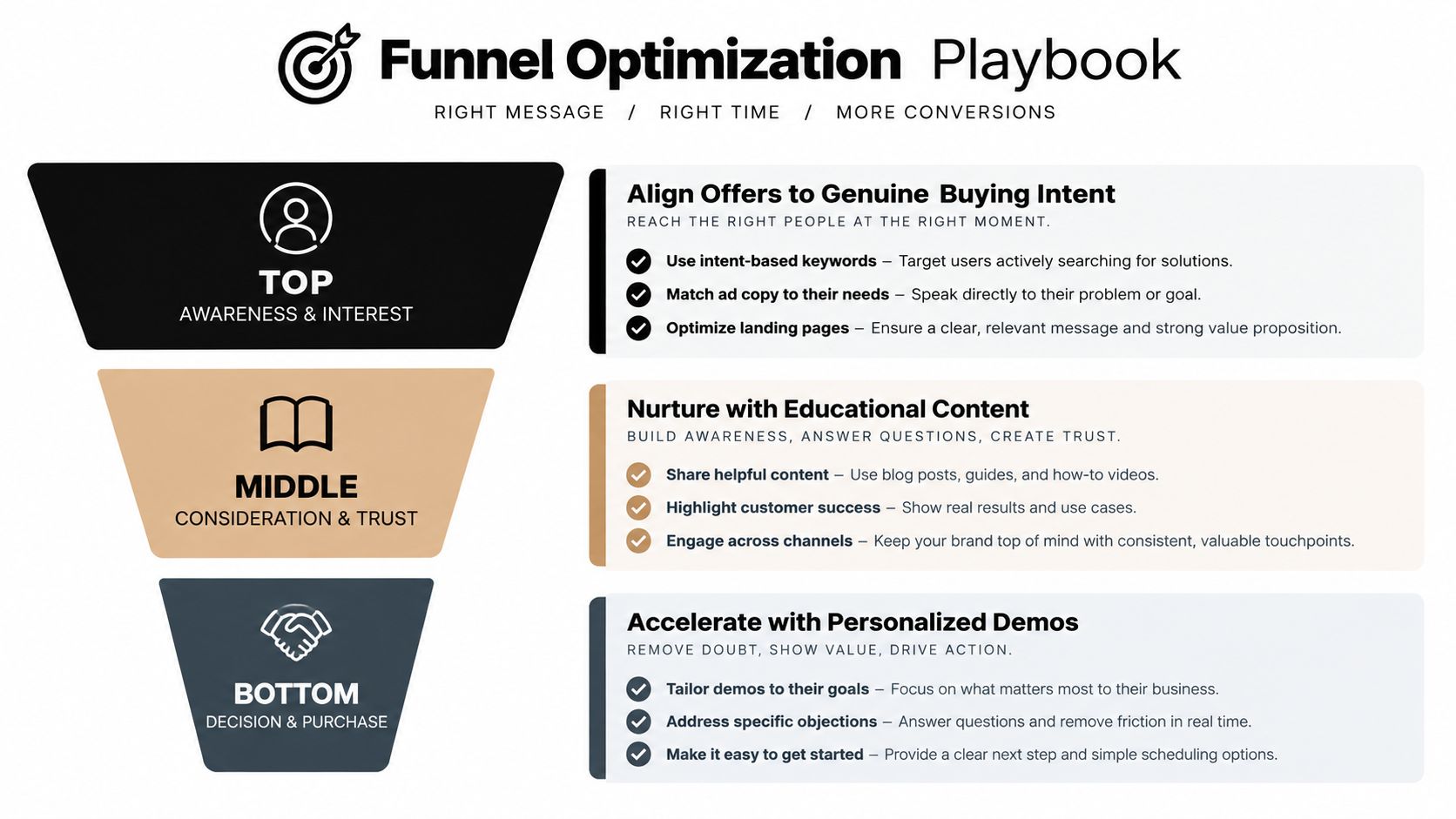
Use this checklist to connect each stage to a specific operating change.
Attract visitors with a reason to continue
- Match the offer to intent: Build a checklist, calculator, audit, or template around the problem behind the search or campaign, rather than attaching a generic ebook to every page.
- Align the landing page: Keep the headline, proof, form, and next action consistent with the source message. A visitor who clicks for a workflow audit shouldn't land on a broad company overview.
- Separate discovery from capture: Educational content can answer the initial question, while a relevant next step earns the contact exchange.
Turn leads into useful MQLs
- Define fit explicitly: Use company type, role, use case, geography, and other attributes that matter to your sales motion.
- Use progressive profiling: Ask for the minimum information needed at first, then collect additional context through later forms, conversations, and product interactions.
- Score meaningful behavior: A pricing visit, demo request, reply, or return to a product page may deserve more weight than a passive page view. Don't let arbitrary activity inflate the score.
Tools that support prospect research can help teams enrich account context before outreach. For a focused comparison of options, review LinkedIn lead generation tools from LeadBeast, then verify that any workflow fits your data practices and sales process.
Move MQLs to sales without losing context
- Set an acceptance contract: Marketing should define what makes a lead ready, while sales should document what it accepts, rejects, or sends back.
- Route by rule: Assign ownership automatically using territory, account segment, product line, or round-robin logic with an escalation path.
- Attach the interaction history: Put source, offer, form responses, pages, and prior messages inside the sales task.
Progress opportunities through group decisions
- Map the buying group: Record known roles and missing stakeholders instead of treating the first contact as the entire account.
- Create consensus assets: Give champions material they can forward, and give technical and commercial stakeholders answers suited to their concerns.
- Qualify the next step: An opportunity should have a defined problem, participants, decision process, and agreed follow-up, not only a positive conversation.
Prioritize the MQL-to-SQL handoff and response workflow before expanding acquisition. A small improvement there can improve the value of every lead already entering the system.
Automated Funnel Workflows Using AI and Outreach Tools
Automation should make the next correct action obvious. It shouldn't create a maze of disconnected notifications that sales learns to ignore.
Speed-to-lead routing
A prospect requests a demo through a form.
- The form creates or updates the CRM contact and account.
- An enrichment step checks company, role, and relevant firmographic fields.
- A scoring rule classifies the request by intent and fit.
- A routing rule assigns the record to the correct representative.
- An alert sends the representative the form answers, source, page context, and suggested opening.
- An AI assistant drafts a first response for approval, or sends a carefully constrained acknowledgement when the workflow permits it.
- A booking link offers the next step, while the CRM records delivery, response, and meeting status.
The important design choice is the SLA. The research cited earlier supports engineering high-intent response inside a five-minute window, not relying on a representative to notice a notification eventually. Test the complete path, including duplicate records, unavailable owners, weekends, and failed enrichment.
Nurture and re-qualification
A contact downloads a practical resource but doesn't request a conversation.
The system delivers the asset immediately, then places the contact into an educational sequence aligned with the stated problem. Engagement events update the record, but they don't all create sales tasks. A return visit to a product page or a response describing an active project can trigger a review. A period of inactivity can pause the sequence or change its content rather than generating more generic messages.
The workflow should also create a feedback loop. When sales rejects an MQL, the rejection reason updates the scoring model or routing rule. When sales accepts a lead, the CRM records which signal justified acceptance. Automation becomes useful when it learns from documented decisions, not when it merely sends more emails.
Teams comparing implementation approaches can review marketing automation for lead generation as a reference for connecting forms, sequences, scoring, and CRM actions.
AI-assisted outbound and voice follow-up
A targeted outbound workflow starts with a relevant account list, not a scraped collection of unrelated contacts. Enrichment adds role and business context, then a human-approved sequence uses different messages for a champion, technical evaluator, or commercial stakeholder.
Inbound and outbound calls can follow the same logic. A voice AI agent can answer an initial inquiry, collect basic qualification details, handle common questions, and offer calendar availability. It should write the call outcome back to the CRM, flag uncertainty, and transfer a conversation to a human when the request is sensitive, complex, or outside its approved scope.
The best workflow leaves a clean record: who engaged, why they engaged, what they asked for, which stage changed, and what the next human action is.
Your Funnel Audit and Next Steps
Start with one CRM export and one operational question: where does a qualified buying signal stop moving?
Calculate your stage transitions using a consistent cohort and documented definitions. Compare the results with the benchmark table, but don't turn the benchmark into a target detached from your sales motion. A long enterprise cycle, a self-serve product, and a services-led funnel can have different healthy patterns.
Then inspect the weakest transition in sequence:
- Validate capture: Confirm that forms, calls, chats, and campaign responses create usable records with source data.
- Measure response: Check the actual time from submission to first human or approved automated contact.
- Review qualification: Read accepted and rejected records to find missing fit criteria, inflated scores, or inconsistent judgments.
- Audit handoff context: Confirm that sales receives the problem, offer, source, role, and relevant activity.
- Automate the repeatable path: Add routing, enrichment, alerts, nurture branches, booking, and escalation where the manual process creates delay.
- Re-measure one leak: Keep the rest of the funnel stable long enough to see whether the repaired transition improves.
Don't confuse more dashboards with better control. A useful dashboard shows stage counts, conversion, response time, acceptance reasons, source quality, and the next owner. If paid acquisition is part of the problem, an external Google Ads audit from NotFair can help separate traffic quality issues from the post-capture failures inside the CRM.
The central lesson is operational. A lead generation funnel isn't repaired by adding a larger audience to a system that loses captured demand. It improves when your team defines each stage, responds quickly, qualifies consistently, aligns the buying group, and lets automation handle the predictable work.
MakeAutomation helps B2B and SaaS teams design and implement lead capture, scoring, nurturing, CRM handoffs, and Voice AI follow-up workflows. Visit MakeAutomation to turn your funnel audit into a documented automation system with clear ownership and measurable next steps.